
Peace Memorial Park is close to the epicentre of the first nuclear weapon used in war, when an atomic bomb was dripped on Hiroshima. I came here once before, several years ago, on a brief visit. It’s not really the sort of place you want to come back to, but I did anyway; I was staying only a ten-minute walk away.
Life for the people of Hiroshima, and for the people of the world, changed beyond measure in an instant. The Park has many kinds of detailed information about the event, including pictures of the area and of the people beforehand. Here is an old picture of the area, including the famous dome, as well as of a local primary school and its children before the bomb was dropped:


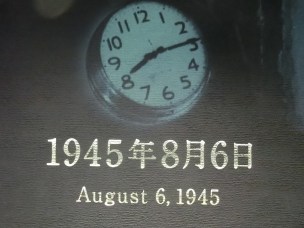
As you probably know, the instant of change was in the morning of 6 August 1945, celebrated these days as Hiroshima Day:
There are pictures of the aftermath, and many moving stories from people affected, located in various parts of the Park. They are all very harrowing and hard to cope with. This is a very sombre place, with people walking around but not talking much. The photographs below show the domed building (which has been left in its bombed state) as well as some of the people affected by the bomb. Those closest to it (including the primary school class above) simply were vaporised by the intense heat of the explosion.


The park has been constructed as a monument to peace and to love, and has been the centre of world anti-nuclear movements and peace movements for some time. It’s a pleasant looking place – until you get too close to it. For example, the mound below looks attractive in the sunshine, but contains the remains of tens of thousands of people, who could not be identified and had to be cremated.

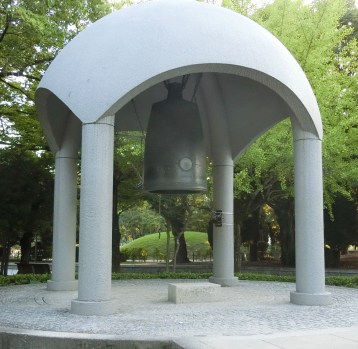
There are often groups of children here, attracted particularly to the monument with a bell in it, ringing the bell to commemorate the children who died as a result of the world’s first nuclear bomb. There are many many paper cranes around the park, too, of the kind that kids get taught to fold (in Japan, but certainly elsewhere), and you can see them next to the bell.


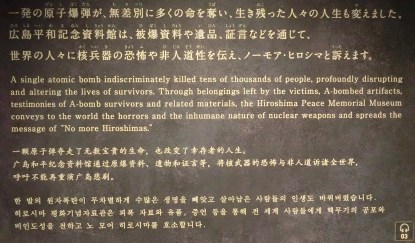
The cranes are related to the story of one of the Hiroshima ‘survivors’ who later contracted cancer and died, even though she folded a thousand paper cranes (hoping that her with would be fulfilled). It’s a well-known story, but in case you’re not familiar with it, here is a little detail (you can click on a picture to enlarge it enough to read it).


Since then, the cranes have become symbolic of something hopeful, and the city continues to be besieged by papers cranes. I noticed them mentioned in the new railway station in Hiroshima when I arrived a few days ago (again, click the image to see the messages).

The cenotaph commemorates the dead at Hiroshima. Numbers vary as it depends in part on how you count them. At least 140 000 people but there are many after effects …


The view through the cenotaph in the centre of the park shows an eternal flame, which the City of Hiroshima promises will never be extinguished. [I discovered later that the flame was lit from a flame burning on Miyajima Island since the ninth century AD, so there’s a fair chance the promise will be good.]
There are some lovely monuments around the park, too. I had read that this Buddhist bell, to be rung for peace, was enclosed in a map of the world without borders; that is, no countries are identified, but just a world for humans without their politics. I’m sure John Lennon would have approved (got me thinking about Imagine again). However, I was unable to see the detail claimed on the monument; maybe I didn’t look hard enough? Still, the sentiment appealed to me.
I’m not sure it was there on my previous visit (and it looked new, so that’s possible), but I also saw the Hiroshima National Peace Memorial Hall for the Atomic Bomb Victims, an impressive underground building:


The (tiny) tiles on the wall represent the 140 000 victims of the bombing, displayed according to where they lived in Hiroshima. If you click on the middle picture, you may just see the small square tiles, one per person. the small fountain in the middle depicts the time of 8:15, and the water is offered in memory of those who died begging for it. It’s beautifully done, but I could not stay there long …
Holidays are supposed to be ‘fun’ – at least according to some world views. But sometimes, the world is not fun, and deserves our attention too. Like most Australians, I was taught only one version of the Hiroshima bombing, but of course it’s never as clear cut as we would like it to be. And I long ago learned that history is always written by the winners. So I don’t want to tangle with the conflicted past, but hope that the world can move on from this awful event, and avoid repeating it. Modern nuclear weapons are, I gather, around 100 times as powerful as the bomb that was dropped on Hiroshima. Surely no political or military problem will be solved through use of such a weapon? There must be a better way to resolve conflict, deal with aggression, settle differences.
And that’s the message of the Peace Memorial Park. Let’s learn from history and not repeat it. The following message captures the intention of the Park well, I think:


I have not seen a message offered in more languages before, including both braille and sign language (via the touch screen).
Indeed, the message of the Peace Memorial Park is that we should have “No More Hiroshimas”.
I agree. We must never do this again. I hope that any world leaders with their fingers on their buttons visit this site and think about the consequences for the thousands upon thousands of ordinary people who might be involved.
The City of Hiroshima seems to have moved on from this event more than 70 years ago. Or at least it seems that way. It’s a nice place, and of course much has been rebuilt. But it can never entirely forget its past, which is respectfully recognised in this park, in my view. The tram stop next to the park is called “A-Bomb Dome”, which makes it fairly unlikely that locals can ever forget. And maybe none of us should forget.

 Barry's travel blog