Tokyo mosque

I was a little surprised to find a mosque in metropolitan Tokyo, although Tokyo is always a city of many surprises. It has been there for about 80 years, and is in fact the site of the local Turkish Culture Center, providing both a place for religious worship as well as meeting for local people with interests or roots in Turkish culture. The mosque is located near Shibuya, and I was able to walk to it from Yoyogi Park (in about half an hour). Like most mosques and churches I have visited, they are happy to have respectful visitors when services are not being conducted.

CIMG5906As a regular visitor to churches, temples, shrines and mosques in many countries, I am always struck by their differences. My interest in mosques has generally been in the beautiful mathematical patterns they include, which arise from Muslim prohibition on the representation of people. The pictures shown in this blog give some examples of this.

I always wonder how the builders and craftspeople create things like this beautiful interior, filled with geometric constructions.

There’s lots of care and attention given to the calligraphy as well, of course.


In this mosque, as with others, there are attractive patterns outside as well as inside, and also many examples of lovely geometric designs on doors, screens, etc. The domes and arches outside are a precursor to the tombs and arches inside. The screen below has a ten-pointed star. I’m pretty sure that I was not taught how to construct something like that in school, using a ruler and compasses. Things used to be in multiples of six. And the elaborate work on the door has ten-pointed stars, pentagons and other shapes, all made with care by a craftsperson with mathematical expertise.

Here are some other shots of the interior of the mosque, which looks beautiful . The dome in particular, is a spectacular object.

The cultural center attached to the mosque also has some lovely mathematical patterns and designs, also beautiful examples of Islamic art, many of them in ceramics. I am intrigued by the geometry in the large dish that provides both nine-pointed stars on the outside and a twelve-pointed star in the middle, as well as small five-pointed stars between these. Very clever. I am reminded that, when Europe was in the ‘Dark Ages’, the science and geometry and mathematics of the ancient world was preserved and enhanced by the world of Islam, although this is often forgotten in our school curricula.

Although the principal purpose of the mosque is to support the Turkish community in Tokyo, and provide them with an opportunity to pray together, the mosque seems to welcome visitors as well, both from elsewhere in Japan or indeed from abroad (like me). If you happen to be in Tokyo, it’s worth a visit. Details are on the website.


Kawagoe

Kawagoe is a small city a short distance north of Tokyo, but far enough away to feel a little bit in the country; you even pass some rice fields on the way. I visited here recently in an afternoon, having not heard of it previously. [The most common day trips out of Tokyo are to Nikko, Kamikura and Hakone, but it seems that this is the fourth in that group, according to Tourist Information I saw.]

The main attraction of Kawagoe is that there is a street and some surrounding area that is locked in a time warp, and apparently resembles Tokyo around 100 years ago. (Sometimes called Ko-Edo … literally ‘little Tokyo’). So it’s a popular spot for Japanese folks to escape the city, remembering the days of old, browsing small shops and eating traditional delicacies of various kinds. Most of the visitors appeared to be Japanese, rather than foreign tourists, perhaps because Kawagoe hasn’t yet become prominent in guide books?

Many young women enjoy hiring traditional Japanese clothing such as yukata (or even the more lavish and expensive kimono), so there were lots of them wandering around when I visited, so that a generally pleasant atmosphere prevailed.

I also visited a large Shinto shrine – which was very popular – in which many young women (especially) were apparently making wishes for a successful marriage, by writing their wishes on small wooden boards (called Ema) or on small paper messages and hanging them on display. (There were also men doing such things, dressed in traditional costume, but many fewer.) There were several other shrines in the city, but time allowed me to sample only one.

Kawagoe is especially famous for an annual festival that is held on a weekend in October, these days attended by around a million people. It’s been going some 400 years now. I was disappointed that my schedule didn’t permit seeing this, but I did go to an interesting museum dedicated to the festival, showing pictures of some of the extraordinary three-tired floats, as well as some actual examples. The photo shows a couple of these turning corners – tricky as they don’t have steering wheels, and so need to be levered around gradually!

Certainly worth the 45-minute trip out of the metropolis!

Australia from the air

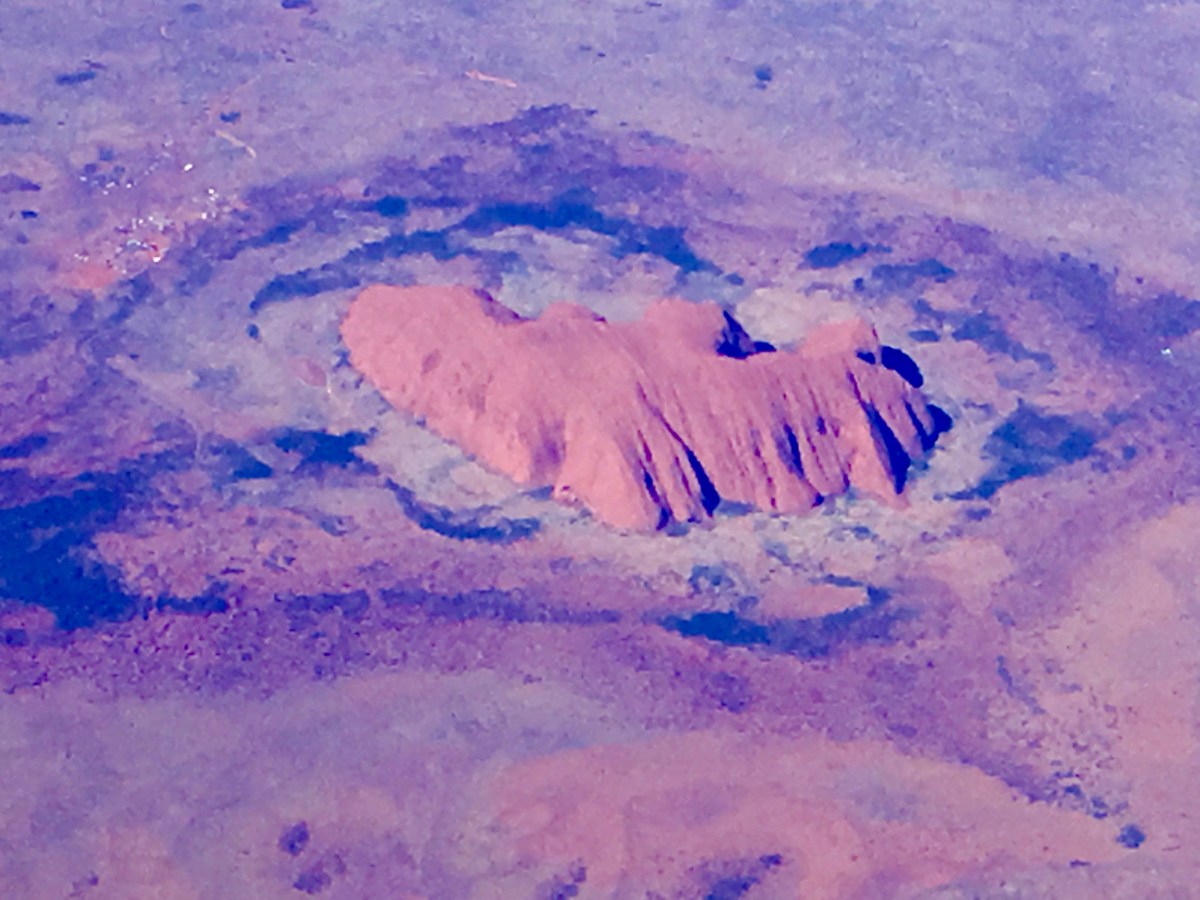
When you live as far away from everywhere as Perth is, air travel is necessary to get to many places. I generally prefer aisle seats so that I can get up and stretch my legs easily, especially for longer flights. But on my recent short trip (just a little over three hours), I chose to sit by the window, partly hoping to see Uluru from the air. I was not disappointed, as there were few clouds (but lots of haze) that day.

Uluru is a large rock in central Australia. Of course it’s been there a long time, and has great significance for local Indigenous people. It was officially returned to them around 30 years ago, having previously been known as Ayer’s Rock. It’s a popular tourist destination for visitors to Australia, as well as locals like me.

The reddish landscape made it clear to me why the phrase ‘Red Centre’ is appropriate, but I was also struck by the lovely natural patterns of various kinds you can see from up high. It made me wonder how Indigenous artists have long represented such patterns in paintings, for thousands of years before anyone took to the air.

As I got closer to Perth, the land is more developed, with farmers growing wheat crops, and lots of lines in the patterns suggesting that the land has been tamed for humans. Many years ago, I worked in what is described in Western Australia (WA) as the eastern wheatbelt, helping collect wheat harvests as a vacation job, so the site of fledgling crops reminded me of how tough it is for many farmers perched on the edge. This shot was taken near Narambeen, where my maternal grandparents were farmers almost a century ago. So far this year, rainfall has been too low for many to even bother to sew a crop. Let’s hope it improves.

Simpson’s gap

We visited Simpson’s Gap on the way from the airport in Alice Springs to the townsite. The gap is a gap in the West MacDonell Ranges, a very long mountain range in this desert-like environment in the centre of Australia.


It’s a lovely environment, including a small colony of rock-hopping wallabies. I loved the colours of the rocks and the grass and the sky, reminding me of the wonderful paintings of Albert Namatjira which I first saw in my childhood. As it is fairly close to town, there was a school excursion there: I always admire teachers who have the courage to take their students out of the classroom, as I know it’s always difficult.

Introduction

I started this blog in 2017, unsure if it’s a good idea or not, but thought that the best way to find out is to try. I thought it may be a nice way to record a travel diary, perhaps as an alternative or supplement to using FaceBook. We’ll see what happens.

CIMG6253

Travelling alone is different from travelling with friends or family, so I was attracted to the idea of writing a blog for myself to record my thoughts and feelings and observations, in the spirit of “How do I know what I think until I see what I say?”, a little notice that I used to have taped to the bottom of my computer screen. I enjoy taking and sharing photos too, to somehow capture the experience for myself and for those not able to be here.

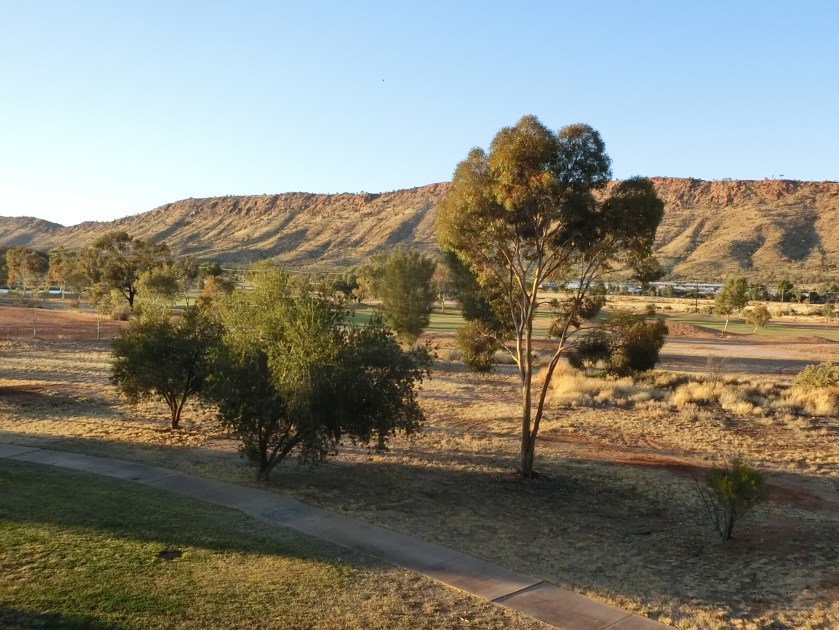
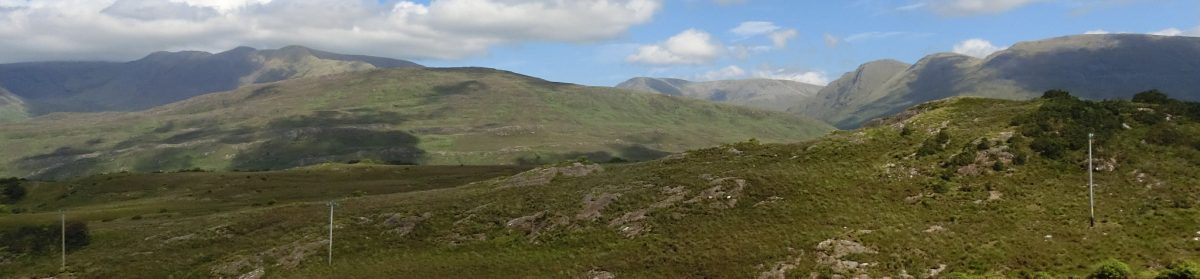
For example, I loved the early morning view out my hotel window in Alice Springs in 2017, and it’s nice to have the above photo as a reminder. (If you’ve not had the good fortune to go to Alice Springs, I hope you like the photo too.) The other picture at the top of this post is of the lovely Connemara National Park in Ireland, which I was lucky enough to visit in 2016 with little sister Cherrie Searle. Irish countryside is lovely, but in a different way. I expect only very rarely to include photos of myself, however; I guess I’m still not part of the selfie generation.

I expected my blog posts to be short, with a selection of relevant photos, but also thought that sometimes they may be longer (e.g., when I don’t have time to make them short). Only time will tell. My posts stopped for a few years after a computer mishap in Switzerland and then were interrupted by the chaos of Covid, so only a some of my recent adventures have been recorded here.

You are welcome to follow and interact with my travels if you wish. Either pop in to this site when you feel like it, or subscribe to it via the link on the right and get an email alert about a new post. I’ll do my best to respond to constructive feedback, as I’m just learning how to do this and will mostly learn by my mistakes, as we all do. But as they say, or at least they ought to, when you stop learning, you’ve stopped living …