Although some of my travels have been decided at the last minute, others have been decided before I left home. Koyasan was one of these. It’s a lovely and famous mountain temple complex in the south of Kansai, based on the Shingon School of Buddhism, founded by the same person as Daishi-on in Miyajima, so around 806 AD. It’s been likened (by some) to Shangri-La … a long way away from the everyday world, but I think that’s overdoing it. It is a UNESCO World Heritage site (or at least some of the buildings and t he cemetery are, I think). Although one of the attractions of the area, high in the mountains, is that you can stay overnight at temples, that looked too hard and so I opted for a day trip.
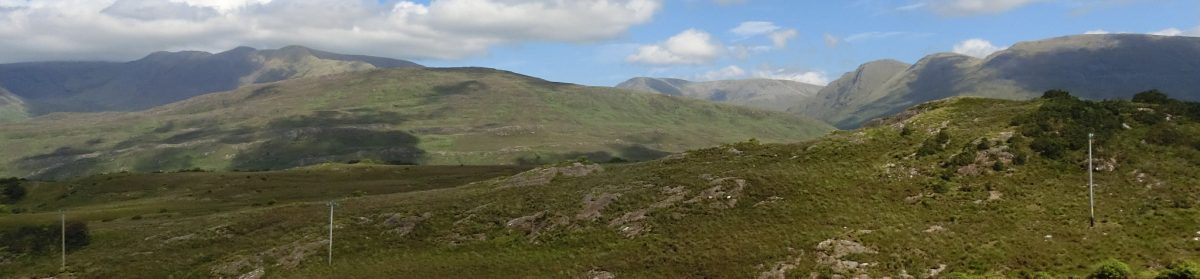
Not that the day trip was easy … the trip involved zipping into Osaka and then catching train for about 90 minutes, before a cable car to get up the mountain itself, and then a bus. The trip itself was interesting, as it was nice to see some rural and mountain scenery, although tough to photograph from moving trains. (We don’t have many mountains in Western Australia, so I’m always attracted to being in other people’s mountains.)


I did find out the difference between a cable car and a ropeway, en route to Koyasan. A cable car is pulled along by a cable at ground level, while a ropeway has a cable in the air from which the cars hang. In Australia, we call these both cable cars – incorrectly, I now realise. The cable car was needed for the last bit of the ride up the mountain; you can see for yourself how steep this was (click on a picture to expand it a bit).


The town was very pretty, with many temples in the area, as well as an extraordinary cemetery, described below. The first temple I visited was Kongobu-ji, which is the head of the (international) Shingon Buddhist group. It was a beautiful complex of buildings, but sadly I was not allowed to photograph the best parts, which were some beautiful rooms with painted sliding doors. I’m never quite sure why photographs are prohibited, but assume it’s a mixture of avoiding people flashing their cameras (as they don’t know how to avoid that!), (thus safeguarding the objects too), preventing people from irritating others (especially the selfie brigade) by upsetting the decorum of the place or making sure that they can sell their printed copies of the objects in question. Whatever the reason, it prevents me from showing you one of the day’s highlights …
I was able to take photos of other bits of the temple, and you can see that it is very beautiful:


The temple is entirely wooden (as are most parts of most temples in Koyasan), which makes me wonder why there is so much forest left. Many of the temples in the area have been burned down at some stage and needed rebuilding; wood looks beautiful but it’s high maintenance if you have to reconstruct it occasionally. You can see above the interesting rock garden … a raked gravel area with tastefully arranged rocks in it (not what I grew up thinking a rock garden was). Apparently, this is the largest one in Japan. I liked it …
At the end of my trip around the temple, I was offered a cup of tea in the main meeting room, which was very large and very splendid, and of course covered in tatami mats:


Again, to repeat a comment I media few days ago, the colours of autumn are just starting to appear; it’s a shame I’ll miss them because of my timing. In a few weeks from now, they will enhance the sight of otherwise glorious buildings like these:


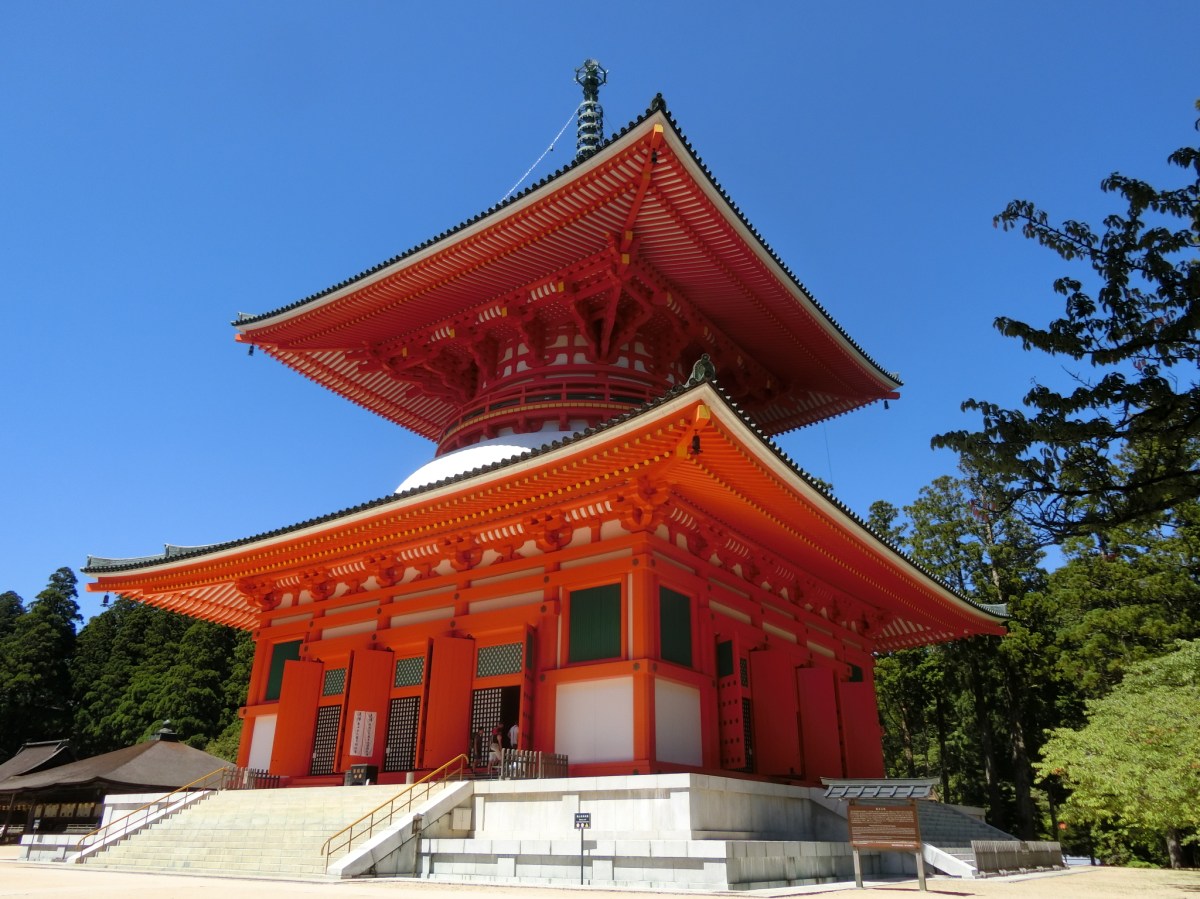
The most spectacular temple here is the vermillion-coloured Great Pagoda (Dai-to) showing at the top of this blog, but there are other lovely pagodas as well, as you can see. It was pretty quiet when I was there (school has now gone back after summer), and I found all of these majestic and beautiful.
 Some of these buildings are very old, at least in one sense. For example, the Great Pagoda was first constructed by Kobo Daishi from 816 AD, but it took many years to build. (the same is true for cathedrals, of course, a spectacular recent example being Barcelona’s Sagrada Familia, still being constructed almost a century after Gaudi’s death!). Since then, it has been destroyed by fire several times and the last time it was rebuilt (in 1934), they chose to use a ferro-concrete base, for fire reasons.
I didn’t quite understand the little monk pictures here and there, but finally worked out that they were a symbol of the recent anniversary of the founding of the complex in 816, 1200 years ago last year!
With all the temples around, it’s not surprising that the occasional monk was evident too. I took snapshots of these two (from the rear, so as not to be intrusive on their raying activities):


Apart from lovely temples, pagodas and other buildings, there were other lovely sights around the town … way too many to document, but I thoroughly enjoyed strolling around for a couple of hours. here are a few snapshots of some nice or interesting things I saw:


The town’s main gate or daimon, looks pretty spectacular, and from that point you can see some of the nearby mountains, of which there are apparently eight:


Apart from temples and the lovely ambience, Koyasan is renowned for its amazing cemetery, very famous in Japan. Apparently, this is the final resting place of about 200 thousand people, most of whom have been cremated. The cemetery (called Okunion) is enormous, and very picturesque (if that makes sense for a cemetery). I think that the central path is a World Heritage site, but the whole area is pretty extraordinary. I walked from end to end, with a few snaps shown below:


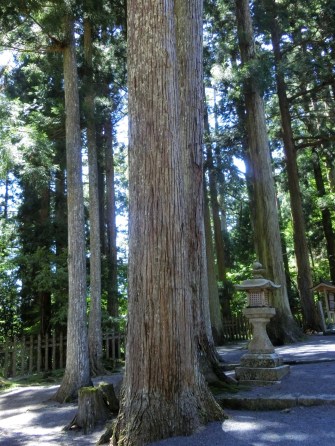
The central path is flanked by many lanterns and huge cedar trees, and indeed the whole cemetery has many huge cedar trees in it, some a thousand years old, as well as lots of greenery of various kinds.
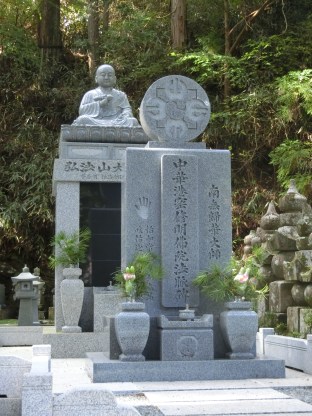
While most things look very old here (not unlike being in an Indian Jones movie!), it’s clear that the cemetery is in active use as there are some clearly more recent tombs, like this one:
Both famous people and commoners are buried here, but the most famous is Kobo Daishi himself, who is in a mausoleum at the end. It’s not possible to see the mausoleum, but there is a collection of deities in the general area, as well as an important temple:

In fact the Shingo Buddhists don’t regard Kobo Daishi as dead, but merely as deep in meditation, and expect him to re-surface one day, when the next true Buddha appears.
If you get a chance, my advice would be to visit this lovely place, Koyasan, and to try to spend the night there at a temple if you can. I certainly enjoyed the whole experience.

 Barry's travel blog
Enjoying your blogs…those I get around to reading. You have a knack of presenting and summarising your impressions without a data overload. Interesting and digestible….😊😊😊
LikeLike