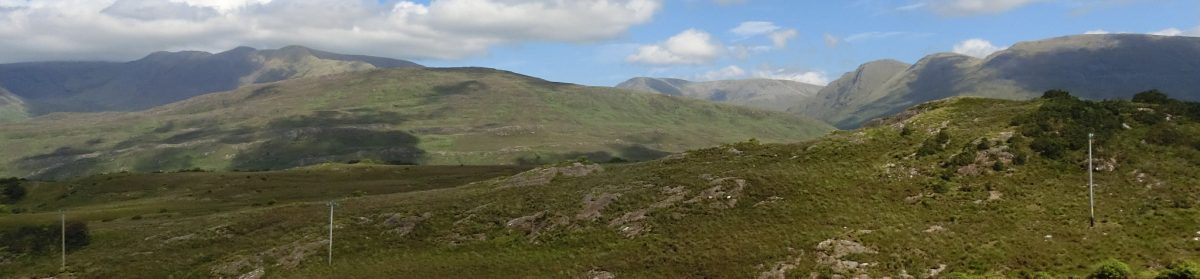

I wondered about visiting Kyoto, as I have been trying to do new things, and have already been there.But it is such a beautiful city – according to some, the most beautiful city in the world. That’s why it has (I think) sixteen UNESCO World Heritage Sites, more than any other city. Opinions will differ on that, of course, and first impressions of Kyoto make it seem like anywhere else in Japan. But it’s not like anywhere else; it’s the cultural heart of the country. And how could I live for five days only half an hour away by train and not visit at all?
So I decided to pop over briefly, and look at only a small corner, at Arashiyama, in the foothills, and walk slowly to soak it all in. (Kyoto sits in a basin surrounded by hills). There are three attractions there, only one of which I have previously visited. I knew in advance there would be a deluge of camera-carrying tourists – great cities of the world always are. But if we avoid the places full of tourists, we miss out on the reason they are there, don’t we? And, anyway, I am a tourist too. And I’ve got my camera. So I’ll just share a few impressions.
The Tenryu-ji Temple is a World Heritage Site just next to the famous bamboo forest, and was first built early in the fourteenth century. It has a stunning garden (which is not uncommon in this lovely city of gardens) which you can walk around or view from the temple, or both. I chose both.


Click on the pictures to see more. I loved the framing of the garden from the viewing seats, on tatami mats, and also loved the way the garden blends into the hills behind and even in the distance. The walking gardens go up the hill, and are meant to be strolled around, and to encourage meditation and admiring of the beautiful natural world.


I did some strolling, and (again) wished I was here in a few weeks time when the colours change or a couple of months ago, when the flowers were all out … but was thankful that I came at all. The greenery is extraordinary and, despite the tourist throngs, it’s quiet, and peaceful. And calm.
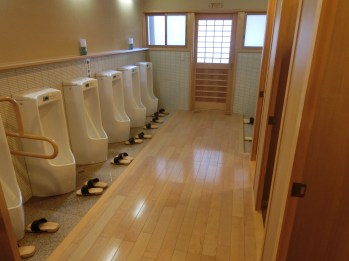
I also needed to visit the toilet in the temple. I very rarely take photographs of toilets, but when provoked, I can make an exception. I think this is the most beautiful toilet I have ever visited. I realise it wasn’t here in the fourteenth century, but it is a testament to the world of Kyoto that things should be made beautiful, whatever they are.
I was intrigued to find a project at the temple for bringing back cultural treasures from abroad. These screens were made by digitally copying the originals, owned by and housed in a Boston museum, and transferring them here. They didn’t come from this temple originally, but from elsewhere in Kyoto (now lost); what a great idea for returning cultural heritage. Bringing together the old world with the new technology.

Speaking of which, there were lots of people wandering around in kimonos, which I assumed were rented for the day, and I spotted many examples of the old world and the new like this one, with the ubiquitous smartphones evident:

The Arashiyama Bamboo Forest is also a tourist magnet, and is adjacent to the temple. It’s a wonderful place to walk through, with enormous bamboos giving it an extraordinary feel. It was full of tourists, of course, but I kept reminding myself that I was one of them and that there was a reason we were all there. However, it would be wonderful to be here almost alone, and I made a mental note to do that next time I return to Kyoto, and to come very early in the morning.
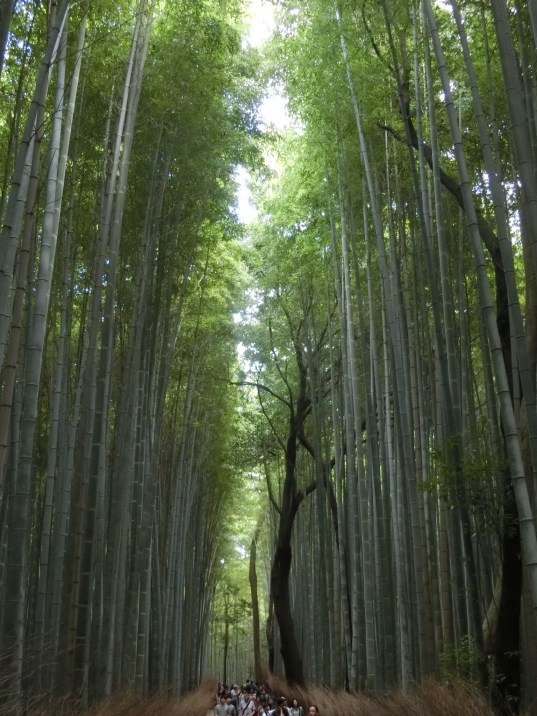
I was amused to see one bamboo going against the grain here and there, such as this one:

Maybe a reminder that none of us lasts forever? And that the world around us will keep going after us.
An uncharacteristic noise (drumming and shouting) suggested to me that something was happening in the forest. And shortly afterwards, I encountered a procession of some kind, with police protection, probably headed to a temple somewhere I assumed. There was no way to find out and five minutes later they had all gone. I resisted the (strong) temptation to follow, as I had set myself on a close time to return to see something of Kobe.


It seemed that a priest was the most important character, although the lady being pulled at the rear on a pedicab was also obviously important. I was intrigued to see the sake barrel having an important role, and was a bit puzzled about all the connections. the marchers (pullers) were all chasing, bot of course in Japanese.
Just past the forest was the third attraction I had decided to visit, a villa and garden called Okochi Sanso, built and owned by a former silent movie star of Samurai films, who died in the 1930s.


The villa itself is lovely, but the gardens are the main attraction. A lovely garden for strolling, and arranged so that there are beautiful views out of the garden as well as lovely plants inside. I had no trouble imagining Okochi san going for a morning stroll around his garden, followed by an evening stroll later, as well as pausing to admire his views. I was thankful that it has been left for tourists to do the same.
These were a couple of my favourite views here, despite the crane in the foreground:


Here is a view from viewing platform, also very attractive (to me, at least) and still ignoring that crane.

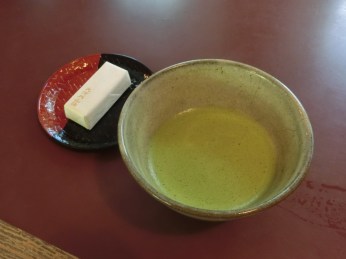
Part of the deal to see the villa and gardens was a cup of tea in the tea house, along with a Japanese sweet, both beautifully served, of course. Very refreshing, even though I don’t normally drink green tea.
My time was almost up, but not quite, so I decided (with my heart and not my head) to have a look at another attraction, some distance away, the Funishi-Imari shrine in Kyoto’s suburbs. So I walked to the station, amidst a throng of tourists, and enjoyed looking at some of the many shops along the way.


Fans were a popular commodity of course, as was food, and I discovered one of the sources of all the kimonos. Many of the shops were very photogenic and I could have repeated this small collection of snapshots ten times over.
The Fushimi Inari shrine is an extraordinary vermillion complex on a hillside, that goes right up the hillside. Again, very popular with tourists, and very photogenic! This is the sight that greets you as you step out of the small Inari railway station (itself with many vermillion decorations):

The shrine has many images of a fox, like this one, a large version near the shrine gate:

There were dozens of fox statues all over the place, however, both large and small. In Japan, the fox was a symbol of good harvest (unlike in western countries where a fox is regarded as an savoury intruder and a pest to be hunted), and the key in its teeth is a key to the granary. These days, it has also become a symbol of prosperity generally (as in business, for example). An interesting cultural difference!


vermillion is evident everywhere in this shrine, as you can see. Even the little prayer votives are vermillion in colour.
Apart from the colour, the most distinctive thing about the shrine are further up from the temple area, requiring a few stairs to be climbed. Again, lots of people in kimonos as well as other camera-laden tourists:

Not far from the station, you encounter lots columns of torii heading up the mountain! At this stage (the lower levels … I was in a rush!) they are full of tourists, but at higher levels, the tourist throng thins out. The first time I was here, I went up as high as I could (almost), until there was just me and the torii. An extraordinary sight; I understand that there are about four kilometres of passages!


In places, they branch out, like this, with one side for going up and the other for coming down. And you are not permitted to go up the down side, as advised by a large sign to keep right.

A sight like I’ve not seen elsewhere. Extraordinary.
I had overstayed my (self-imposed) quick visit to a little corner of Kyoto by about an hour, but still left enough daylight to zip back to Kobe and to look around, thankfully. I was pleased that I decided to see somewhere I had previously visited.
I learned in Hiroshima that Kyoto was one of half a dozen targets considered for the first atomic bomb explosion. I am pleased and thankful that it was not chosen, as that would have been a senseless war crime of incomparable magnitude.
Kyoto is a wonderful city. A magical place. I realise that beauty is in the eyes of the beholder, but this beholder has never seen a more beautiful place. If you are ever in Japan, don’t miss it. Join the tourists: they know.

 Barry's travel blog
Once again, beautiful photos of a beautiful place. I spent ages trying to see the crane – but I was peering into the trees thinking it was a bird. Thanks for a peaceful break.
LikeLike
Oops! Sorry! I did see a real crane (bird) yesterday, but not in Kyoto, where I just saw a mechanical crane. Tricky language, English!
LikeLike