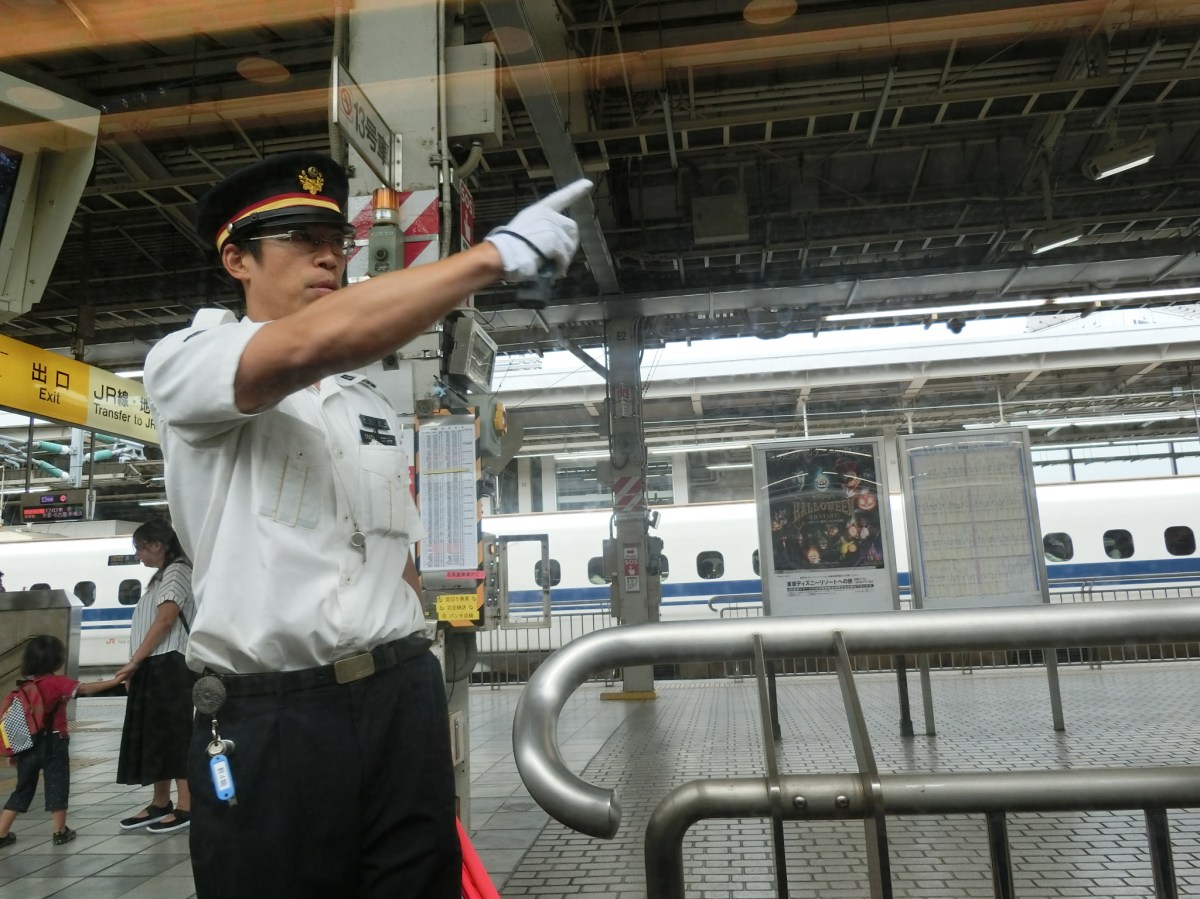
I’m enjoying train travel in Japan. It’s incredibly efficient and well-organised and almost everywhere is accessible by train. Sitting in a train allows you to see the world go by, always interesting in a country other than your own, but capturing it on film can be a challenge. So this blog is just to illustrate the challenge, as well as some of the solutions, on my trip today from Kobe to Takayama, just in case you want to try to do the same. At the risk of making a bad pun, the blog is intended to give you some pointers, as suggested by the photo above. (I apologise in advance to those who know more about this than I do; the advice is not directed at you!)
The trip began in a shinkansen (aka ‘bullet train’) from Kobe to Nagoya and then a regular diesel train from Nogoya up into the Japanese Alps to Takayama. The picture above shows a station officer sending the train off in Kobe. Staff always wear white gloves (as do taxi drivers), and take their roles very seriously. This chap is verifying by pointing that he has checked that all is OK in that direction, before waving the train off. Trains leave exactly on time and usually arrive exactly on time. Drivers go through a similar routine, I have noticed, to verify to themselves that they have checked the appropriate signals, etc. I feel very safe on Japanese trains, as human error has been reduced as much as possible.
The photo of the chap was made out my window, just as the train was leaving, so it was moving very slowly. Apart from the driver standing in front of the pole, which clutters up the picture, it’s not a challenge to take such a photo.
When the train is moving, it’s a different matter, of course. And shinkansen move pretty fast – although nowhere near as fast as a bullet. The technology is now quite old, and some high speed trains in other countries are much faster, but a typical shinkansen speed is around 220 kilometres per hour, fast enough to make photography challenging. So what can go wrong?
Firstly, when the train is travelling fast, photos will be blurred, unless the camera shutter speed has been made very fast. If you’re using your smartphone as your camera, you may find it hard to do much about that, as the camera will decide for itself what shutter speed to use (and will usually result in a blurred image, as it doesn’t know you’re going fast.) If you have a real camera, you may be able to set the shutter speed. On most cameras on which this is possible, you need to set the camera to S mode (for speed) and adjust the speed to suit the circumstances. The numbers are ‘backwards’, too, so that a setting of ’60’ means 1/60 th of a second, which is half as fast as a setting of ‘120’, which is 1/120 th of a second.
In the photo below, my camera was set to 1/160 th of a second – easily OK for normal photography, but not for a photo from a shinkansen, even when it had not reached full speed:

This photo is obviously unacceptable, because of the blurring. Notice that it is more blurred closer to me in the train than it is further away. After posting it here, I have discarded it. When I noticed the problem (this was the first photo out of Kobe), I changed the setting to 1/640 th of a second, which is what I normally use for a shinkansen photo.
Another problem are the reflections in a window. These are worst on the sunny side of the train usually, and are often hard to avoid. The photo below shows an awful example, where I have managed to photograph myself as well as the scene out the window, so this one is a failure too. On one train today, I was able to switch sides of the train as it moved directions, when there were few passengers, but that is not always possible. Sometimes, you have to wait for the train to change direction if you can’t move.
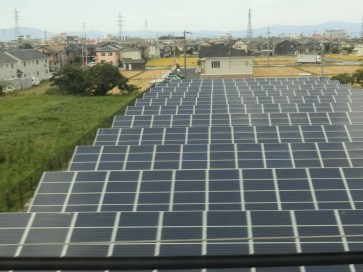
Another problem in trains in particular is that there are often poles outside, which appear exactly when you don’t want them, so a nice photo can be ruined because it turns out to be a photo of a pole, with a nice background. There’s an example below. I was interested in the regular use of solar panels in the Japanese countryside, but this pole appeared at precisely the wrong moment! The photo also has some window reflections in it, and is also to be discarded.

Avoiding poles is not easy, especially at high speed, as you are not looking for them. But in fact, they are often quite regular, almost rhythmic, and can be avoided with practice for some kinds of shots (such as scenery); it’s harder for taking photos of objects like the solar panels, however.
Even getting what you want to photograph in the frame at speed is hard sometimes, especially when you can’t see far ahead. So this photo of some other solar panels just misses the panels, as I pressed the shutter a little bit too soon and also needed to zoom out a bit first. There’s no time to zoom at speed in fact, so you need to have the camera zoom already set to the appropriate width ready for a photo. Still, an impressive array of solar panels, but another discard!
There are other ways to miss a photo, too. We passed this enormous solar panel by Panasonic (at least 100 m long, I think), but I was simply too slow to photograph it, so only caught a tiny bit and got the tree in front instead! Yet another disaster … and there were no other objects like this I saw today. You get only one chance, often, so have to be alert.

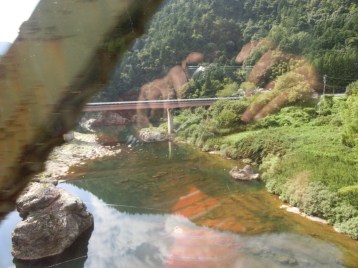
Never content with making one mistake at a time, I often managed to make several at once, such as this disastrous photo, which misses the main object (the bridge), gets a pole in the road and has many reflections. Yet another failure!

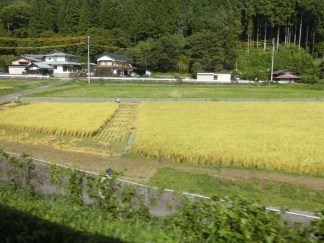
Some problems can be repaired afterwards, by careful cropping, fortunately. Here’s an example. I wanted to take a photo of someone working in the fields, not just of the scenery. The photo I took managed to do that, but the farmer is quite lost and only just visible in the photo (as I had been previously trying to photograph wide scenes).
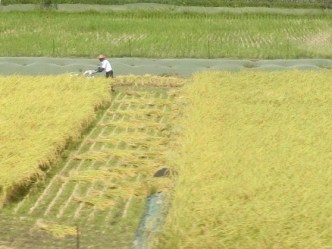 If the photo is cropped, and is of sufficiently high resolution to permit that, it can be improved a bit. I usually take photos at 3 megapixels, which allows some zooming without losing too much resolution, as in this case. It is not always clear how (or even whether) you can change the resolution on camera phones, however. I’m not unhappy with this photo, which gives a sense of the enormity of the farmer’s task, without background clutter.
 Zooming in even further may be problematic, as the photo will become quite grainy, unless it is was originally at a much higher resolution (say 10 or 16 megapixels). In this case, I’m unhappy with the graininess, although some might be less unhappy with it; it’s all a matter of personal preference and style at some point, of course. And, again, you may not be able to change the resolution on your camera if it is actually a smartphone.
Taking photos from trains often is difficult with things getting in the way, especially electrical wires, and physical barriers set up to keep noise away from communities with a train going through them. Sometimes, it is just not possible to take a photo at all; at other times, the photo will unavoidably include wires, and you have to accept that (or manipulate it later using software such as PhotoShop, which is probably too much hard work for casual holiday snaps. So, I will tolerate the wires in a photo like the one below, persuading myself that it’s actually part of the scene:
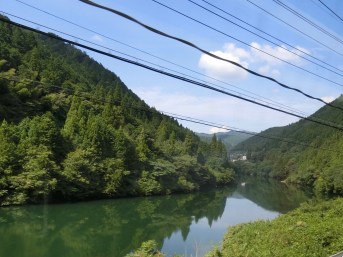
The scenery in the mountains was stunning, and there were many views like this that I enjoyed, despite my inability to capture them with my camera.
I remember many years ago having my portrait taken by a colleague (who was the photography teacher in the school), back in the days before digital cameras. He said that he discarded most photos he took, expecting to get one or two shots from a roll of 36 that he was prepared to print, a ‘hit-rate’ of less than 10%, which surprised me. He was an experienced professional (and not shooting out of a train window!) So I am not easily discouraged, and with a digital camera, it’s easy to discard failures with essentially no cost (unlike film). On my train trip today, I took around 100 photos, of which about a dozen are worth keeping … and it kept me amused for most of the trip!
Here are a few of the small number of photos I chose to keep. [You can click on photos to see larger versions, if you wish.] Of my several attempts, mostly abject failures, I liked the following two photos of solar panels, the first showing that they are often blended into the farmyard environment, as if farmers are growing electricity as well as rice, while the second was a lucky shot, showing a giant electrical company recognising the need to get electricity to use its products. It’s clear to me that Japan takes alternative energy sources very seriously, possibly more so after the Fukushima nuclear reactor disaster, and no doubt in accord with its signing of the Paris agreement on reducing greenhouse gases.


I saw many rural scenes, with crops in various stages of production, and it seemed to me that very little usable land was not being used for cultivation. So I enjoyed photos like the following:


I often saw cases where the crops came right up to the farm buildings and where a cemetery (clearly immovable) had crops growing all around it. I also liked some of the scenes later in my journey that showed the mountains as well as the fields and gave a sense of the wider landscape.
I saw many rice fields under cultivation, unsurprisingly as rice is commonly eaten in Japan (much more so than is the case in Australia). But there were other things cultivated as well. I was surprised, to see that tea was also grown, for example; after several attempts, I managed to capture a small plantation, as shown below. I should not have been surprised, of course, as tea is very popular in Japan, and grows well at higher altitudes, so is more likely to be seen as we got closer to Takayama and away from the plains of Kansai. Vegetables are also important and I saw some greenhouses apparently for that purpose as we got into the mountains, where earlier on lower land, vegetables were simply grown in fields next to the rice fields.


In the mountains, there were many lovely scenes involving rivers bubbling through the landscape. Here are a few examples:


I also saw some interesting bridges en route, such as these (but failed miserably to photograph most of the bridges I saw!).


Although most of my photos were unsuccessful, I have long ago learned that you have to fail, and fail often, before you can succeed. This applies to lots of things, of course, not just to photography. Despite my many failures today, I thoroughly enjoyed the wonderful scenery passing all too quickly past my window, and I was pleased that I managed to catch a few bits of it on my camera. I will remember some of my journey later, as well as the visual delights of the Japanese countryside, by looking at the ‘surviving’ photos.
And if you are a beginner, hopefully some of my tips are of use, not just for trains but for other moving vehicles like buses and cars.

 Barry's travel blog
Great camera work Barry. Countryside looks wonderful. Thanks for the tips.
Cheers
LikeLike