Walking around Dotombori

The Lonely Planet Guide described Dotombori in Osaka in two ways. They said it was an example of “evolution: survival of the flashiest”, and also suggested that, if Lady Gaga was a city, this would be it. I think they got it right on both counts. As you can tell from the picture above, ‘flashy’ is an apt description.

But first, the process of getting there. I’ve not found Osaka as easy to navigate as Tokyo, but maybe that’s just my unfamiliarity. I stumbled upon the extraordinary Namba Walk from Namba Station that seems to go for miles (well, at least hundreds of metres!), and needs its own map to navigate. The walk comprises shops and shops and shops and restaurants and shops and restaurants … and lots of people going to and from train stations or to eat and drink and shop. (This picture is unusually empty)

CIMG7718

I was greatly surprised to see a few familiar paintings on the wall (reproductions, of course), and only then noticed that I was in the Chicago Gallery in Namba Walk, with reproductions from the Art Institute of Chicago, one of my favourite museums. (Click on the pictures to see them in full).

There are other walking arcades around the area, too, with wonderful high ceilings, as typical Japanese ‘shopping streets’ often seem to have. And lots of signs! More and more shops and signs and people and unusually (for Japan) noisy.

Many of the little side streets off the walking arcades  look OTT as well, such as these examples with their signs and lavish use of electrical cables.

But Dotomobori Arcade itself, a hundred metres or so of street, was completely over the top – a riot of restaurants, bars, shops, etc all competing (very loudly) for customers with spruikers everywhere and advertising banners like I’ve not seen elsewhere.

If you’re not some sort of showman, you’ll not survive here long in business, as the LP suggested, encouraging flashiness. Lots of the advertising actually moves, too! The crab legs, for example. The Fugu fish are a particular Japanese specialty and prominent in advertising; I’ve not tried them, but I think they can be poisonous if you’re not careful. (I’m careful.)

Behind the arcade is a small canal, and it looks a bit quieter and more refined (until you look up!)

At night, the lights come on and it looks like sideshow alley, with lots of neon lighting everywhere. It felt completely safe, however.

In the middle of all the madness, however, there is a little Japanese Temple, Hozen-ji, which seemed to be a slight relief from the mayhem around it:

Just in case you thought that everything in Japan is peaceful, quiet and restful; if you have such an illusion, come to Dotombori.

Unforgettable.
Architecture in Osaka

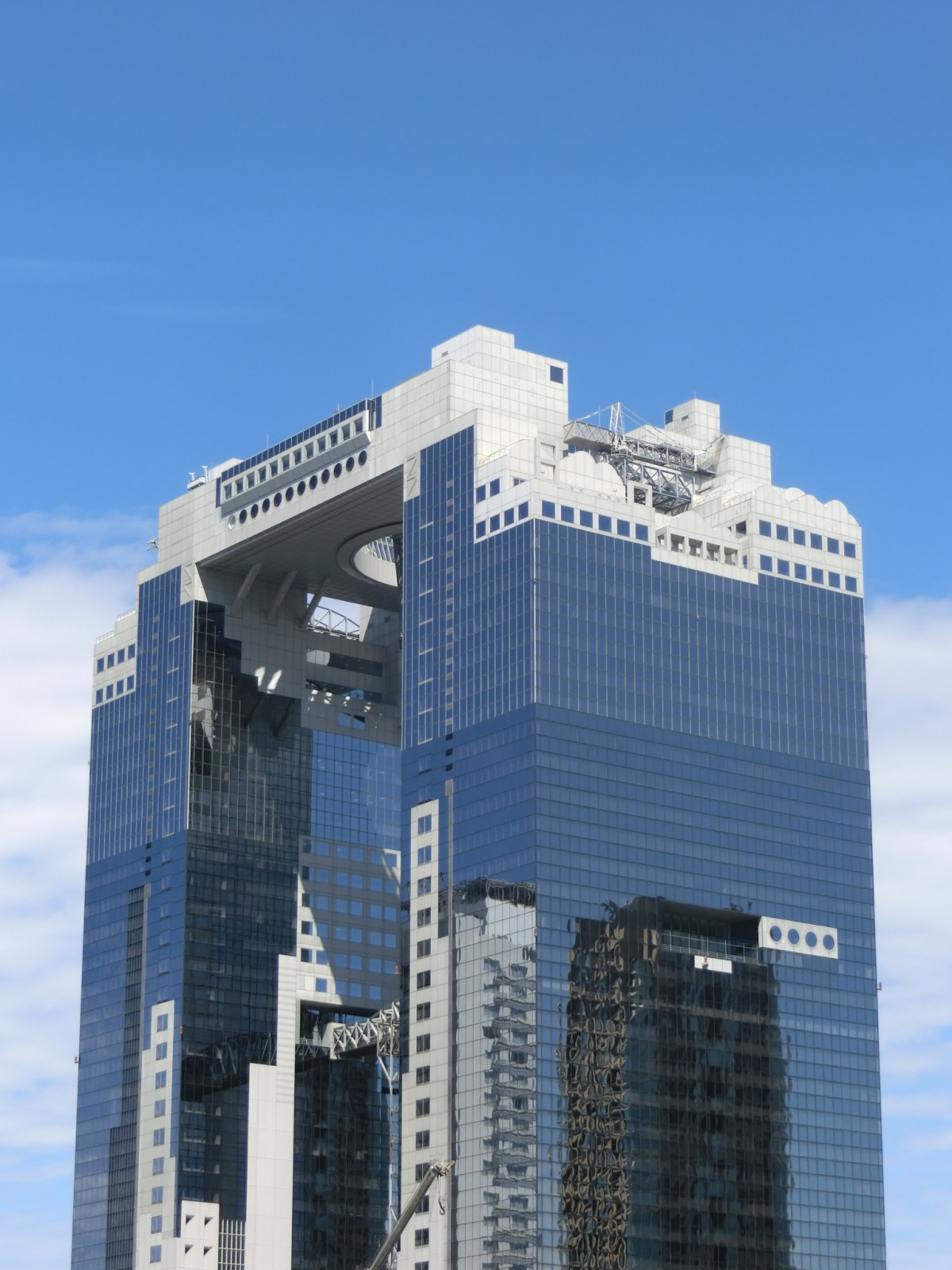
I think I’ve always liked buildings, and of many different kinds. I enjoy old temples, Greek ruins, skyscrapers, English manor houses, Japanese castles, churches, etc. I’ve been lucky enough to see some fabulous buildings over the years, but (perhaps like Prince Charles?) I don’t like boring buildings. [But, to be fair, beauty is in the eyes of the beholder, and what I find boring, others might actually like.] So I was attracted to Osaka’s wonderful Umeda Sky Building, pictured above, and it was the first thing I headed for after arriving.

It’s a fabulous modern building, with an observation area on top, to which I headed. Getting to the top involves going on an escalator between the two towers, however – a slightly scary experience! Here they are (one up and the other down) from the ground level:

And this is what they look like from the inside, as you are about to launch off on a ride between the towers, as well as from above, once you’ve arrived. It’s a spectacular sight and feeling. And of course I was pleased that the steps moved all by themselves, and didn’t need me to climb!

As you’ll expect, although the building is not super high (I think around 40 stories), there’s a pretty good view of the city from the observation platform at the top. Here are a few snaps to prove it. (Click on them if you wish, for a better view).

I’m embarrassed to say that I did not realise there was so much water around Osaka until I saw it from above, and nor did I know there was a downtown ferris wheel! The airport is very close to the city, and it’s always interesting to look down on planes …  I watched the trains going over the railway bridge for a while: there were often three, four and even five in view at once. You can see what’s happening in a city and what it looks like from this height.

The observation area itself was interesting, as it was constructed on the ground first and then lifted to the top as a block (of more than 1000 tons!) after the towers were built! Wow! It took about seven hours, but I’m nonetheless amazed at such a feat. Apparently, it was the first building to use this technique.

Another interesting aspect was the floor below the observation deck, which had nice pods to sit in (with friends) and from which one could watch the world out there. Those of you who know my views about selfies will not be surprised at my reaction to the two young ladies, sitting up high in a coffee shop lookout of one of the world’s great buildings, with fabulous views to see, and who took a photo – of themselves! Ye gods!

Wherever I walked around and in the building, I was greeted with wonderful views, such as the following few examples. I enjoyed looking down on next-door’s helipad!

There was an interesting display in the observation area of famous buildings. This snapshot shows just a few of them (click it to see them), but you’ll probably recognise some of these (such as the Eiffel Tower, La Sagradia Familia,The Temple of Heaven, The Taj Mahal, etc.). This particular building was named by a Times of London journalist a few years back as one of the top 20 buildings in the world. No doubt others have other lists, but I certainly enjoyed seeing it and being in it briefly.

Architects, like artists and poets, deserve to be named. Bravo Hiroshi Hara!

There are many other examples of lovely architecture in Osaka, some parts of which have a great feel. For example, this is the new Osaka train station (in the background on  the left). I loved the human touch of benches to sit on outside, too. And, being Japan, there is no litter at all anywhere. (People take their litter with them or deposit it in the place from which they bought it.)

The feeling of spaciousness inside newer train stations is extraordinary, as these snaps suggest. One of them at least is the Osaka station and another is the new Namba station elsewhere in the city (my recollection is hazy). It must be very satisfying to work as an architect and to be allowed to create spaces for people like these, but which nonetheless fulfilled their function as well.

Similarly, the examples below caught my imagination, too. Lovely shapes, designed for the joy of making something lovely. And of course, the mathematics is everywhere …

These are all newer pieces of architecture, clearly, but for me they added a nice feel to the city. I hope you like them too.

Climbing Mt Misen on Miyashima Island

The view from the top of Miyashima Island has been described as one of the three top scenic views in Japan, so I had determined to see it. (They were described as uninterrupted 36o degree views, hardly a surprise as they’re on top!) But with sore feet after the temple experience, and because of the hot weather I decided to get the available ropeway there and back (a ropeway in Japan is what I had previously called a cable car), rather than just one way and walking back as originally planned. I regard this as evidence that I am getting smarter as I get older – albeit scanty.

En route to the ropeway, I stopped to rest my feet and have some lunch. I spotted a deer outside the restaurant and inside noticed that they used tatami mats for seating around tables. There are many deer on Miyajima Island, all quite tame and this one looked as hungry as me. I’ve long ago stopped sitting on the floor to eat, however, and had chosen a chair with my table … further evidence of advancing wisdom.

I always worry a bit about cablecars, to be honest. I can all too easily imagine the effects of a little bit of rust, a little bit of metal fatigue, an unusual response to environmental stress, etc. But I threw all caution to the winds and took off up the mountain, which tops out at 535 m.

Actually, there were two successive ropeways in this case, the first one with a smaller car than the second. Both show the luxuriant tree growth on the island, and both proceeded without incident (phew!). A nice thing about a small cable car is that you can meet others, of course, similarly imperilled, and in this case I met a lovely family holidaying from Tokyo. I even tried to engage the older child (a boy) in English conversation, ready for the return to school tomorrow, especially as he had not yet done his homework. [I was surprised to find children got lots of summer holiday homework, which is rare in Australia.]

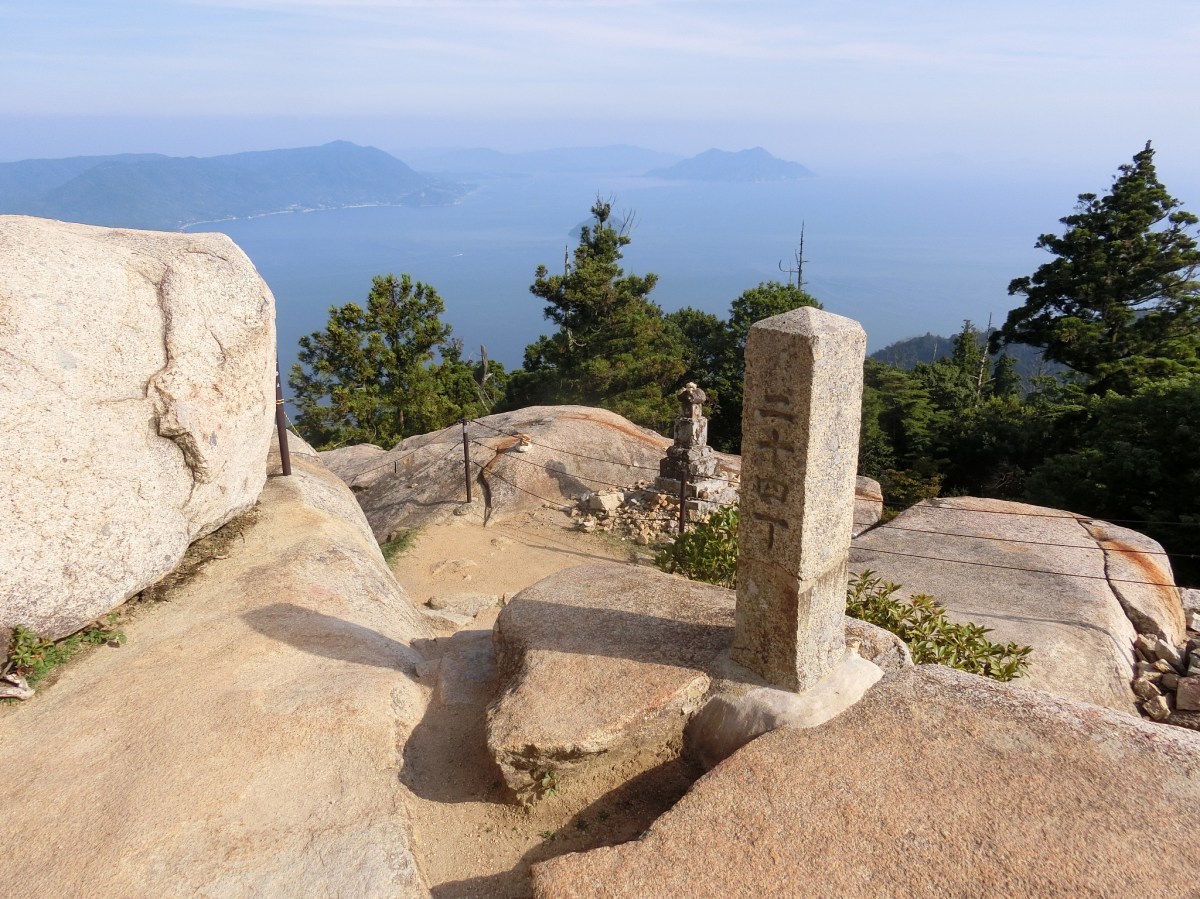
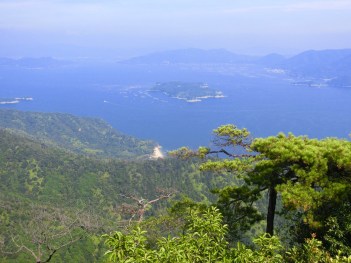
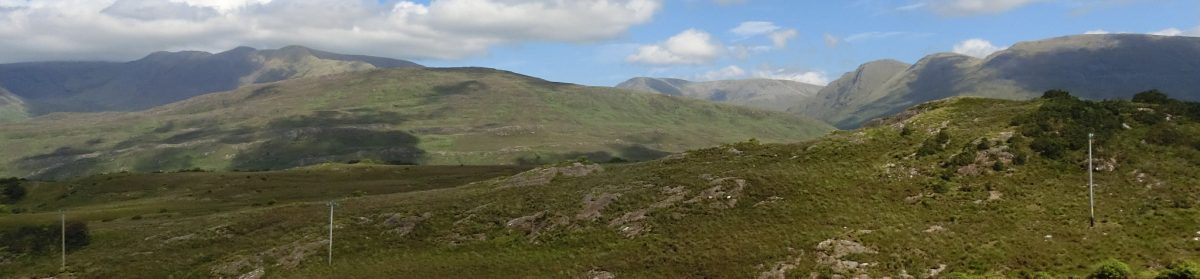
Once we reached the top, the view was indeed terrific. I could se parts of the ‘inland sea’ between Honshu and Shikoku, including some islands. The heat made it a bit hazy, but I was still pleased to be there.

CIMG7217

However, the climb was not over, as there was a walk to the top of the mountain. This proved to be very hard in the heat, with my feet still complaining from the temple walk and because it was quite steep. I did not have to climb (in the Hillary and Tensing sense), but it was tough going. Made me realise that although my brain still thinks I’m about 22 or so, my body has better evidence of my age, and I was uneasy about getting to the top observatory before it closed at 4 pm.

Along the way there were small temples, some founded by the same man who founded Daisho-in temple, as described in another blog. Reikado Hall is quite famous it seems for housing a fire that has been burning for 1200 years! The same fire was used as a pilot to light the flame of remembrance in Hiroshima’s Peace Park (as described briefly in another blog), making an interesting and unexpected connection of my two blogs. But all I noticed on the way up, having stopped at the temple to catch my breath (only just successfully) was that there were still more stairs to climb! (Click on the images to expand them, and see the stairs for yourself).

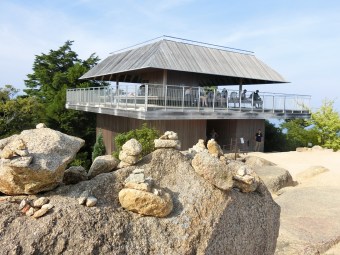
So I trudged on up the hill, determined not to be beaten, against the advice of my feet. To prove I actually made it, here is a picture of the observatory, at the top, which was a very welcome sight. I’m pleased that Mt Misen was not 540 m high … I don’t know that I could have made another five metres!

CIMG7251

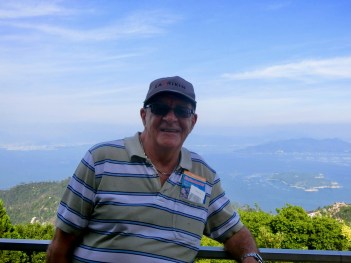
I rarely indulge in selfies, having already a pretty good idea of what I look like, even under conditions of heat stress, but on this occasion I succumbed to a suggestion of my companion family (who had reached the summit some time before me) to recognise my success with a photo:

CIMG7237

The view was indeed magnificent, and in all directions. I was able to see more of the Inland Sea and of course across to Hiroshima, from whence I had come for the day out. here are a few snaps:

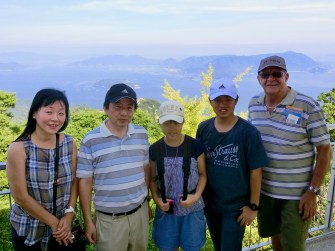
And here is a picture of my travelling companions and myself, enjoying the comforts of the observatory before tackling the descent. They were very pleasant company.

CIMG7243

The trip down the hill was a little easier, after the success of the climb. I paused occasionally to capture the views, and especially liked seeing some of the trees against the sea, even dead trees:

In all, a wonderful day’s outing to Miyajima, that made me glad I came, despite the physical hardships. It’s a lovely place, and I can now see why some people prefer to stay overnight at the island to enjoy its many charms, but at a more relaxed pace. The sense of achievement in reaching goals is pretty nice too, as even my feet probably agree.