Everyday life in central Santiago seems manageable for most people; I am surprised how accustomed I have become to it, so it’s certainly manageable for those of us passing through. On my last (full) day in the city, I visited a few museums and enjoyed a stroll around town. A few small everyday things caught my eye.
Going for a walk is always interesting, especially when one is not at home. I took some laundry to a local service this morning and passed (again) a rather stern looking pair of police vehicles outside the local church. I’ve seen these before, and they look a little less scary every day: I guess vehicles like these need to be parked somewhere, and I no longer see them as evidence of an imminent problem! The big sign welcoming the pope sends a different message, too, although I assume security will be very tight when he arrives in January. I have spotted several of the rosary signs in local churches, too, over the past few days. There is no doubting that Chile is a Catholic country.


On my way to my chosen first museum, I encountered a bike counter, and stopped for a while to see if it was working (it was). Bike lanes here are quite prominent, and clearly do not tolerate cars wandering into them (as they do routinely in Perth) as there are big barriers on the road; the City is trying to get people out of their cars and onto their bikes a bit, and they are commonly seen in parks and footpaths as well as roads. As a second example, the Los Heroes park near my apartment (and other parks too) always have ramps as well as steps; I’ve not seen a wheelchair on one, and just the occasional pram, but lots of bikes.


I saw fruit juice sellers on lots of corners, easy to spot. They provide (very) freshly squeezed orange juice for passing trade. I also passed lots of murals and graffiti, which no longer worry me, and even give the area a bit of character. The locks on doors (which were not part of the original design) also suggest something to me, but I was taken aback to find an Institute for Military Geography! (Ye gods! What on earth is military geography?? Maybe I’m mistranslating it?) Isn’t geography just geography? What is ‘military’ about it that need a multi-story building?


I am surprised at the very large number of universities here, and worry that many of them must be pretty dodgy. There would be at least a dozen within a five-minute walk of my apartment; maybe I’m in the university part of town (which would surprise me, as there is a very large number of auto parts shops in this bit of town!). I passed several universities and lots of students this morning, mostly milling around in the street, presumably waiting for classes.

The students above are examples: they seem to be all about the same age (suggesting that university study is not for older people? a big inference!), all having backpacks and all pleased to be in the company of friends, enjoying lots of seating. It was quite late in the morning (around 1030 am), so I’m not sure why they were outside.
The first museum I visited was originally the palatial home of a wealthy family (the Cousino family) who made their money mining silver in the nineteenth century, but it has now become a museum.


It is beautiful inside, and is in very good shape, despite some water damage from a fire some years ago and of course a bit of earthquake damage (pretty normal for Santiago!). It’s set next to a small and lovely park, and is in nice manicured grounds. Most of the original furnishings, drapery, wallpapers, parquet floors, etc are all in good condition, and I thoroughly enjoyed my guided tour (I had a 1-person tour, and in English! I even got a substantial senior discount to enter. Win-win-win!) Unfortunately, I was unable to take photos, so can’t share the detail here, but it was a very stately home indeed. The owners were very inclined towards French and Italian things, which certainly showed in the house internal decorations. There was very little in it that could be described as Chilean, in fact!
Similarly, when I visited Museo Nacional de Bellas Artes, I could see from both the name and the style that it was clearly modelled on French designs, and had an obvious reverence for Italian arts, with the massive copy of the head of Michelangelo’s David in the main room, as well as homages to European painters elsewhere, and Greek and Roman sculptures. I have got the feeling that when the Europeans conquered Latin America, and Chile in particular, they created a high society that preferred European things over Chilean things. Even Pablo Neruda, the famous Chilean poet, was pretty obsessed with French things and was French Ambassador for a while.


There were some Chilean works in the MAC (museum of contemporary art) adjacent to the museum, however. I really enjoyed the feel of the neoclassical building, with high ceilings and lots of beautifully tiled floors, but also enjoyed the works of art – or at least some of them.


Contemporary art is often huge in scale, and the blue image above comes from a room that had moving lights in it, captured still in the photo. Dynamic works like that are certainly different from a static picture on a wall. The other example shown above has many pictures on the wall, however, and also took my eye.
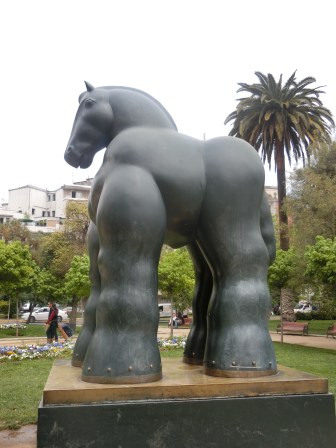
Something else that took my eye – unavoidably – was the large sculpture outside the museum. It was of course by the Colombian Fernando Botero, and reminded me immediately of the sculpture I saw in Singapore just a week or so ago. It’s a very distinctive chunky style!
Adding to the French connections – perhaps – is an abandoned railway station that has now been converted into an exhibition space. It was previously the Estacion Mapocho, a huge and extravagantly styled railway station that fell into disuse after trains became problematic (I think partly through earthquake damage? Not sure), but which has been recently revived in 1994 as a cultural venue for concerts, trade exhibits and art shows, etc. I could not go into the main space, which was being prepared for a show, but these snaps give an impression of the former glory that is being returned:


It was hard to not imagine that they got the idea of restoring this from the wonderful job done on Musee D’Orsay in Paris, but maybe I’m wrong with this guess. (Nothing I read mentioned the possibility, so it’s pure speculation.)
In my museum day, I also popped into the National History Museum, right in the middle of town. This was an older style museum and a bit challenging as everything was in Spanish. I can stumble by in such situations, as my Spanish reading is (much) better than my hearing, but it’s still bit taxing. And I was running out of time, which didn’t help.


The snapshots above refer mostly to the European influences on Chile. I was surprised at the portrait of Christopher Columbus (Colon in Spanish) as a relatively young man, who changed the world by bumping into the Americas. I remember learning why American Indians were called ‘Indians’ by Columbus – because he at first thought that he was in India! (Navigation was not what it is today back then!). The Spanish conquistadores certainly changed the world of Chile, and there was a still a clear hankering to be ‘European’ in Chilean high society of a hundred years ago. Indeed, I wonder if it hasn’t yet disappeared.
The painting above (next to Columbus) was the subject to an entire gallery in the Museo de Bellas Artes, where the ‘unknown’ people were described. The painting shows the first Spanish scaling of what is now Cerro Santa Lucia (subject of an earlier blog) overlooking Santiago, with particular Spanish dignitaries identified, but nobody remembers who many of the (local) people were. It reminded me a bit of learning history, where we learned about famous people (such as politicians, generals, etc.) but didn’t;’t really learn anything about everyday people (the farmers, shopkeepers, seamstresses, teachers, …). So it was nice to see the painting for real in the museum.
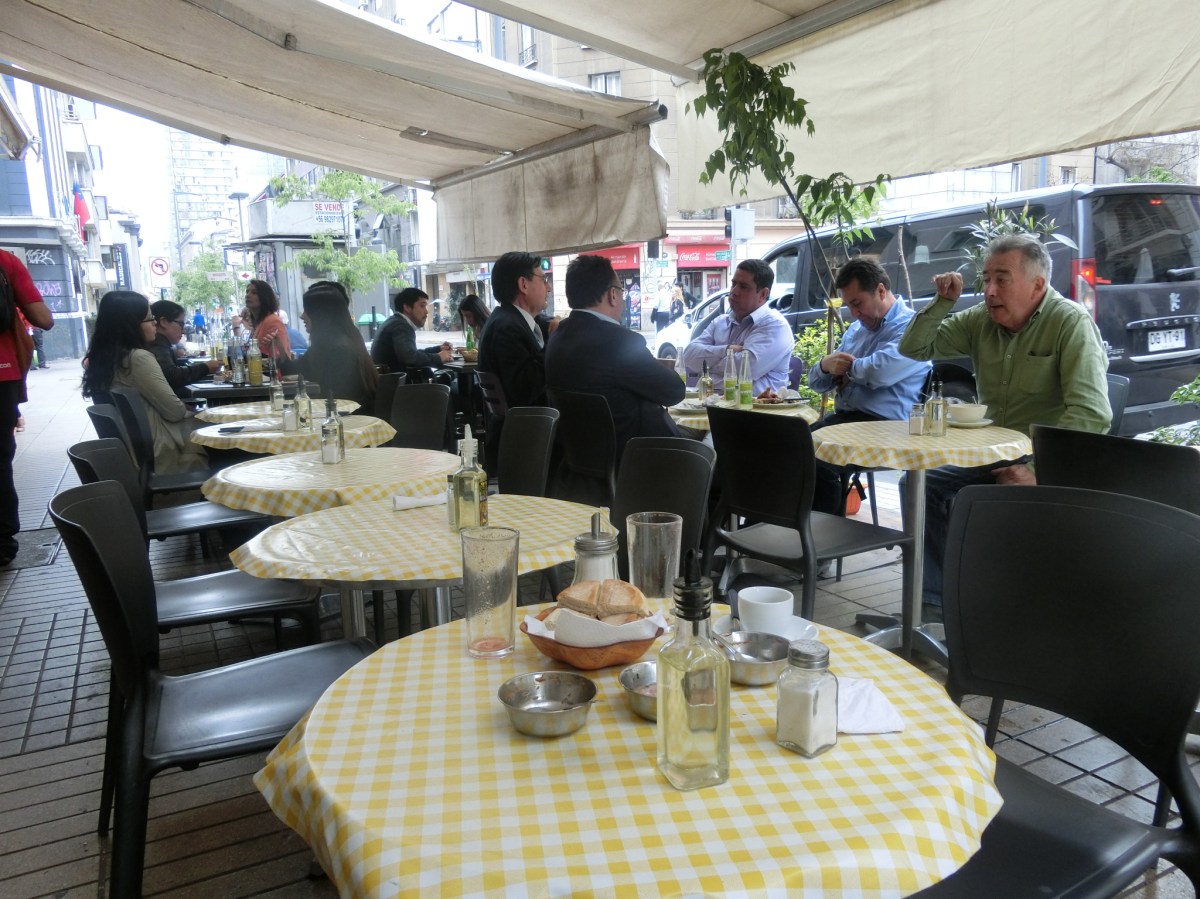
It was past time for some lunch, so I stopped at a small cafe/restaurant for a daily menu (a good deal, with a three-course meal, with drink, usually for about $8). I had some delicious soup, a tortilla with salad, some bread and bits, as well as a bowl of jelly and a glass of strawberry juice. A pretty good deal, I thought, and very inexpensive. Opposite me there were people selling clothes in the street (for very little money), which made me feel as if I was being positively reckless with my money. But the real story here is told with the photo at the top of this blog.


Two young women sitting next to me had finished their meal and left, and the table had not yet been cleared. (The photo at the top of the blog shows the table.) To my surprise, a middle-aged chap came by, and ate most of the leftovers, while standing at the table. He drained the dregs of the juice, scooped most of the savoury mixture out of the bowl onto some bread and ate the rest of the bread. And why not? Of course he was hungry, and the food would presumably be thrown out anyway. Nobody said anything, including the chap in the green shirt who was either the head waiter or the owner, and who must have seen it happening. I noticed that the table was cleared soon after the chap left. I don’t know whether it is a standard practice to tolerate this, or whether this was just a one-off event. But it certainly served to remind me (again) how lucky I am.
My last museum visit for the day was to Londres 38, a house that became infamous in the Pinochet regime for torturing political prisoners and the development of a system of people ‘disappearing’, via extrajudicial executions, especially in the early days of the military dictatorship from 1973-1975. The English guide pamphlet describes it as a ‘Former centre for repression and extermination’, but which is now used to ensure that memories of these awful events are not forever buried and forgotten. The government even changed the house number (from 38 to 40) at one stage to distract attention from it.

Not a pleasant stop, of course, but it’s important to not let bad things disappear, as the sign outside says: All the truth, all the justice. The relative recency of state-sponsored terrorism of this kind might account in part for the respect with which the police and the armed forces are clearly given here; the military dictatorship happened with military and police cooperation, I think. I’m not sure. I still need to know more …
On a (slightly) lighter note, here are my last few photos of the day’s wanderings. I was not sure why there were mounted police in the main square; I don’t think they were there the other times I came. I saw lots of fruit stalls and lots of fast food stalls during the past several days. Book stalls were less common, however; that shown here is outside a university, so unsurprising (and slightly reminiscent again of Paris?).


The statue in the style of the Easter Island statues is probably as close as I will get to Easter Island in the rest of my travels this trip, although I expect to see lots of food stalls, lots of fruit, lots of policemen but maybe not lots of books. We shall see.
I have enjoyed my week in this city, which has made it clear to me that I have lots more to learn about Chile.
Off to Valparaiso tomorrow to continue that project.
Hasta luego!

 Barry's travel blog