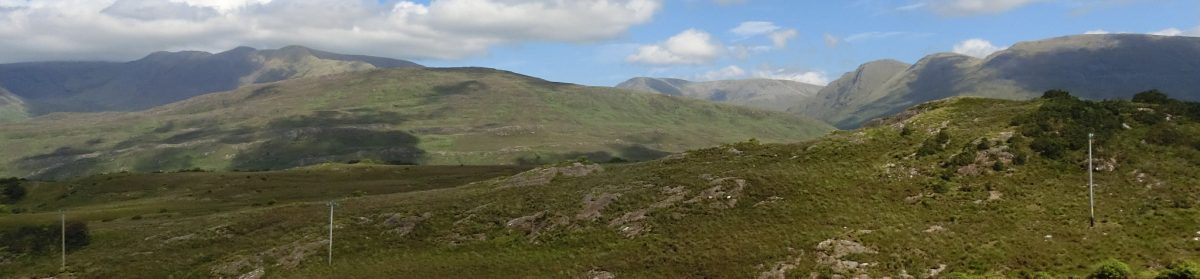

Since last I wrote, I have been on a few trips out of the cities and enjoyed some of the wonderful environment Chile offers, despite having some wet days. (When you’re only here for a few days, there’s no sense in waiting for fine weather!) This is a beautiful country, with lovely environment and interesting histories, and there are many lovely national parks in the southern regions I visited.
From Villarrica, I took a day tour out to the Huilo-Huilo Reserve, which is a large area undergoing active improvement and conservation. This was a little challenging linguistically, as everyone else spoke Spanish, but some things don’t need a language. I took hundreds of photos, but will share only a handful here. We passed through the seven lakes in the region, with spectacular scenery, despite the rainfall most of the day. The picture at the top of this blog shows an example. Here are a couple more examples. including a selfie to prove I was enjoying the experience:


Other natural features we enjoyed included some waterfalls amidst all the mountain scenery. Here are two examples, once again with a selfie!


In fact, both of these are called salto in Spanish, which means ‘jump’ rather than ‘fall’. There was an enormous amount of water coming down each, so they were very loud. We clambered all the way to the bottom of the first one shown here, many many steps below the surface, in slightly slippery and muddy environment. In the second case, we had walked through mud, water, rainforest, steps and rain, so that by the time I arrived I was soaking wet and the lovely umbrella Pete and Helen bought me was no longer up to keeping me dry.
A variety of other things occupied our day. We visited a deer park, a testimony to the conservation project which has successfully bred many of the Andean deer, a previously endangered species, and also visited some Mapuche areas. (The Mapuche are the local Indigenous people, who have a somewhat chequered history with other Chileans (hardly surprisingly in view of the Spanish conquistadores murdering lots of them not all that long ago). We saw lots of examples of Mapuche statues carved in wood and actually had lunch in a Mapuche settlement in the forest.


We also visited an extraordinary hotel built into the environment. If you look carefully at the picture below (with people snapping photos), you will see a large construction covered in growth; it’s a large hotel, in which we stopped for a coffee and a wander around. Wandering around the building built of wood in the middle of a forest was an interesting exercise.


As you can see, the environment is very green, probably exaggerated a bit by the rain, but I was surprised all day at how green something can be -a bit like Ireland, but even more so. The trees above are part of the hotel ‘backyard’.
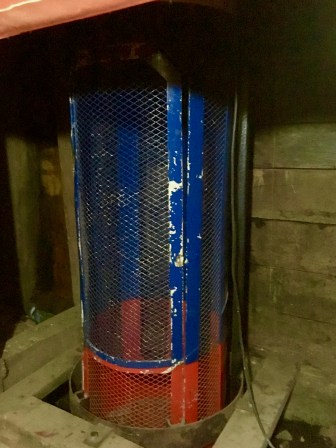
We had time for only a short stop at a large museum with many traces of human activity, as well as mineral activity (Chile has been a major miner for many years, not always in a helpful way for its environment). I had forgotten about the amazing mining rescue in 2010 of ‘los 33‘, the 33 miners stuck underground in the Atacama Desert that made international news, after they were all recovered after being underground for 69 days. The capsule below is a replica of the one used to bring them to the surface in the dramatic rescue, which captured international attention, and was featured annoys many other things in the museum.
Back in town, I wandered around some of the markets where local crafts were both generated and displayed and even had a (delicious) meal in a traditional Mapuche hut in the middle of Villarrica:


But my abiding memory of the day out was how green everything was.
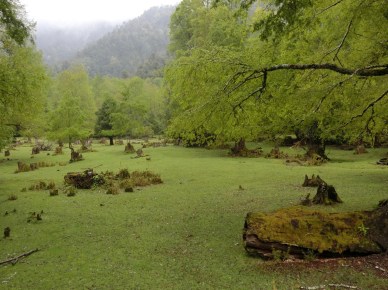
From Villarrica, I proceeded several hours further south to Puerto Varas, a cute little city on a lake, with lots of volcanoes around. Puerto Varas is in a region officially known as the lakes region, even though there are lakes further north, such as those shown above on my day trip out of Villarrica. The trip on the bus was lovely, passing through rolling landscapes, farmlands and lots of greenery of different kinds.
Puerto Varas has a distinctly middle European feel, due no doubt to the immigration of quite a lot of German people to the area in the middle of the nineteenth century. Unsurprisingly, they built many houses and churches in the style to which they were accustomed, with a few examples shown below.


Again, I decided to do a day trip out of the city, pleasant as it was to walk around. I chose a trip passing along the side of the lake on which Puerto Varas sits and then traversing a larger lake by catamaran. The day was hampered a little by incessant rain, so I was left to imagine how spectacular it would all be on a fine day.
We stopped on the way to see another salto, which was very impressive, with a huge amount of water rushing over rocks and making a lot of noise. When there were occasional patches of sunlight, as you can see, some of the effects were quite beautiful, with fast rushing water, mossy trees, interesting growths and lots of rocks.


The large lake we traversed by catamaran was surrounded by spectacular mountains, many of which were snow-capped, but my photographic skills (together with the weather) meant that it was hard to capture this. Here’s a few examples, however:


(Both pictures are taken in full colour, in case you thought otherwise.) It reminded me a little of Milford Sound in New Zealand, but was considerably larger. It would be spectacular on a decent day. The waterfall shown here was very high and our ship went quite close to it for some spectacular scenes. At the end of the boat trip, we had lunch in a large hotel (which I am sure depends on that sort of daily tourist trade); I would normally avoid such things, but the view from the hotel into the foothills of the Andes was quite spectacular:

It was about a kilometre or so from the boat to the hotel, and shuttle buses were provided. But I chose to walk instead, as the rain was only slight and the countryside was just spectacular. Why would you sit on a bus when you could breather the mountain air and smell the flowers, I thought to myself. Here are a couple of snapshots of my walk:


And here are a few of the flowers I smelt:


I went for a stroll to work off my lunch, up the hillside, following a lovely little waterfall (called La Cascada de la Novia – The Bride’s Waterfall) for a while. It was a really beautiful spot:


I found a sign that indicated that we were only 25 km from Bariloche, in Argentina. (In fact, some people on a tour from Argentina joined out catamaran for the trip back to Puerto Varas.) It’s a very beautiful part of the world.
So, despite the inclement weather, it was a lovely day out. The following day, I ventured out again, this time using the local buses to go up the lake coast a bit to Frutillar and then later on a bit further to Puerto Octay. (The local buses are very cheap: the 56 km trip back from Puerto Octay to Puerto Varas cost me about $3.) This proved to be an interesting day out as well.
Frutillar describes itself as Music City, and has a spectacular pretty new Concert Hall on the lake itself, in which are held regular events, including with international people. (I saw a sign for a forthcoming concert with some artists from the New York Met and from Berlin, for example.) I took a tour of the hall, which was a bit challenging as it was all in Spanish (which I knew in advance) and a bit problematic as there were some school groups rehearsing in the hall, so that we could not take pictures inside with children in them. It is a spectacular hall, however, as the couple of pictures below suggest, and I would happily have trekked up again to hear a performance, but alas everything was on just after I was leaving.


All the bus stops in the (smallish) city had a treble clef on them and there were musical things all over the place, such as the statue of a piano lakeside shown above.
There was also a nice outdoor museum in Frutillar of the German people in the area, and I enjoyed finding out about the history (of which I was previously completely ignorant, I’m embarrassed to report). The Germans were encouraged to come to Chile to help secure the land for the (new) country and to open it up. Of course, as immigrants generally are, they were very industrious and did a great job of turning many parts of the region into productive farmland, which it still is today, and also made beautiful buildings and rural farm scenes along the way.


I was surprised to see a small pier, reminiscent of English piers, on the lakeside, which generally offered beautiful views across the lake to one of the local volcanoes (Osorno, I think). A lovely little town, which again would no doubt be even lovelier in nice weather.


My trip up to Puerto Octay again passed some beautiful countryside, with rolling hills and farm view, as well as lake, mountain and volcano views. The little town itself was less attractive (at least to me), although there were some interesting old German buildings, originally houses, but now re-purposed for other things, such as shops. They looked run down to me in some cases – and maybe they were; it’s not an affluent community. Or perhaps people just like old things to look old and not restored? I don’t know.


I saw lots of animal life in my travels out of town, especially lots of birds I hadn’t seen before (like the species above, which was very common) and a very large number of dogs. None of the dogs was a menace (to me, at least), but they really seemed to be everywhere in the towns and villages.


I was reminded yet again of how lucky I am, watching the chap out collecting firewood in Puerto Octay, along with his dog. (Wood fires are very common here.) There seemed to be lots of people – men especially – sitting around with nothing obvious to do, too. Maybe they were just relaxing, or maybe they didn’t have work and the means that people like me do to wander off to visit other places? I don’t know, and there didn’t seem to be an easy way to engage with them to find out.
The most famous sights around these parts are the volcanoes; there are hundreds of volcanoes in Chile, but the most famous ones are in this region I think. I enjoyed seeing the volcano gradually appearing as the clouds lifted a bit (for a while) in Frutillar, as shown below.

But I especially enjoyed my final look across the lake in Puerto Varas before getting on the bus to leave to start my journey home, where I could see a good bit of both of the famous local volcanoes at once in the morning light.

What a beautiful place this is.
How lucky I am to be able to be here.
I hope that you can get here too one day.
 Barry's travel blog