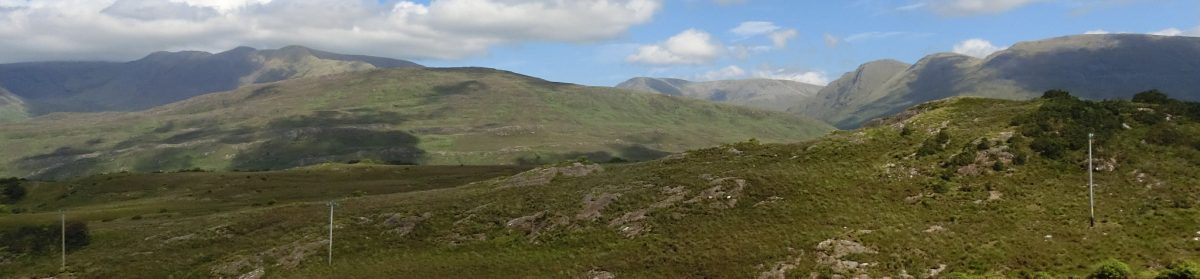

What a lovely time I have had in this interesting and diverse country! It’s hard to capture it in a single blog, but I’ve pasted a few impressions of various kinds here to have a first attempt at that.
My travels around Taiwan have been easy, thanks to a great public transport system. I’ve ridden on the newish High Speed Rail lines, other long-distance train lines, various MRT systems in cities, local buses and special tourist buses, inexpensively and generally without any problems. The High Speed Rail lines are especially fast – as their name suggests, and reminded me of the Japanese shinkansen:
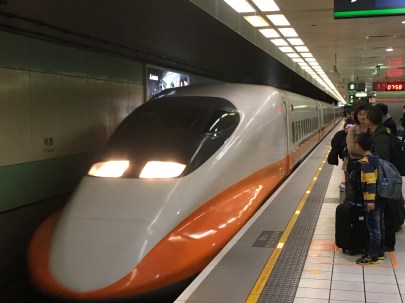
They run efficiently, precisely on time and the only (slight) problem was that the new stations are sometimes not in the middle of cities, so you need to use other means of transport as well (which was never difficult, however). You could navigate the ticketing systems with English, and stops are announced in English as well.
Other trains, such as the MRT (similar to Singapore’s and just as good) have English signage inside stations and the trains too, so I didn’t get lost often. Even when it was tricky, it was fun to learn, as in the example below, where the Tourist Information Service had shown me how to go to a museum with a handwritten note, but not quite written down all the information. So I knew the station started with Bo and had the Chinese characters to match. The note was enough for me to buy a ticket and, as you can see, the Chinese characters for Bao’ an in the train itself were interpretable if you looked hard enough! I got there without a hitch – although with a little anxiety!


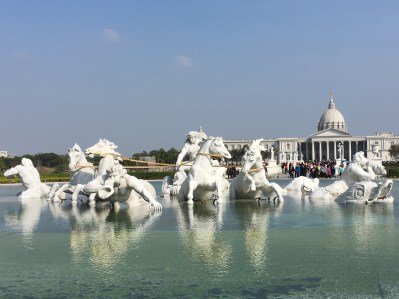
The museum I visited at Bao ‘an (a suburb of Tainan) was the extraordinary Chimei Museum, newly built and reminded me a bit of Versailles from the outside! Inside was very interesting too, and I and sure that it will become better known in time.
The premier art museum in Taiwan, however, which I had also been lucky enough to visit previously, was the National Palace Museum in Taipei. When the Chinese Nationalists fled mainland China after the civil war was lost to the communist party, they took the art treasures as well, so that the museum now houses the best collection of Chinese art in the world. It is huge, and displays rotate, so it’s worth returning. I spent several hours there, but offer here only four snaps, to give an idea of it all:


The large lion statue is reminiscent of such statues all over Taiwan, while the traditional drawing/painting is one of a large number of (very old!) paintings held, some over a thousand years old. There were lovely jade carvings, and lots of beautiful metallic ornaments (some influenced by the Silk Route and Chinese trade with India and the Middle East, long before the European renaissance. I also saw many lovely ceramics, porcelains, tapestries, carvings, … but the space here is limited!
There are many many temples in Taiwan, in fact thousands of them, each one different from the rest and many of them stunningly beautiful and detailed. It’s easy to get ‘templed out’, just as it is easy to get ‘cathedralled out’ in parts of Europe, but I enjoyed visiting many temples and admiring the fine work. Here some recent examples from Taipei:


Temples are mostly less ‘reverent’ and more relaxed places than are Christian churches or Islamic mosques, but are places where people’s deeply held beliefs are practiced and made public. Of course, these always seem slightly strange to others (just as a Catholic church will seem slightly strange to a non-Christian, I guess). Ancestors are more revered than is the case for Western traditions, but there is no shortage of gods to appeal to and petition. Nowhere was this more evident than in the tossing of wooden dice-like objects (called bwei) to seek advice from a higher source, as nicely explained here in a temple in Tainan:
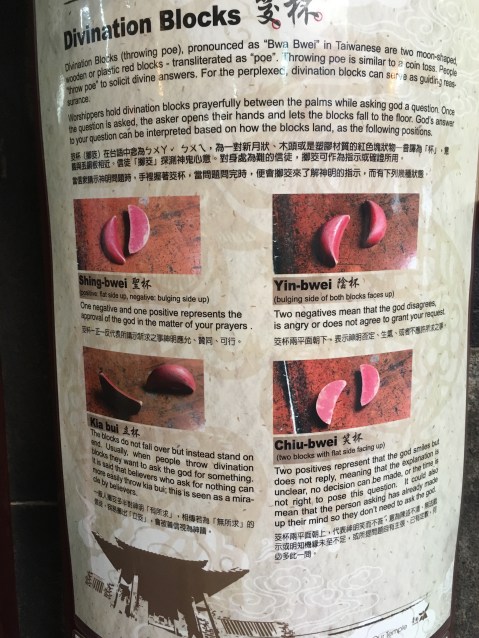
I heard the clatter of these on the tiled floors often in my travels. Of course, I was respectful enough to not be too intrusive, but just to add a context, here is a typical scene in a temple in which people are getting advice in this way:

Despite being mostly a Chinese country, in addition to the original Indigenous people, there were Christmas decorations in the cities I visited, perhaps more a reflection of the commercial impact of Christmas, rather than its religious significance. (And I am not convinced that it’s much different from that in Australia for many people, of course, where Christmas is mostly about presents, holidays, parties and family, not Christian churches!). Here are a couple of examples of decorations, as well as the one I’ve chosen to put at the top of this blog.


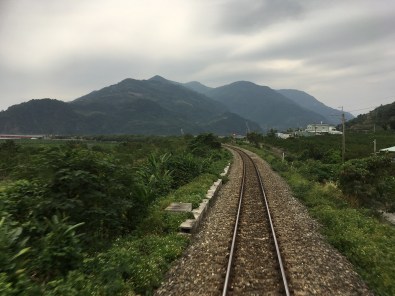
Taiwan is a very mountainous place, with most of the middle of the island too mountainous to navigate and very few roads going east-west. Some mountain are over 4000 m high, in fact, amongst the highest in Asia (if you ignore the Himalayas). Just like Australia (but for a different reason), most people live on the coasts. I enjoyed travelling along the coasts by train, and could often see the nearby central mountains, as in this shot:
I did not have enough time for serious hiking or mountaineering – beyond my skill set anyway – but did enjoy a lovely day in the famous Taroko Gorge on the east coast, just next to the city of Hualien. Here are some snaps from my day in the Gorge, which capture some of its diversity and grandeur. (Click on the photos to see them better).


I could have spent several days here, and there were enough marked trails of varying levels of difficulty to do that. The marble walls and cliffs were spectacular, and I enjoyed wandering various paths, surrounded by greenery, rocks, mists and extraordinary cliffs and drops. certainly worth a visit!
Taipei had some monumental buildings, in great Chinese style. Two very impressive examples are shown below. The building with the red pillars is part of a shrine to Chinese Nationalists who died in various battles, firstly against the invading Japanese and then against various Chinese groups (such as war-lords) and lastly the Chinese Communist party, which eventually won the long civil war, leading to the People’s Republic of China (what used to be known as ‘Red China’). [The Nationalists under Chiang Kai-shek fled to Taiwan and founded the Republic of China, which used to be recognised as ‘China’, but is no longer so.] The other two photos are from the Chiang Kai-shek Memorial Park in central Taipei, which includes the huge memorial shown, as well as two other spectacular buildings. These (and others) are beautiful examples of traditional Chinese architecture.


As well as monumental buildings, there are many smaller distinctive creations, such as the two showing below. The carving was on a footpath in Beitou (the hot springs area outside Taipei), while the four characters were at the Confucius temple in Taipei. I saw many others, as well …


In a central park in Taipei, I even saw this construction for DIY foot massage, with an associated reflexology chart. Chinese medicine has lasted for thousands of years, and this is just one example, I guess. (You’ll need to click on the picture to see the details)


Although Taipei (and a couple of other cities) are quite large, you’re never far away from greenery and countryside, and of course never far away from people. Taiwan has a similar population to Australia but is much much smaller geographically. the snaps below were taken in Maoking (half an hour south of the city on the MRT and then on cable cars) as well as Beitou and Yangminshan (half an hour north of the city on the MRT).


The hot springs at Beitou have always been popular, of course, and became even more so with Japanese occupation early in the twentieth century. The cable cars at Maokong were built in part to allow people to get out of the city and into the hills, where there is lots of greenery, tea plantations, etc. The couple I photographed (son and mum) shared a cable car ride with me and were very friendly, but not more so than people everywhere in Taiwan. I was regularly offered help and advice and a hand of friendship wherever I went, and never felt even slightly uneasy or anxious about people.
Although I visited in winter, there was still some nice weather and I also saw lots of greenery and flowers. The three snaps below give typical examples, of lovely flowers, of manicured trees (this one next to the Chiang Kai-shek memorial) and bunches of flowers in temples (everywhere).


A constant source of stimulation in Taiwan is from food, which is simply everywhere! One of the photos below is from a night market in Kaohsiung, similar to night markets all over Taiwan, in which there are many many fast street food outlets like this. One of the photos is from a DIY restaurant in Taipei, where you paid by weight for what you chose. The third is not technically food (for most of us) but the extraordinary collection of Scotch whisky in the hotel in which I stayed in TaoYuan (just of out of Taipei). (The whisky cache was unusual, to say the least, unlike the other two).


Finally, I have hundreds of other photos and at least as many memories, but space is always limited here, so I’ll finish with three snaps of everyday life in Taiwan.


I saw many people (mostly – but not only – men) engrossed in a board game of same kind all over the island, and also saw a countless number of scooters. The latter were usually clogging the footpath, but these were unusually in a scooter park. And there were many many small shops, small streets and distinctively Chinese shopping areas, like the one shown above.
Taiwan is a lovely place to visit, with rich diversity, only some of which is captured in these few slides. Friendly people, mostly inexpensive, easy enough to get around and enough interesting stuff to keep most of us amused for a long time.
I’m pleased I went to Taiwan, and would happily go again.






 Barry's travel blog