
I was attracted to the Taiwanese city of Kaohsiung in part because I had heard of their recent artistic adventures, but I did not really know what to expect until I arrived. In fact, the first thing I noticed when I arrived in the city was the extraordinary railway station (the HSR – High Speed Railway – has fairly new stations on Taiwan’s west coast, as it has only been going recently). They all have spectacular high ceilings, with girders, like the one below (a comparatively small example, in fact). I don’t think there is a technical reason for the height and all the exposed girders … except to create a feeling of spaciousness. (Of course, it also creates a mathematical space … but that’s another story.)

The HSR stations are all a bit out of town – as they have just been built – so I had to travel on the MRT from the HSR station into the centre of the city where my hotel is located. My arrival at the MRT station was a great surprise: a spectacular coloured dome (under which a lady was playing a grand piano!) greeted me, and I then travelled to the surface under spectacular roof constructions, shown below. (Click on the images to see them in full).


There is no need for any of this: a subway station can be boring and uninteresting, but I was pleased that it wasn’t. Somehow, artistic creations of these kinds are uplifting – at least to me. It got me thinking about who might have designed these, and how pleased they must have been with the end results. I loved the (apparently) curved roof, made up of perfectly flat planes of glass … a 3D version of some designs I have done and got students to do in mathematics, in fact, just because they look good.
I travelled by MRT to Kaohsiung’s Pier-2 Art District, which is a large area of disused and abandoned warehouses on the waterfront. They have been resurrected by the energetic arts community if Kaohsiung into a spectacular artistic space. Many of them are now being used as museums, commercial spaces, design studios, galleries, restaurants, etc. I was unsure of which way to go when I arrived, until I spotted this massive construction of old containers about 500 m away, so knew I was heading in the right direction:

What makes something ‘artistic’? I really don’t know, but the things I saw today all provoked a feeling of some sort in me, usually a pleasurable feeling of some kind. The big red container construction was visible from a long way away and had a certain sort of solidity to it. I loved the shapes and the angles and how it looked different from different places.
The warehouses (about 20 or 30 of them – I didn’t count carefully) often look quite drab from the outside, and thus have retained some of their past lives:

But there is often a twist. In the example above, the arms of the thing on the roof (which was certainly not there when it was a warehouse!) is constantly moving – even wriggling – around. Somehow, the building seemed to be alive!
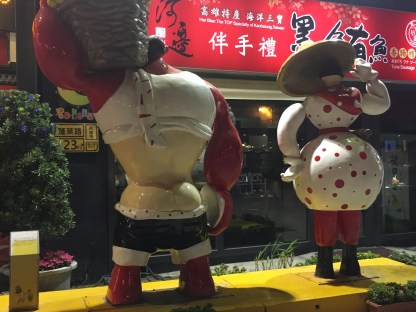
And it’s not just the buildings, but also the spaces around them. I was amused to see these fanciful sculptures outside one building, as well as the drawings of faces, made with rusty steel, which looked different as I moved around them. So art doesn’t have to look ‘beautiful’ … but it should provoke a reaction of some sort.


Some of these figures reappeared in several ways, sometimes huge in size, as the picture at the top of this blog shows. I loved them … looking slightly fantastical, and designed to amuse. They serve no useful purpose at all, except perhaps to entertain people (which they did, judging by the number of people photographing them – or giggling at them). Here are some more examples of the same sort of them, scattered around the area:


They seem likely to have been made by the same artist – I couldn’t tell, as any descriptions were hard to find and, anyway, written in Chinese. I loved them. I especially liked the big guy and the big lady (shown at the top of the blog), somehow adding a neat gender balance to the industrial world of warehouses and waterfront. To my surprise, the sculptures looked the same from the front and the back – which was a bit disconcerting – but why should they not.
Sometimes, art is intended to surprise, as it did in this case. Later on, I saw another example, which similarly amused me:
There were other sculptures around, too, each of which provoked me in one way or another. It was very hard to ignore things like these!


Some sculptures were less obviously anthropomorphic, but also caught my fancy. here are four examples:


The small train going under the huge sculptured objects looked like lots of fun … it ran around the precinct of a warehouse that housed a museum devoted to early sugar trains and was popular with kids – and not only little kids. When I was a lot younger, I used to think that paintings ought to look right (as in a photograph) and sculptures should be of something real, but that is not the case, of course. All of these provoked me, or jolted me in some way, which is presumably part of their purpose.
Some of the buildings too had become art objects, with elaborate murals or decorations of some kind, as the two examples below show. I enjoyed both of these.


Some of the local buildings are already artistic, in fact, such as the temple top and the huge gate below, both characteristically Chinese. Does something have to be in an art gallery to be ‘artistic’? Of course not.


Other building decorations were clearly designed to amuse or entertain, however, such as this mosaic built around a water outlet, which periodically came on (unexpectedly) to the amusement of whoever was passing by! The young boy was about the size of a 5 or 6 year old.

I hope that you don’t find this offensive, but I’m pretty sure that you won’t … as almost everyone who saw it when I was around found it amusing and in some cases, shrieks of laughter or giggles from children could be heard. The artist is having fun, and we are invited to share the joke.
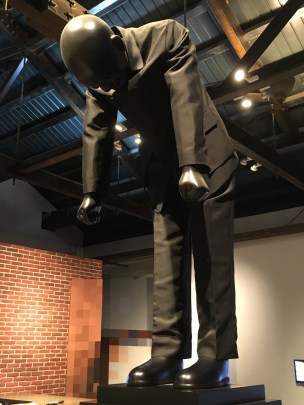
Similarly, this sculpture on a pedestal inside one of the buildings got me wondering about why sculptures never wear clothing … and also got me wondering what was under the clothing …
I am not sure which of the things I saw today were permanent and which were part of an art exhibition that just opened. And I’m a little embarrassed to not know the details of the artists, but it was not easy to find these. (I may know more when I return later. There are various art exhibitions available in the arts precinct, so I’m hoping to find time to see them.)
I thoroughly enjoyed my first afternoon in Kaohsiung, wandering around various works of art that had me wondering, admiring, liking, amused, excited, annoyed, puzzled, irritated, confused … and various other reactions. I have similar sorts of reactions to mathematics, by the way, which may account for why many of us regard mathematics as a form of art, too … except those who keep asking what ‘use’ it is.
As I wandered around the various art forms today, I hardly ever asked myself what ‘use’ anything was … so there’s a tale …

 Barry's travel blog