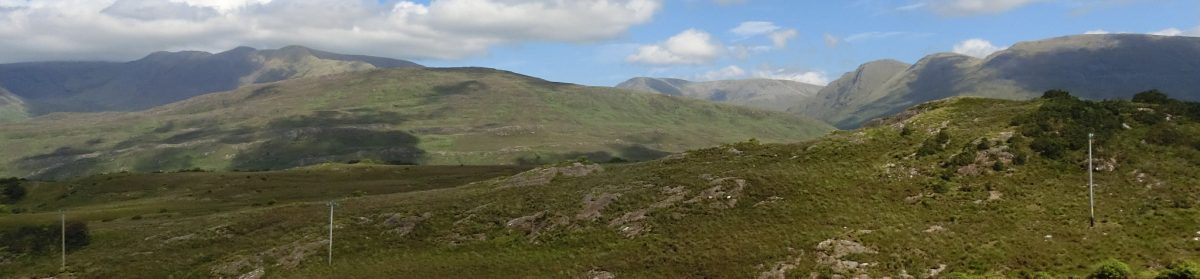
Growing up in post-war Australia, like many others, I was aware of a view that the countryside in Europe, depicted by the nineteenth century landscape painters, was ‘beautiful’, depicting mountains, lakes, ordered fields and greenery. There are many examples of these in our art galleries and even in travel brochures. It was not at that stage fashionable to see beauty in the Australian countryside, and those (like my mother) who described it that way were regarded a little strangely. We’ve changed, of course, now, and I hope these these few photos of a recent drive in Australia’s south-west corner show that we live in a beautiful part of the world.
One of the things I have found surprising in the northern hemisphere is that summer is associated with green, where I have always associated winter with green and summer with brown. At least in Western Australia, rainfall is almost entirely a winter affair, so that dry scenes like this farm in January are common in summer time:
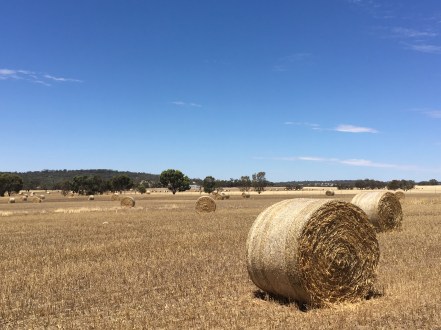
Driving in the populated south-west often is through farmland, but quite different from farmland in the UK or the USA, as the relative lack of rain here means that farms are much larger, so that it is rare to see a farmhouse and almost never can one see two different farmhouses at the same time.
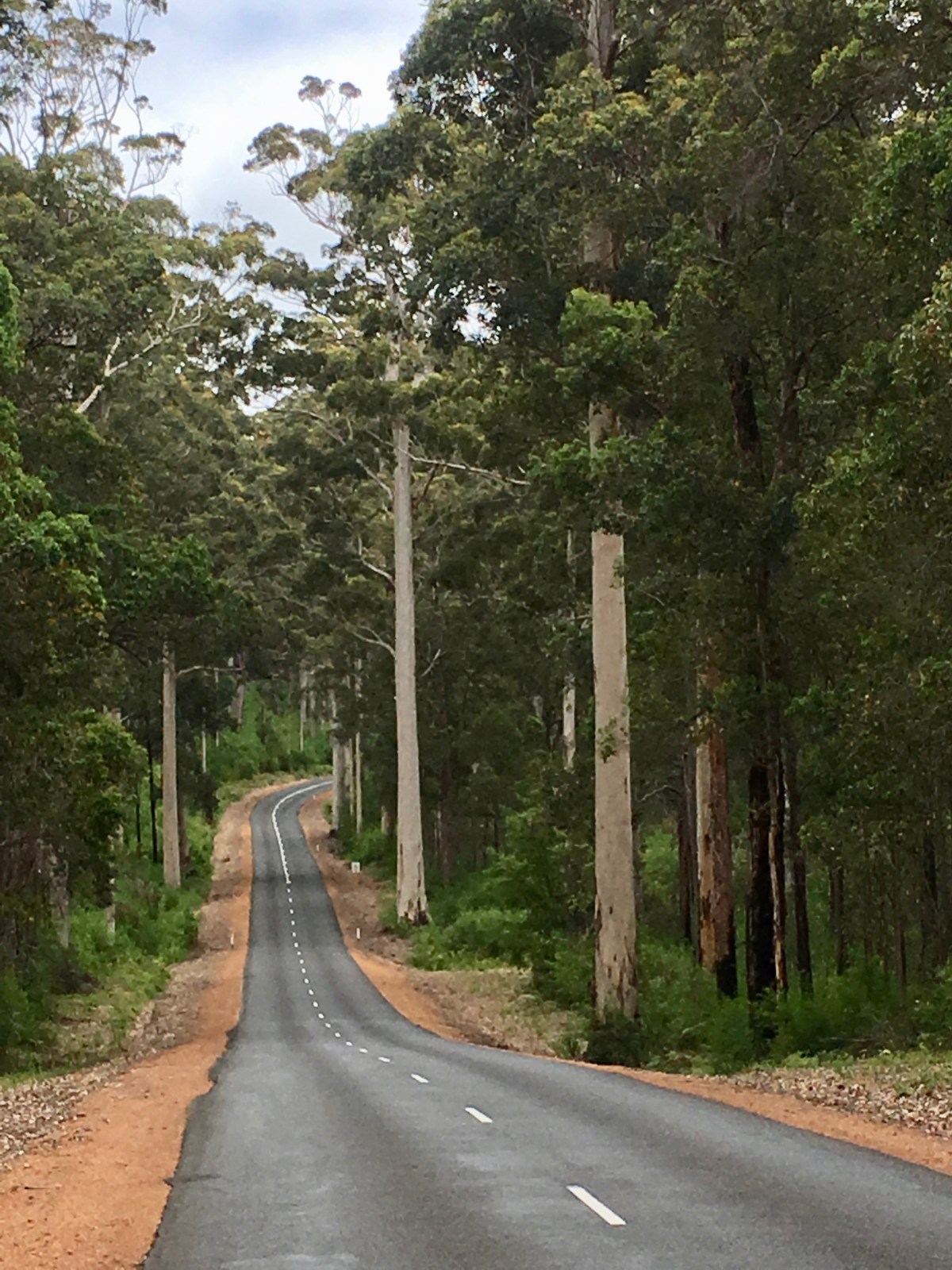
As the photo at the top of this blog shows, some country roads go through lovely (evergreen) forests. There is still a timber industry in our south-west, although increasing concern about the environmental consequences of cutting too much old growth forests for commercial reasons. Fortunately, it is still possible to drive through lovely forested areas like these:


While the roads look small, at least by international standards, they do not carry as much heavy traffic as in more populated parts of the world. The roads shown here are nonetheless the main highways in the area, and I drove a total of about 600 km on roads of this size. Not all of them drove through forests like these, however … many were in large flat spaces through farmland, from which trees have long since been cleared, as in the hay bale photo above. The small white posts on either side of the road are wonderful for night driving, making corners easy to see. I had not appreciated how useful they were until driving overseas in places that do not have them, and which are much less safe accordingly.
The forest (which is generally described in Australia as ‘bush’, not ‘forest’, explaining the title of this blog) is a rich ecosystem, with many native species there, when one looks hard enough. There are also many signs of fires, a serious problem for local inhabitants, but at the same time an important part of the process of regeneration of the bush for thousands of years. Balancing the needs of people and land is always tricky.


There are also fauna, of course, not shown here. One of the hazards of driving in our bush is the prospect of hitting kangaroos coming out of the bush across the road, especially at dawn or dusk. Such a prospect is quite dangerous, often because people swerve to avoid hitting the animals, and lose control of their vehicles, in the worst cases hitting other things like trees instead. Indeed, many local residents have a ‘roo-bar’ on their vehicles to minimise risks.
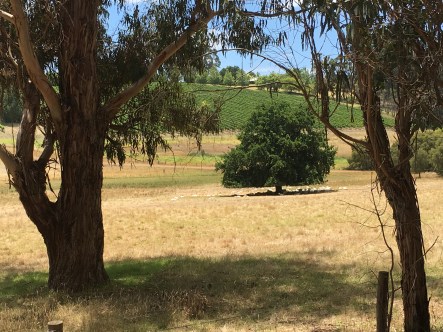
Away from forested areas, some farmland scenes are also attractive, such as this one near Pemberton, showing grape vines and sheep (resting under the tree) as well as some trees that have escaped clearing for grazing of animals. There are about three sheep in Australia for every person, which might account for our national dish – if there is one – to be sometimes described as roast lamb; it also accounts for the phrase from an earlier time that ‘Australia rides on the sheep’s back’, referring to a once very important wool industry.
The south-west of WA is justifiably famous for its flora, with thousands of examples of indigenous plants (here called ‘wildflowers’) that are unique to the area. here are a couple of examples:


A walk in the forest at any time of the year will reveal many examples of these kinds, if one looks hard enough (in summer, especially); it is not necessary to look too hard in some places at other times, where the countryside is covered in flowers. Even when flowers are not evident, the bush has some spectacular indigenous plants, perhaps none more so than the widespread (and spiky) grass trees shown here:

Driving in the country is not restricted to farms and forests; it also can involve the lovely oceanside. Western Australia’s coast is more than 20 000 km in length (around 13 000 miles), most of it uninhabited. Most of the coastline borders the Indian Ocean, although the south coast is regarded (by Australia) as bordering the Southern Ocean, separating Australia from Antarctica.


The wind farm shown above comprises the turbines shown and provides about 80% of the electricity needs of Albany, a major town at the bottom of the state. It overlooks a lovely stretch of coastline. In fact, the whole coastline is lovely, but in changing ways. In many places, there are hundreds of kilometres of pristine beaches, unlike the photo above that shows hills and rocks. The citizens of Western Australia (most of whom live near a beach) have long taken our beaches for granted, thinking (mistakenly) that beaches are like that all over the world.
This blog has shown no people at all, although there are signs of their presence, with roads, farms, vineyards and turbines. But rest assured, there are people here as well. The population density of Western Australia is around one person per square kilometre, but it varies greatly between Perth and the rest of the state. The density of greater Perth (in which there are about 2 million people living) is about 315 persons per square kilometre, while that of the rest of the state is about 0.2 persons per square kilometre, or about one person for every 5 square kilometres (roughly one person for every 2 square miles). So people are pretty thin on the ground, but you will find them friendly to talk with when you come here.
I’ve deliberately kept this blog short, with just a few photos, to induce you to come look at the bush for yourself and get the bigger picture.
I hope you can make it soon!

 Barry's travel blog
Our countryside in WA is very unique and different from other states, varying vastly as one travels our state, it has a beauty of its own. Guess growing up in the country gives one a different view of it with a father who was a real bushy, having spent his early childhood at Kinchega, NSW
LikeLiked by 1 person
It all looks lovely and reminds me if our trip ‘down south’ all those years ago. I remember the wind turbines in Albany.
LikeLiked by 1 person
This is my second go at a reply.
A wonderfully descriptive blog,Barry. I felt like I was on the ride with you.
I too grew up with the notion that our bush was harsh and ugly but now I see it through different eyes.
I think Dorothea said it all!!
I love a sunburnt country ,
A land of sweeping plains
Of rugged mountain ranges
Of droughts and flooding plains .
I love her far horizons
I love her jewel seas.
Her beauty and her terror
This wide brown land for me.
Love your writing
Keep up the blog. Xx
LikeLike
Thanks Gen. Yes, I agree on the wonderful poem, too. So evocative and somehow more powerful now than it was when we learned it as kids! Xx
LikeLike