Sculptures in Rome

I loved my visit to Rome last year (2023), but didn’t record anything of it in this blog. So I thought I would just reflect a bit now (a long time later) on the extraordinary number, variety and quality of statues in the city, both inside museums and in the open air. I have just chosen a small sample of the very many statues I saw and the large number of them I chose to photograph to remember later.

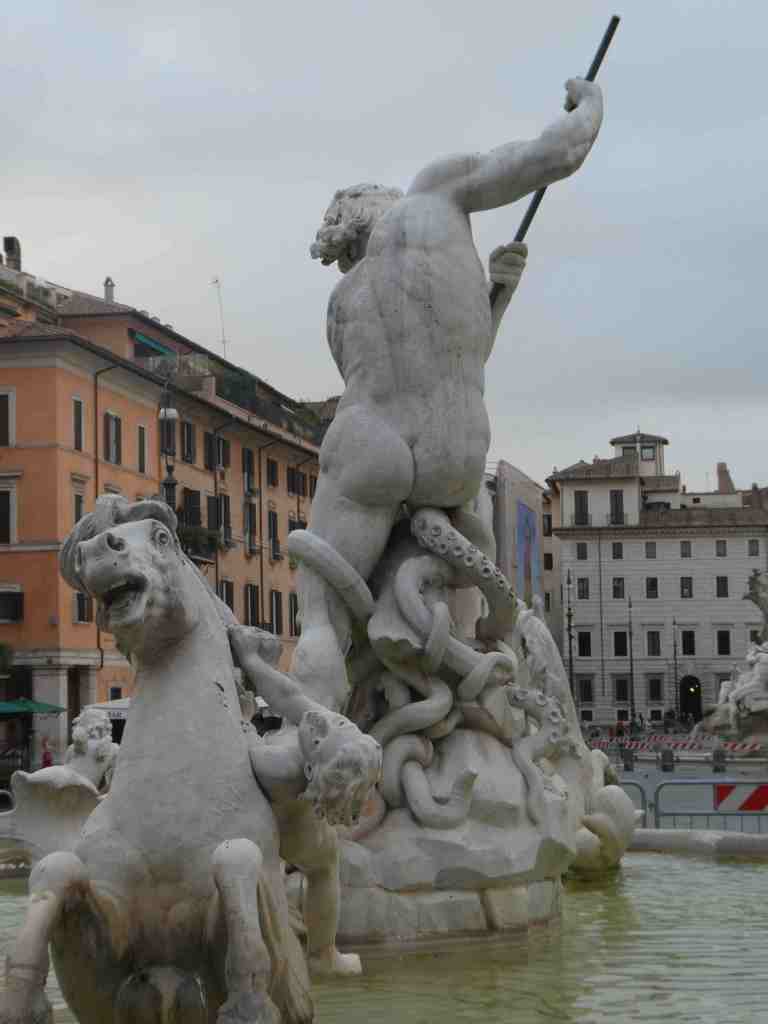
When I arrived in Rome, my first stop was the wonderful Piazza Navona, which I had remembered from my first visit some thirty years ago. It’s still a wonderful place, and all the more so because of the wonderful set of three large statues in the piazza:

These are so full of life, so it’s no wonder that they are usually being photographed by lots of tourists. Bernini’s masterpiece of the Four Rivers (on the left) has the papal symbol (of keys) just before the obelisk above it.

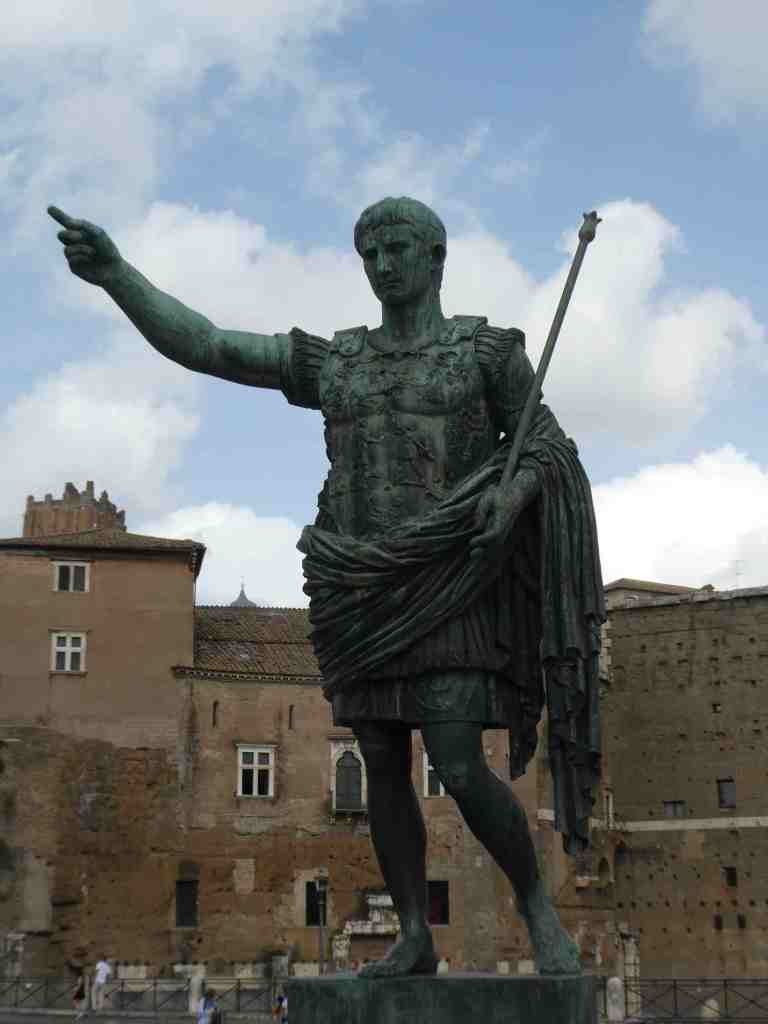
As a reminder that Rome has been a major centre for two millennia are the statues around the Roman Forum, an ancient set of ruins right in the middle of the city. These two statues of Roman emperors overlooking the Forum have stood the test of time, out in the open and subject to the weather ever since, yet still manage to project the power of Imperial Rome:
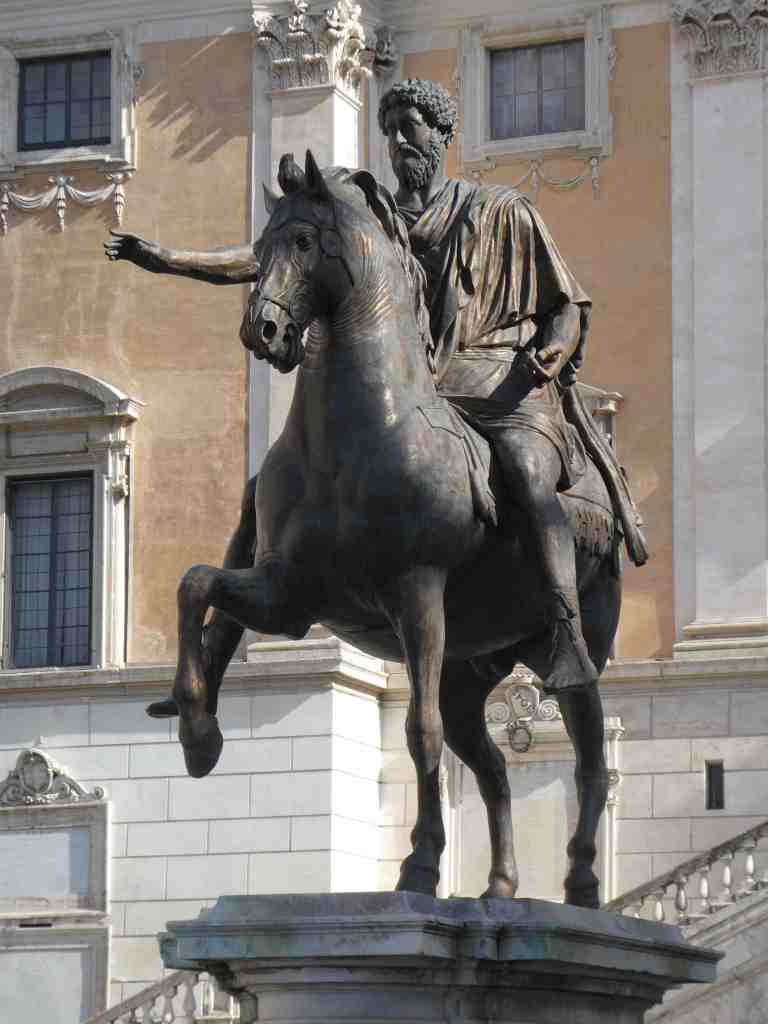
Weathering is of course a problem with old statues, and a good example is the statue of Marcus Aurelius, from about 180 AD shown at the left below. The statue has now been moved inside the Capitoline Museum (into its own climate-controlled room) and a replacement has been put outside in the weather (the middle statue below). Inside the museum is also an ancient statue of the mythical she-wolf suckling the twins Romulus and Remus, mythical founders of Rome. The statue is from about 500 BC, but the twins were added later in the fifteenth century. (You’ll need to click on int to see it all).

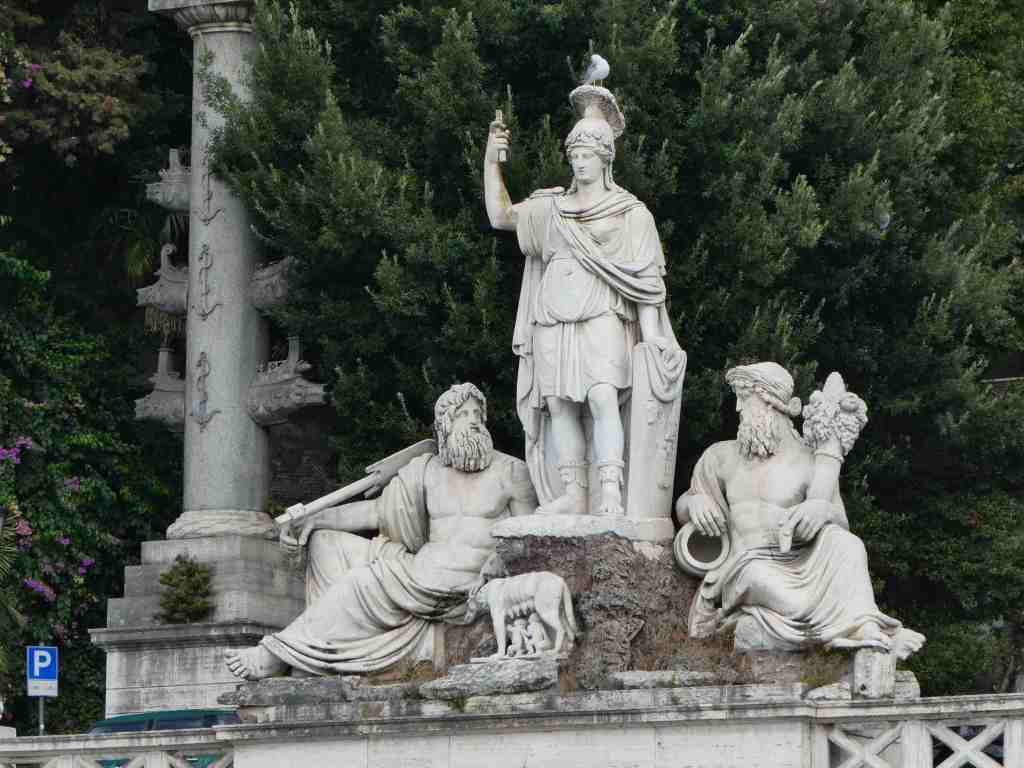
Also outside is the statue set from Piazza del Popolo, overlooking the large square below, in which there is often a market of some kind, and there is a large number of statues of saints on top of St Peter’s Basilica in the Vatican overlooking the huge square below. I’m not sure which of the saints is shown on the middle below, although I guess someone has a list of them all somewhere. The other statue with a boat-load of pilgrims or refugees is also from St Peter’s Square, but is of much more recent origin. (It was easy to see the statues in the square because the queue to get into the Basilica was very long, as you can see by clicking on the boat).
Another example of weathering is the set of statues shown below, in Hadrian’s Villa in the hills outside Rome. (Hadrian was Emperor in the second century AD, when the wall in his name was erected in northern England to keep the Scots at bay). The villa is huge, sprawling over a large area, and included what must have been a wonderful pool many centuries ago, with lots of statues around it, some of which are shown here.

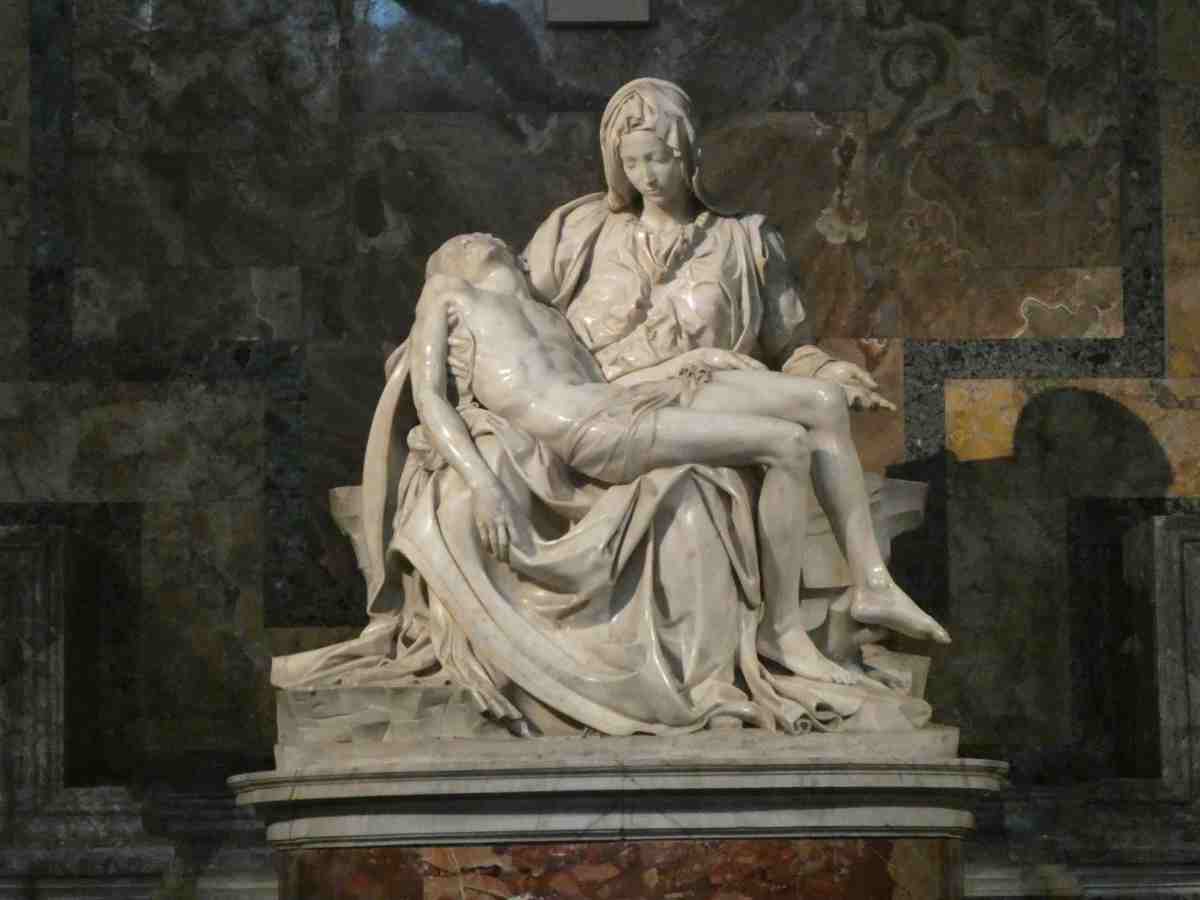
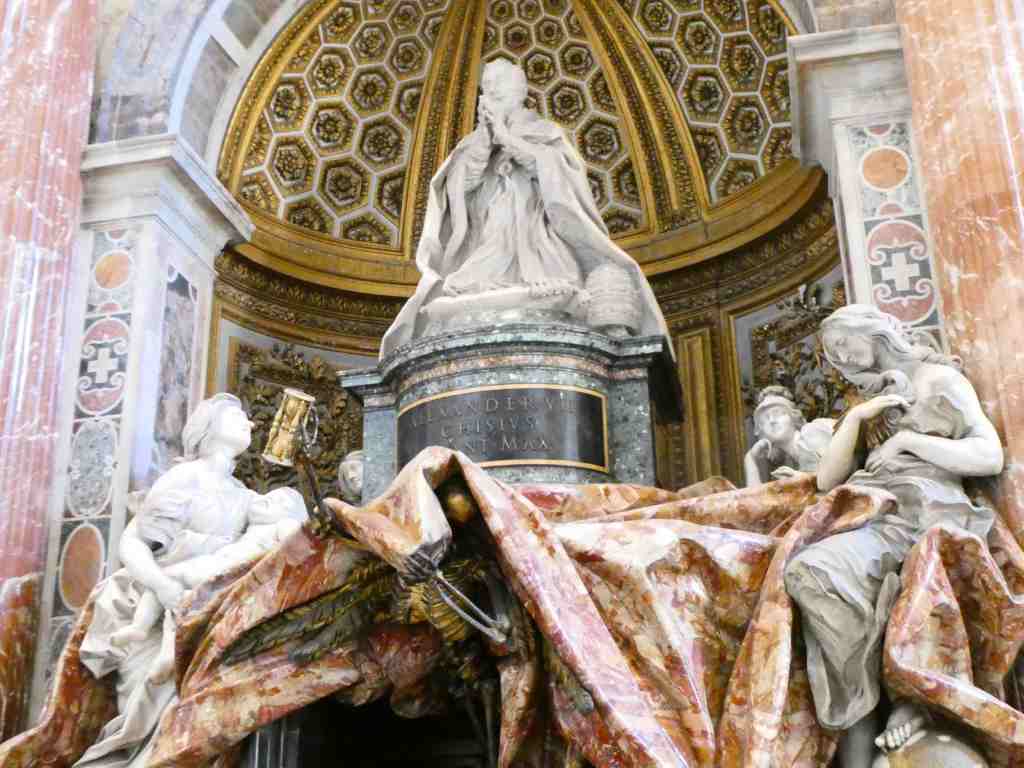
Of course, there are many wonderful sculptures inside buildings, such as the 13th century bronze statue of St Peter himself below and the wonderful Pietà of Michelangelo shown at the top of this post. The Pietà was damaged some years ago (by a crazed Australian with a hammer) and so is sadly behind a plastic shield, but still looks magnificent. It is one of the main drawcard of the basilica in fact and always has a very large crowd of amateur photographers in front of it – unsurprisingly; it is a magnificent work. The other sculpture below by Bernini caught my eye because of the extraordinary folded ‘carpet’ at its base (but the carpet is made from marble not from cloth!) How clever!

And, speaking of Michelangelo, another wonderful statue of his, in much dingier surroundings, is his statue of Moses as part of a large papal tomb, located in a relatively drab church in Rome … St Peter in Chains. I gazed on this for a long time, wondering how any body can be so clever. It almost seemed like Moses was alive, in part because the church had arranged a beautiful illumination to come on periodically.

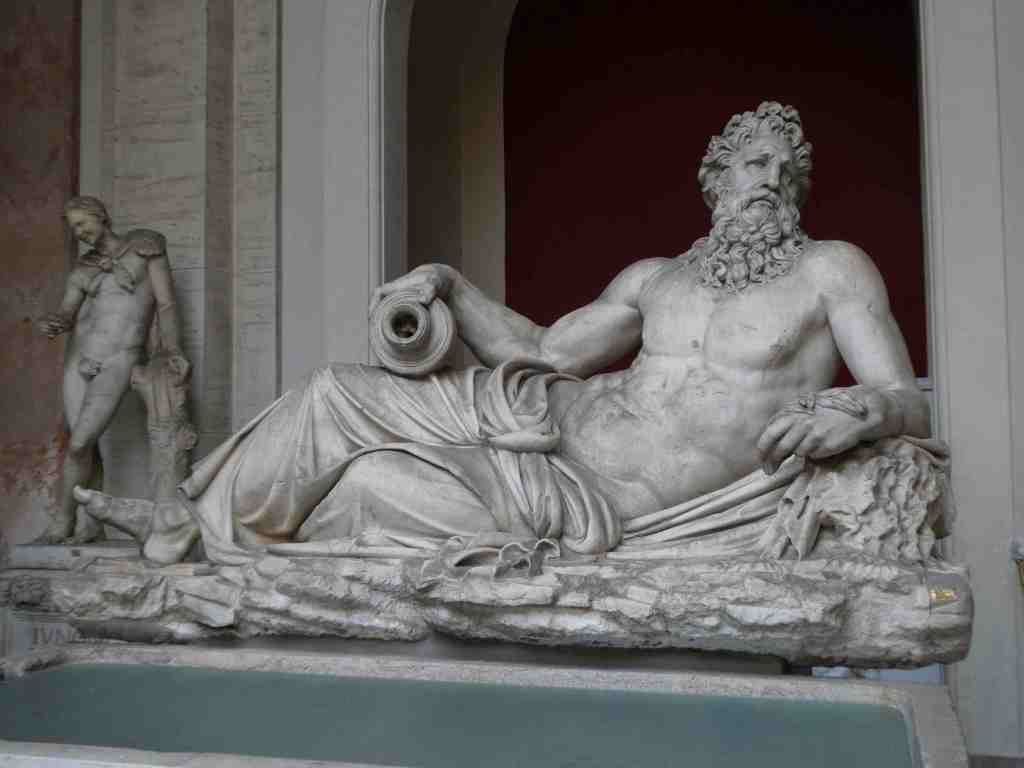
There are lots of statues of Moses in Rome, several like the reclining version shown below, which is in the (extraordinary) Vatican Museums. This was a very large statue, much larger than life-size.
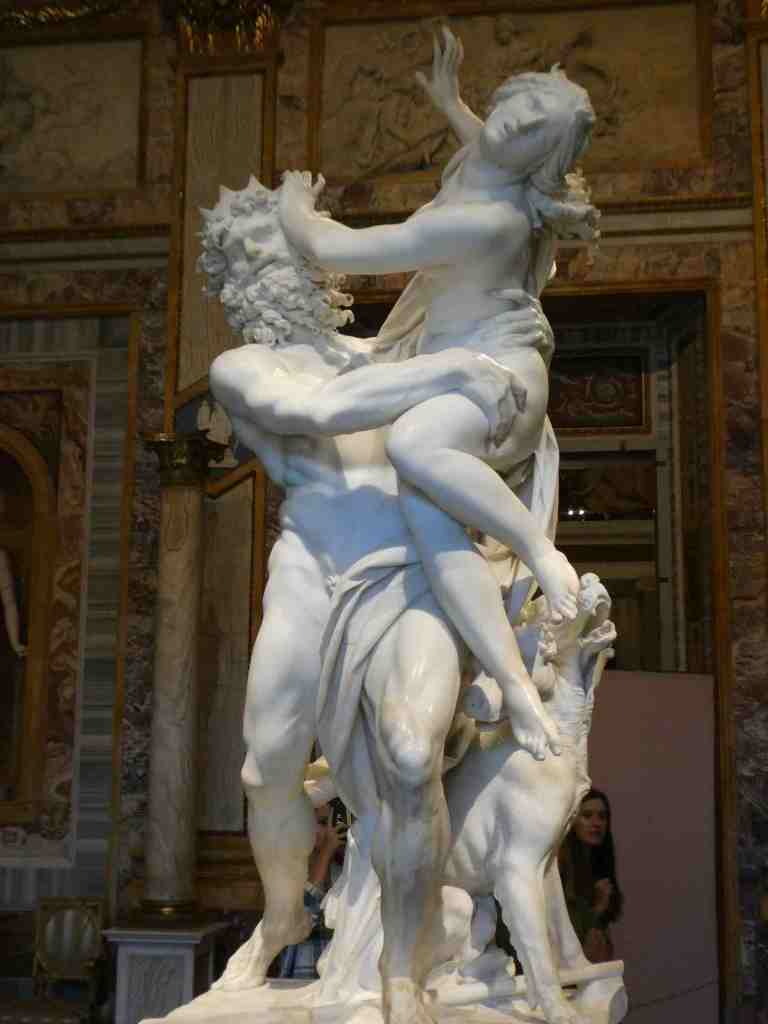
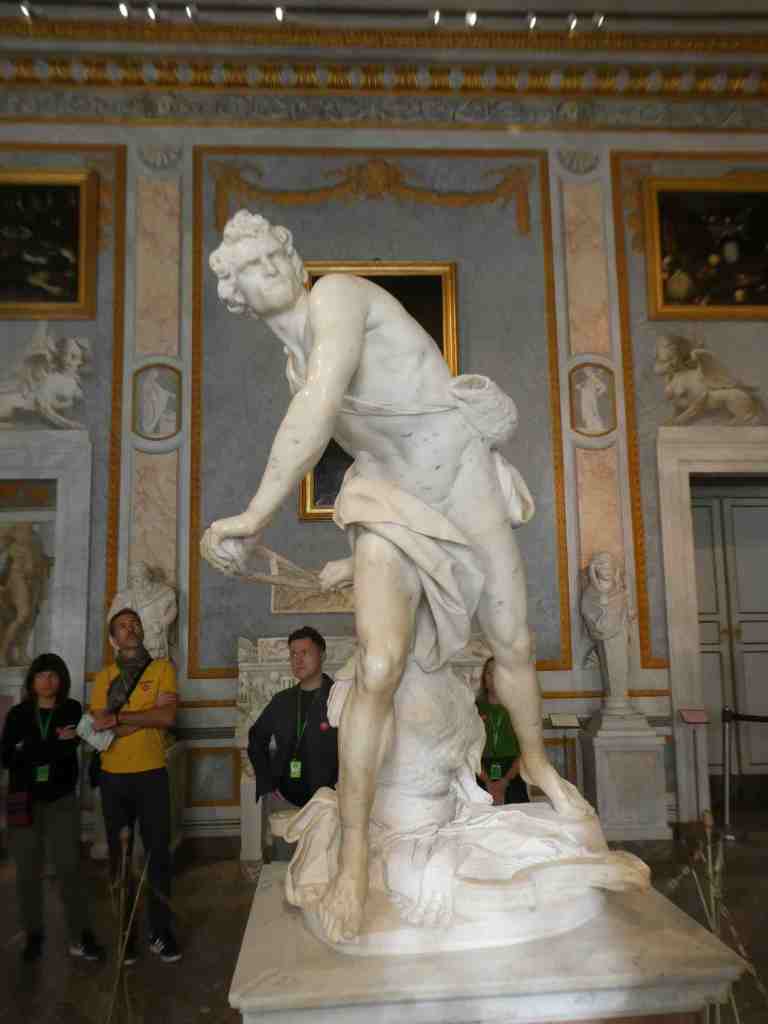
My trip to Galleria Borghese was a highlight of my trip to Rome, with some stunning sculptures on display, none more moving than the two shown below. There are several statues by the baroque master, Gian Lorenzo Bernini, in the gallery (as Cardinal Borghese was a big fan and a patron, think) and the sumptuous setting adds to their effect. The two statues below stopped me in my tracks. Bernini’s statue of David is different from Michelangelo’s David (in Florence), but just as compelling.
Also in Galleria Borghese its the beautiful statue by Canova of Paolina Borghese, who was Napoleon’s sister. It almost seems real and I expected it to move.

Finally, one of Rome’s most popular tourist attractions is the wonderful Fontana di Trevi, hidden away in a back street in the centre of the city (but easily found because of the throng of tourists and tour groups and people selling things). It’s not easy to take a photograph of it without a very large number of tourists in the picture, in fact. It is a lovely work, justifiably famous.

Of course, I threw a coin into the fountain, hoping to return some day …

Opening of Boorloo Bridge

Boorloo is the Nyoongar name for Perth, Western Australia. (The Nyoongar people are the traditional owners of the land in the south-west corner of Australia, who were here for around 60 000 years or so before the British colony was founded in 1829). So it is fitting that the new pedestrian/cycling bridge across the river, which opened today, is named after the city. I am of course pleased that public funds are being used for a pedestrian bridge, rather than further freeway extensions in this city, which is dominated by cars, so decided to attend the public opening ceremony today, despite the excessive heat.

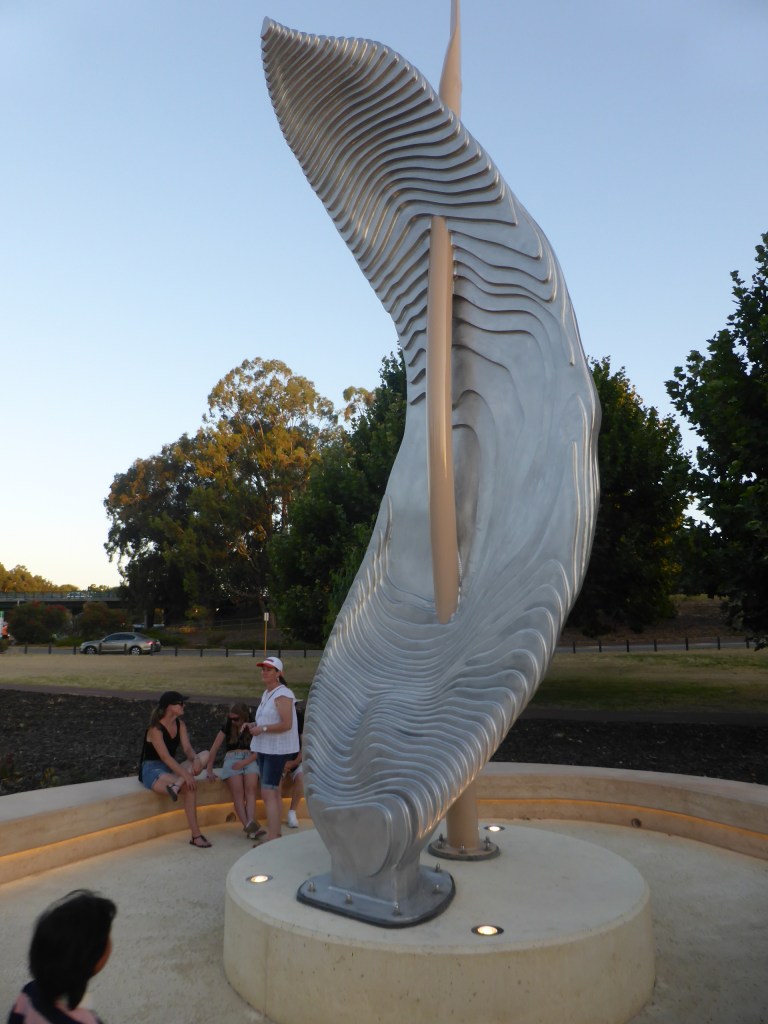
I arrived shortly before dark, to avoid the heat, and the first thing I saw was a sculpture depicting traditional objects – a digging stick (wanna) used by women and a booka (a cloak generally made of kangaroo skin). The first part of the bridge has very large versions of the wanna holding up cables, as you can see:

The bridge goes over what has always been called Heirisson Island as long as I can remember, although very few local people seem to know it was named after an obscure and otherwise insignificant Frenchman on a scientific mission up the Swan River around 1804 (well before the British arrived). A long time before that, in 1697, a Flemish explorer, Willem de Vlamingh, got as far up the Swan River as the islands, but no further. Little surprise that the area was known to the local Nyoongar people as Matagarup (which means ‘one leg deep’), which accounts for Vlamingh’s lack of progress I assume. [Probably a major reason for the British colonisation in 1829 was to make sure that they did so before the French, or even the Dutch.]

The island has had a chequered history, including recent Aboriginal protests, and most Perth people have never been on it. (I have been on it several times n recent years, however). A traffic Causeway across the island was critical for many years in the colony before the Narrows Bridge and the Freeway were built in 1959, finally providing a link between north and south of the river. Prior to the Freeway construction, southern suburbs like South Perth and Como (where I live) were hard to reach efficiently from the city and even regarded as a long way away by many people north of the river. The new bridge provides a link for pedestrians and cyclists, who rarely use the Causeway, and will allow people to easily, and pleasantly, walk or cycle around the entire Swan River area adjacent to the City.

I was pleased to see free drinking water stations available for the event, as most people these days carry a water bottle. The temperature had cooled down to about 37 C (from an earlier unpleasant maximum of 41 C) when I arrived around 7 pm.

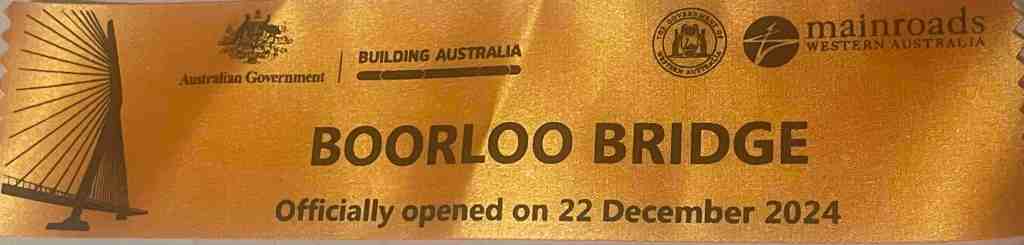
As well as a welcome drink of water, I picked up the commemorative banner of the occasion:


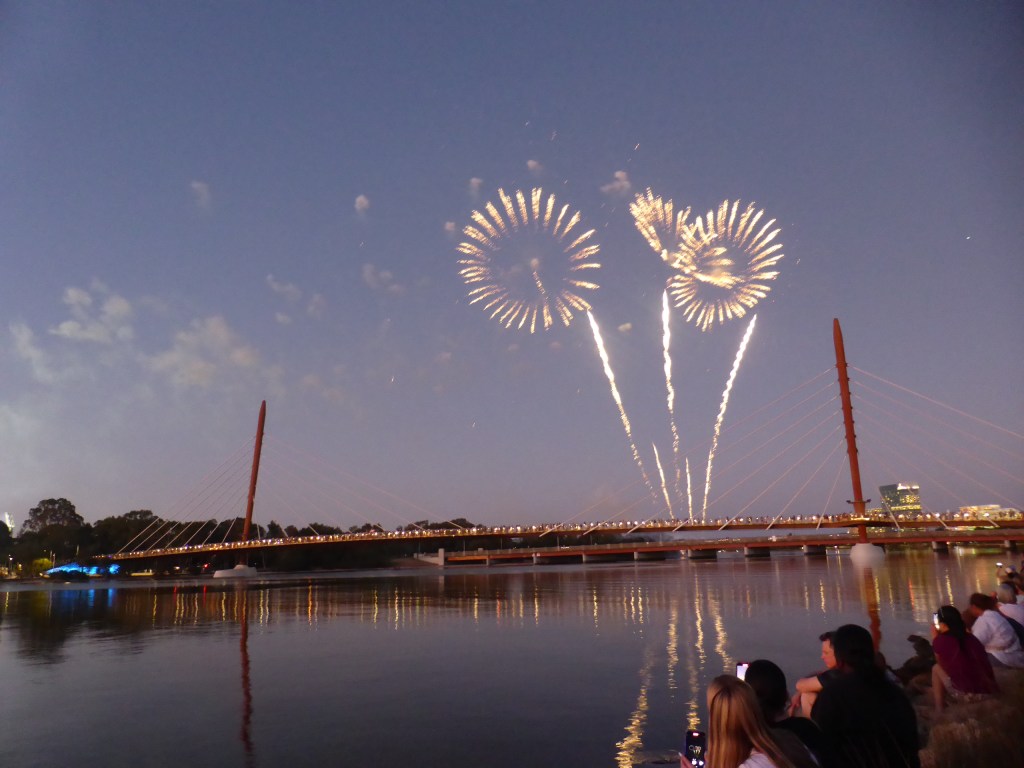
As the sun set, the bridge was opened with a fireworks display, appreciated by the crowd of picnickers assembled, including me. I’m not very good at photographing fireworks, but here is a sample of them to give a flavour of it. Clicking the mages will give you a better version, I think:

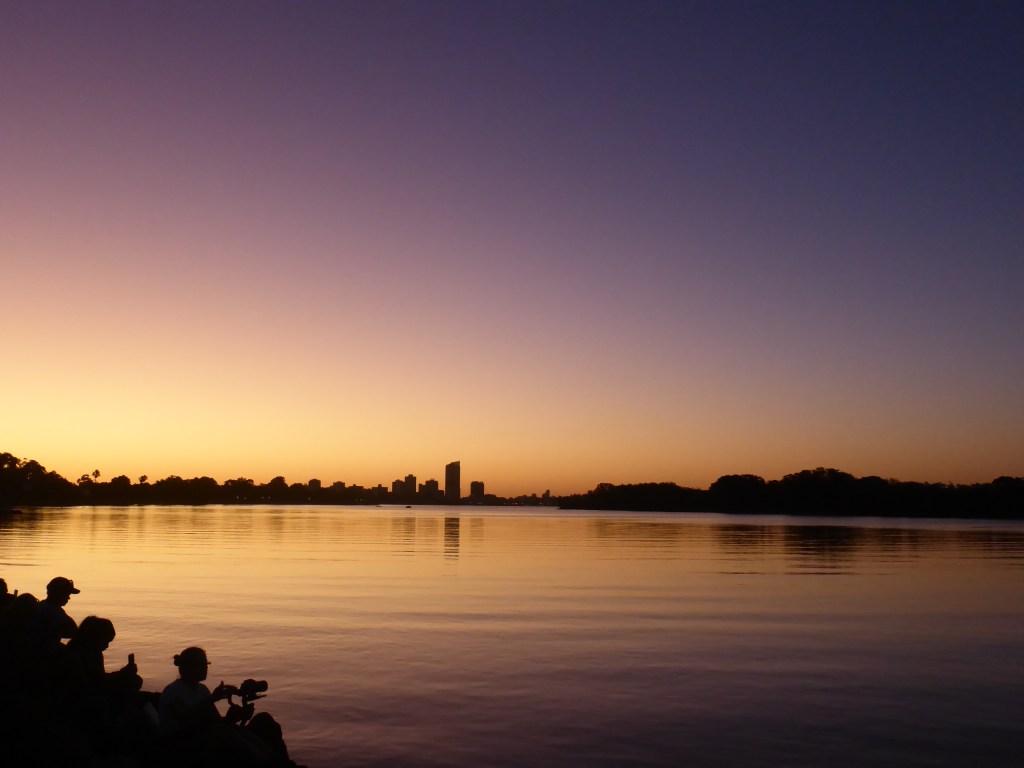
The fireworks distracted us a bit from the glorious sunset in the other direction: you can see the South Perth foreshore in the distance, with its new high-rise building sticking up. (The City of Perth is a bit right of this picture, and not shown here.) Beautiful colours … and expectant photographers waiting for the fireworks to start.

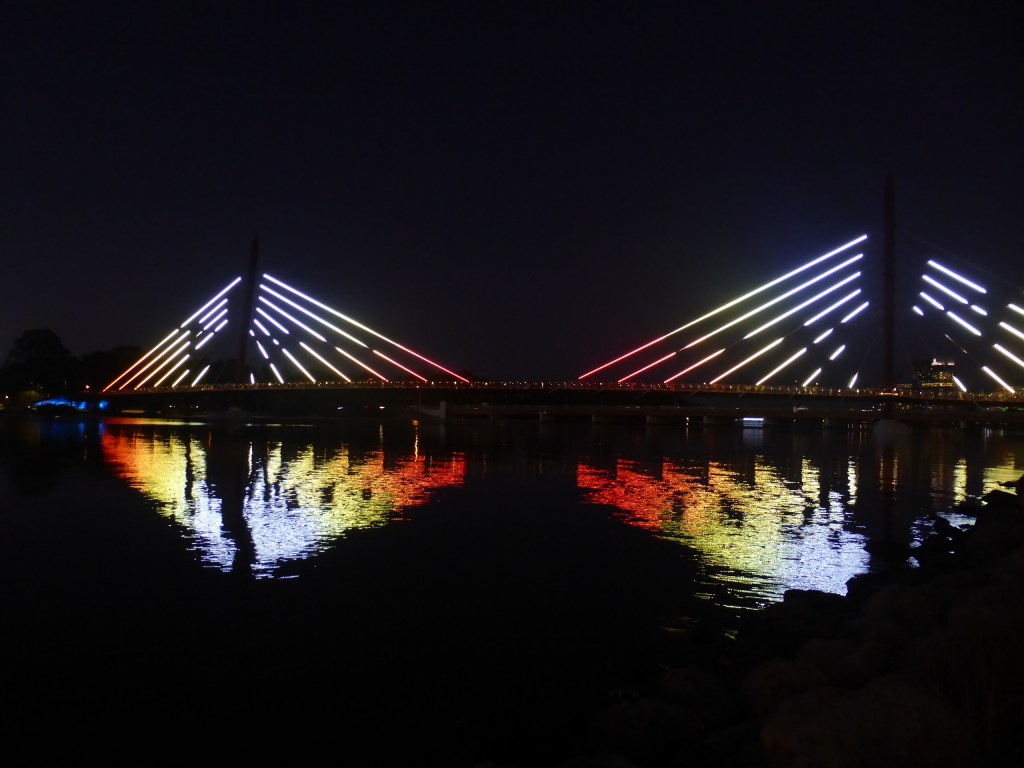
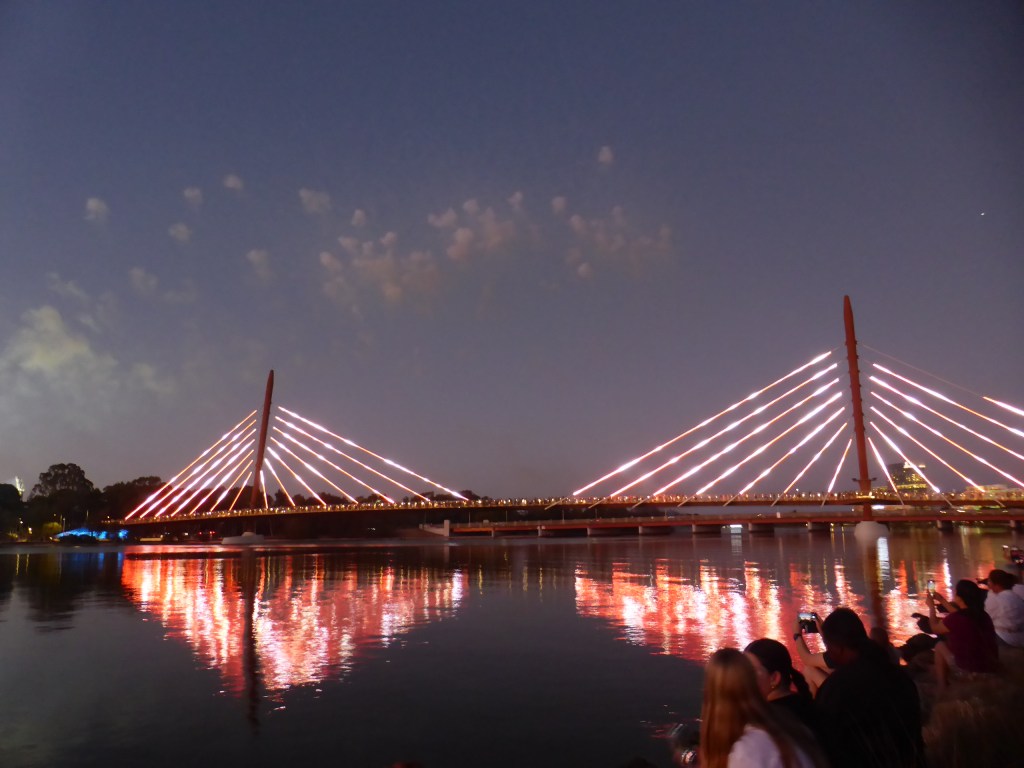
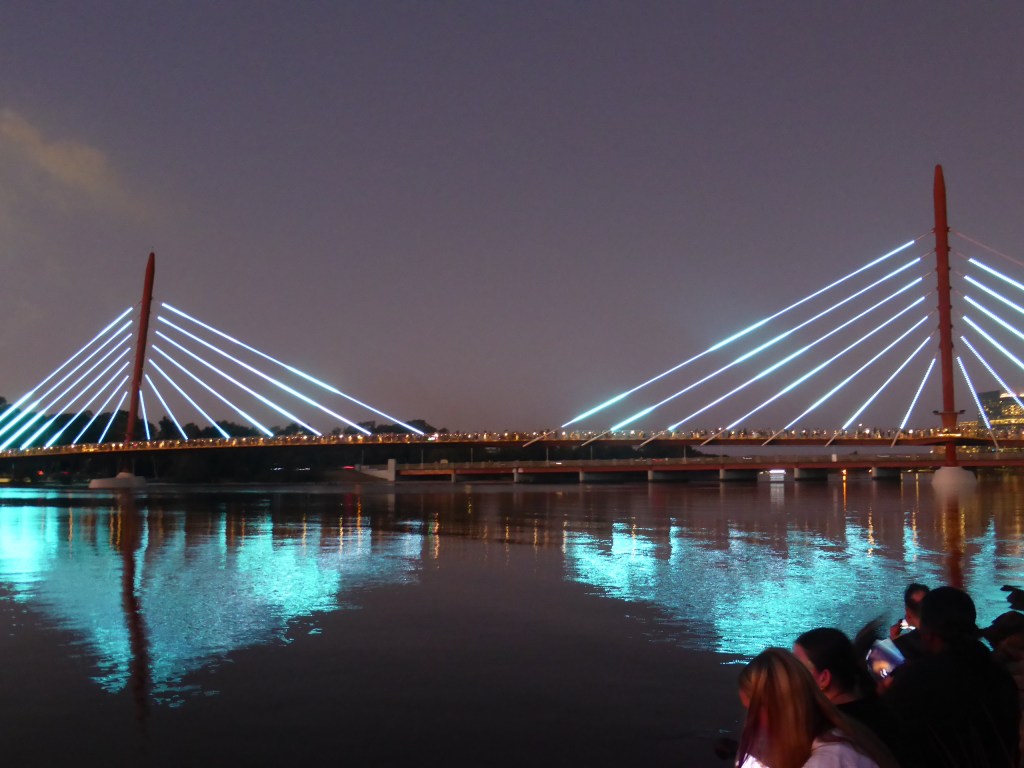
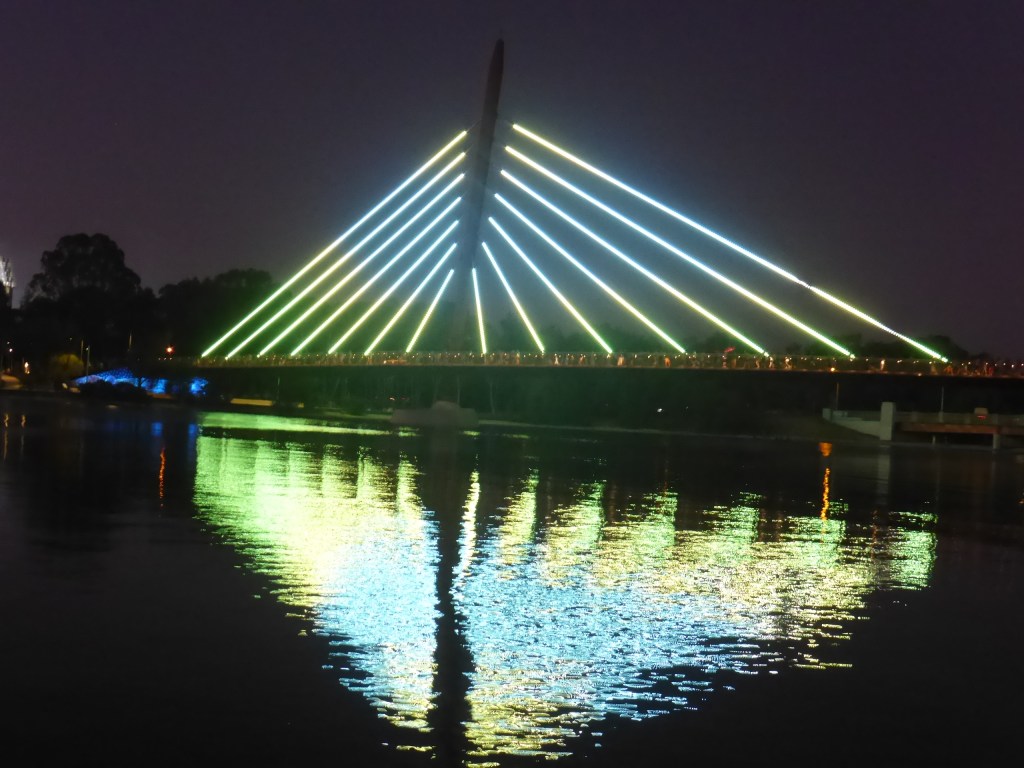
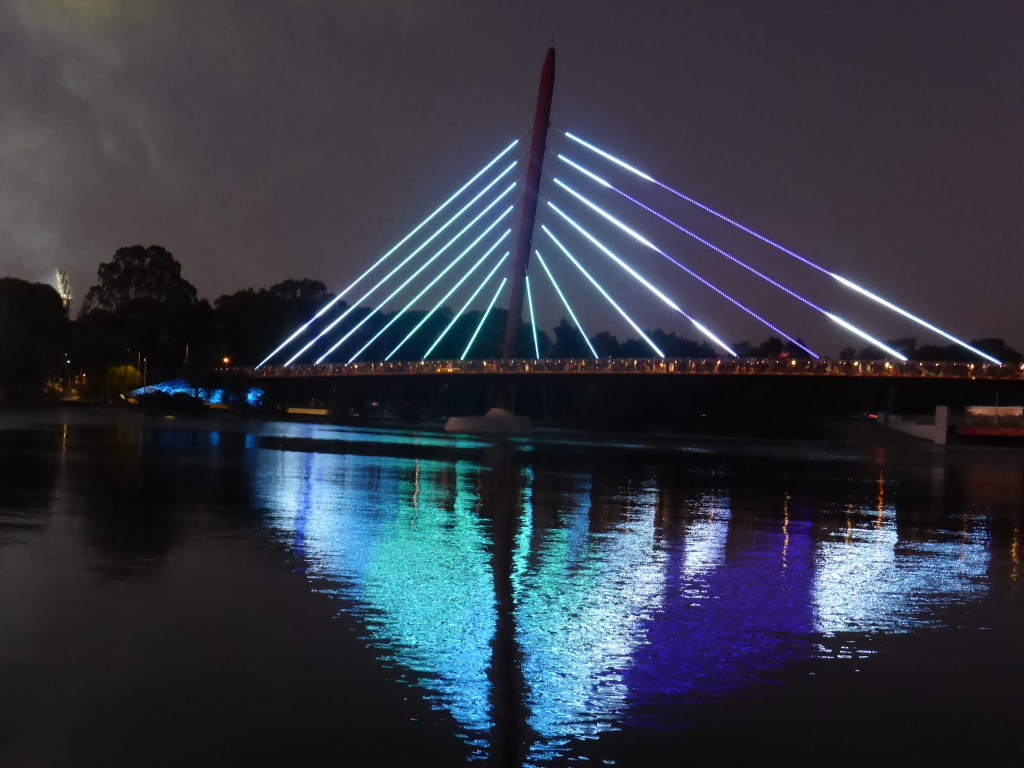
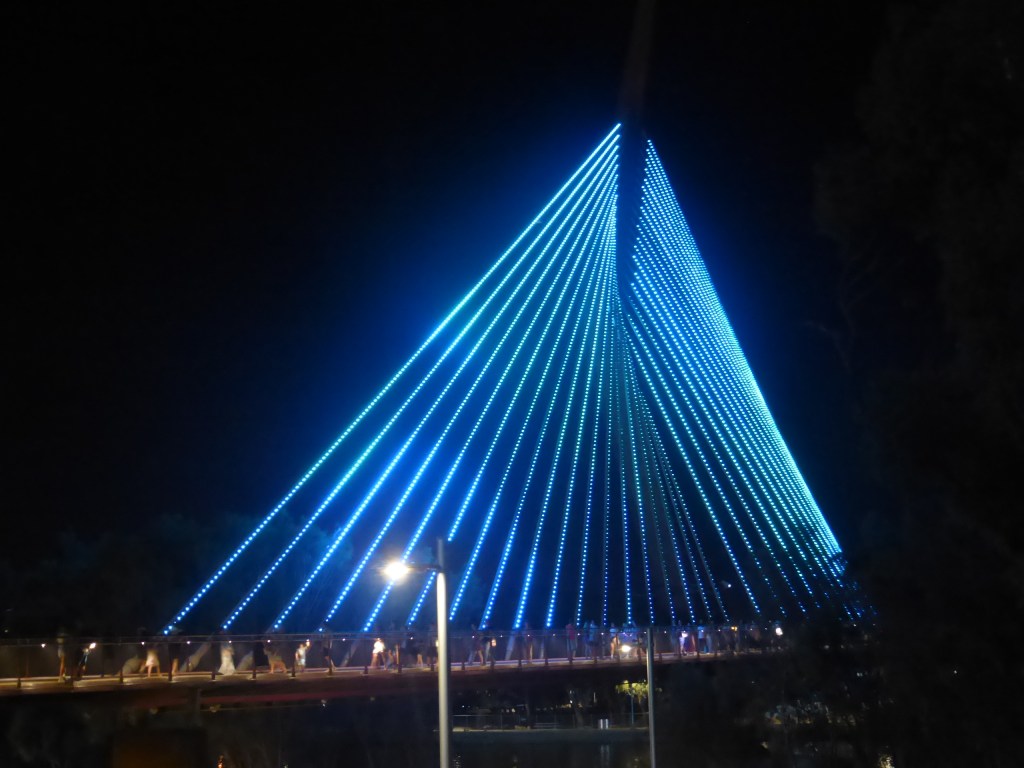
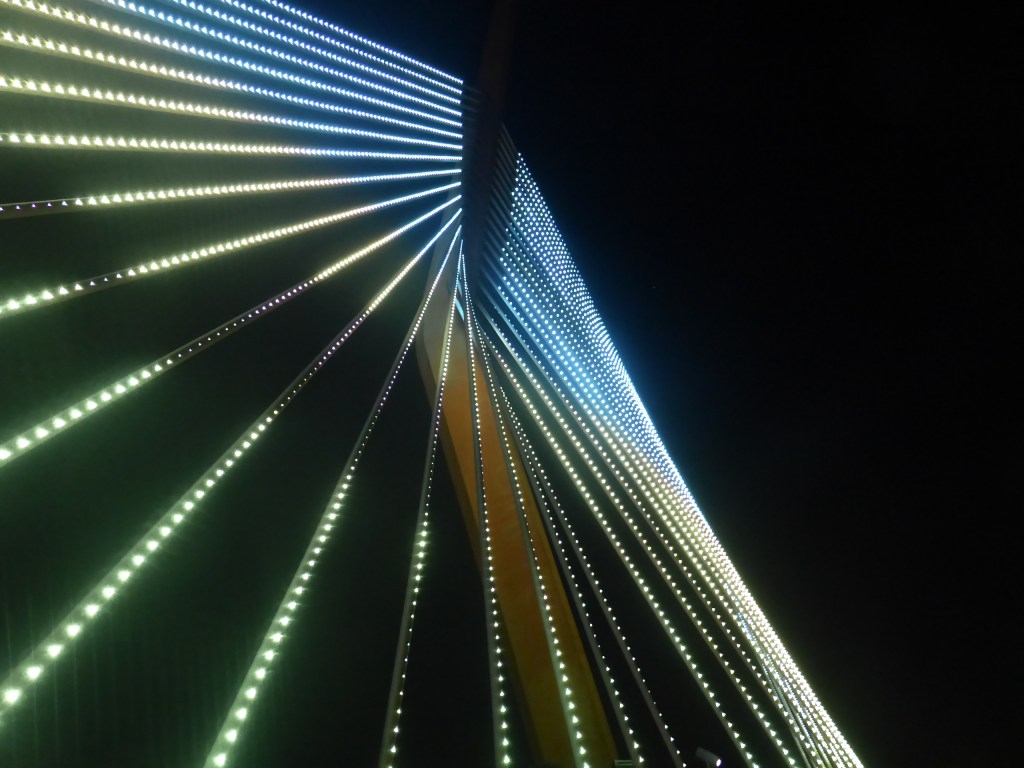
After the fireworks, we were treated to a lovely display of lighting on the various parts of the bridge. There are small LCD lights in the cables, which can be programmed in various ways to create lovely effects. (We are accustomed to this sort of thing with the Matagarup Bridge linking the Perth Stadium to the other side of the river.) Here is a sample of the lovely effects:

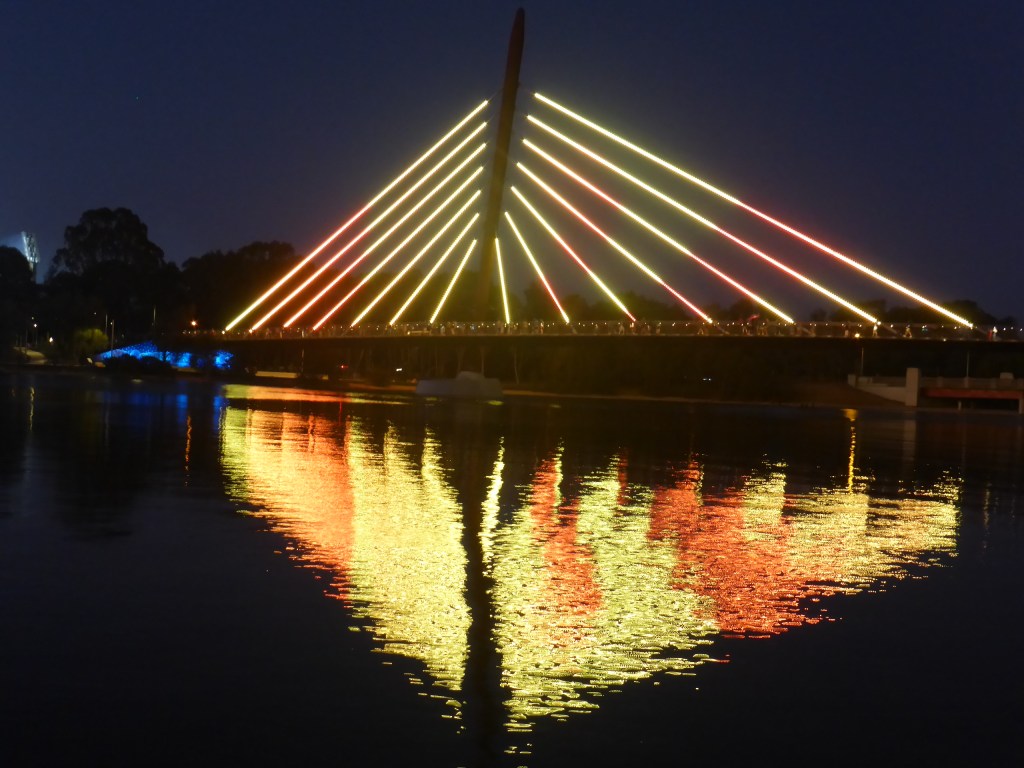
Here are a few more examples of just one part of the bridge, like the one shown at the top of this post, showing how the lighting system can create some lovely effects, helped along by their reflections of course.

I walked across the bridge, of course, along with others, and enjoyed doing so as well as seeing the second part of the bridge, linking Heirisson Island to the north bank of the river. Where the first part of the bridge has two vertical struts, the second has only one, in the shape of a boomerang (not very clearly photographed here, I’m afraid, although much clearer in daylight). Also not clear is the way in which there are some native animals (such as kangaroos, fish, reptiles, … ) depicted as moving shadows in the lights. If you’re ever in Perth, check these out for yourself, as they exceed my photographic capabilities to show well.
There were various other artistic works associated with the bridge, and several plaques helping people interpret these as well as to learn a few words of the Nyoongar language. The traditional owners have of course been carefully consulted throughout the project and I hope that these will help with ongoing efforts to increase recognition of (all) of our heritage. Here are some examples:

Despite the heat, I was pleased that I was there at this historic time. I’m sure that I will make good use of the Boorlo Bridge, as will others, and am pleased that it is finally finished. I have walked right around the river (called Perth Water locally, or Derbal Yerrigan to Nyoongar people) several times, and have never enjoyed the Causeway bit; that has now been fixed. Of course, it is expected that cyclists will also use the bridge to get to work in the city or for leisure (as they already do at the other end, via the Narrows Bridge), so I think the bridge is a good investment of government funds, both state and federal. Hopefully, it will help to encourage people to get out of their cars a bit more and enjoy their beautiful city a bit more.

Finally, the picture below on the bridge deck says welcome (Kaya) to Perth (Boorloo) and also shows our native symbol of a black swan (ironically shown here in white light!).

Welcome to Boorloo Bridge!

Araluen

Araluen Botanical Park is in the hills outside Perth, and has long been a popular place for locals to enjoy, especially in springtime. Most people associate it with the tulips planted there, but there are many other flowering plants as well, and some nice picnic spaces. Araluen has its own micro-climate making it a good place to grow tulips, which generally would not survive Perth’s warm Mediterranean climate. I visited the park – as I have often done previously – and enjoyed meandering around it. It was towards the end of the annual Tulip Festival, but there were still many beautiful specimens on display. The park was originally privately owned; however, when the owner was contemplating selling it (and it might then have become a housing estate), the Western Australian government purchased it so that it can be permanently a park. A small army of volunteers is responsible for the annual planting of tulips.

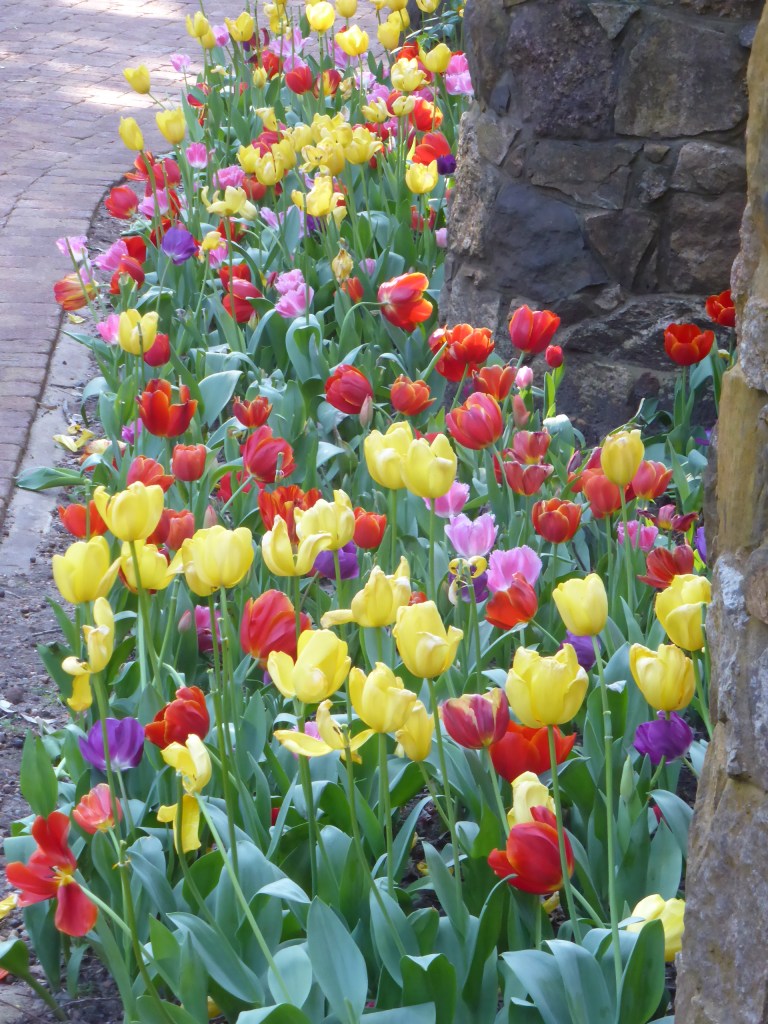
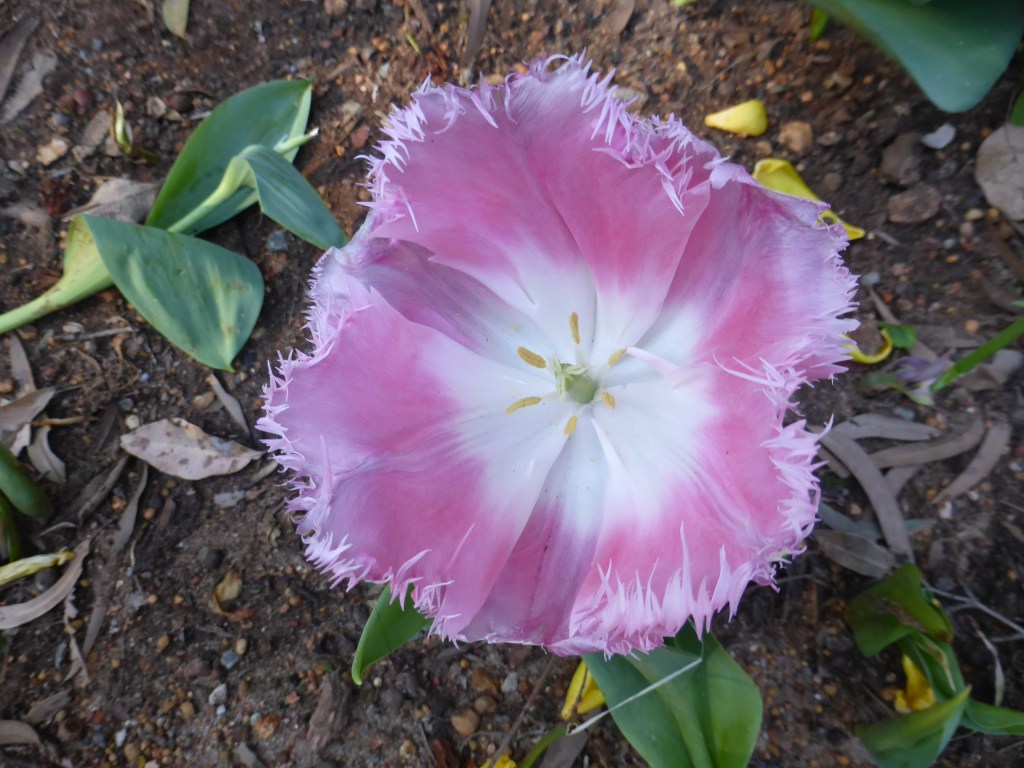
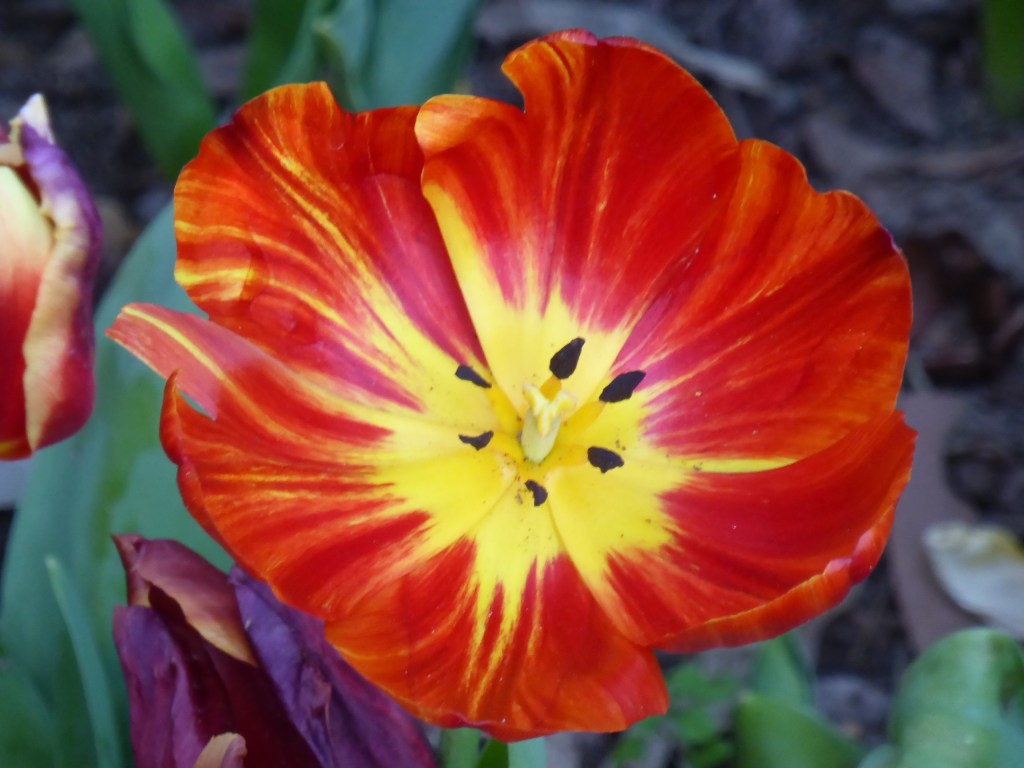
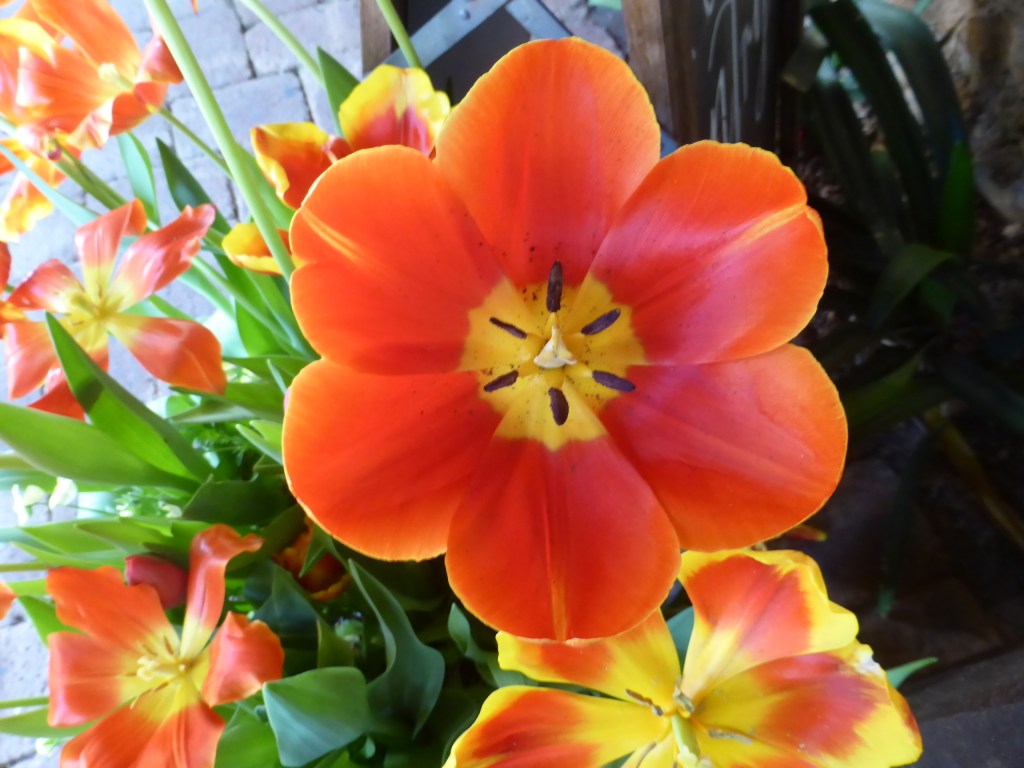
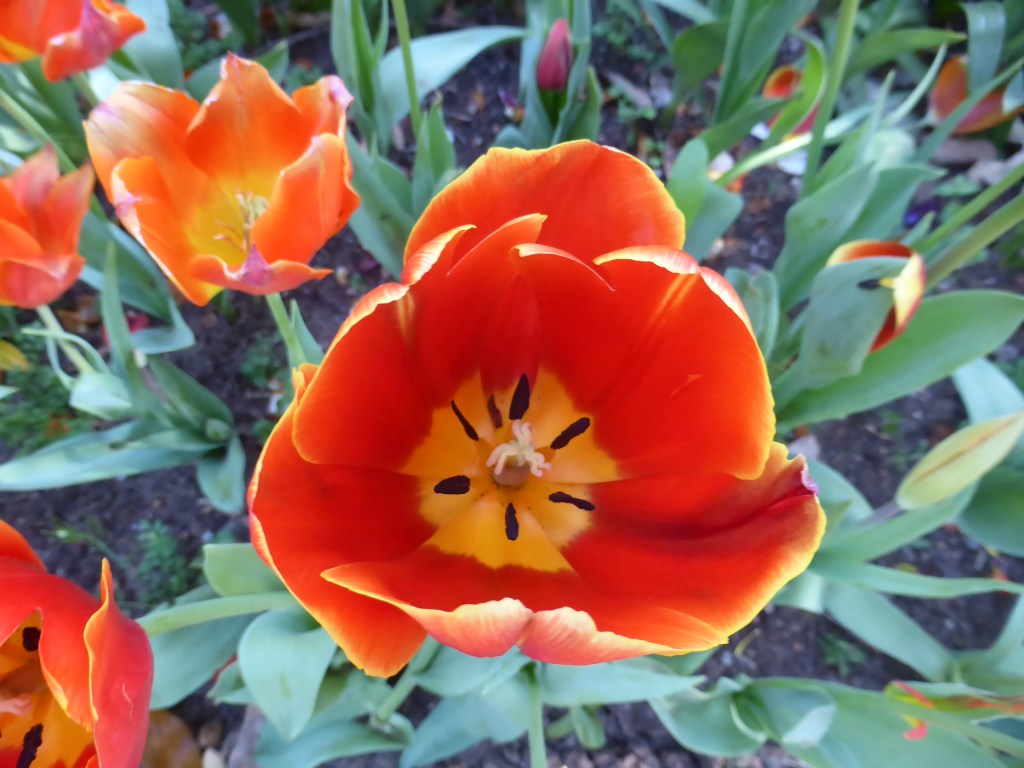
Here are a few photos of tulips from my visit. including some close-up shots. Tulips seem to come in many different colours and shapes. I can still recall seeing a bright red tulip coming out of the snow in Chicago years ago – and love the bright colours. If you click on a photo, you can see more of it.

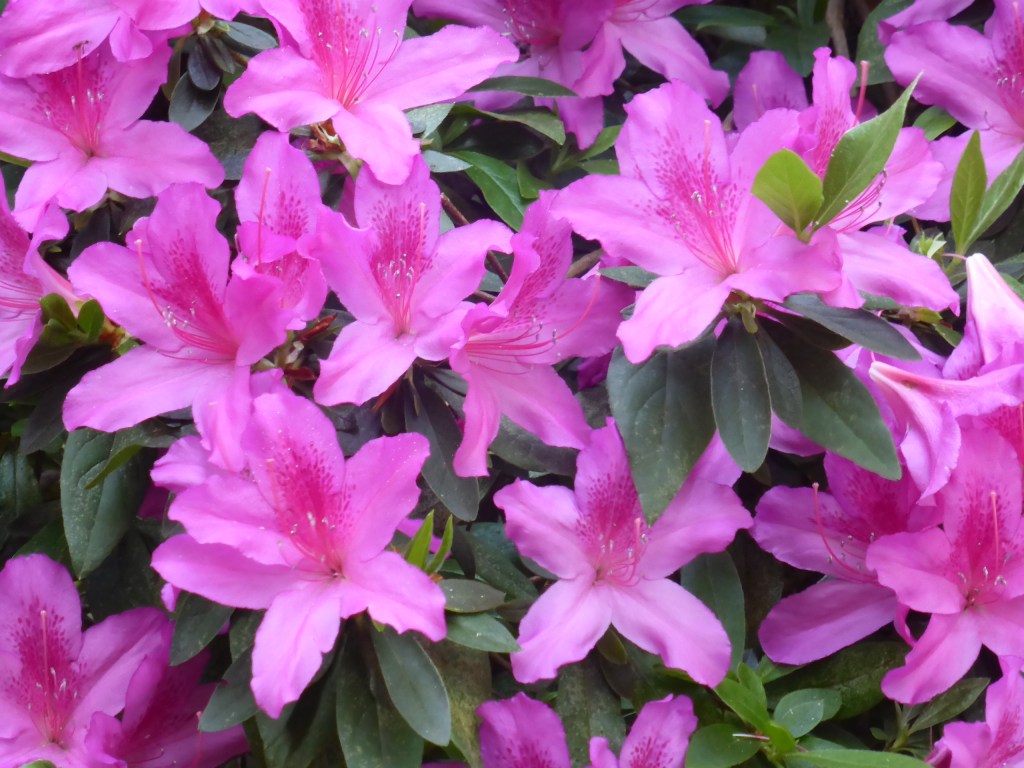
Although tulips are the most prominent (at least at the time I visited) there are other plants besides tulips at the park, including some lovely irises and blossoms. Here is a selection of them.

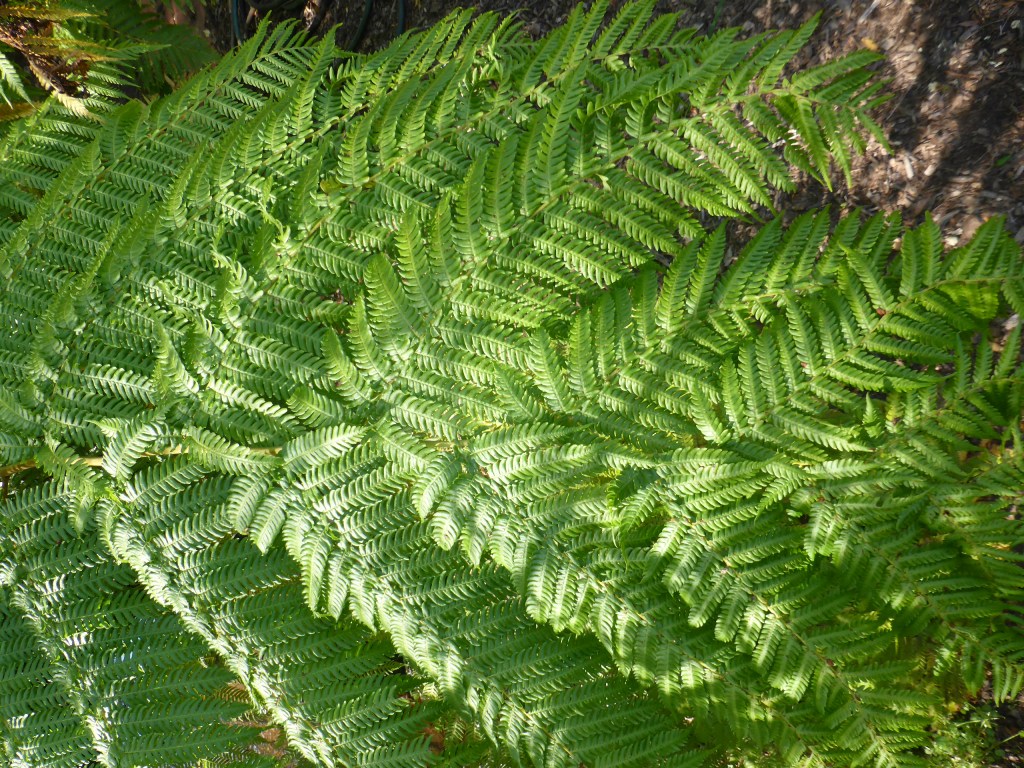
I love the wisteria on the small restaurant (Chalet Healy) at Araluen. The two photos are taken from outside and inside the restaurant. I also love the greenery around the park. The ferns below are good examples of fractals (these are mathematical shapes that are ‘self-similar’ in the sense that a larger frond is made up of smaller fronds of the same shape, which are in turn made up of smaller fronds of the same shape …).

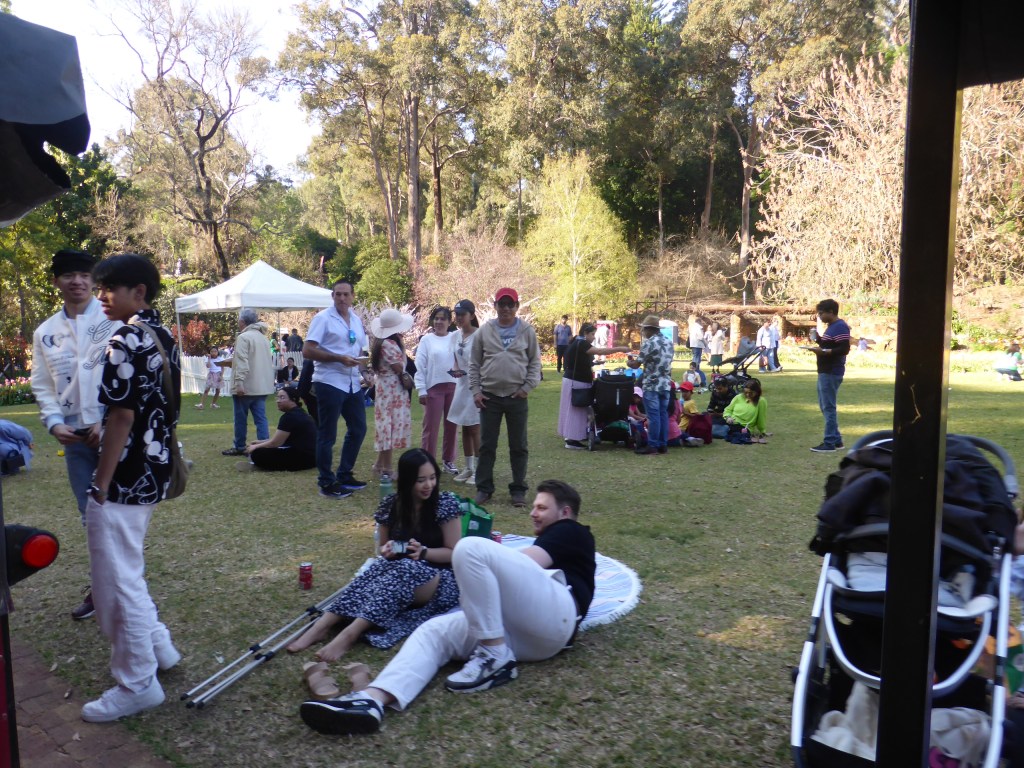
On the day we visited, I was a little surprised to notice that most of the other visitors looked as if they came from various south-east Asian or South and West Asian cultures; it’s impossible to tell without asking them of course: I expect many were (like us) local citizens enjoying a day in the hills, while some others may be tourists. Maybe many locals have visited Araluen many times before so that it is no longer a novelty? I don’t know, but think it would be a shame if locals didn’t visit Araluen at least once a year to enjoy the floral magnificence. And it’s a lot easier than gardening.


A lovely spot to visit, whether you are a local or a visitor, especially around August in Perth.