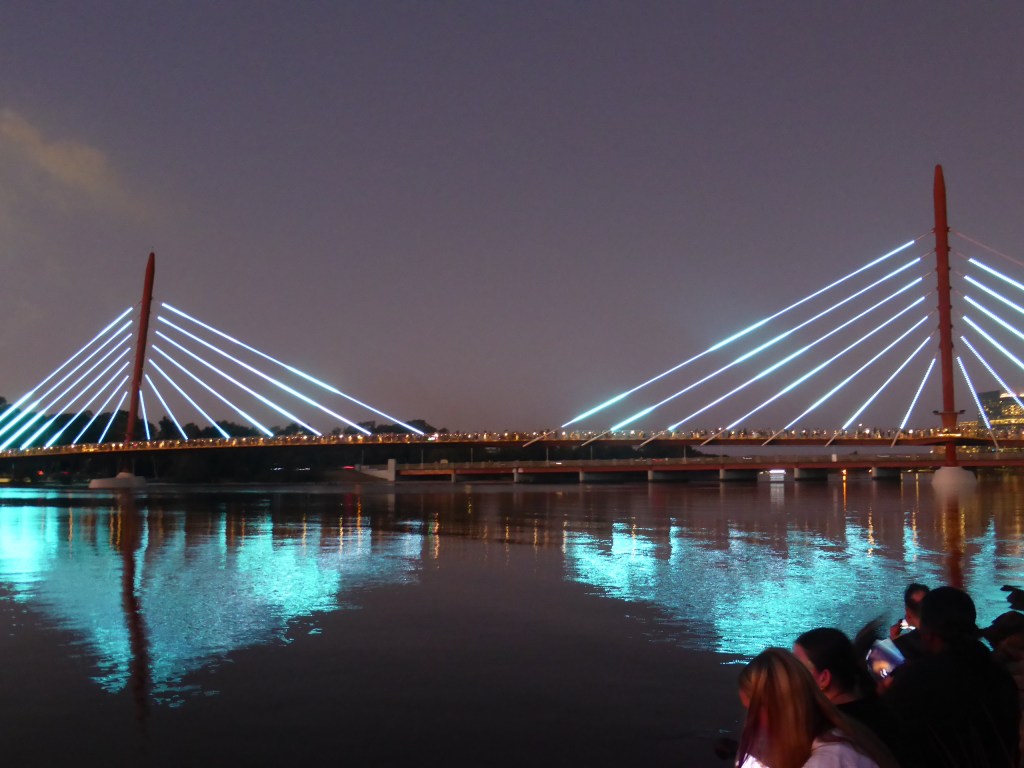
Opening of Boorloo Bridge

Boorloo is the Nyoongar name for Perth, Western Australia. (The Nyoongar people are the traditional owners of the land in the south-west corner of Australia, who were here for around 60 000 years or so before the British colony was founded in 1829). So it is fitting that the new pedestrian/cycling bridge across the river, which opened today, is named after the city. I am of course pleased that public funds are being used for a pedestrian bridge, rather than further freeway extensions in this city, which is dominated by cars, so decided to attend the public opening ceremony today, despite the excessive heat.

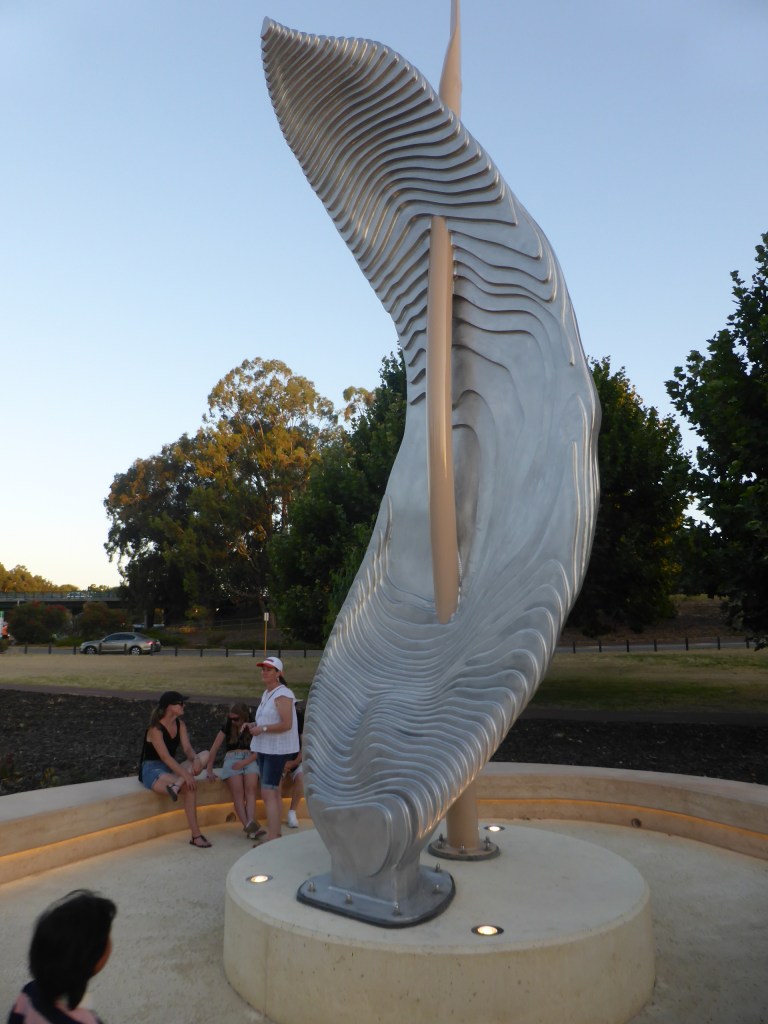
I arrived shortly before dark, to avoid the heat, and the first thing I saw was a sculpture depicting traditional objects – a digging stick (wanna) used by women and a booka (a cloak generally made of kangaroo skin). The first part of the bridge has very large versions of the wanna holding up cables, as you can see:
The bridge goes over what has always been called Heirisson Island as long as I can remember, although very few local people seem to know it was named after an obscure and otherwise insignificant Frenchman on a scientific mission up the Swan River around 1804 (well before the British arrived). A long time before that, in 1697, a Flemish explorer, Willem de Vlamingh, got as far up the Swan River as the islands, but no further. Little surprise that the area was known to the local Nyoongar people as Matagarup (which means ‘one leg deep’), which accounts for Vlamingh’s lack of progress I assume. [Probably a major reason for the British colonisation in 1829 was to make sure that they did so before the French, or even the Dutch.]

The island has had a chequered history, including recent Aboriginal protests, and most Perth people have never been on it. (I have been on it several times n recent years, however). A traffic Causeway across the island was critical for many years in the colony before the Narrows Bridge and the Freeway were built in 1959, finally providing a link between north and south of the river. Prior to the Freeway construction, southern suburbs like South Perth and Como (where I live) were hard to reach efficiently from the city and even regarded as a long way away by many people north of the river. The new bridge provides a link for pedestrians and cyclists, who rarely use the Causeway, and will allow people to easily, and pleasantly, walk or cycle around the entire Swan River area adjacent to the City.

I was pleased to see free drinking water stations available for the event, as most people these days carry a water bottle. The temperature had cooled down to about 37 C (from an earlier unpleasant maximum of 41 C) when I arrived around 7 pm.

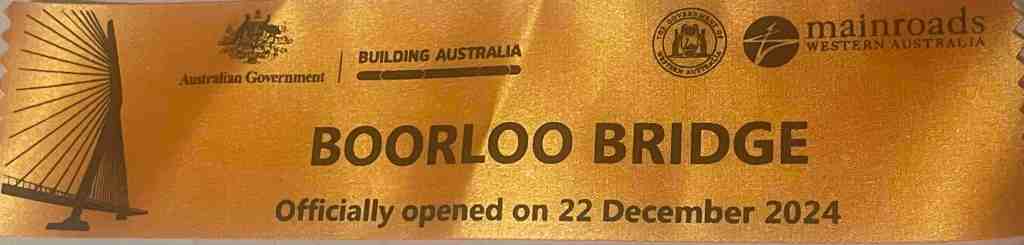
As well as a welcome drink of water, I picked up the commemorative banner of the occasion:

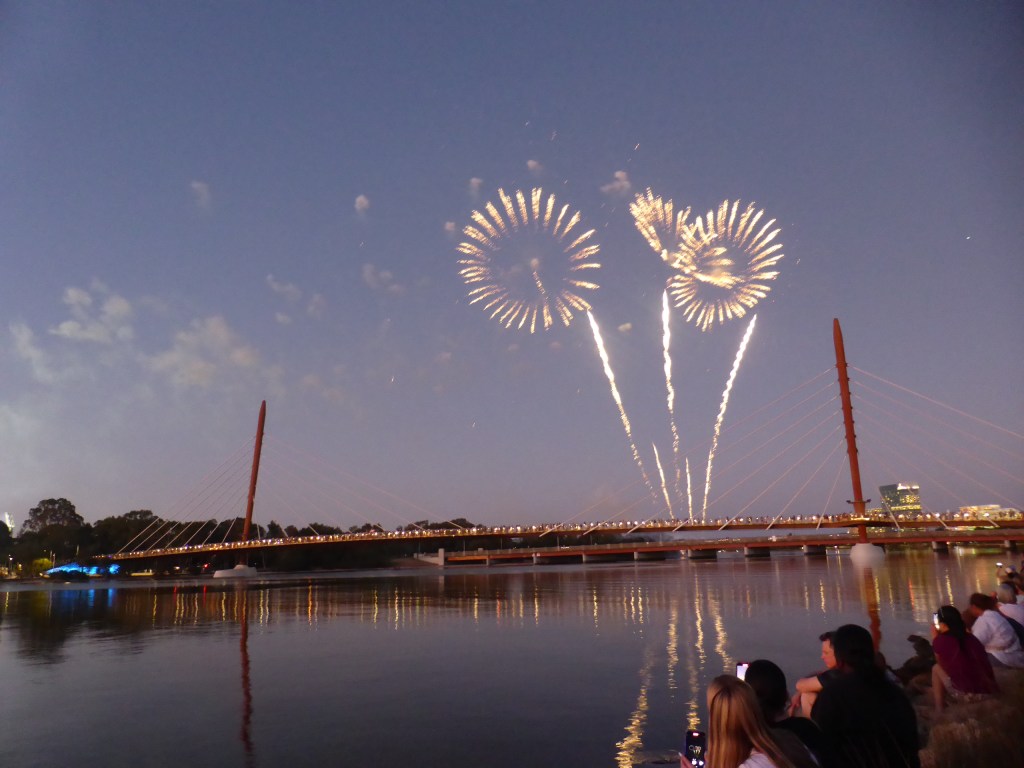
As the sun set, the bridge was opened with a fireworks display, appreciated by the crowd of picnickers assembled, including me. I’m not very good at photographing fireworks, but here is a sample of them to give a flavour of it. Clicking the mages will give you a better version, I think:

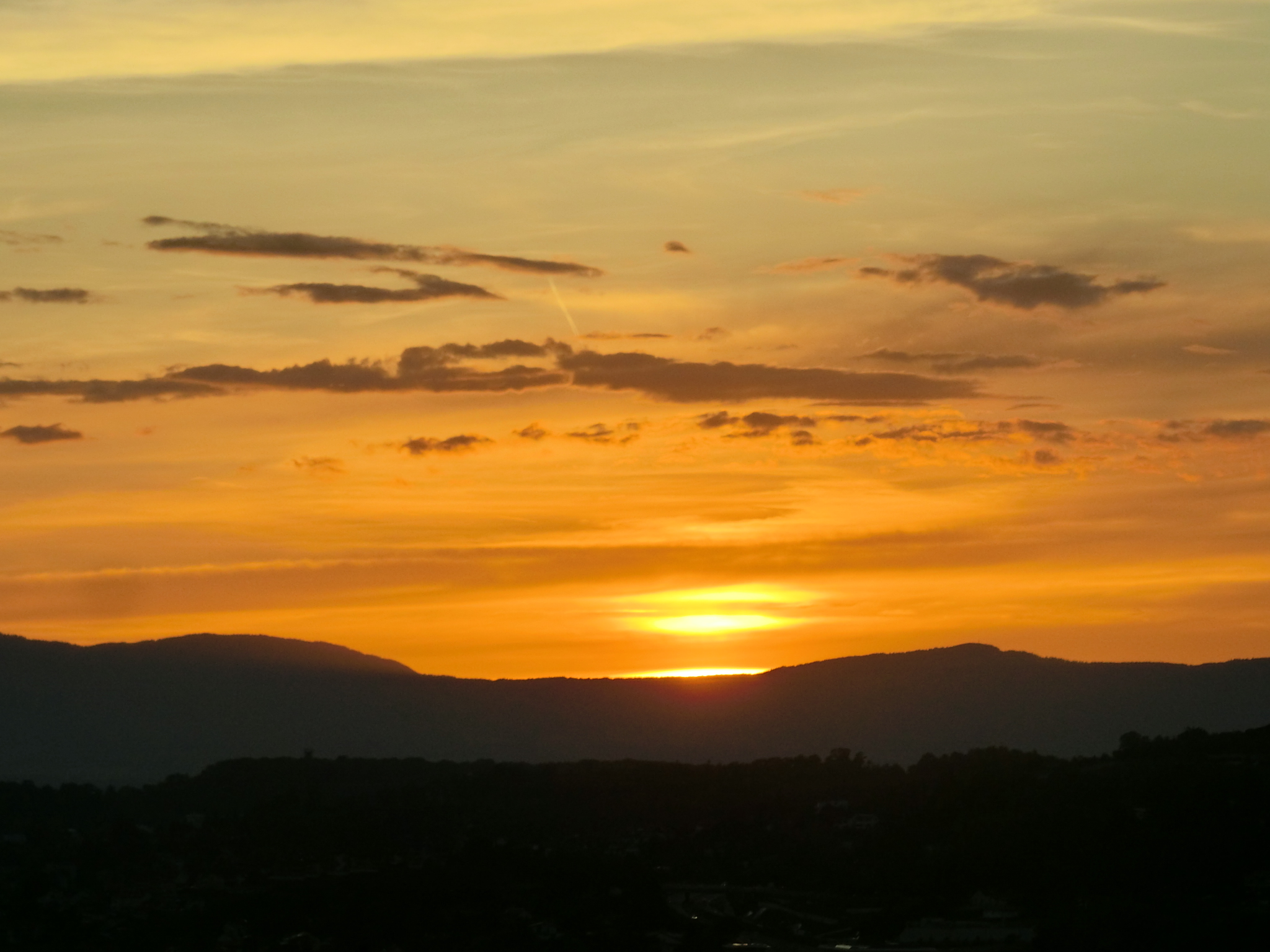
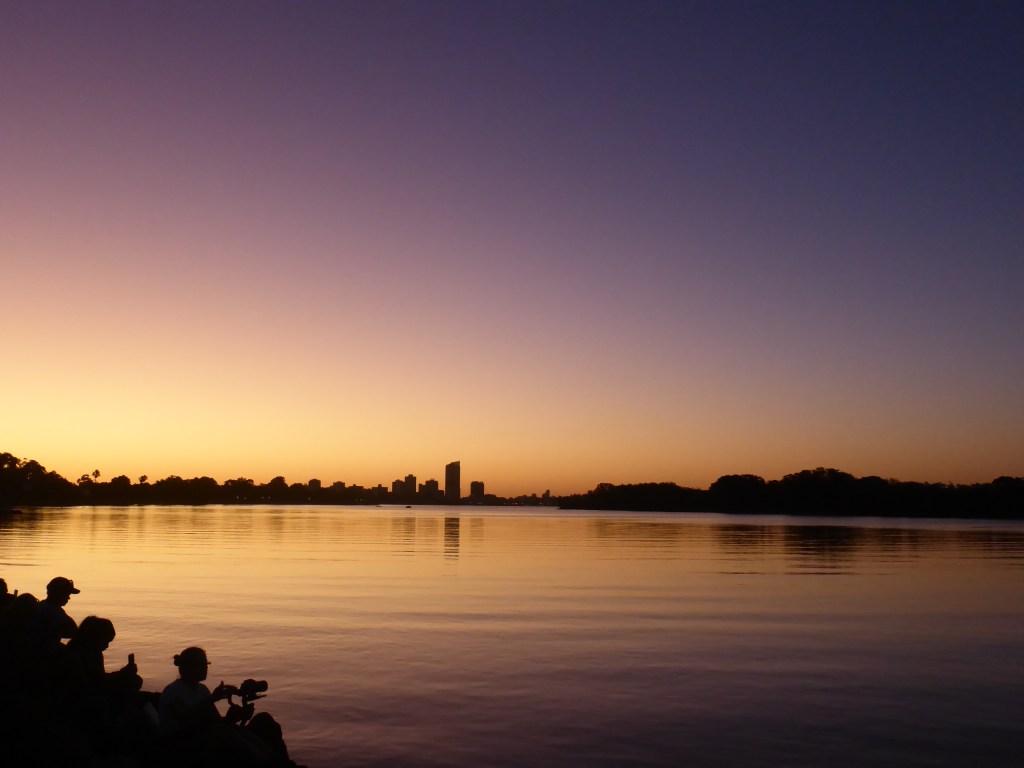
The fireworks distracted us a bit from the glorious sunset in the other direction: you can see the South Perth foreshore in the distance, with its new high-rise building sticking up. (The City of Perth is a bit right of this picture, and not shown here.) Beautiful colours … and expectant photographers waiting for the fireworks to start.
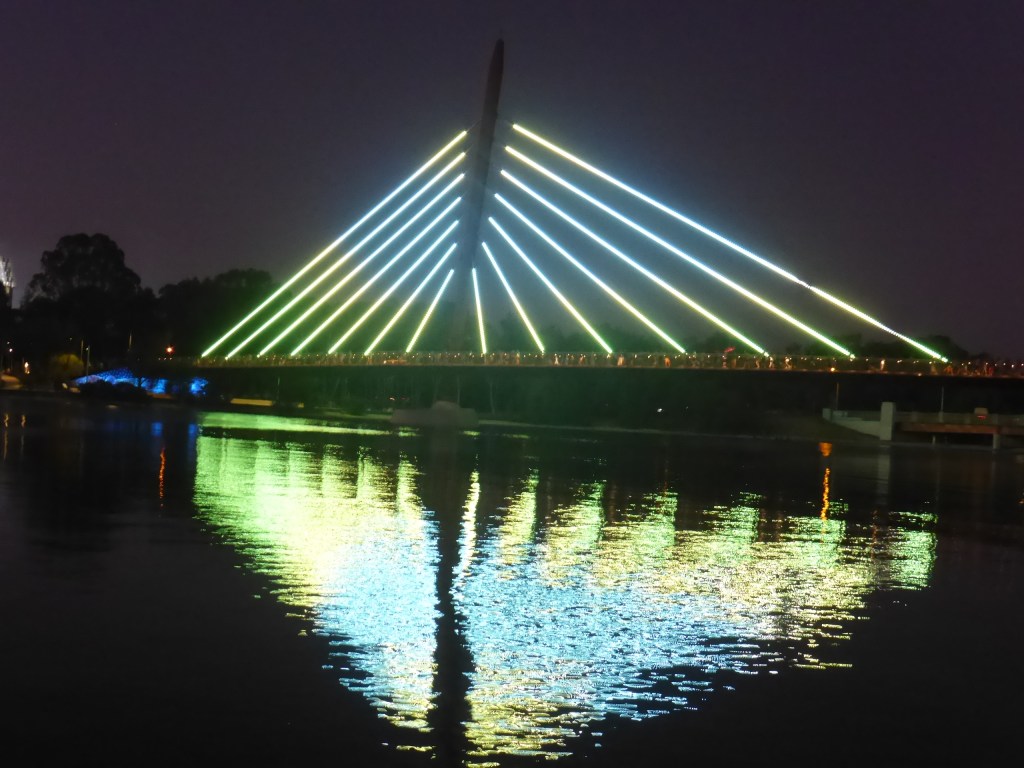
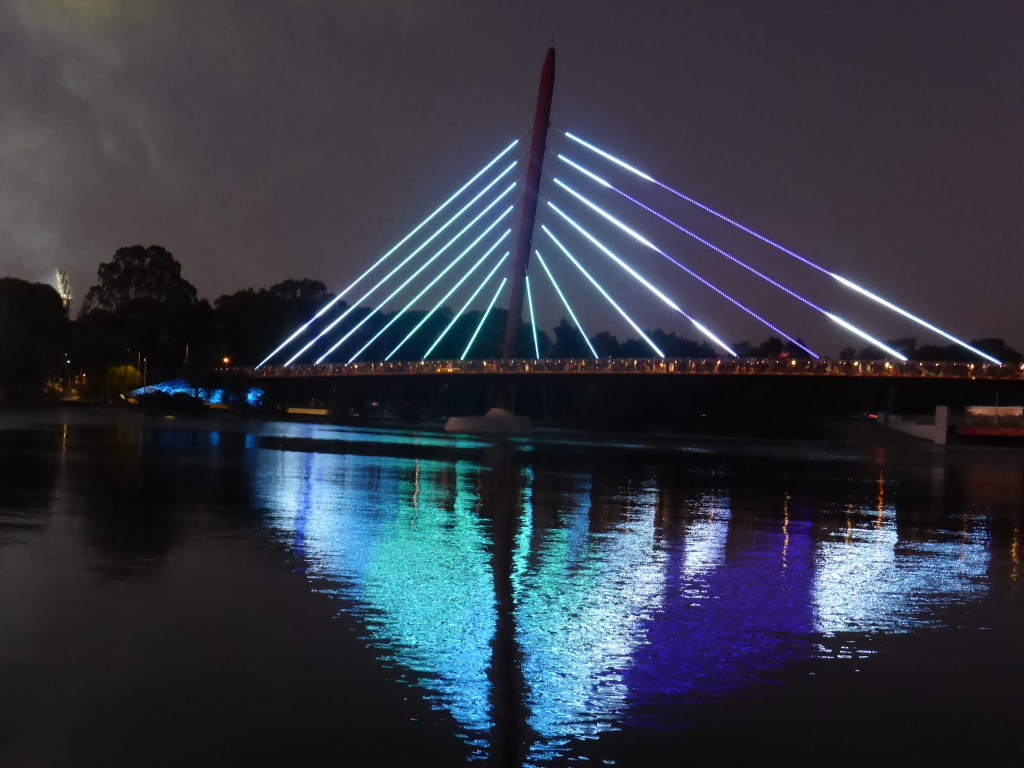
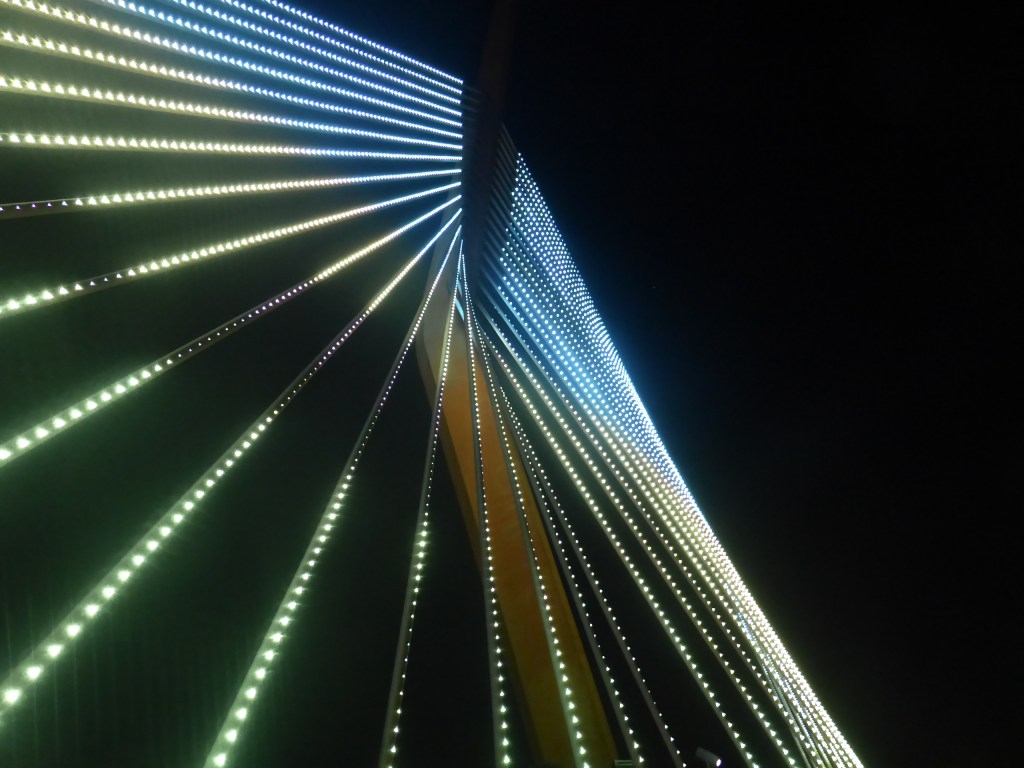
After the fireworks, we were treated to a lovely display of lighting on the various parts of the bridge. There are small LCD lights in the cables, which can be programmed in various ways to create lovely effects. (We are accustomed to this sort of thing with the Matagarup Bridge linking the Perth Stadium to the other side of the river.) Here is a sample of the lovely effects:
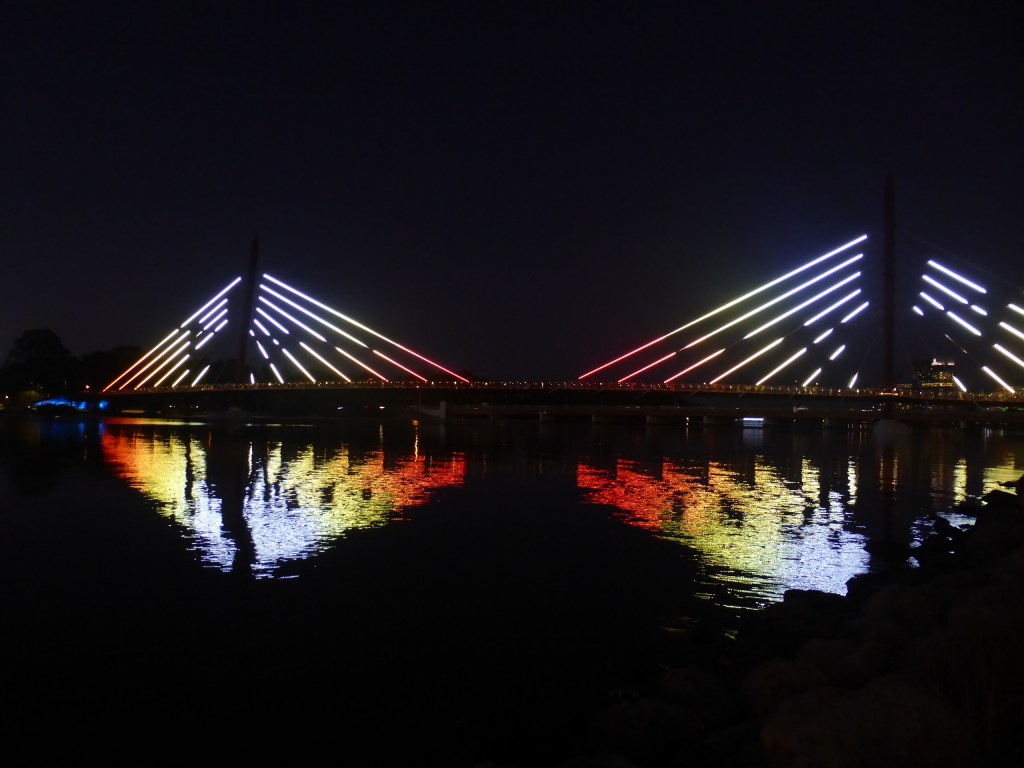
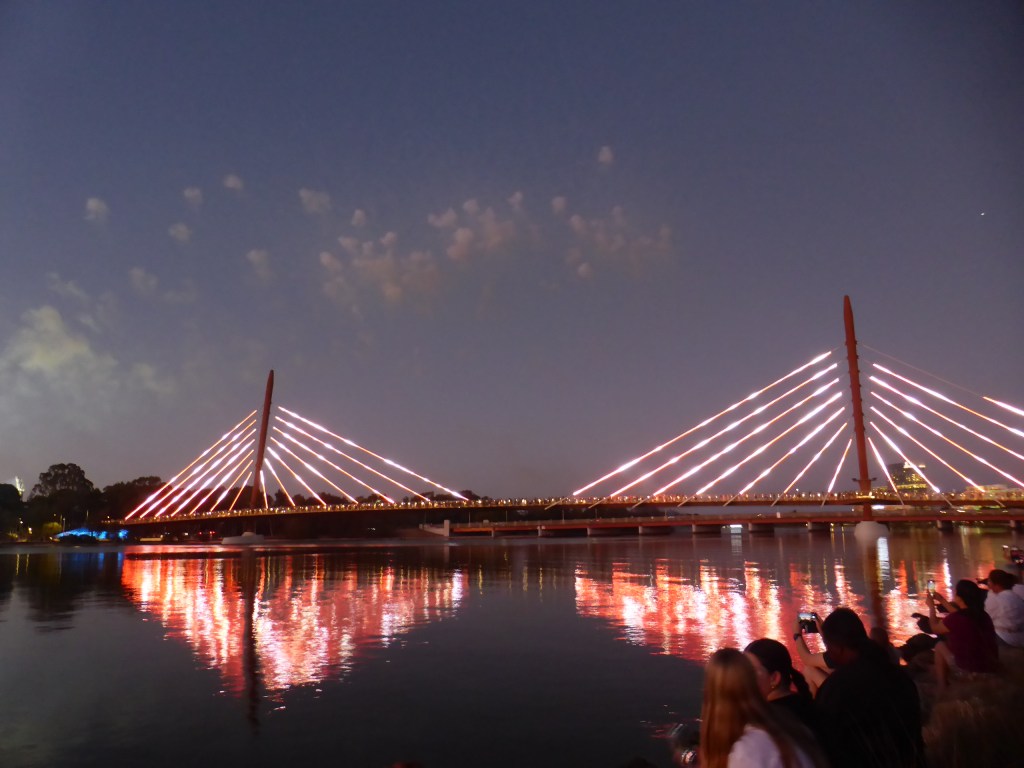
Here are a few more examples of just one part of the bridge, like the one shown at the top of this post, showing how the lighting system can create some lovely effects, helped along by their reflections of course.

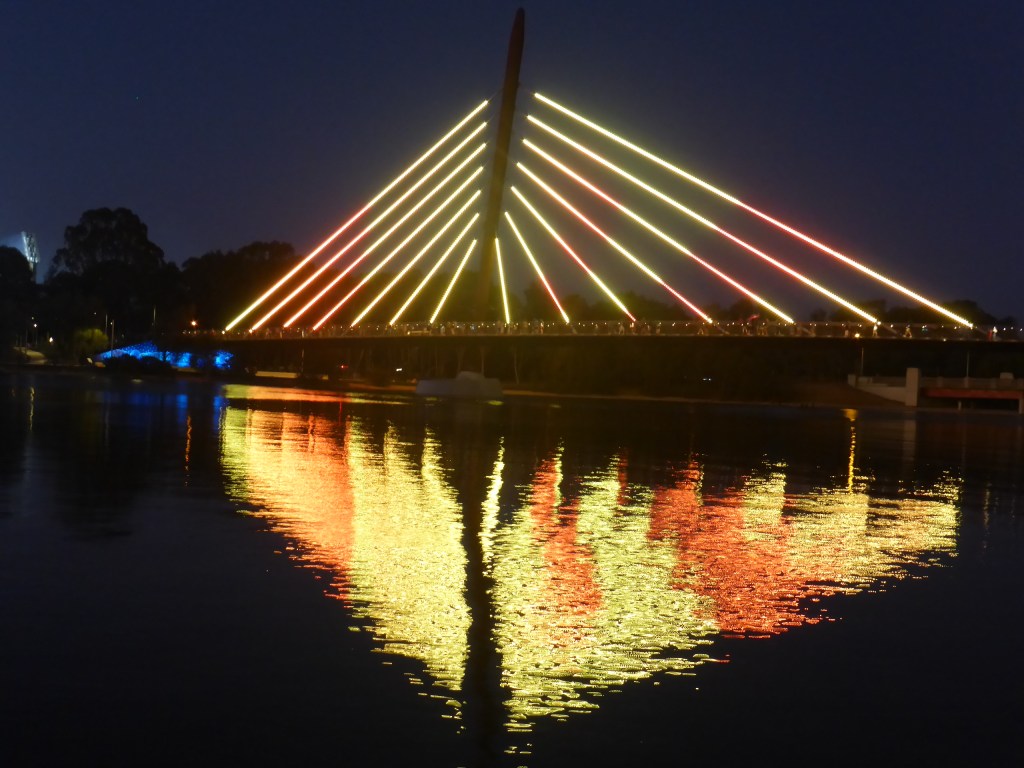
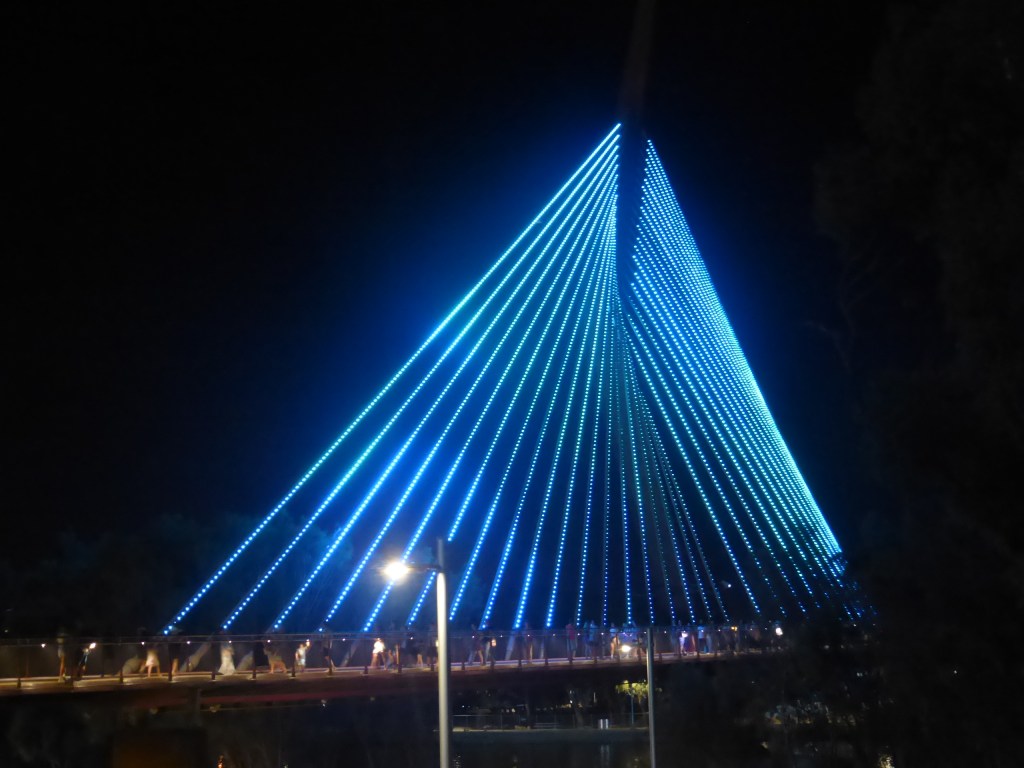
I walked across the bridge, of course, along with others, and enjoyed doing so as well as seeing the second part of the bridge, linking Heirisson Island to the north bank of the river. Where the first part of the bridge has two vertical struts, the second has only one, in the shape of a boomerang (not very clearly photographed here, I’m afraid, although much clearer in daylight). Also not clear is the way in which there are some native animals (such as kangaroos, fish, reptiles, … ) depicted as moving shadows in the lights. If you’re ever in Perth, check these out for yourself, as they exceed my photographic capabilities to show well.
There were various other artistic works associated with the bridge, and several plaques helping people interpret these as well as to learn a few words of the Nyoongar language. The traditional owners have of course been carefully consulted throughout the project and I hope that these will help with ongoing efforts to increase recognition of (all) of our heritage. Here are some examples:

Despite the heat, I was pleased that I was there at this historic time. I’m sure that I will make good use of the Boorlo Bridge, as will others, and am pleased that it is finally finished. I have walked right around the river (called Perth Water locally, or Derbal Yerrigan to Nyoongar people) several times, and have never enjoyed the Causeway bit; that has now been fixed. Of course, it is expected that cyclists will also use the bridge to get to work in the city or for leisure (as they already do at the other end, via the Narrows Bridge), so I think the bridge is a good investment of government funds, both state and federal. Hopefully, it will help to encourage people to get out of their cars a bit more and enjoy their beautiful city a bit more.

Finally, the picture below on the bridge deck says welcome (Kaya) to Perth (Boorloo) and also shows our native symbol of a black swan (ironically shown here in white light!).

Welcome to Boorloo Bridge!

Araluen

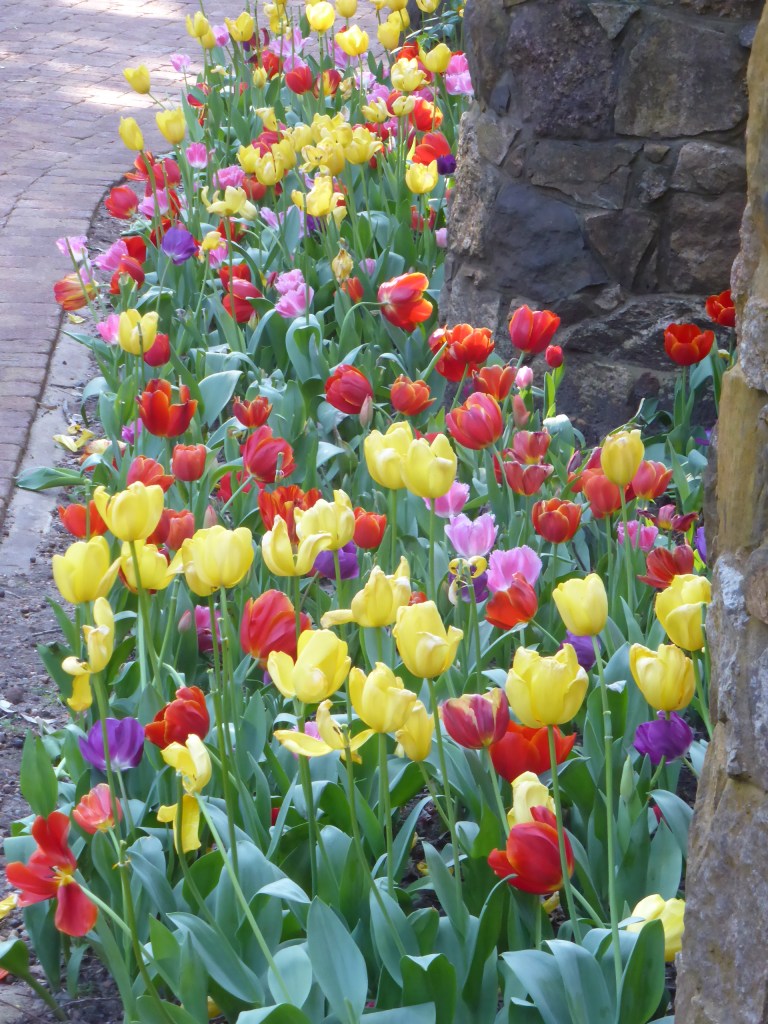
Araluen Botanical Park is in the hills outside Perth, and has long been a popular place for locals to enjoy, especially in springtime. Most people associate it with the tulips planted there, but there are many other flowering plants as well, and some nice picnic spaces. Araluen has its own micro-climate making it a good place to grow tulips, which generally would not survive Perth’s warm Mediterranean climate. I visited the park – as I have often done previously – and enjoyed meandering around it. It was towards the end of the annual Tulip Festival, but there were still many beautiful specimens on display. The park was originally privately owned; however, when the owner was contemplating selling it (and it might then have become a housing estate), the Western Australian government purchased it so that it can be permanently a park. A small army of volunteers is responsible for the annual planting of tulips.

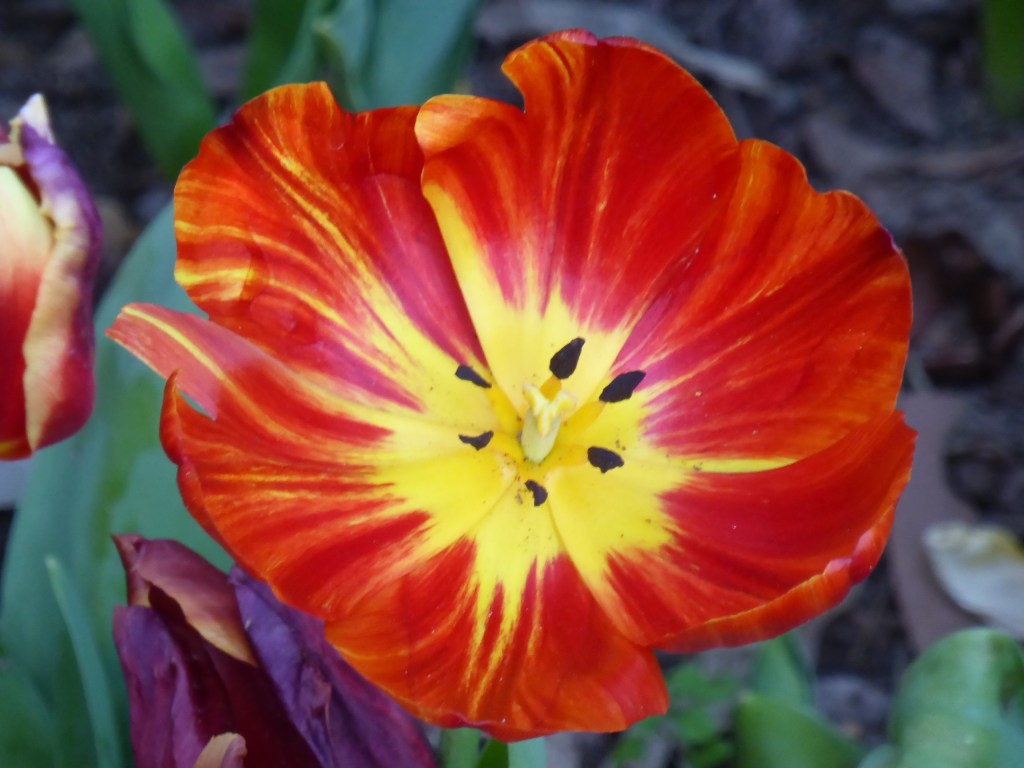
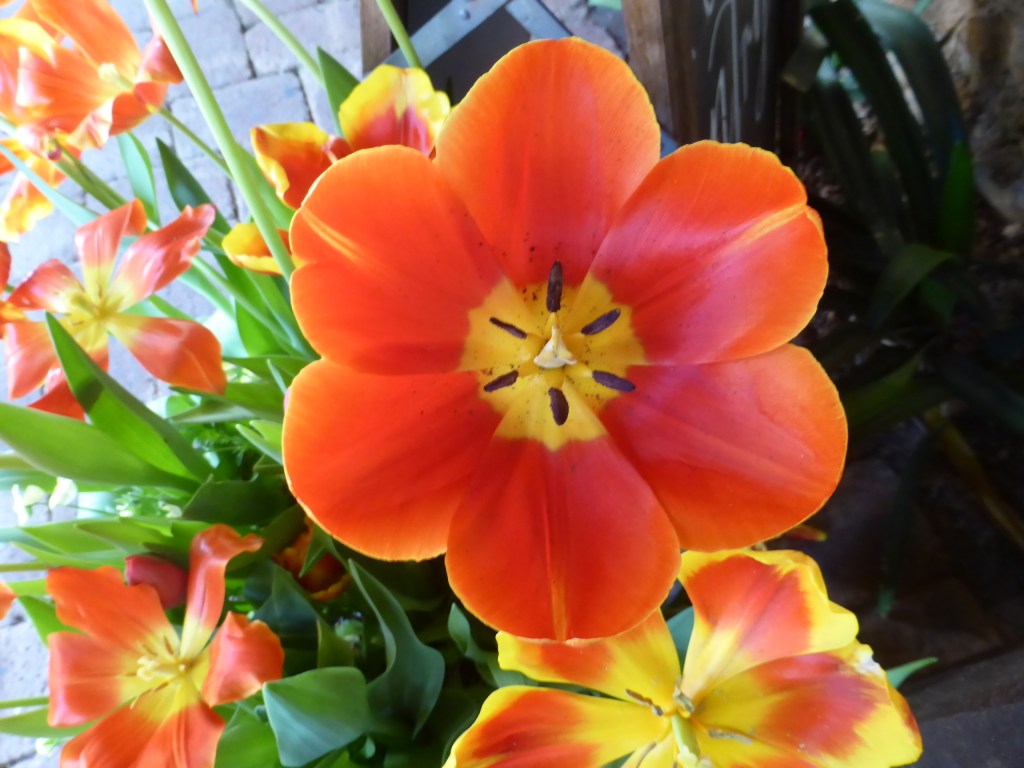
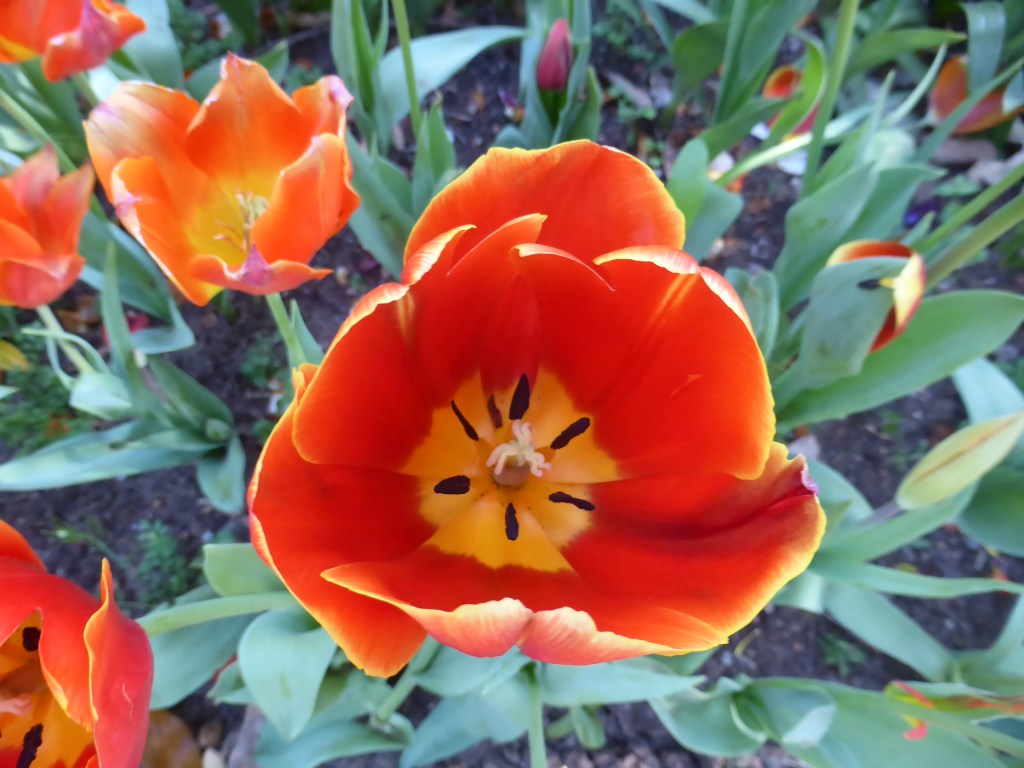
Here are a few photos of tulips from my visit. including some close-up shots. Tulips seem to come in many different colours and shapes. I can still recall seeing a bright red tulip coming out of the snow in Chicago years ago – and love the bright colours. If you click on a photo, you can see more of it.

Although tulips are the most prominent (at least at the time I visited) there are other plants besides tulips at the park, including some lovely irises and blossoms. Here is a selection of them.

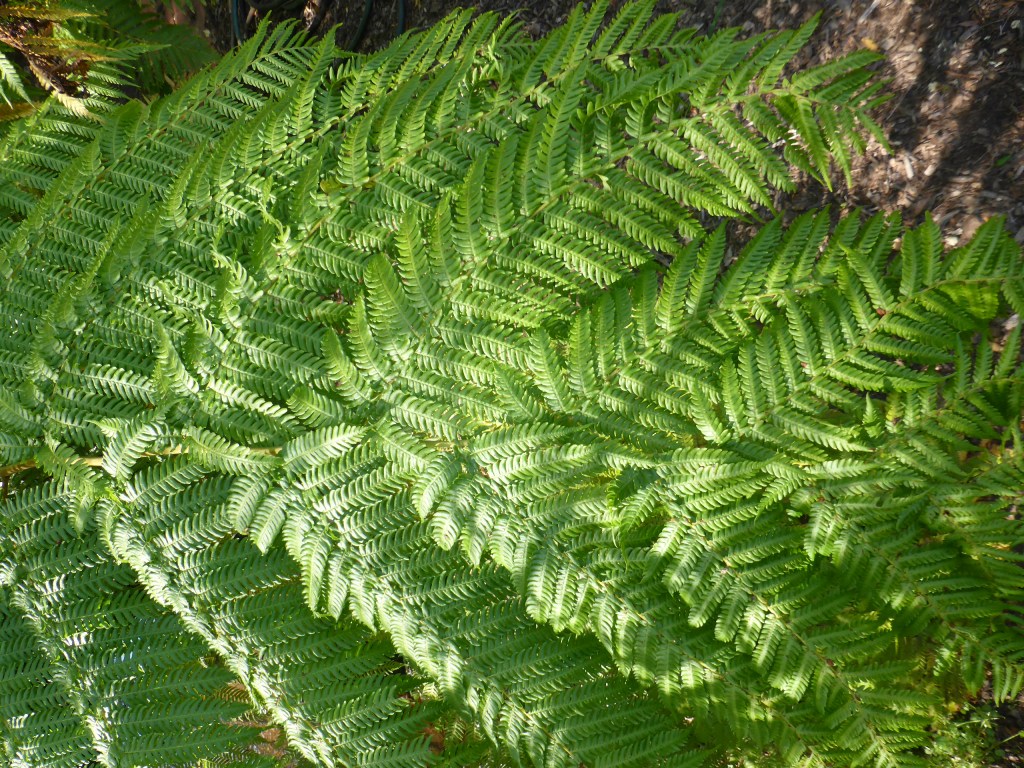
I love the wisteria on the small restaurant (Chalet Healy) at Araluen. The two photos are taken from outside and inside the restaurant. I also love the greenery around the park. The ferns below are good examples of fractals (these are mathematical shapes that are ‘self-similar’ in the sense that a larger frond is made up of smaller fronds of the same shape, which are in turn made up of smaller fronds of the same shape …).

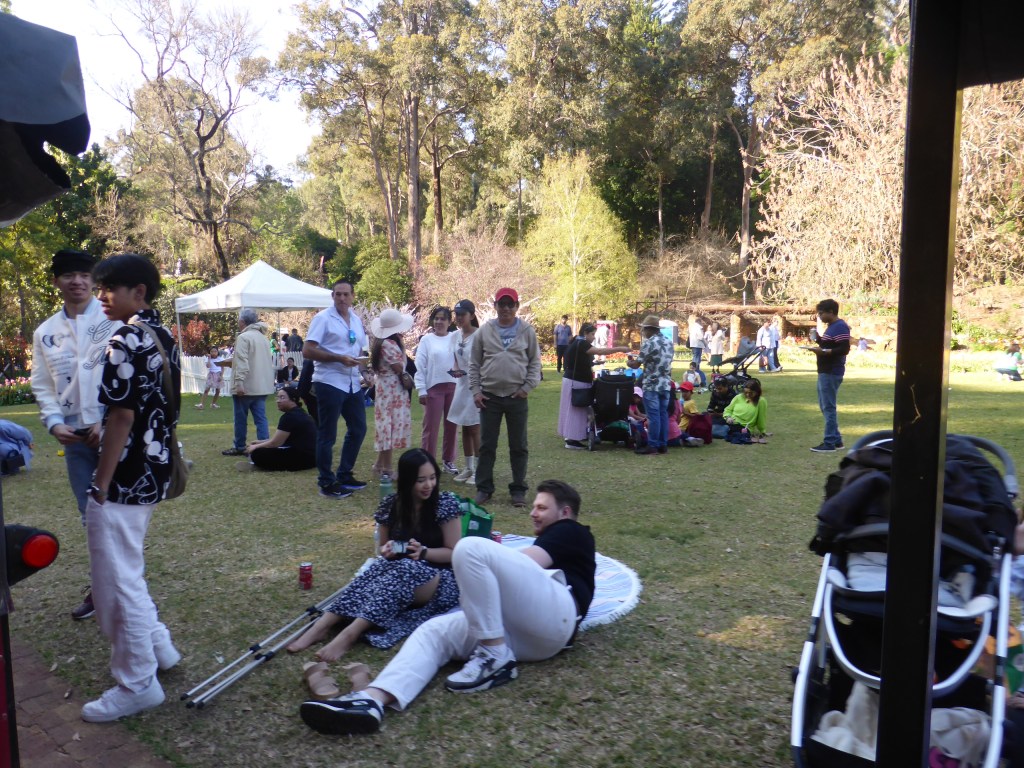
On the day we visited, I was a little surprised to notice that most of the other visitors looked as if they came from various south-east Asian or South and West Asian cultures; it’s impossible to tell without asking them of course: I expect many were (like us) local citizens enjoying a day in the hills, while some others may be tourists. Maybe many locals have visited Araluen many times before so that it is no longer a novelty? I don’t know, but think it would be a shame if locals didn’t visit Araluen at least once a year to enjoy the floral magnificence. And it’s a lot easier than gardening.


A lovely spot to visit, whether you are a local or a visitor, especially around August in Perth.

Meandering around Fremantle

I had a couple of hours to kill today, and used them to meander around Fremantle, which is Perth’s port. It’s long been one of my favourite (urban) places in Western Australia, and would certainly take several visits to explore thoroughly. In this blog, I mention only some of them …

One of the delights of wandering around Freo (as it is often known by the locals – Australians are notoriously prone to short handing names!) is the built environment. Although it dates only from the early part of the nineteenth century, the architecture often seems ‘old’ by local standards and many buildings have been lovingly renovated recently. The main impetus for the renovations was the America’s Cup yacht race, which was based in Freo in 1986. The images above show some examples, ranging over at least a century. Many fine buildings show some of the affluence of the port years ago, while others show the early influences of convict labour. (Western Australia was founded as a British penal colony in 1829.) A stroll around Freo will delight anyone interested in Victorian-era and early 20th century streetscapes.

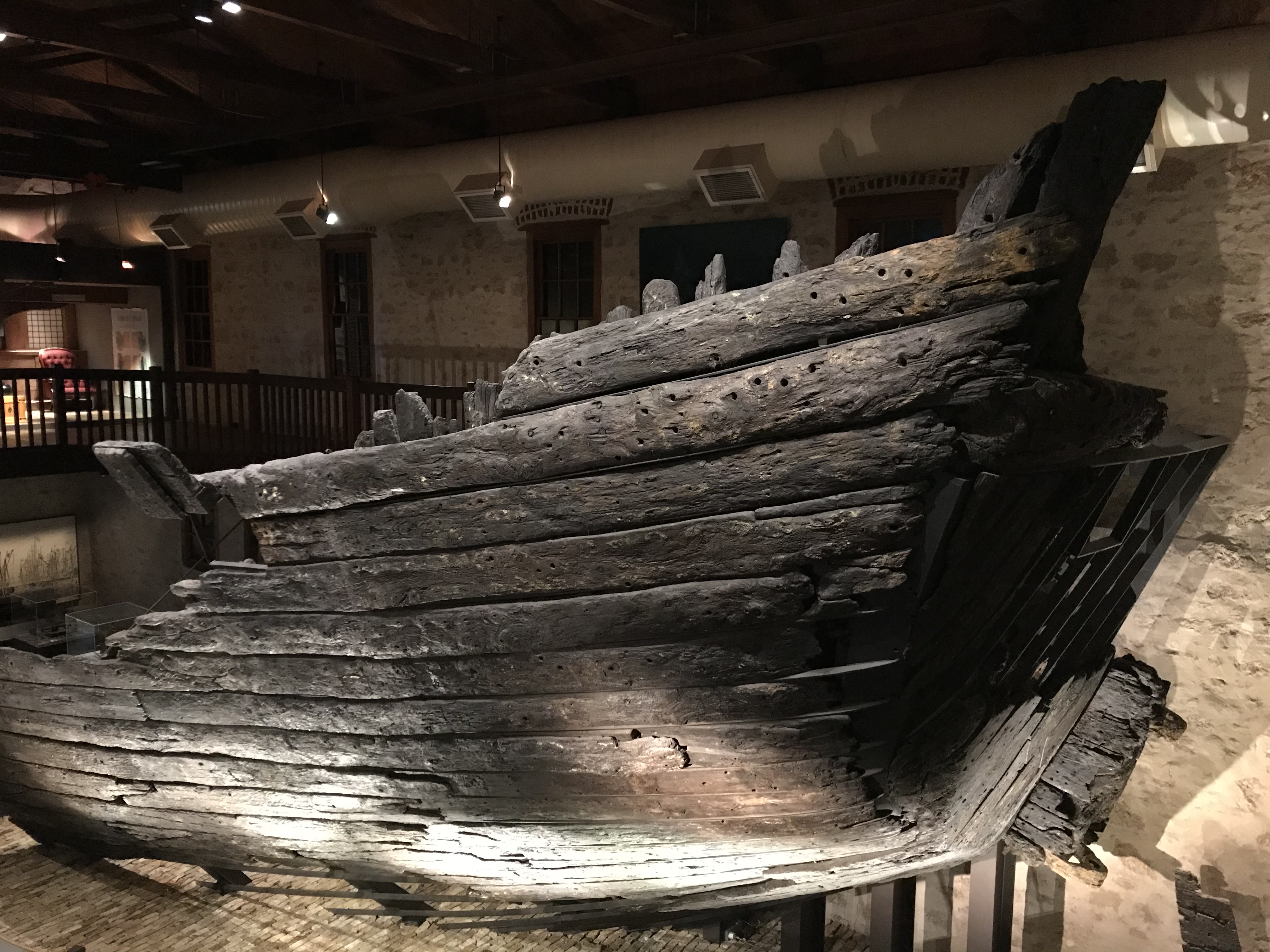
I also popped in to the lovely Shipwrecks Museum, a museum constructed and maintained by the state government, focusing on the many maritime adventures associated with early Western Australia. It’s a lovely museum with many aspects of the maritime world on display, and so it’s very easy to spend an hour or two there. Pride of place in the museum is a gallery housing some recovered parts of the Batavia, a vessel owned by the Dutch East Indies Company, which sank on Western Australia’s coast in the 17th century:

The first image shows a scale model of the Batavia, while the second shows a large part of the reconstruction. The ship sank in 1629 (a full two hundred years before the penal colony was founded), with details of the events still being found; a mutiny was involved, some evil events too place (murdering of men, women and children) and ultimately some ringleaders were executed. The ship sank en route to Batavia (the same name as the ship, but is a city today called Jakarta, in today’s Indonesia), and senior crew went there and back to get help. This area of the world was frequently encountered by the Dutch, as it was not far from the route from the bottom of Africa to the Dutch East Indies (known as Indonesia today), a major source of spices for Europe and wealth for the private company VOC.

As a child growing up in Australia, I was taught the patently false information that the English mariner Captain James Cook ‘discovered’ Australia. (Recently, there was even a plan by our Federal government to further exaggerate this mistruth by circumnavigating the continent in a replica ship!) The continent was inhabited by Aboriginal people for some 60 to 100 thousand years before it was ‘discovered’ and of course there was lots of connections made by those in the north of the country to nearby parts of southeast Asia. In fact, Cook was not even (close to being) the first European to ‘discover’ Australia, as the museum makes clear in many ways. The Dutch East Indies (private) company – known as VOC – made landfall many times on the Western Australia coast, partly because navigation in those days was not as successful as it is today:

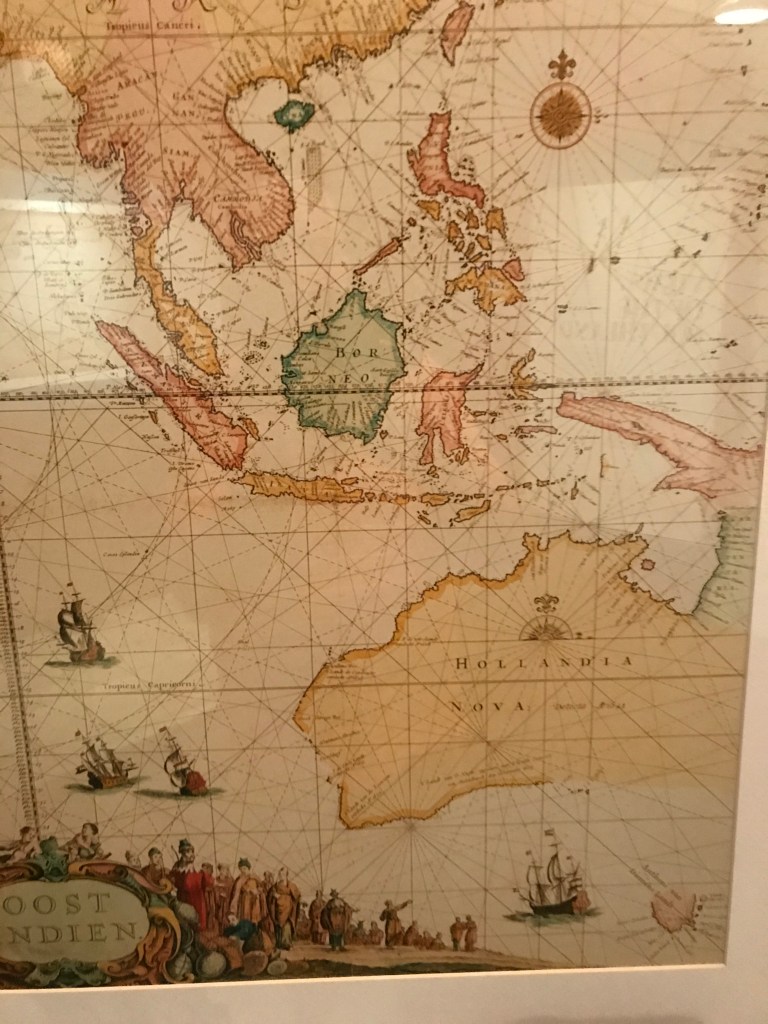
Over time, the western half (at least) of the Australian coastline was mapped fairly well by Dutch navigators, so that the following remarkable map of the East Indies by Pieter Goos that was available as early as 1660 (well over a century before Cook arrived). The ‘Great Southland’ aka ‘New Holland’ as well as most of Tasmania was well known to other Europeans long before the English arrived late in the eighteenth century. A good part of the map was the result of the work of the Dutch navigator Abel Tasman, after whom tasmania was later named.

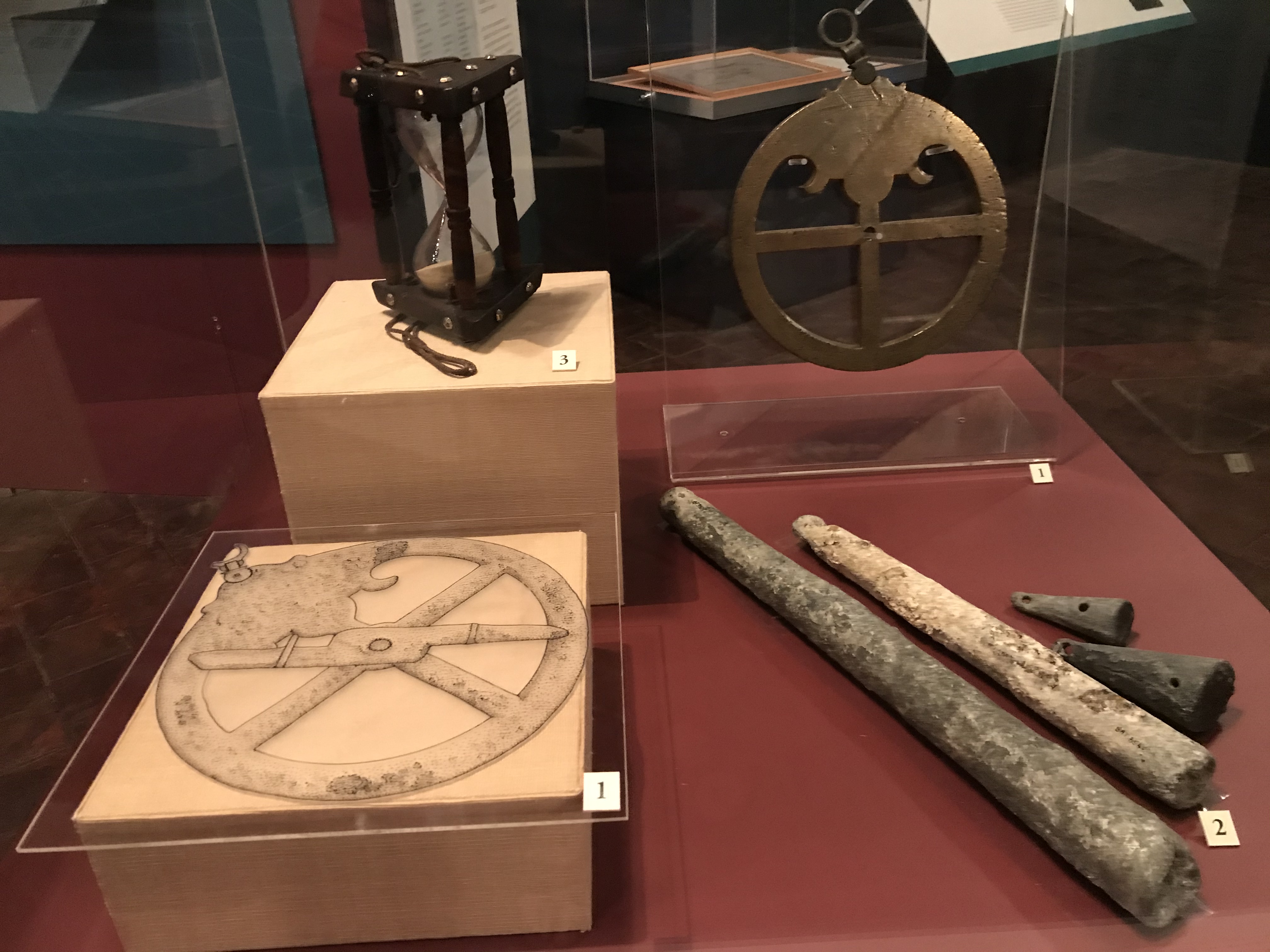
The Museum had some interesting displays of various kinds about navigation – a much trickier prospect in the 17th century than it is today (when my smartphone uses its GPS much more efficiently than any printed maps.) Here are some of them:

Mathematics was a of course a major tool used by navigators, but the photo shows some other kinds of tools: an astrolabe (to determine the location of the sun, and thus help to locate the latitude of the observer), an hourglass (to measure time, from which boat speed could be measured) and some weights (used with an attached string to determine water depths). I continue to admire the early seafarers and map-makers using such tools so well, on small ships in difficult sea conditions – a tribute to their mathematics, of course. At this stage, navigation had not mastered the art of determining longitude efficiently, as this required a good chronometer, measuring time very accurately, which accounts for the regularity of ships running ashore and sinking … in fact, Captain Cook’s ship was one of the first to be testing better navigation methods using a chronometer, but that was long after the Dutch navigators had mapped much of Australia.

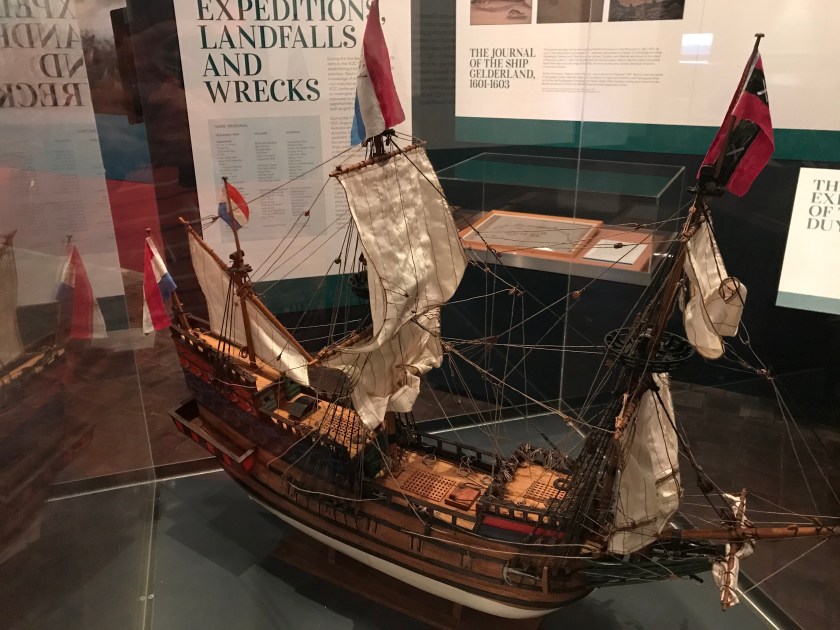
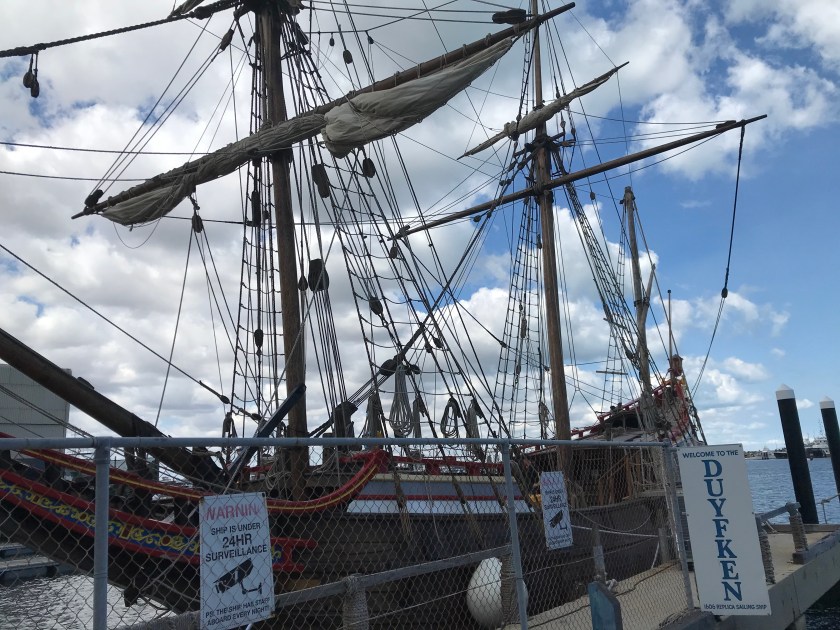
The Museum had several delightful models of early ships, including the Duyfken shown above, which was the first European ship to visit Australia (in 1606). These are painstakingly studied and constructed, and a delight to see. At the moment (for just a few more days) a replica of the Duyfken is actually moored in Fremantle, as the second photo shows. (More details are at https://www.duyfken.com) It is sailing away (forever!) in a few days from now, so I hope to see it more closely while there is still a chance. It continues to amaze me so that so many people could inhabit such a small vessel for so long and in such dangerous circumstances …

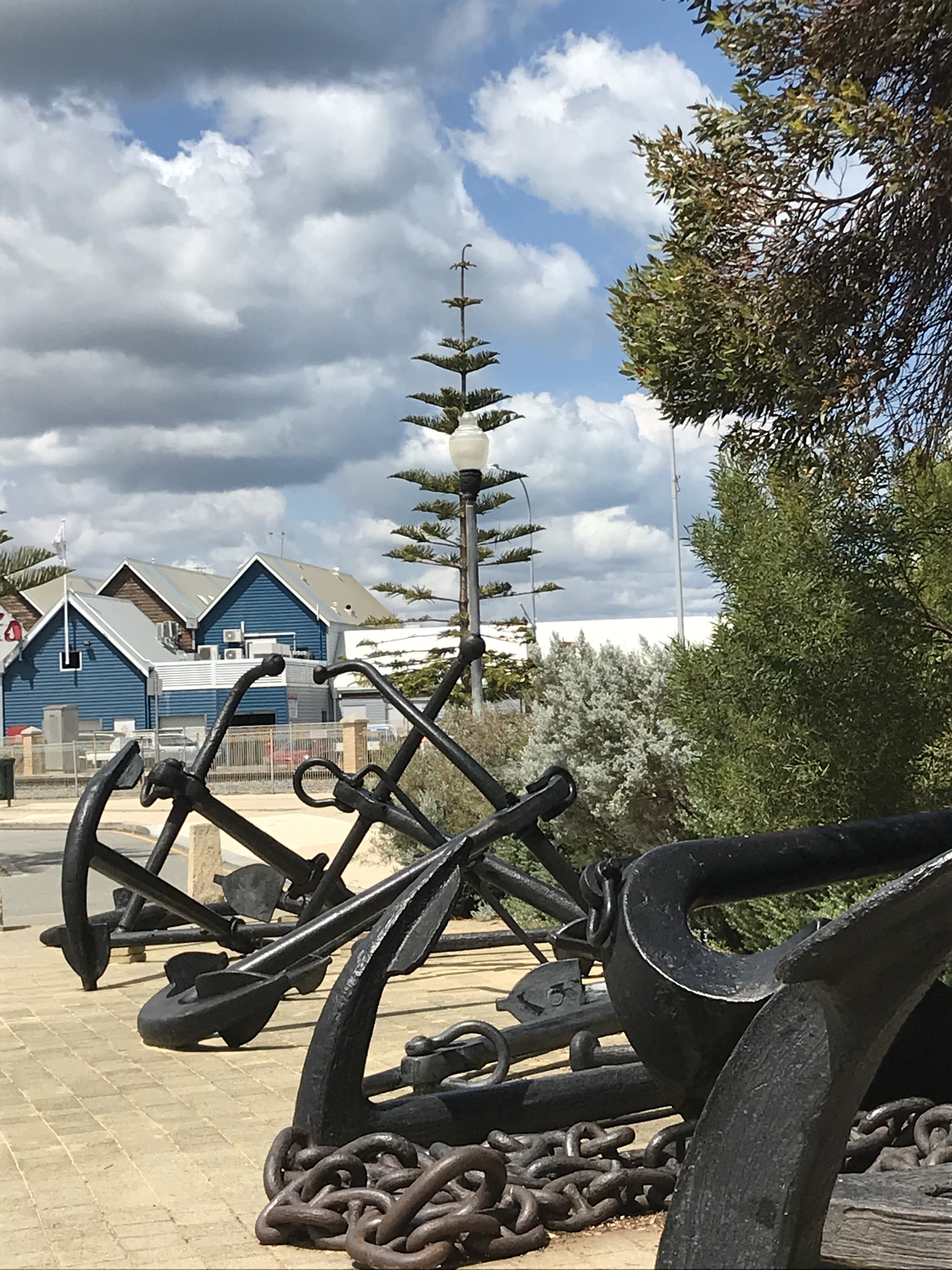
Leaving the Museum, it’s not hard to see the connection with the sea, which is a very short distance away. These days, of course, it is a much easier and safe matter to visit Fremantle than it was for the early seafarers, and the nearby shore is mostly used for recreation rather than for rescuing ships in trouble.

The nearby fishing boat harbour is still used for a small fishing fleet, but is known to many of us an area in which food and beverages are available in casual settings – most obviously various forms of seafood, including of course fish and chips.

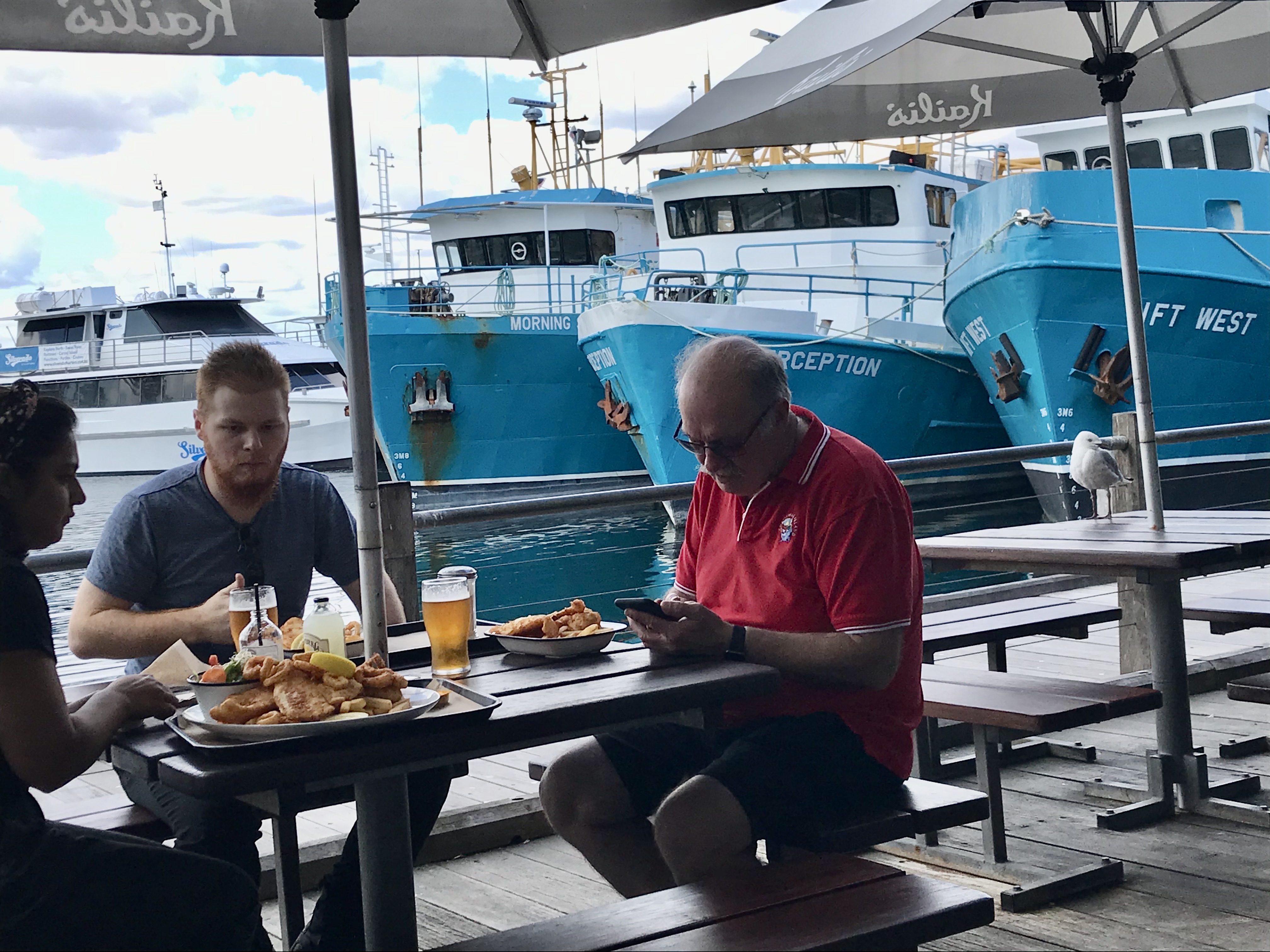
The modern fishing industry was originally developed (I think) by mostly southern European migrants, and I love the sculptures recognising that past – one of which is shown here. I have eaten many times at Kailis’ outdoor eatery at the harbour, too, but usually had to fight hard to find a table (as well as fight hard to keep the seagulls at bay!). The Kailis family were of Greek origin and had a big influence on local fishing, as well as eating outlets like this one. Sadly, these days, the place is almost deserted, as the pandemic has kept tourists away and locals are busy at work. It feels strange to have so few people there, but it’s still a lovely place for lunch.

The early Italian influences on Fremantle are never very hard to find. A good example is Gino’s coffee shop, which has been here on a conspicuous corner for as long as I can remember, and long before it was fashionable to go out to have a cup of coffee with a friend. They still make great coffee, but the ‘cappuccino strip’ (as it came to be called) on which it is located is struggling these days from the effects of the pandemic, and the loss of tourist trade. It’s sad to see so many shops falling vacant, unable to survive … I hope that times will change before much longer.

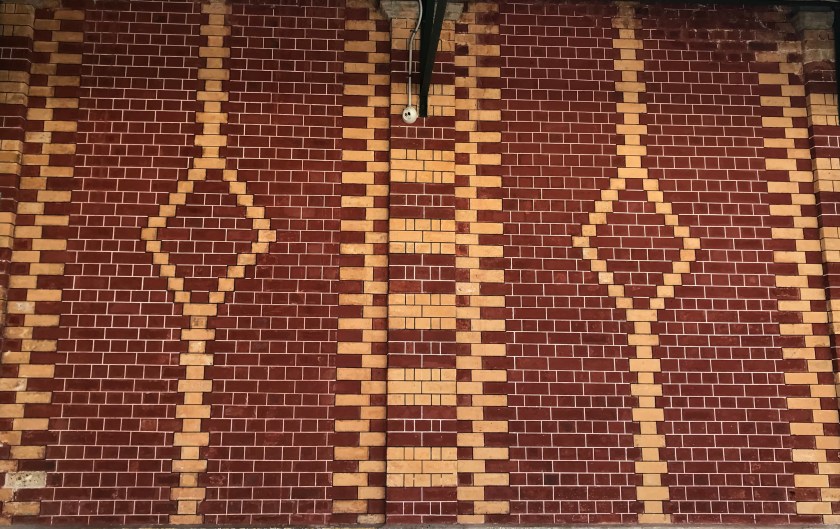
Elsewhere in Freo, all kinds of reminders of other times are evident. Too many to document here, but here are just two examples. A lovely old wall (in fact, right behind Gino’s), with an artistry in bricks that is never seen these days and a delightful grocery with the most amazing smells; the Kakulas Sisters sell all sorts of bulk spices, coffees, teas, sweets, and many other things that make it a delight to wander around. (Click on the images to see more of them.)

By its nature, a port city like Fremantle is connected to cultures elsewhere. While the Italian and Greek roots are evident, and there is increasing recognition of local Aboriginal (Nyoongar) people, Fremantle has always had a multicultural feeling. Indeed, the whole of Australia is multicultural, with around 30% of us born overseas. So I enjoyed the sign below, drawing attention to who we are:

‘Meandering’ has an intrinsic sense of ‘slow pace’. Fremantle is still a lovely place to meander around, and has many more attractions than the few things mentioned here.

If you’re nearby, its certainly worth a day trip … when we are all allowed to travel again.

Public art in Como Beach

I enjoyed learning about public art in my City of South Perth on a recent bus tour, which included a short stroll near my home in Como. Most of the public art on display was already familiar to me, but one of my comments during the tour was that it was poorly documented and little known. So I thought I would share some of my thoughts and some pictures. Como is a large suburb of South Perth, which is in turn immediately south of the City of Perth, Western Australia. My focus here is on Como Beach, adjacent to the Swan River (and a busy freeway) and all within a few minutes’ walk of my home. The picture below shows part of the beach, and the iconic jetty, the longest in the Swan River, once a playground for those living down here.

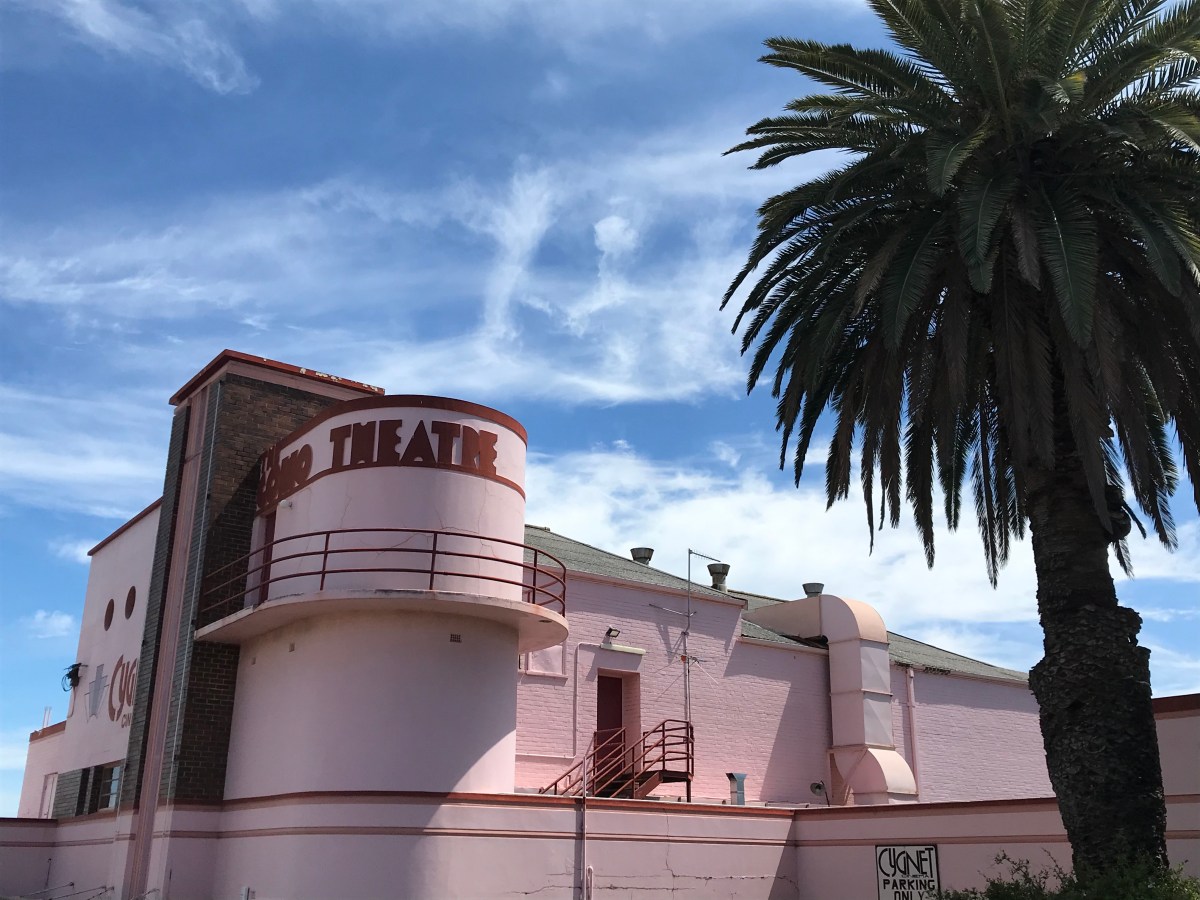
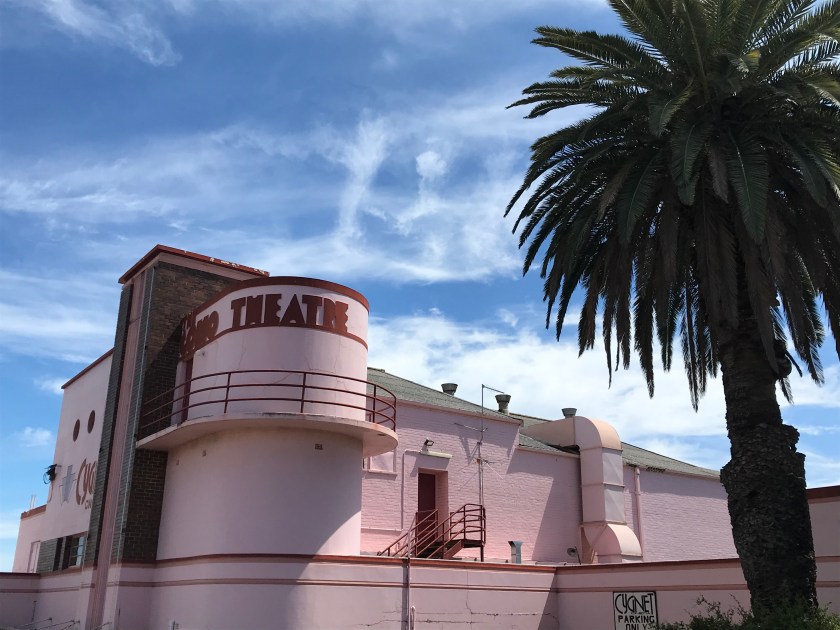
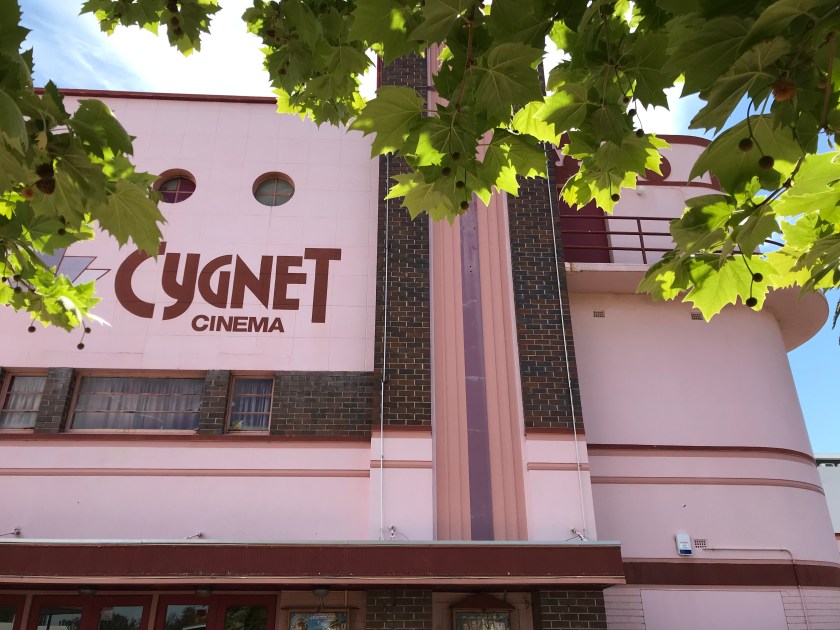
Strolling down the main street, Preston Street, the most obvious reminder of location is the Cygnet Theatre, long a landmark of Como and still a functioning cinema (or, at least, about to be again post COVID-19). This wonderful, pink, heritage-listed art deco building is not technically described as ‘public art’ – as it is architecture, not art – but it comes pretty close to that in my opinion.

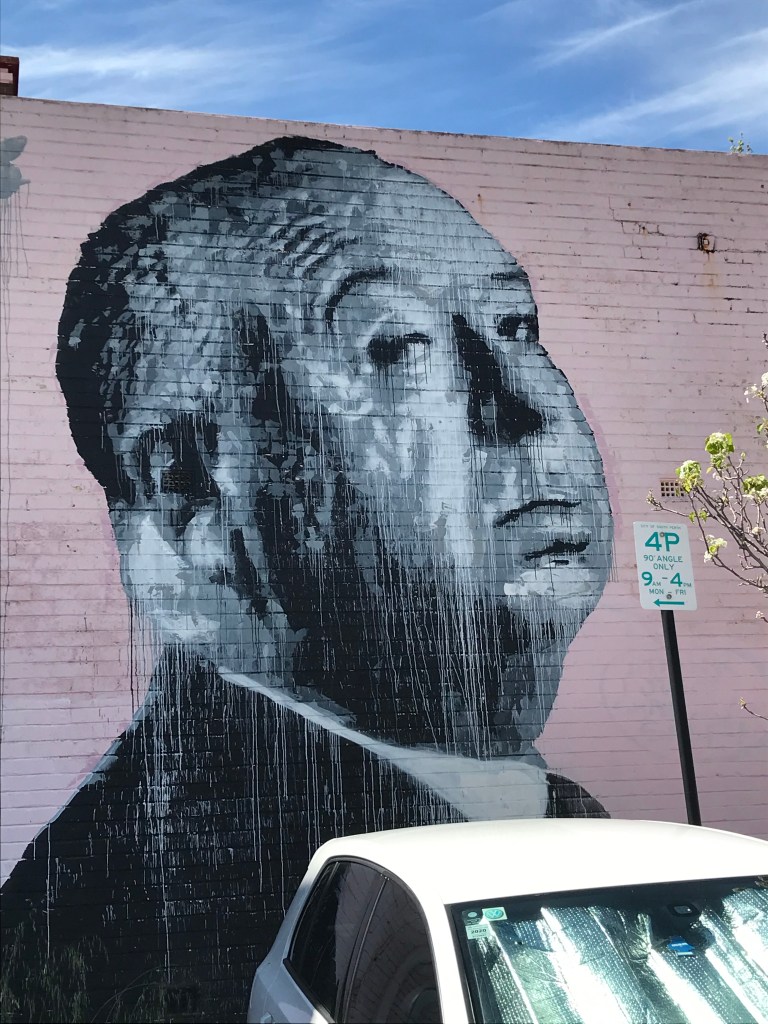
So, what is ‘public art’? In a nutshell, it seems to comprise works of art that are available for the public to enjoy. There is a surprising amount of it around, once you open your eyes a bit, and this is especially so in the City of South Perth, which now requires builders of large projects to devote 1% of their budget to some agreed public art (and they, in turn, devote 2% of their budget for large projects to public art). There are, of course, works of public art around that have been provided gratuitously, rather than as a direct result of the City policy. If the Cygnet Theatre is not an example of public art, then certainly the murals on its wall is an example:

The unmistakable portrait of film director Alfred Hitchcock adorns a wall of the theatre, nestling among the parking area, the foliage and the cars – looking down on them with that famous sneer. Murals have become more common these days, and I really like this one. There is another mural nearby, in fact, which also certainly qualifies as public art, on the wall of a Malaysian restaurant adjacent to the theatre:

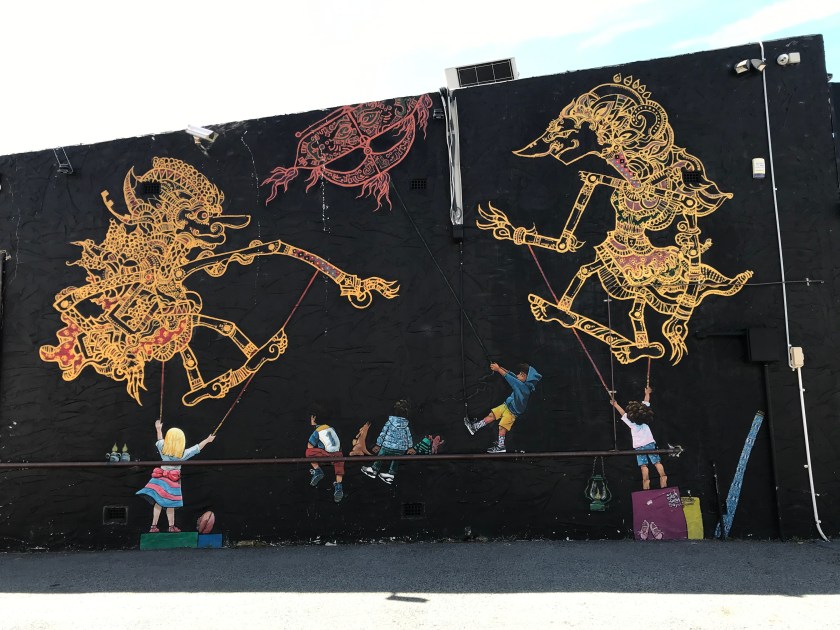
An otherwise ugly wall on the Nasi Lemak restaurant has been transformed into a playful and colourful piece of art work. I like the large Wayang Kulit (shadow puppets, used in Java for plays, with the puppets used to cast shadows on a white screen. The characters are from the ancient Hindu tales, such as the Mahabarata, and are all well-known to Javanese people.) But I also like the addition of the kids, playing with the puppets, and acting as puppet masters. I learned in Valparaiso, Chile (explore my website to see the details) that murals are used to deter graffiti, as street artists are unlikely to despoil the work of other artists; seems to be a win-win strategy for enhancing the environment.

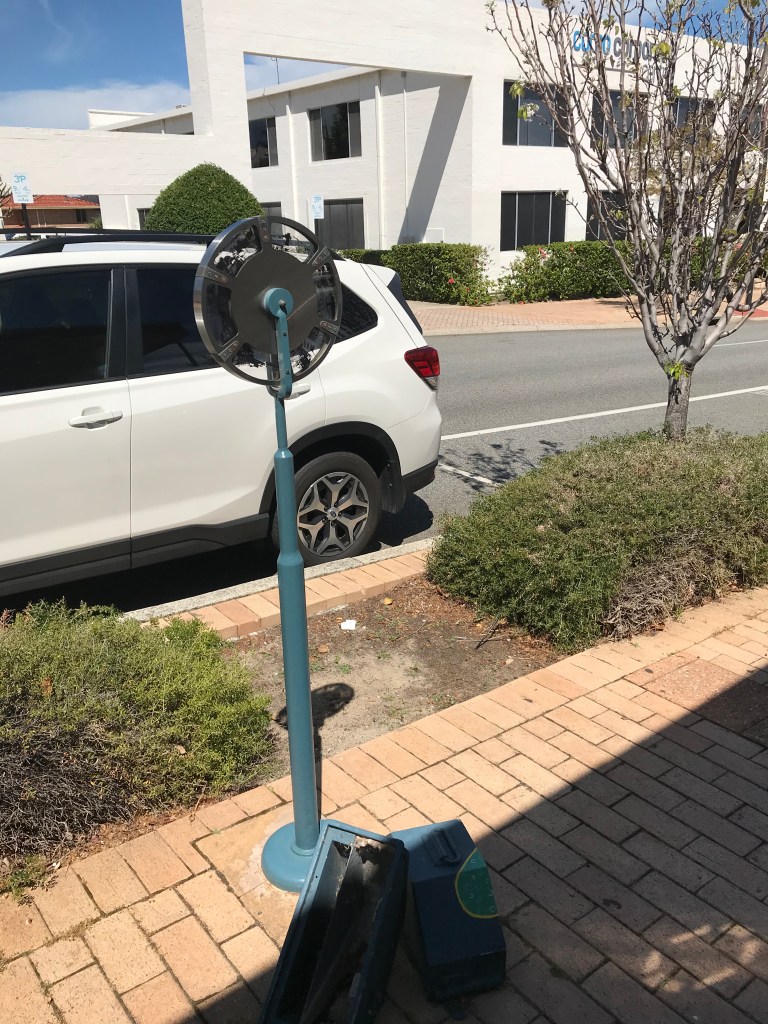
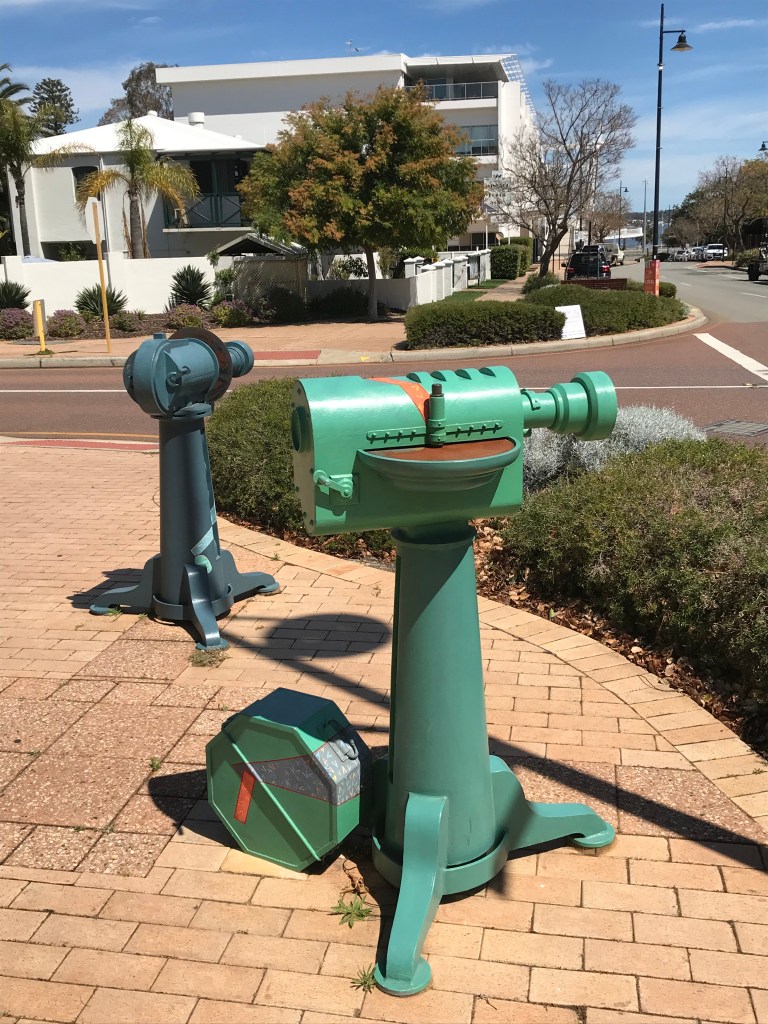
Continuing down the street a little, there are some strange-looking objects (which I learned that some people had mistaken for parking meters!) in various places. Here are some of them:

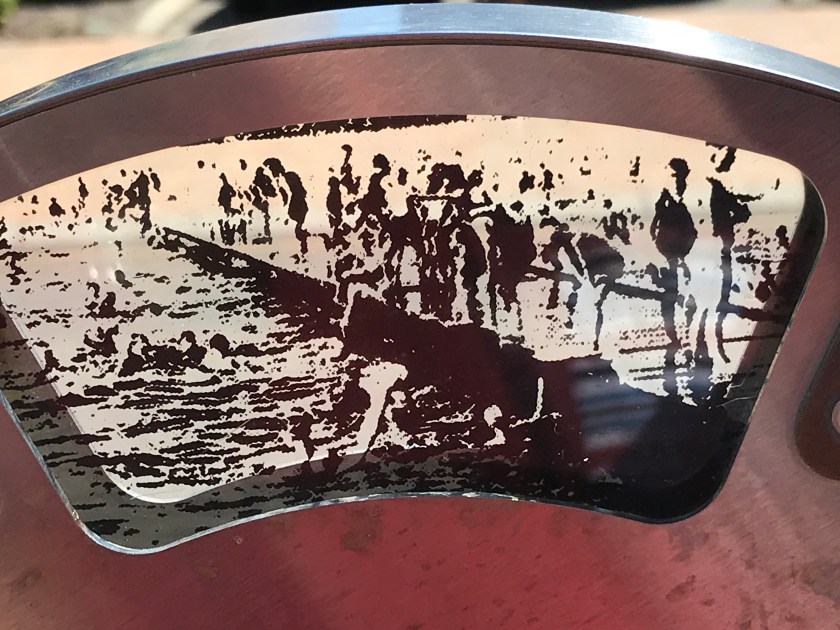
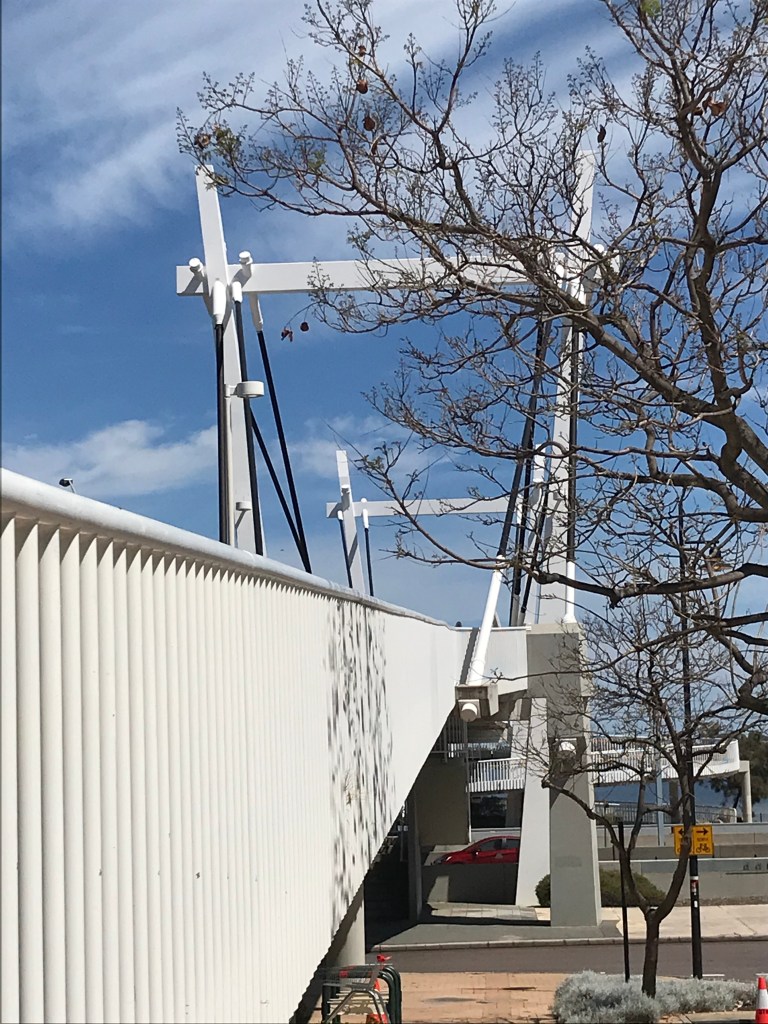
On closer inspection, it becomes clearer that these artworks are connected to the history of the area, and in particular the nearby theatre. I heard one local observing that his children thought the green objects were guns, but they are in fact reminders and representations of the olde world film projectors once used by the nearby theatre. Close inspection of the film reels also gives a reminder of the historical past of Como Beach, with its jetty a popular swimming spot, long before people had easy access to Perth’s beaches. Indeed, the path to the swimming spot is nearby, with a gleaming white bridge over the freeway:

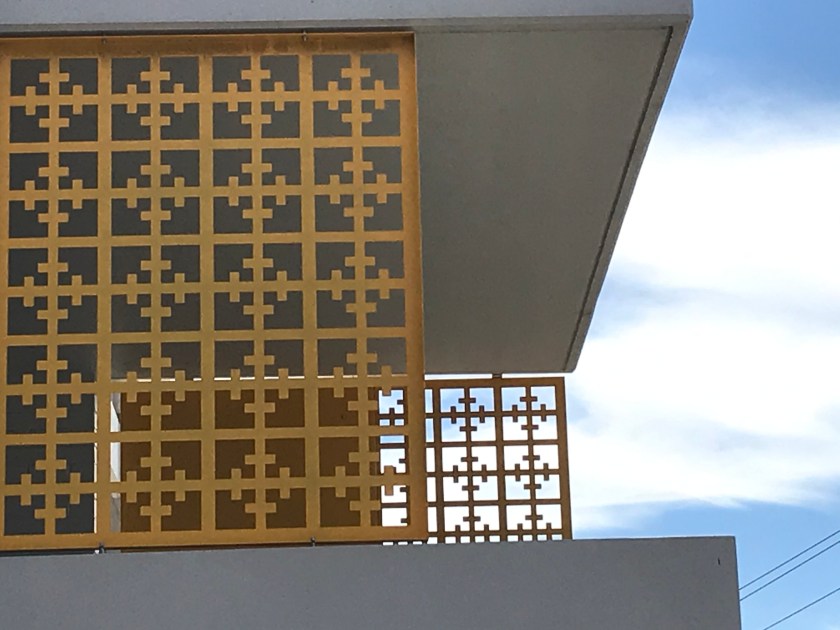
Is this an example of public art? Apparently not, as it’s architecture, not art, but it certainly tweaks some of my aesthetic impulses, especially with the blue Perth sky as background. But before we cross the bridge, there are some public art works near its base:

The shell shown here is a reminder of the days in which Como Beach was a playground, and children could collect shells from the river shore. It has been erected gratuitously by the people who built the adjacent small apartment building, presumably for others to enjoy and to pay some homage to the locale. I had seen it before – and enjoyed it – but had not noticed the artists’ inscriptions carved in the base. Anne Neill and Steve Tepper produced this for others to enjoy, but I did not realise that until recently. Makes me wonder about how artists get recognised adequately.

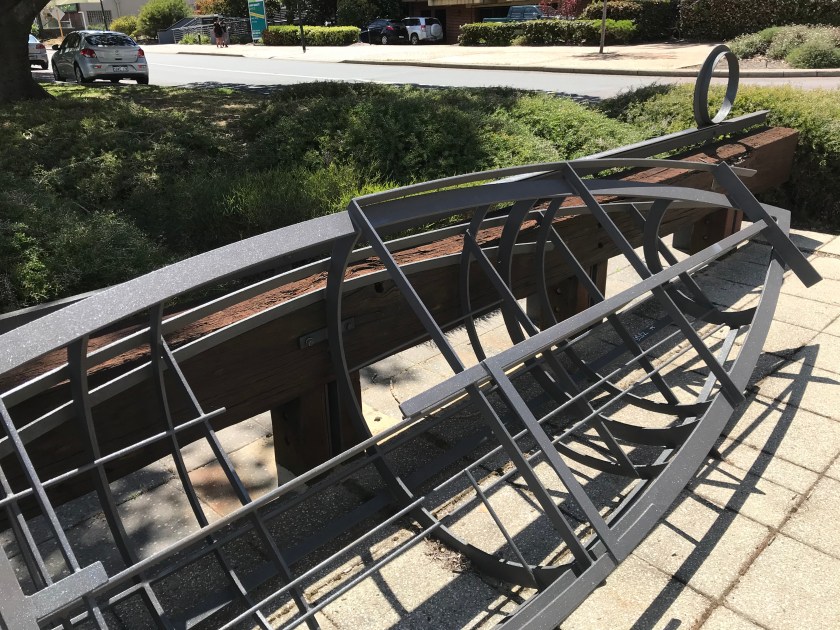
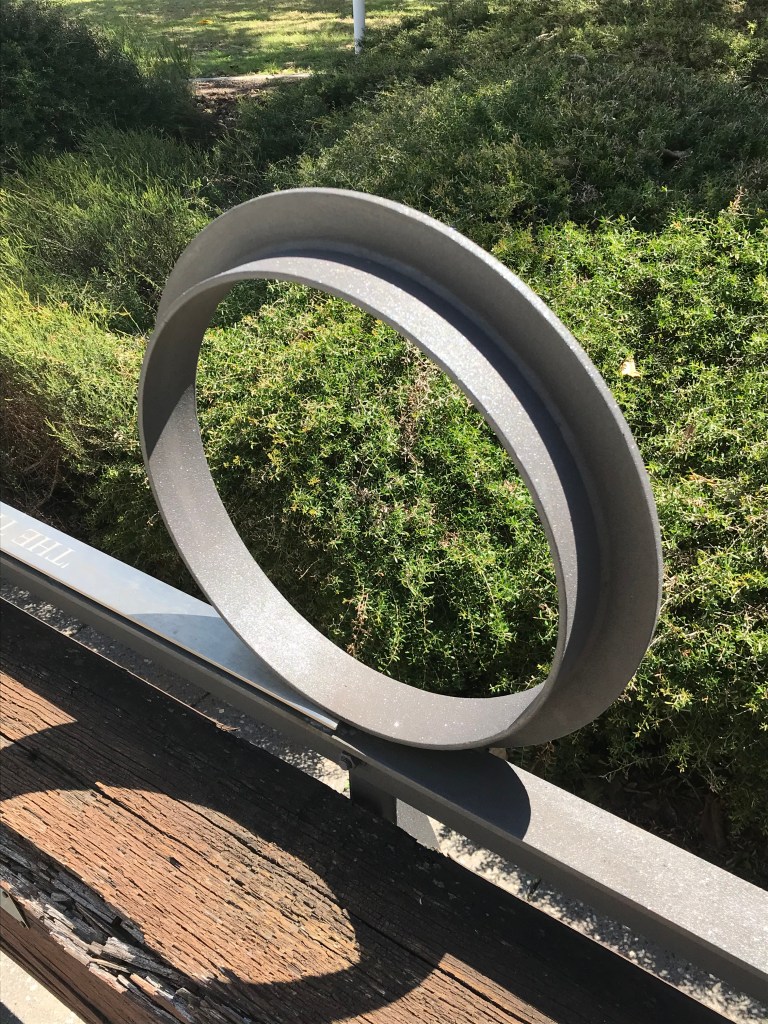
The other two images here show some sculptures at the base of the bridge, also reminding us of the past. The boat represents the many boats that used to visit this spot in the river, both locals and ferries, while the wheel is a reminder that trams used to come to this place, bringing people to a family swimming. picnicking, fishing and prawning spot, long before other forms of transportation. (I had also seen these often, as I walk over the bridge often, but not really connected them to the past. How can that be easily done, unobtrusively and aesthetically? There is an inscription on the work – not shown here – that I had not previously read.) There’s something ironic about these memories of a bygone age sitting quietly next to a freeway full of racing traffic … But let’s go over the bridge …

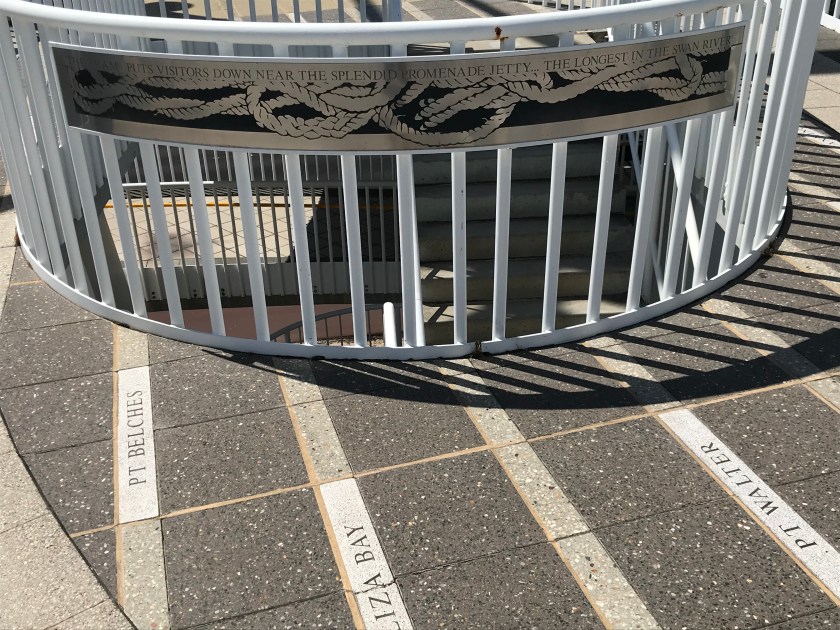
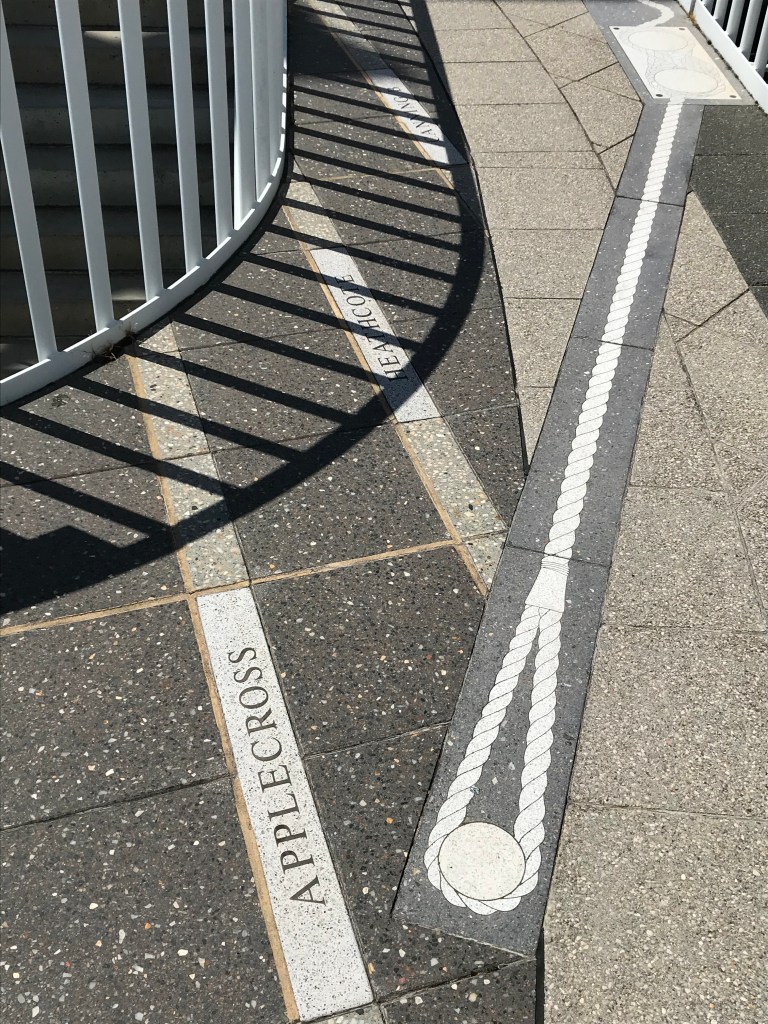
The bridge itself contains some public art works, representing in various ways the ferries and the jetties around the Swan River, as Como Jetty used to be a ferry stop and the jetty itself is still visible to all in the river, or driving past on the freeway. The names of the actual ferries are all there, so that a stroll over the bridge is a walk down memory lane. Well, not quite: most people strolling over the bridge are not actually ‘remembering’ those days, but hopefully learning about them. This bridge was constructed with government funds, so the art works were an agreed part of the project. Crossing over the busy freeway, we get to Como Beach itself:

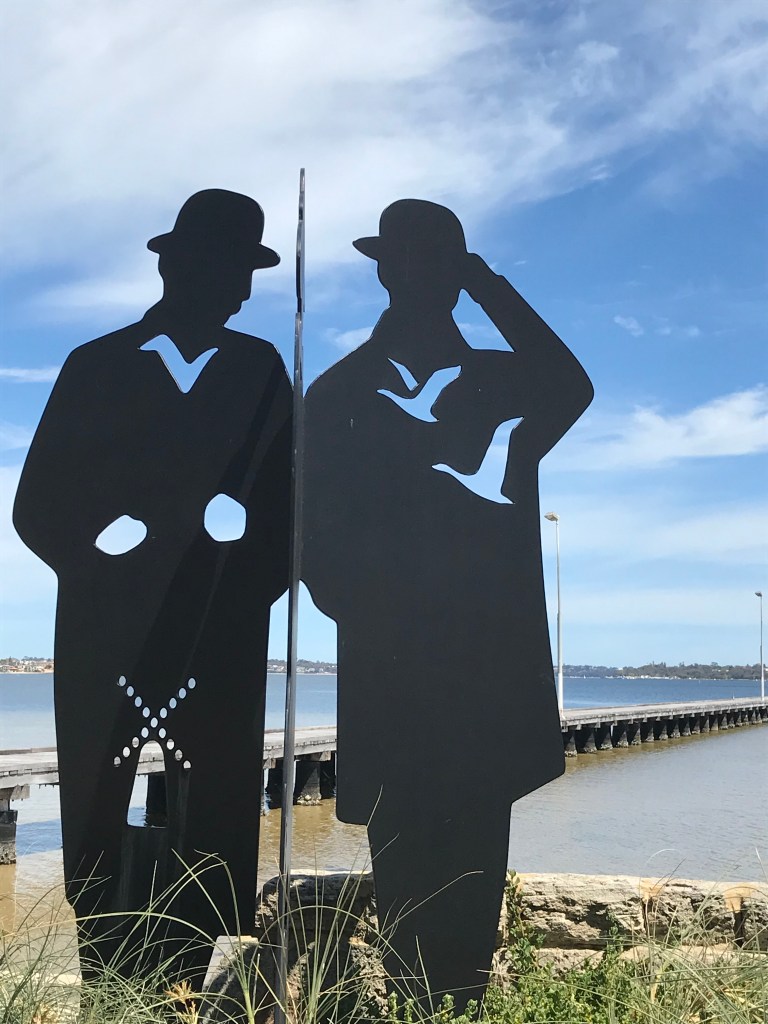
The silhouette sculptures on the beach are reminders of an age gone by, when people travelled to Como Beach to meet up with friends, and children played on the shore. The jetty is still there, of course, but the crowds have diminished … funny how planting a freeway can discourage people to stroll down to the river. But all is not lost, as there are now playground and sandpit renovations being completed, new seating areas and the picture at the top illustrates that picnic space is returning; so watch this space. A pleasant spot to watch the sun go down, ride a bicycle into the city or just sit and think about the passing traffic – cars, yachts or pelicans …

Back over the bridge is the most recent addition to the local collection of public art, a beautiful statue commissioned by the owners of a new building a block away from mine:

A statue is more like what is normally regarded as ‘art’, and I think this is a lovely statue by Anna Ruwhi, whom I think is a local Iraqi immigrant, was completed just a few months ago in 2020. The Inscription in the base notes, “The two human figures, a man and a woman, pay homage to the multicultural tapestry of the South Perth community, and how its blend of people live, love and interact.” I couldn’t put it better myself, except to note my delight at the pelican joining the man and the woman, as pelicans are emblematic of the Como Jetty – and I have often marvelled at their patience in sitting atop one of the light towers. A lovely statue, which would probably not exist but for the City policy of requiring some public art contributions by developers to the local environment. I am pleased that such a policy is in effect.

Statues can be problematic, of course, as recent events in the USA have illustrated, but they can also enhance the environment wonderfully for the general public. I recall reading once that, other things being equal, a city was likelier to be better if it had more statues, and my meanderings around London, Paris, New York and many other places attest to this. Statues of old dead men can be problematic if they reflect a colonial, racist or oppressive past (remembering the statue of Saddam Hussein toppling or the agonised debates about Cecil Rhodes in Oxford), but somehow I think that lovely statues like this will be safe from the tides of political or social change. I hope so, anyway.

Wandering home from my stroll, I can’t help but wonder about what is, and what isn’t ‘public art’. Public art can remind us of our past, as well as our present, can tell stories or just enhance our outlook. So building decorations, verge plantings and even plants visible to the public all have aesthetic elements to them, even if they don’t come within the City’s definitions of ‘public art’. It all reminds me of how lucky I am to live here, as well as how pleased I am that public art is part of my surroundings, and that the City of South Perth is working to keep it that way, and improve it.

I hope that you enjoyed my tour; but it’s more fun to do it for yourself, if you happen to live close enough to do so.

A day in the Lavaux region

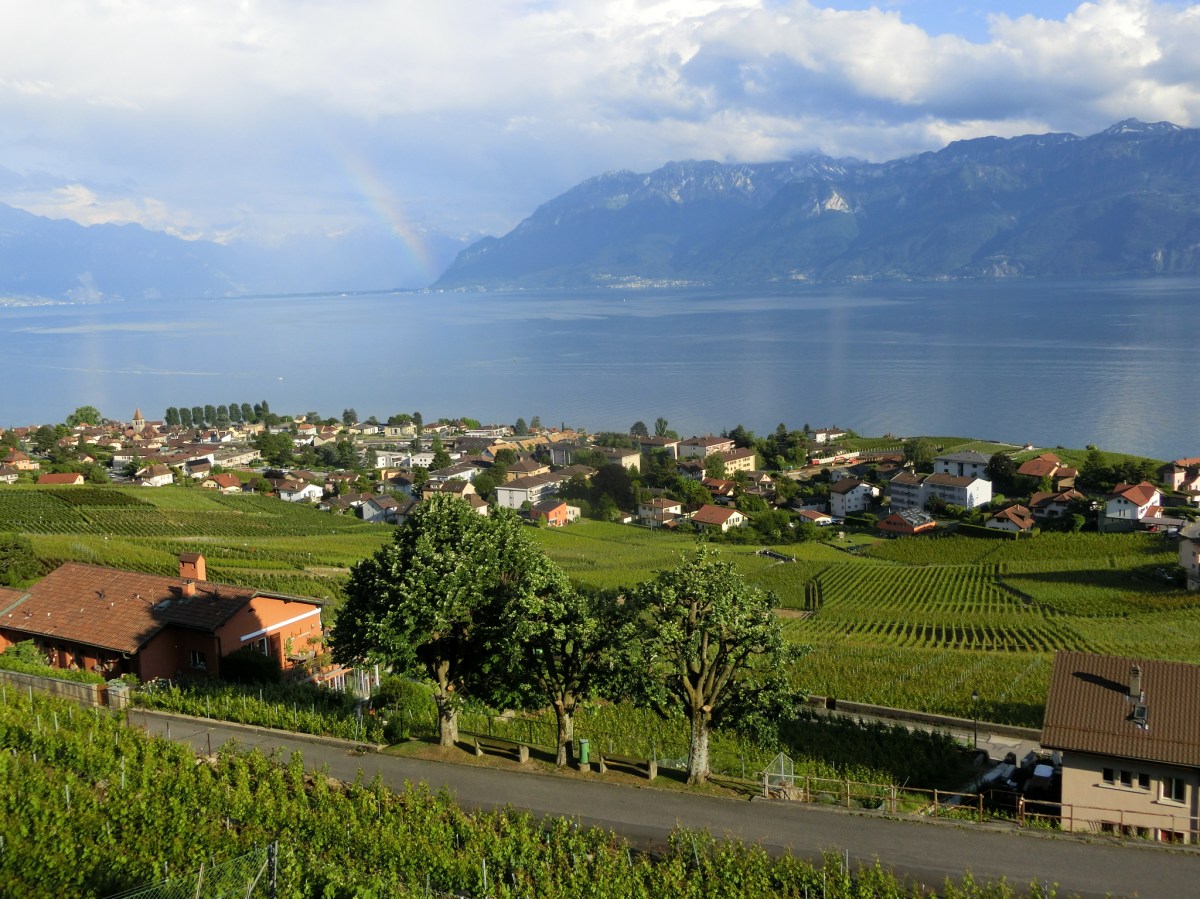
Nestled on a hillside adjacent to Lac Léman (popularly, but incorrectly, known as Lake Geneva), we were fortunate to stay in the small village of Grandvaux, set in a beautiful location with stunning views across to the Alps from our high vantage point. The village of Grandvaux is part of the Lavaux region, just out of Lausanne. The border between France and Switzerland goes down the midle of the lake, so that the Alps immediately opposite, showing in the picture above, are in France.

This region has UNESCO World Heritage status because of its lovely terraces upon which wines have been produced for many hundreds of years. The holdings are relatively small and drape over the hillside in picturesque ways.

Local restaurants, such as this fine dining example in Grandvaux itself serve local wines, and even show patrons precisely where the grapes were grown for a particular wine, as you can see from the wine map provided at the tables. You can also see that the restaurant has wonderful views across the lake to the mountains beyond, so that the excellent food and wine is not the only attraction.

Looking over the lake from our balcony is a delight, especially in the sunshine that we have enjoyed recently, with beautiful views in all directions, and the occasional craft sliding by. We also saw yachts, stand-up paddle boards and other vessels, enjoying the environment and helping to create lovely pictures.

Although it is tempting to just sit and look and take it all in, we embarked on an excursion, wandering by car around the area before heading up to a chalet in the nearby (Swiss) mountains. Chalets are typically owned by families for many years, and were essentially holiday houses in many cases. These days, with the benefits of cars to get around, they are easily accessible up small mountain roads, even in winter seasons. The family chalet we visited had jaw-dropping views across the valley and nearby mountains.

Inside the chalet, traditional Swiss furnisihings and designs were apparent … this chalet was a veritable family history museum, with lots of memorabilia, as well as being somewhere comfortable to spend time in various seasons.

High up in the mountains (this chalet was at around 1100 m), summer flowers are evident everywhere, basking in the sunshine, so it was a delightful place to wander around and enjoy the views and the mountain air. It’s always good to slow down and smell the roses (or other flowers) and you can do that a bit by clicking on the pictures to see more of them.

In summer time especially, the beautiful countryside of the Lavoux region is enjoyed by walkers and cyclists as well as by car drivers. It looked to me to be a very long way to ride a bicycle uphill, or to walk, so I was pleased to be driven up instead. We saw many cyclists during the day, both around the wine-growing terraces and even up in the mountains, as well as casual walkers and hikers.

Even higher up the mountains from the chalet, at just over 1600 m, we enjoyed lunch at a traditional restaurant, with startling views across the valley.

The green colours everywhere are beautiful and we were confident that the cattle wandering high in the mountains thought so too.

Driving back through Montreux, on lake’s edge, was also a delight. Montreux has been famous for many years because of its annual Jazz Festival, but is also a lovely place to visit, and is reminiscent of the French Riviera. People strolled along the lovely lake, enjoying the general ambience, the flowers and the views across the lake. It’s also likely to be a place for affluent people – we even saw an Indian wedding in progress, which no doubt cost a great deal of money to stage here.

Several notable people have lived in Montreux and nearby. The statue of Freddie Mercury, lead singer of Queen, reminds visitors of one example, but there are others from the entertainment industries, such as Charlie Chaplin and David Bowie.

Being here in summer, on a lovely day, has no doubt added to the ambience, although I suspect that this region is beautiful at any time of the year and in almost any conditions. The summer flowers have certainly added to the occasion, helping everything to look clean and sparkling, and the grapes (just starting to appear) will help create an ambience of abundance and beauty long after we regrettably leave.

Sunset over the lake is a reminder that this is a stunningly beautiful part of the world that can only be appreciated by being here, not looking at photos or reading about it. I have heard it said that life can be somehow measured in part by the moments that take your breath away … there are lots of those up here.

CIMG3419

We are so lucky to be here. I hope that you can make it here one day to see it for yourself.

Chateaux of the Loire Valley

The Loire Valley has long been famous for its chateaux, which are basically similar to castles, although less obviously concerned with military matters. There are many chateaux in the Loire Valley, and they are wonderful resources to understand the conspicuous wealth of the French nobility prior to the French Revolution in 1789. Of course the chateaux were also connected with French royalty, the creme of French nobility. The nobility were predominantly hereditary nobles, so that people achieved their status and their wealth essentially because of their birth, rather than their talents or their achievements.

In this short post, I will describe briefly only two of the chateaux, which I have had the good fortune recently to visit. The top picture shows the Chateau de Chenonceau, a favourite of many people, located on the Cher river near Tours. The other chateau is Chateau Villandry, also located near Tours. The conspicuous feature of Villandry is its beautiful and geometric gardens, as can be seen from the picture below:

CIMG7804

Chateau Villandry was resurrected fairly recently (around a century ago), as it had fallen into disrepair. Joachim-Leon Carvallo gave up a promising career as a medical scientist to devote his energy, time and money to the chateau, and especially to its gardens. The gardens are arranged in beautiful geometric patterns, as the vegetable gardens above suggest. Here is another part of the gardens – the Love Garden – which looks different the higher up the viewpoint. From a reasonable distance, the love hearts (and thus the name become clear:

Other gardens at Villandry are similarly geometrically interesting:

The many vegetable gardens are neatly arranged too, in geometric patterns of various shapes and colours. I don’t know what they do with all the vegetables produced, but I assume that they will be important to the chateau to generate additional income.

While the main interest in this chateau is in the garden, the inside of the chateau is not uninteresting, as the images below suggest:

There were enormous bunches of fresh flowers in the building, and many rooms had period furniture of various kinds. One of the images above shows a view of a kitchen, while another shows a detail from a room described as an ‘arab’ room, and which displayed some wonderful Islamic patterns (the only examples I have seen amongst the chateaux so far).

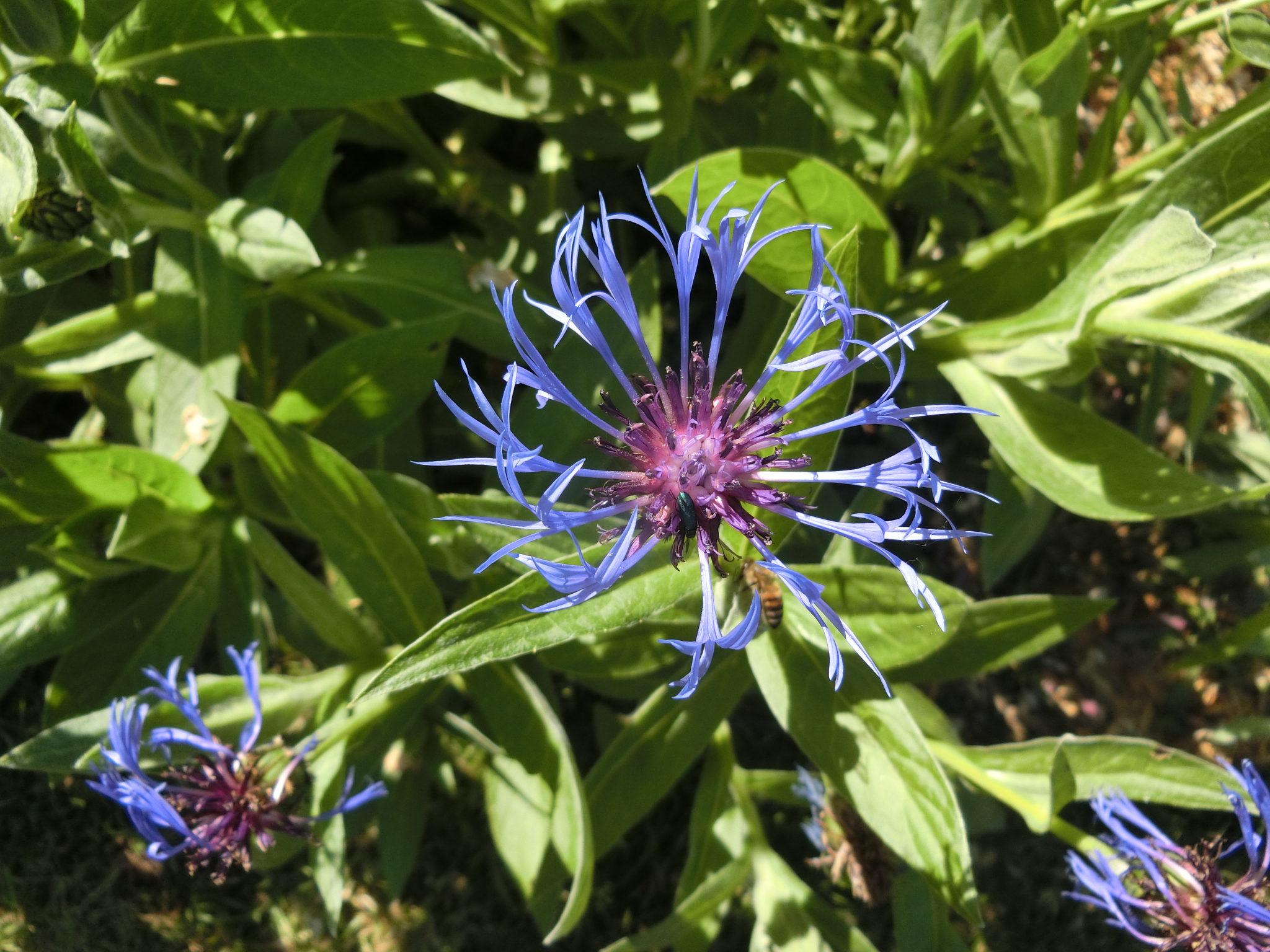
Of course, there were many lovely flowers among the gardens, such as the following, which was new to me:

CIMG7823

In contrast Chateau de Chenoncaux had a more interesting interior, with sumptuous decorations in rooms characteristic of the times. For example, the photos below show bedrooms fit for a king:

Indeed, residents for a while included King Henri IV and his wife, Catherine de Medici, so it was important that the bedrooms be fit for kings (and queens). Extravagant fireplaces and rich tapestries also gave an air of extreme wealth to the rooms:

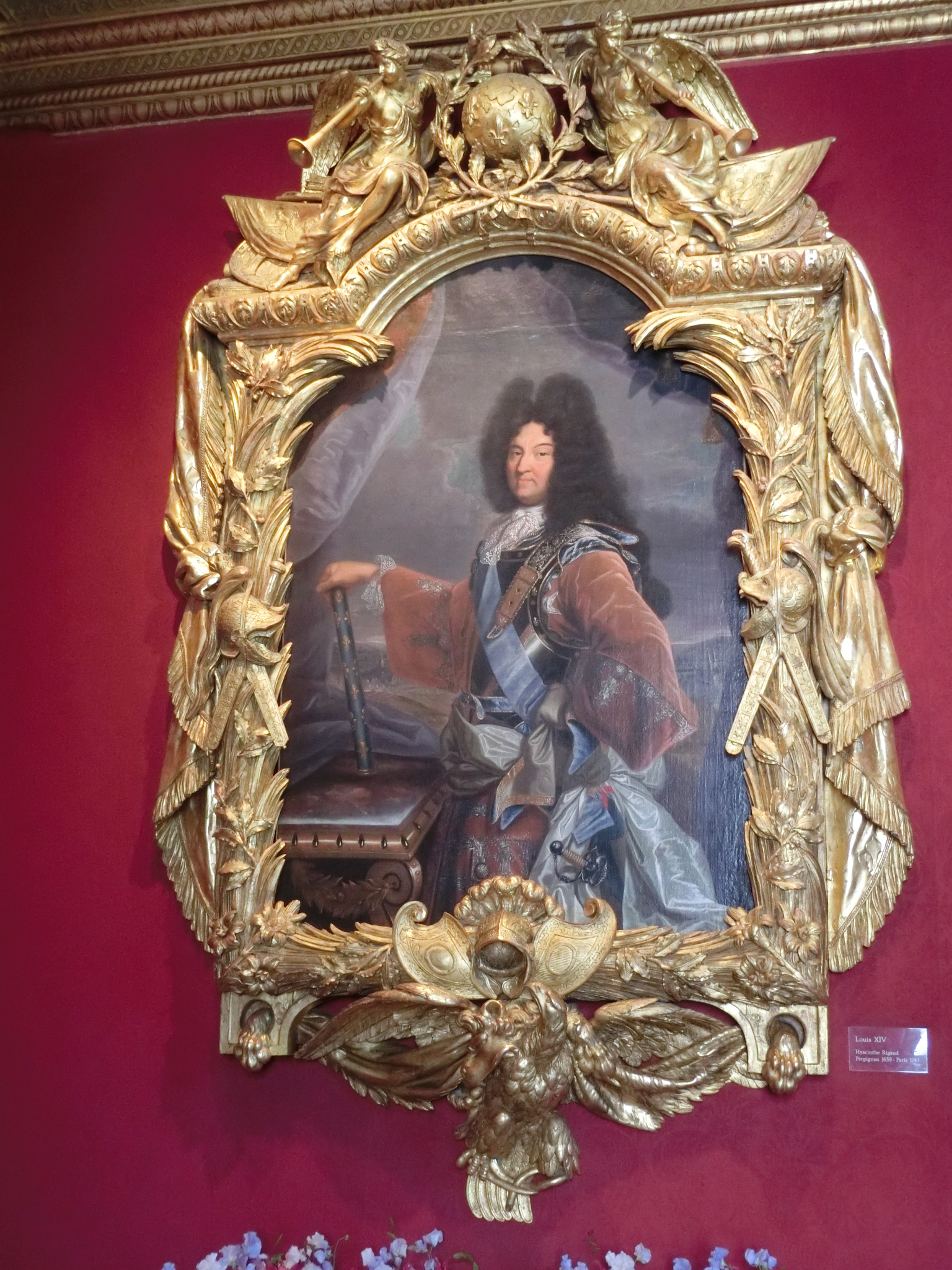
One of the rooms contained an enormous portrait of the king (Louis XIV), adding credence to the royalty connections of the chateau:

CIMG7902

Throughout the chateau were art works, priceless tapestries, beautiful furniture as well as lovely floors and ceilings. Here are some pictures to give a hint of that, showing also one of the enormous bunches of (fresh) flowers on display.

The building has changed over time, starting out as a remodelled version of a mill, and then gradually being extended (across the river) by the addition of long corridors to produce the shape shown at the top of this page. These corridors served as entertainment spaces and places for artistic work to be displayed, although their purpose has changed a little now, and are often full of tourists. They also provide an easy way to cross the river to see the Chateau and its gardens from across the river.

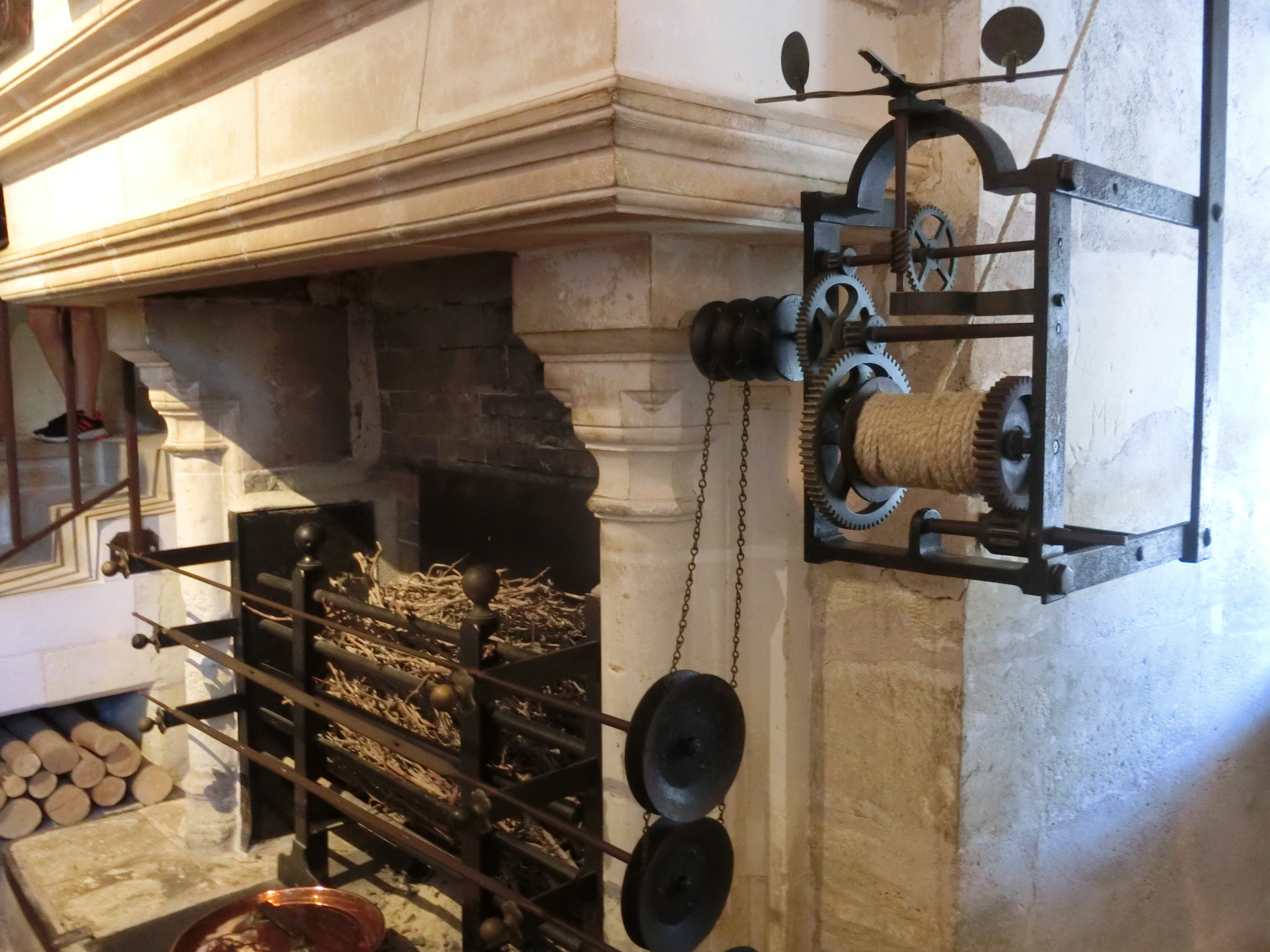
A chateau has to work, of course, and a good example of this was the clever arrangement to provide a rotisserie facility over an open fire, using a heavy weight and a clockwork mechanism cleverly for the purpose:

CIMG7919

An interesting aspect of Chenonceau, apart from its treasures and its beautiful construction, is its interesting history. Over the course of a few hundred years of French history, it has firstly served the nobility and royalty, then became a base for intellectual thinking (most obviously through the agency of Jean-Jacques Rousseau, a key figure in the Enlightenment who was a frequent visitor for a while.

After the French Revolution, when the old nobility and the church were attacked by the people of France, the character changed yet again and then in the twentieth century, it served as a hospital for French wounded soldiers. the location of the chateau – right on a  line of demarcation – gave it particular importance, as it became a mechanism for people to escape the clutches of Nazi soldiers and a means of escaping across the river.

The gardens of Chenonceau are less extensive than those at Vilandry, but just as geometrically organised. The two main areas are shown below, showing large square spaces with lovely spring flowers appearing recently.

Elsewhere in the grounds are other attractions, including an old maze (the idea of Catherine de Medici, it seems), a small farm and lovely forest paths to walk along, as the following pictures show.

There are many other chateaux in the region and they are certainly worth travelling to France to enjoy.

A drive in the bush

Growing up in post-war Australia, like many others, I was aware of a view that the countryside in Europe, depicted by the nineteenth century landscape painters, was ‘beautiful’, depicting mountains, lakes, ordered fields and greenery. There are many examples of these in our art galleries and even in travel brochures. It was not at that stage fashionable to see beauty in the Australian countryside, and those (like my mother) who described it that way were regarded a little strangely. We’ve changed, of course, now, and I hope these these few photos of a recent drive in Australia’s south-west corner show that we live in a beautiful part of the world.

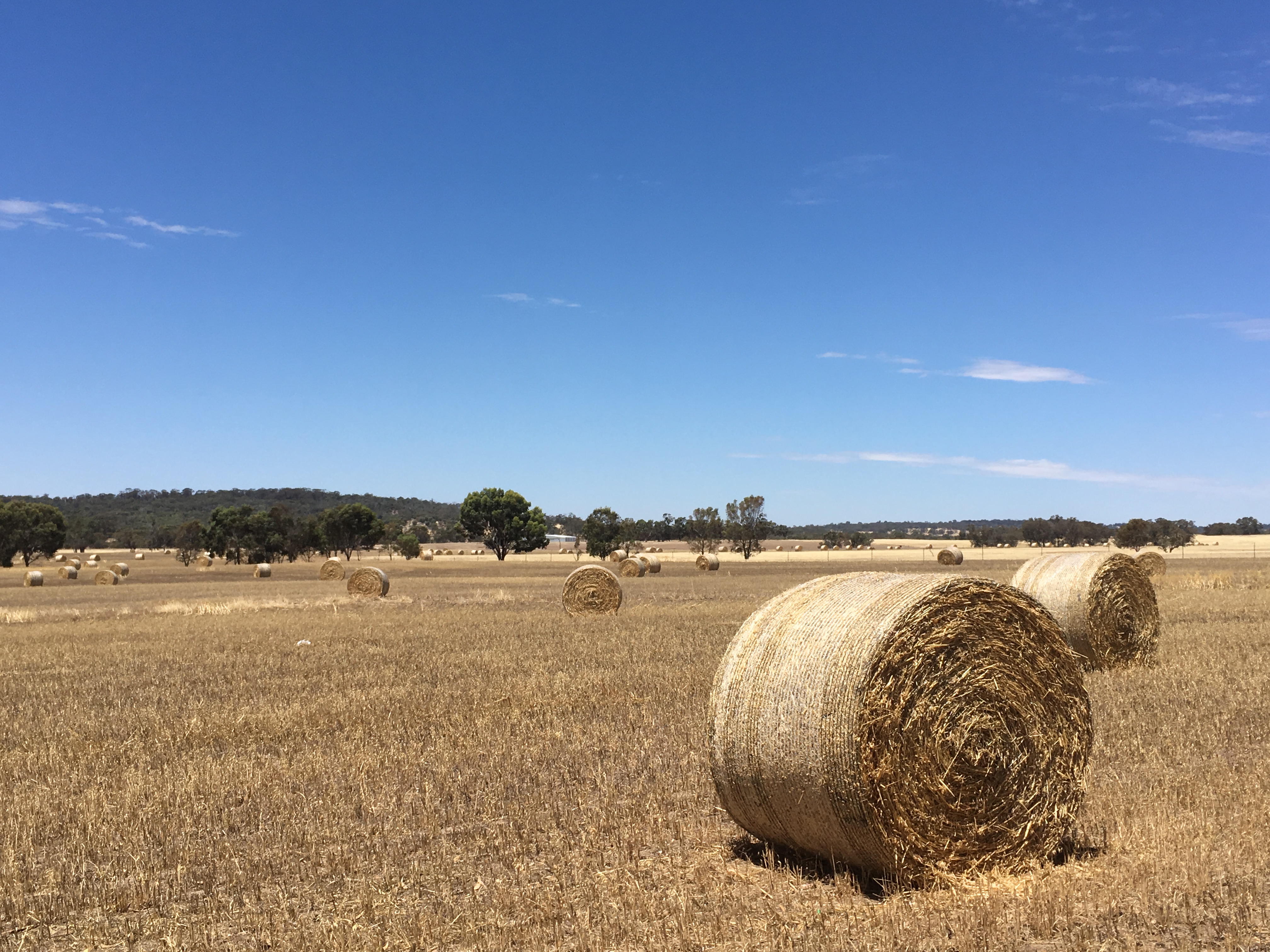
One of the things I have found surprising in the northern hemisphere is that summer is associated with green, where I have always associated winter with green and summer with brown. At least in Western Australia, rainfall is almost entirely a winter affair, so that dry scenes like this farm in January are common in summer time:

IMG_6529

Driving in the populated south-west often is through farmland, but quite different from farmland in the UK or the USA, as the relative lack of rain here means that farms are much larger, so that it is rare to see a farmhouse and almost never can one see two different farmhouses at the same time.

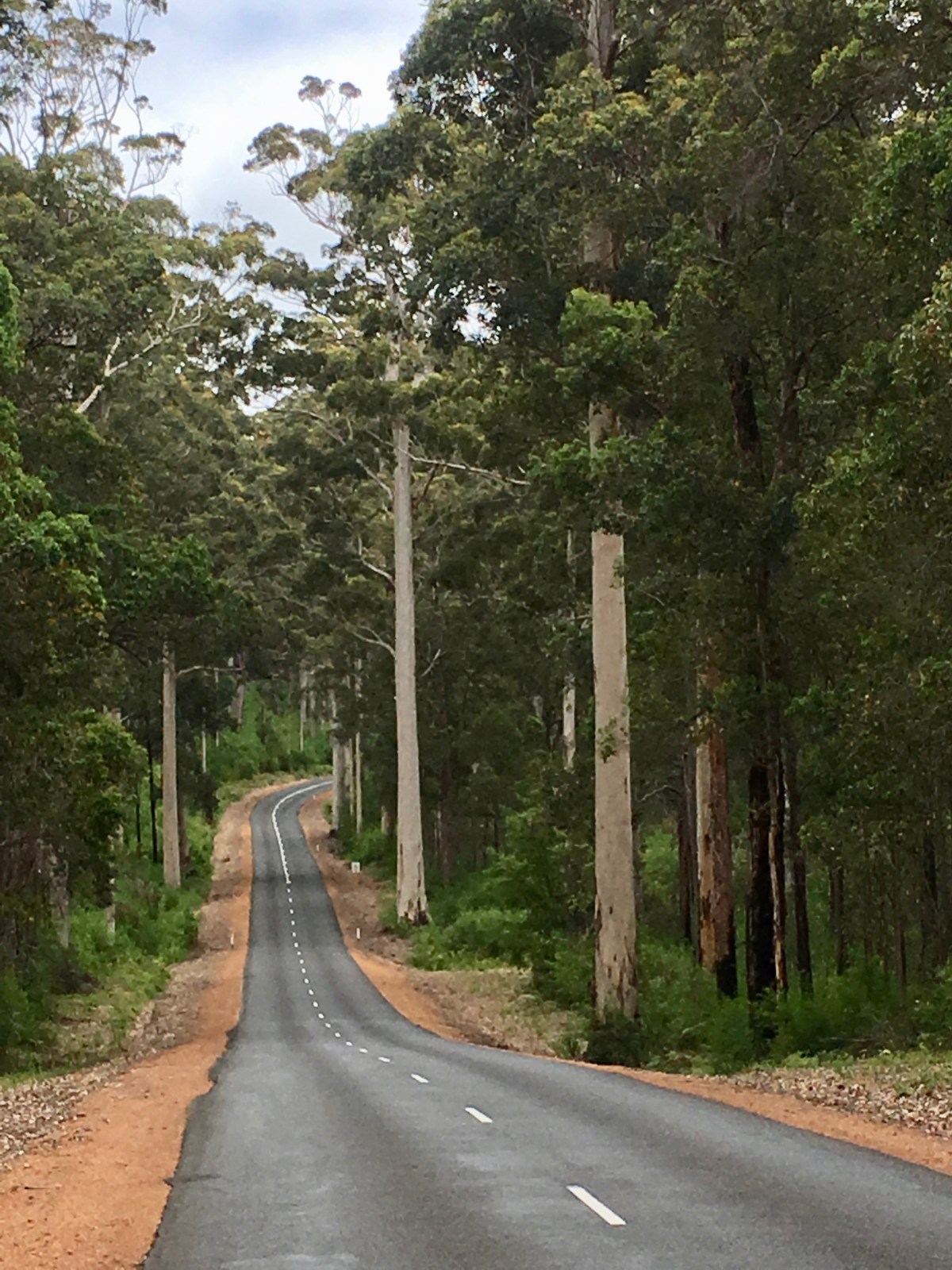
As the photo at the top of this blog shows, some country roads go through lovely (evergreen) forests. There is still a timber industry in our south-west, although increasing concern about the environmental consequences of cutting too much old growth forests for commercial reasons. Fortunately, it is still possible to drive through lovely forested areas like these:

While the roads look small, at least by international standards, they do not carry as much heavy traffic as in more populated parts of the world. The roads shown here are nonetheless the main highways in the area, and I drove a total of about 600 km on roads of this size. Not all of them drove through forests like these, however … many were in large flat spaces through farmland, from which trees have long since been cleared, as in the hay bale photo above. The small white posts on either side of the road are wonderful for night driving, making corners easy to see. I had not appreciated how useful they were until driving overseas in places that do not have them, and which are much less safe accordingly.

The forest (which is generally described in Australia as ‘bush’, not ‘forest’, explaining the title of this blog) is a rich ecosystem, with many native species there, when one looks hard enough. There are also many signs of fires, a serious problem for local inhabitants, but at the same time an important part of the process of regeneration of the bush for thousands of years. Balancing the needs of people and land is always tricky.

There are also fauna, of course, not shown here. One of the hazards of driving in our bush is the prospect of hitting kangaroos coming out of the bush across the road, especially at dawn or dusk. Such a prospect is quite dangerous, often because people swerve to avoid hitting the animals, and lose control of their vehicles, in the worst cases hitting other things like trees instead. Indeed, many local residents have a ‘roo-bar’ on their vehicles to minimise risks.

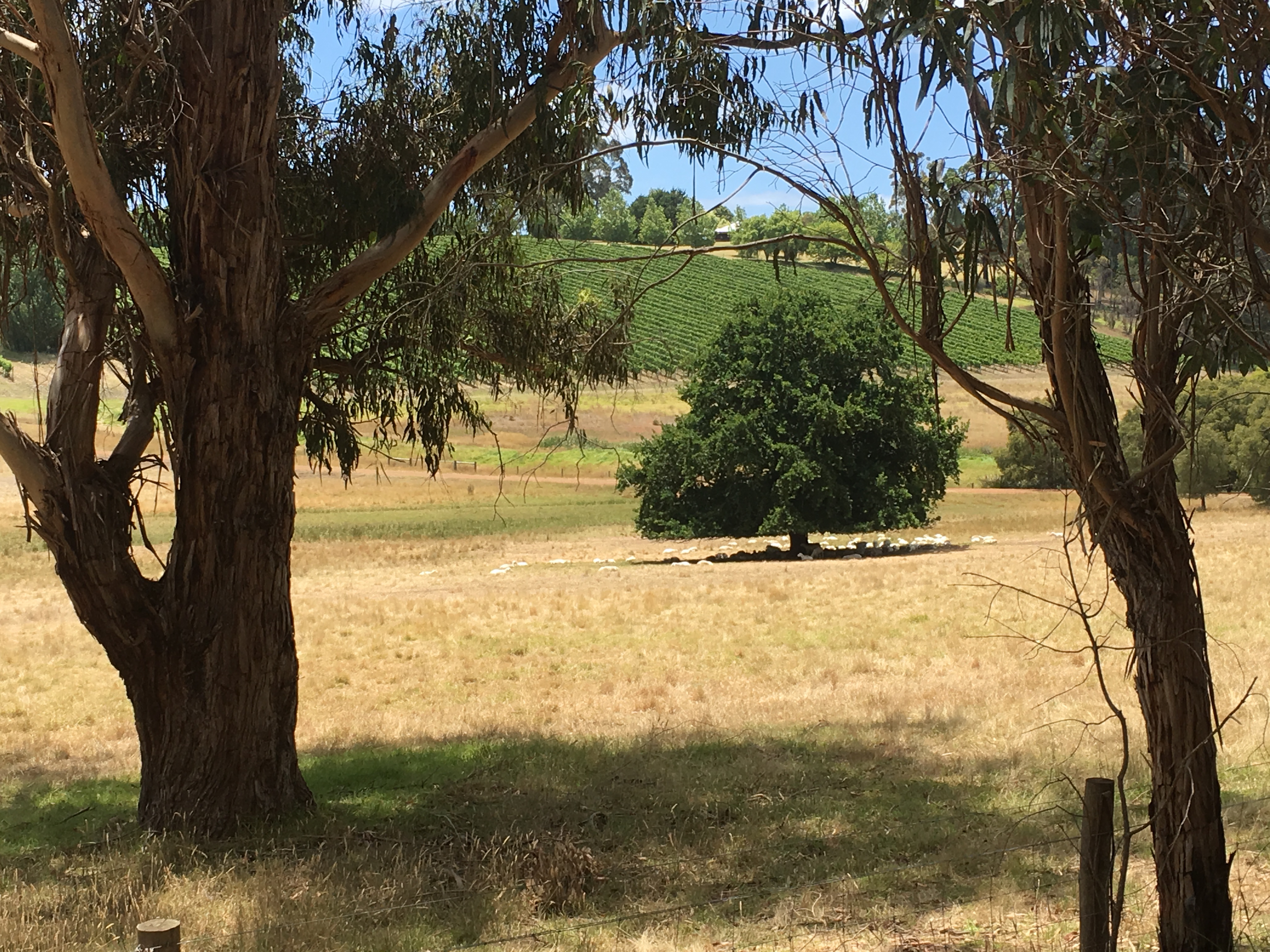
Away from forested areas, some farmland scenes are also attractive, such as this one near Pemberton, showing grape vines and sheep (resting under the tree) as well as some trees that have escaped clearing for grazing of animals. There are about three sheep in Australia for every person, which might account for our national dish – if there is one – to be sometimes described as roast lamb; it also accounts for the phrase from an earlier time that ‘Australia rides on the sheep’s back’, referring to a once very important wool industry.

IMG_6631

The south-west of WA is justifiably famous for its flora, with thousands of examples of indigenous plants (here called ‘wildflowers’) that are unique to the area. here are a couple of examples:

A walk in the forest at any time of the year will reveal many examples of these kinds, if one looks hard enough (in summer, especially); it is not necessary to look too hard in some places at other times, where the countryside is covered in flowers. Even when flowers are not evident, the bush has some spectacular indigenous plants, perhaps none more so than the widespread (and spiky) grass trees shown here:

IMG_6634

Driving in the country is not restricted to farms and forests; it also can involve the lovely oceanside. Western Australia’s coast is more than 20 000 km in length (around 13 000 miles), most of it uninhabited. Most of the coastline borders the Indian Ocean, although the south coast is regarded (by Australia) as bordering the Southern Ocean, separating Australia from Antarctica.

The wind farm shown above comprises the turbines shown and provides about 80% of the electricity needs of Albany, a major town at the bottom of the state. It overlooks a lovely stretch of coastline. In fact, the whole coastline is lovely, but in changing ways. In many places, there are hundreds of kilometres of pristine beaches, unlike the photo above that shows hills and rocks. The citizens of Western Australia (most of whom live near a beach) have long taken our beaches for granted, thinking (mistakenly) that beaches are like that all over the world.

This blog has shown no people at all, although there are signs of their presence, with roads, farms, vineyards and turbines. But rest assured, there are people here as well. The population density of Western Australia is around one person per square kilometre, but it varies greatly between Perth and the rest of the state. The density of greater Perth (in which there are about 2 million people living) is about 315 persons per square kilometre, while that of the rest of the state is about 0.2 persons per square kilometre, or about one person for every 5 square kilometres (roughly one person for every 2 square miles). So people are pretty thin on the ground, but you will find them friendly to talk with when you come here.

I’ve deliberately kept this blog short, with just a few photos, to induce you to come look at the bush for yourself and get the bigger picture.

I hope you can make it soon!

Visiting Taiwan

What a lovely time I have had in this interesting and diverse country! It’s hard to capture it in a single blog, but I’ve pasted a few impressions of various kinds here to have a first attempt at that.

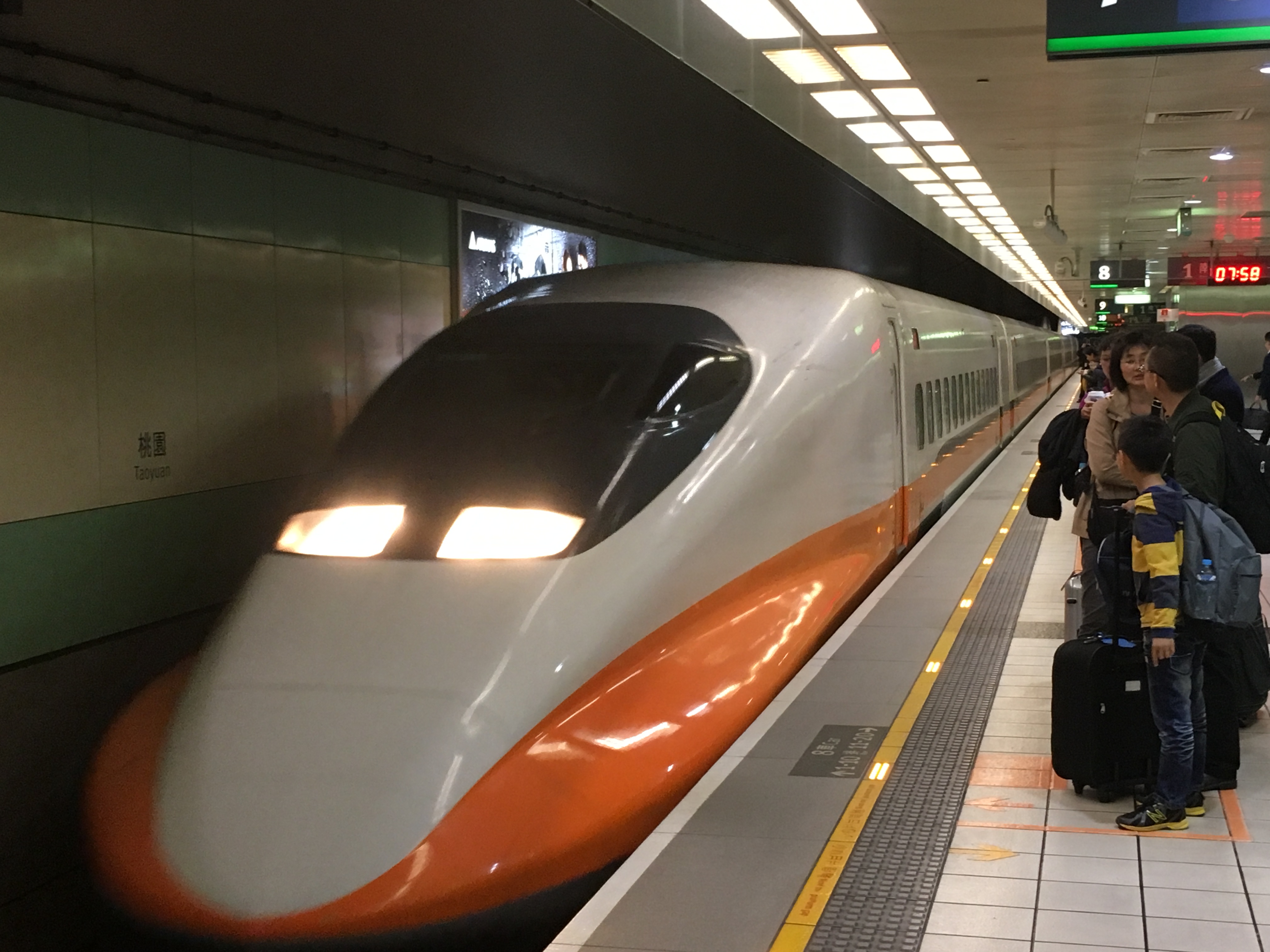
My travels around Taiwan have been easy, thanks to a great public transport system. I’ve ridden on the newish High Speed Rail lines, other long-distance train lines, various MRT systems in cities, local buses and special tourist buses, inexpensively and generally without any problems. The High Speed Rail lines are especially fast – as their name suggests, and reminded me of the Japanese shinkansen:

IMG_4782

They run efficiently, precisely on time and the only (slight) problem was that the new stations are sometimes not in the middle of cities, so you need to use other means of transport as well (which was never difficult, however). You could navigate the ticketing systems with English, and stops are announced in English as well.

Other trains, such as the MRT (similar to Singapore’s and just as good) have English signage inside stations and the trains too, so I didn’t get lost often. Even when it was tricky, it was fun to learn, as in the example below, where the Tourist Information Service had shown me how to go to a museum with a handwritten note, but not quite written down all the information. So I knew the station started with Bo and had the Chinese characters to match. The note was enough for me to buy a ticket and, as you can see, the Chinese characters for Bao’ an in the train itself were interpretable if you looked hard enough! I got there without a hitch – although with a little anxiety!


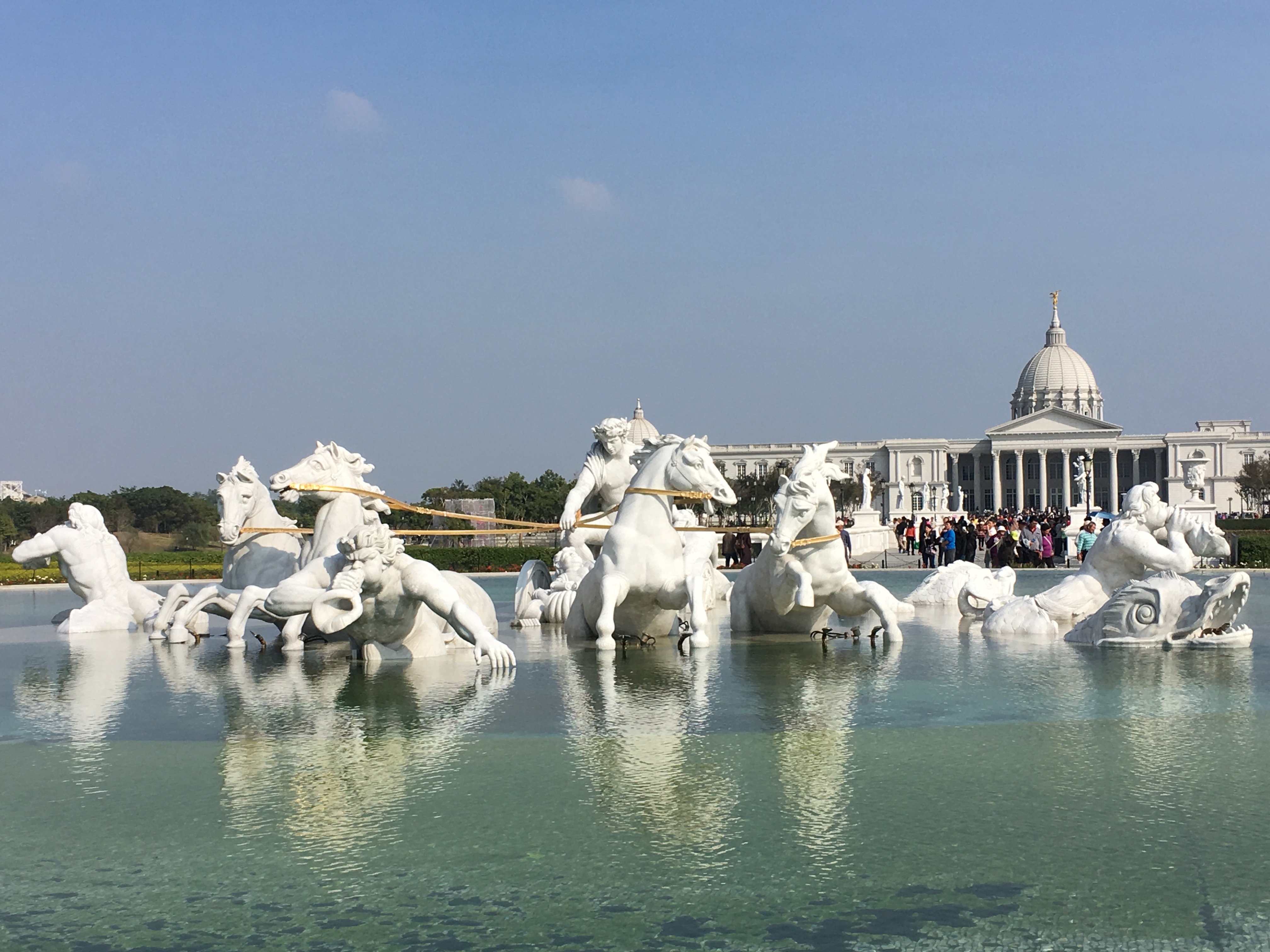
The museum I visited at Bao ‘an (a suburb of Tainan) was the extraordinary Chimei Museum, newly built and reminded me a bit of Versailles from the outside! Inside was very interesting too, and I and sure that it will become better known in time.
Chimei

The premier art museum in Taiwan, however, which I had also been lucky enough to visit previously, was the National Palace Museum in Taipei. When the Chinese Nationalists fled mainland China after the civil war was lost to the communist party, they took the art treasures as well, so that the museum now houses the best collection of Chinese art in the world. It is huge, and displays rotate, so it’s worth returning. I spent several hours there, but offer here only four snaps, to give an idea of it all:


The large lion statue is reminiscent of such statues all over Taiwan, while the traditional drawing/painting is one of a large number of (very old!) paintings held, some over a thousand years old. There were lovely jade carvings, and lots of beautiful metallic ornaments (some influenced by the Silk Route and Chinese trade with India and the Middle East, long before the European renaissance. I also saw many lovely ceramics, porcelains, tapestries, carvings, … but the space here is limited!
There are many many temples in Taiwan, in fact thousands of them, each one different from the rest and many of them stunningly beautiful and detailed. It’s easy to get ‘templed out’, just as it is easy to get ‘cathedralled out’ in parts of Europe, but I enjoyed visiting many temples and admiring the fine work. Here some recent examples from Taipei:


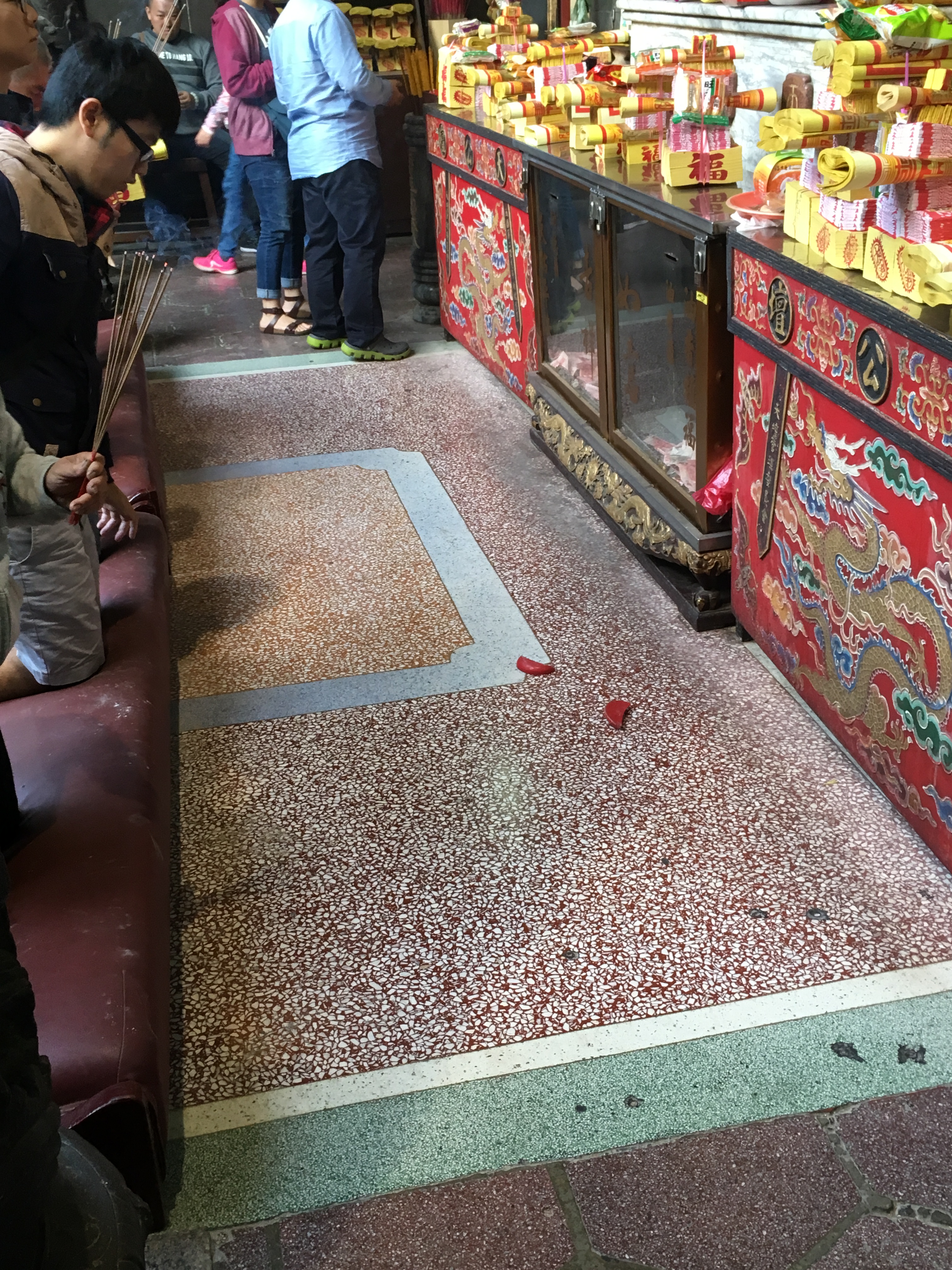
Temples are mostly less ‘reverent’ and more relaxed places than are Christian churches or Islamic mosques, but are places where people’s deeply held beliefs are practiced and made public. Of course, these always seem slightly strange to others (just as a Catholic church will seem slightly strange to a non-Christian, I guess). Ancestors are more revered than is the case for Western traditions, but there is no shortage of gods to appeal to and petition. Nowhere was this more evident than in the tossing of wooden dice-like objects (called bwei) to seek advice from a higher source, as nicely explained here in a temple in Tainan:

temple

I heard the clatter of these on the tiled floors often in my travels. Of course, I was respectful enough to not be too intrusive, but just to add a context, here is a typical scene in a temple in which people are getting advice in this way:

IMG_5371

Despite being mostly a Chinese country, in addition to the original Indigenous people,  there were Christmas decorations in the cities I visited, perhaps more a reflection of the commercial impact of Christmas, rather than its religious significance. (And I am not convinced that it’s much different from that in Australia for many people, of course, where Christmas is mostly about presents, holidays, parties and family, not Christian churches!). Here are a couple of examples of decorations, as well as the one I’ve chosen to put at the top of this blog.


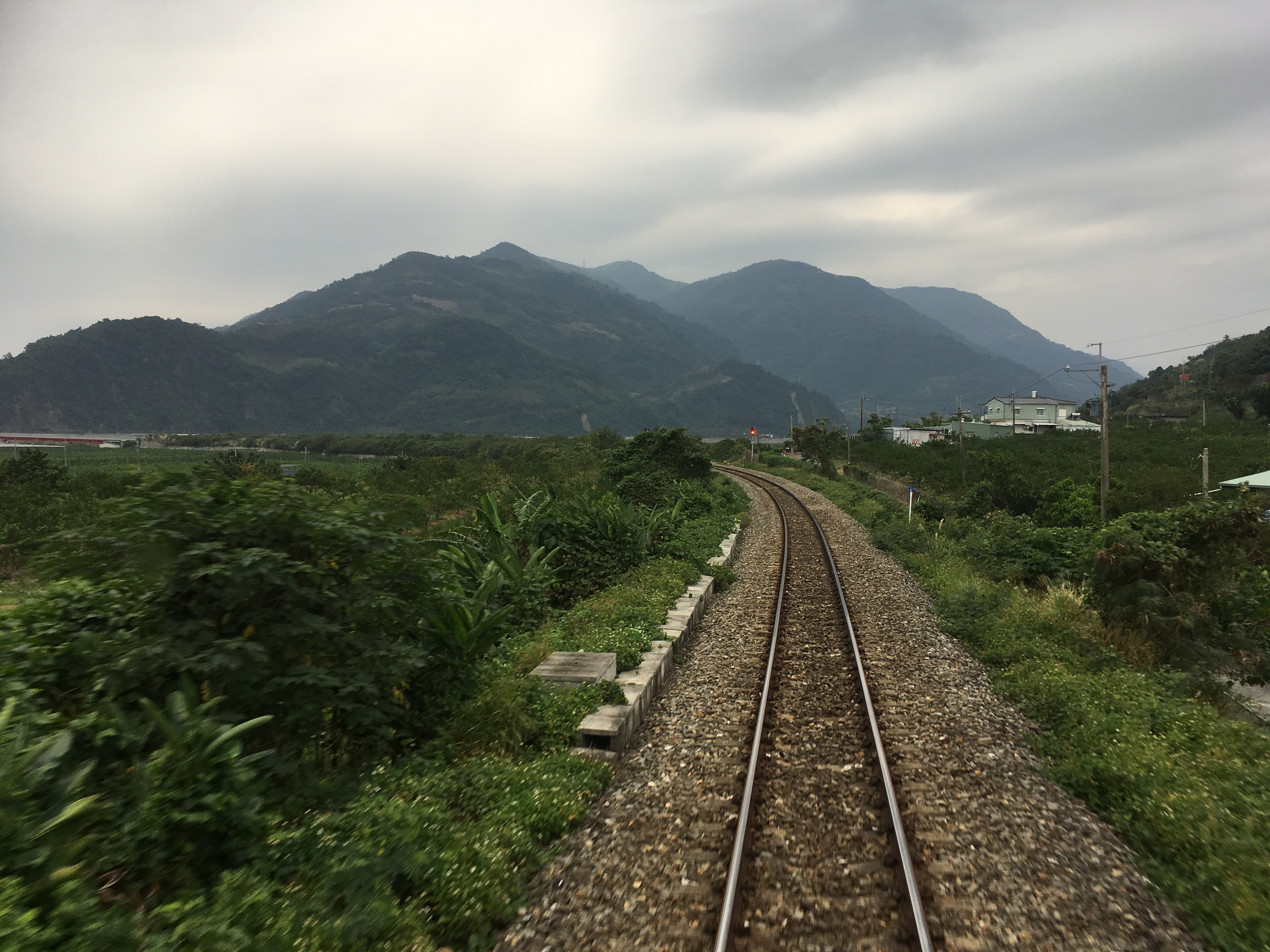
Taiwan is a very mountainous place, with most of the middle of the island too mountainous to navigate and very few roads going east-west. Some mountain are over 4000 m high, in fact, amongst the highest in Asia (if you ignore the Himalayas). Just like Australia (but for a different reason), most people live on the coasts. I enjoyed travelling along the coasts by train, and could often see the nearby central mountains, as in this shot:

IMG_5442

I did not have enough time for serious hiking or mountaineering – beyond my skill set anyway – but did enjoy a lovely day in the famous Taroko Gorge on the east coast, just next to the city of Hualien. Here are some snaps from my day in the Gorge, which capture some of its diversity and grandeur. (Click on the photos to see them better).


I could have spent several days here, and there were enough marked trails of varying levels of difficulty to do that. The marble walls and cliffs were spectacular, and I enjoyed wandering various paths, surrounded by greenery, rocks, mists and extraordinary cliffs and drops. certainly worth a visit!

Taipei had some monumental buildings, in great Chinese style. Two very impressive examples are shown below. The building with the red pillars is part of a shrine to Chinese Nationalists who died in various battles, firstly against the invading Japanese and then against various Chinese groups (such as war-lords) and lastly the Chinese Communist party, which eventually won the long civil war, leading to the People’s Republic of China (what used to be known as ‘Red China’). [The Nationalists under Chiang Kai-shek fled to Taiwan and founded the Republic of China, which used to be recognised as ‘China’, but is no longer so.] The other two photos are from the Chiang Kai-shek Memorial Park in central Taipei, which includes the huge memorial shown, as well as two other spectacular buildings. These (and others) are beautiful examples of traditional Chinese architecture.


As well as monumental buildings, there are many smaller distinctive creations, such as the two showing below. The carving was on a footpath in Beitou (the hot springs area outside Taipei), while the four characters were at the Confucius temple in Taipei. I saw many others, as well …


In a central park in Taipei, I even saw this construction for DIY foot massage, with an associated reflexology chart. Chinese medicine has lasted for thousands of years, and this is just one example, I guess. (You’ll need to click on the picture to see the details)


Although Taipei (and a couple of other cities) are quite large, you’re never far away from greenery and countryside, and of course never far away from people. Taiwan has a similar population to Australia but is much much smaller geographically. the snaps below were taken in Maoking (half an hour south of the city on the MRT and then on cable cars) as well as Beitou and Yangminshan (half an hour north of the city on the MRT).


The hot springs at Beitou have always been popular, of course, and became even  more so with Japanese occupation early in the twentieth century. The cable cars at Maokong were built in part to allow people to get out of the city and into the hills, where there is lots of greenery, tea plantations, etc. The couple I photographed (son and mum) shared a cable car ride with me and were very friendly, but not more so than people everywhere in Taiwan. I was regularly offered help and advice and a hand of friendship wherever I went, and never felt even slightly uneasy or anxious about people.

Although I visited in winter, there was still some nice weather and I also saw lots of greenery and flowers. The three snaps below give typical examples, of lovely flowers, of manicured trees (this one next to the Chiang Kai-shek memorial) and bunches of flowers in temples (everywhere).


A constant source of stimulation in Taiwan is from food, which is simply everywhere! One of the photos below is from a night market in Kaohsiung, similar to night markets all over Taiwan, in which there are many many fast street food outlets like this. One of the photos is from a DIY restaurant in Taipei, where you paid by weight for what you chose. The third is not technically food (for most of us) but the extraordinary collection of Scotch whisky in the hotel in which I stayed in TaoYuan (just of out of Taipei). (The whisky cache was unusual, to say the least, unlike the other two).

Finally, I have hundreds of other photos and at least as many memories, but space is always limited here, so I’ll finish with three snaps of everyday life in Taiwan.

I saw many people (mostly – but not only – men) engrossed in a board game of same kind all over the island, and also saw a countless number of scooters. The latter were usually clogging the footpath, but these were unusually in a scooter park. And there were many many small shops, small streets and distinctively Chinese shopping areas, like the one shown above.

Taiwan is a lovely place to visit, with rich diversity, only some of which is captured in these few slides. Friendly people, mostly inexpensive, easy enough to get around and enough interesting stuff to keep most of us amused for a long time.

I’m pleased I went to Taiwan, and would happily go again.

Out and about in Kaohsiung

I enjoyed an interesting day wandering around Kaohsiung, especially the Lotus Pond area and the small offshore island of Ciji. Both of these places are popular with locals and with Taiwanese tourists. Like

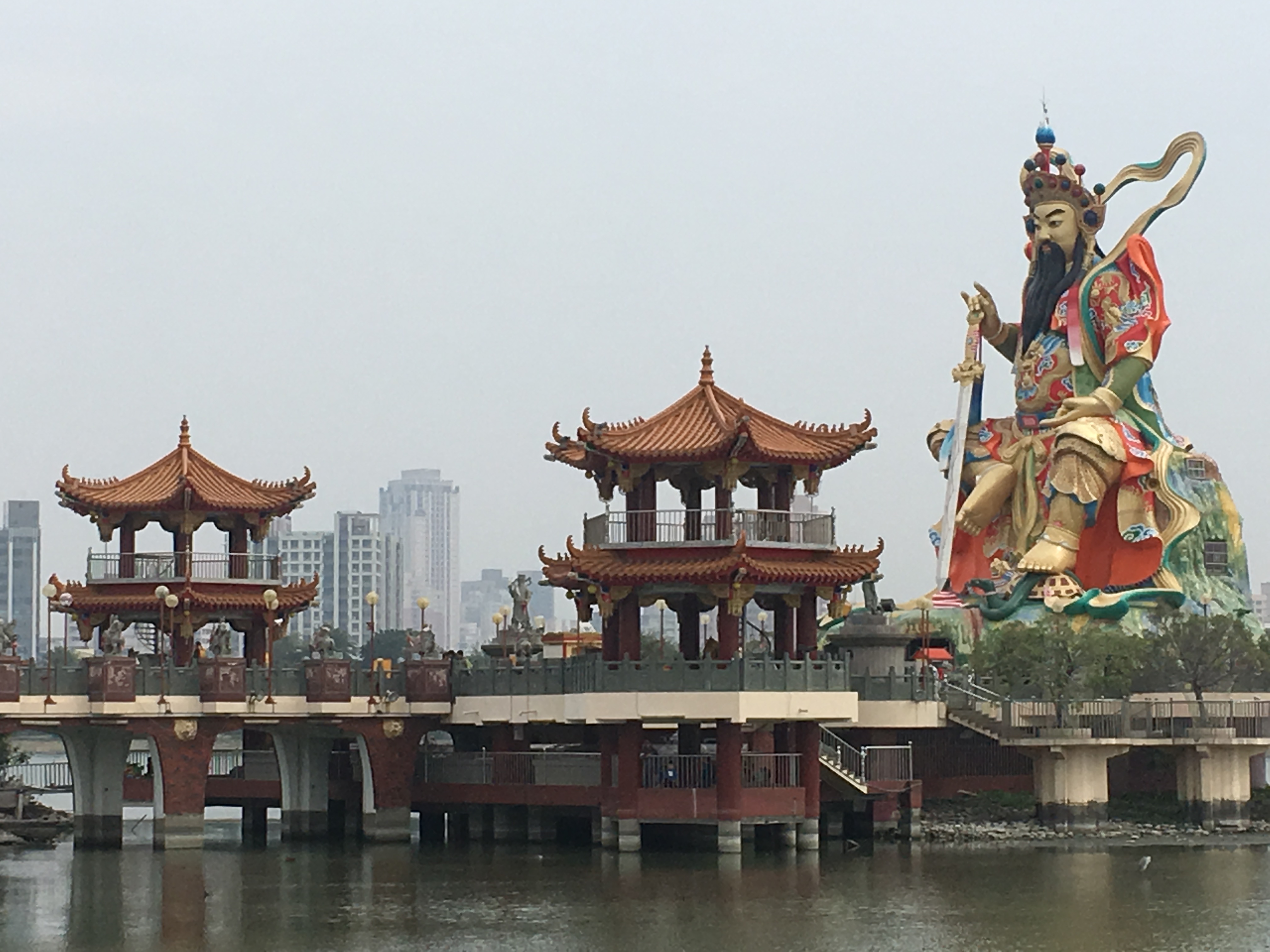
Lotus Pond comprises a large lake and a number of ‘attractions’ around it. It’s very kitsch, mostly, although there are a couple of temples of note as well. The picture at the top shows the Tiger and Dragon pagodas, which are about as kitsch as it gets. Like Chinese temples, the paths to the entrance of the pagodas are zig-zagged (I think to prevent evil spirits from chasing someone – they have to keep turning corners; not sure).

As you can see below, you enter the pagodas via the mouth of the animal. There is another example below, from a bit further around the lake. It shows a dragon, but another picture shows the insides of the dragon, which is filled with all sorts of beings from Chinese stories and legends not recognisable to me.


The lake was also decorated with this enormous statue. It was also possible to go up inside the statue, where there was a small temple of some sort.

IMG_5166

Kitsch it might be, but the workmanship of these kinds of things was pretty impressive, as the next couple of pictures suggest. Lots of intricate carvings are involved and the whole collection has an air of fun about it.


Less obviously fun-like were the genuine temples around the lake, although these too had fabulously detailed carvings and paintings in them. These few photos give an idea of the extraordinary work involved in some of them:


I’m always a bit uneasy around religious sites, never quite knowing how to behave, and very conscious that my own religious upbringing had very strong views about ‘proper’ and ‘respectful’ behaviour. It seems to me that the Chinese religions and temples are rather more relaxed than are Christian, Jewish, or Muslim sites of similar significance, but it’s hard to tell and there are certainly protocols that need to be observed. I am often struck by the wildly fantastic nature of the temples, but it is too easy to forget that other religions probably have a similar view of Christianity! It’s hard to break loose of the things you grew up with and of course everybody claims that their own religion is the ‘right’ one and all the others are mistaken …

I enjoyed the Confucius Temple at Lotus Pond, rather different from the Buddhist and other Chinese temples above. The Confucian philosophy is deeply ingrained in much of the Chinese world, so much so that I have colleagues in the Far East who talk of a ‘Confucian Heritage Culture, valuing education, scholarship, ethics, meritocracy, etc and claim that this is one of the reasons for the success of many students on Chinese origin in the west. Here are a couple of pics of the temple, clearly different from the others and much more sedate:


In fact, when I was there, there were some people dressed up in traditional garb; I’m not sure if they were rehearsing for a wedding or an advertising shoot …


Lots of other things caught my eye, wandering around the lakeside. A few of them are captured below in the snaps:


I was puzzled by the Wheelchair gates (of which I saw several) … it looked to me as if they were making it harder for wheelchair people; since I never saw them being used, I didn’t understand them. The innate sense of humour of it all was captured for me in the hen with her golden eggs and with the Lego block display version of the Tiger and Dragon. I saw lots of morning shopping opportunities, with countless food stands, fruit and vegetable stalls and even live shellfish. Just walking around revealed lots of things to me that I am sure were of no interest at all to locals – as it is all familiar to them. No doubt the same would be true if Taiwanese wandered around Perth suburbs …

My trip to the island later in the day involved travelling on the excellent MRT system, common in the Far East but sadly rare in Australia. It is a quick, easy, safe and efficient way of getting around. Lots of things caught my eye – too many to record here, of course – but here are just three examples:


Everyone seems to be dressed up as if it is cold (it is actually ‘winter’ but the days often reach into the 20’s Celsius, so it’s hardly cold, at least by my standards). I was impressed that some of the ladies here had matched their hats to their outfits. I was also impressed with the large stations, which had lots of facilities, shops, etc (and free toilets, unlike too many countries), including breast-feeding rooms, as you can see. The High Speed Rail stations are exceptionally large, as you can see, and there is of course a very large number of motorcycles parked there.

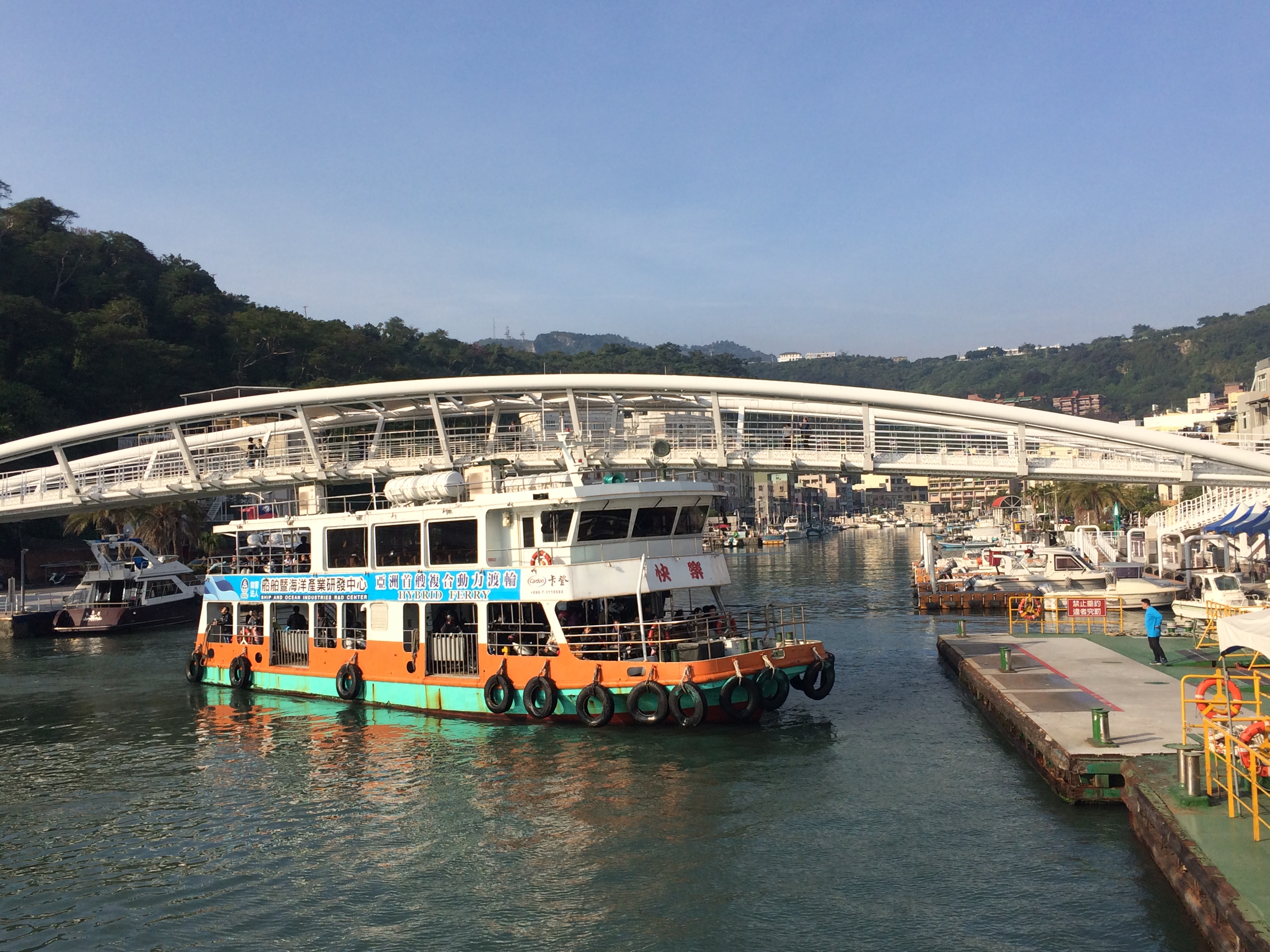
I was (slightly) uneasy about my ferry across to Cijin Island – bringing to mind all those stories about ferries sinking in various Asian places in recent years, but only slightly, as the trip was very short and across a harbour!

IMG_2889

There was a ferry every few minutes throughout the day, taking people as well as people on their motorcycles, so there was no need to wait. [As for the MRT … no need to find a timetable, as the next one is almost here already.]

The island is very popular with locals, who seemed to day trip across mostly to eat seafood, walk or ride along the beach front and also to watch the sunset.


There were many places apparently designed essentially as sunset watching places, it seemed to me, so it was a shame that the sunset was spoiled a bit by cloud cover. There were seats and little stands available for watching the sunset and even this massive shell-like construction to allow people to photograph the sunset through the shell. many people hired bikes or carts to wander up and down the beach (but didn’t get much exercise as many of them were electric! I walked and so got lots of exercise!)

People were very relaxed on the island, and often seemed to be there in family groups. I enjoyed the experience as well, and so stayed to have a beer and some dinner, waiting for the sunset, a very pleasant way to end an interesting day.


Art in Kaohsiung

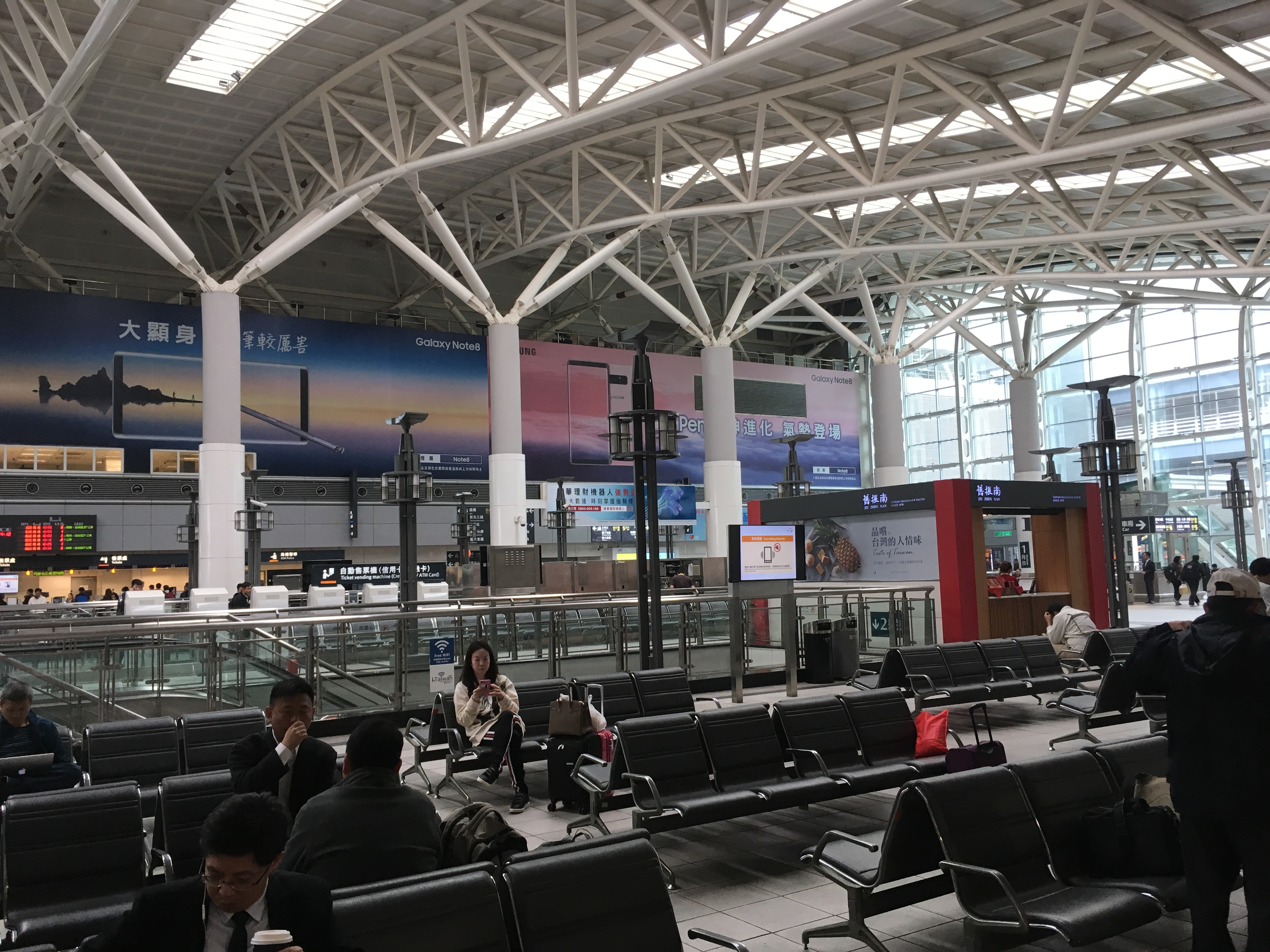
I was attracted to the Taiwanese city of Kaohsiung in part because I had heard of their recent artistic adventures, but I did not really know what to expect until I arrived. In fact, the first thing I noticed when I arrived in the city was the extraordinary railway station (the HSR – High Speed Railway – has fairly new stations on Taiwan’s west coast, as it has only been going recently). They all have spectacular high ceilings, with girders, like the one below (a comparatively small example, in fact). I don’t think there is a technical reason for the height and all the exposed girders … except to create a feeling of spaciousness. (Of course, it also creates a mathematical space … but that’s another story.)

IMG_4974

The HSR stations are all a bit out of town – as they have just been built – so I had to travel on the MRT from the HSR station into the centre of the city where my hotel is located. My arrival at the MRT station was a great surprise: a spectacular coloured dome (under which a lady was playing a grand piano!) greeted me, and I then travelled to the surface under spectacular roof constructions, shown below. (Click on the images to see them in full).

There is no need for any of this: a subway station can be boring and uninteresting, but I was pleased that it wasn’t. Somehow, artistic creations of these kinds are uplifting – at least to me. It got me thinking about who might have designed these, and how pleased they must have been with the end results. I loved the (apparently) curved roof, made up of perfectly flat planes of glass … a 3D version of some designs I have done and got students to do in mathematics, in fact, just because they look good.

I travelled by MRT to Kaohsiung’s Pier-2 Art District, which is a large area of disused and abandoned warehouses on the waterfront. They have been resurrected by the energetic arts community if Kaohsiung into a spectacular artistic space. Many of them are now being used as museums, commercial spaces, design studios, galleries, restaurants, etc. I was unsure of which way to go when I arrived, until I spotted this massive construction of old containers about 500 m away, so knew I was heading in the right direction:

IMG_5047

What makes something ‘artistic’? I really don’t know, but the things I saw today all provoked a feeling of some sort in me, usually a pleasurable feeling of some kind. The big red container construction was visible from a long way away and had a certain sort of solidity to it. I loved the shapes and the angles and how it looked different from different places.

The warehouses (about 20 or 30 of them – I didn’t count carefully) often look quite drab from the outside, and thus have retained some of their past lives:

IMG_5033

But there is often a twist. In the example above, the arms of the thing on the roof (which was certainly not there when it was a warehouse!) is constantly moving – even wriggling – around. Somehow, the building seemed to be alive!

And it’s not just the buildings, but also the spaces around them. I was amused to see these fanciful sculptures outside one building, as well as the drawings of faces, made with rusty steel, which looked different as I moved around them. So art doesn’t have to look ‘beautiful’ … but it should provoke a reaction of some sort.

Some of these figures reappeared in several ways, sometimes huge in size, as the picture at the top of this blog shows. I loved them … looking slightly fantastical, and designed to amuse. They serve no useful purpose at all, except perhaps to entertain people (which they did, judging by the number of people photographing them – or giggling at them). Here are some more examples of the same sort of them, scattered around the area:

They seem likely to have been made by the same artist – I couldn’t tell, as any descriptions were hard to find and, anyway, written in Chinese. I loved them. I especially liked the big guy and the big lady (shown at the top of the blog), somehow adding a neat gender balance to the industrial world of warehouses and waterfront. To my surprise, the sculptures looked the same from the front and the back – which was a bit disconcerting – but why should they not.

Sometimes, art is intended to surprise, as it did in this case. Later on, I saw another example, which similarly amused me:

IMG_5053

There were other sculptures around, too, each of which provoked me in one way or another. It was very hard to ignore things like these!

Some sculptures were less obviously anthropomorphic, but also caught my fancy. here are four examples:

The small train going under the huge sculptured objects looked like lots of fun … it ran around the precinct of a warehouse that housed a museum devoted to early sugar trains and was popular with kids – and not only little kids. When I was a lot younger, I used to think that paintings ought to look right (as in a photograph) and sculptures should be of something real, but that is not the case, of course. All of these provoked me, or jolted me in some way, which is presumably part of their purpose.

Some of the buildings too had become art objects, with elaborate murals or decorations of some kind, as the two examples below show. I enjoyed both of these.

Some of the local buildings are already artistic, in fact, such as the temple top and the huge gate below, both characteristically Chinese. Does something have to be in an art gallery to be ‘artistic’? Of course not.

Other building decorations were clearly designed to amuse or entertain, however, such as this mosaic built around a water outlet, which periodically came on (unexpectedly) to the amusement of whoever was passing by! The young boy was about the size of a 5 or 6 year old.

IMG_5030

I hope that you don’t find this offensive, but I’m pretty sure that you won’t … as almost everyone who saw it when I was around found it amusing and in some cases, shrieks of laughter or giggles from children could be heard. The artist is having fun, and we are invited to share the joke.

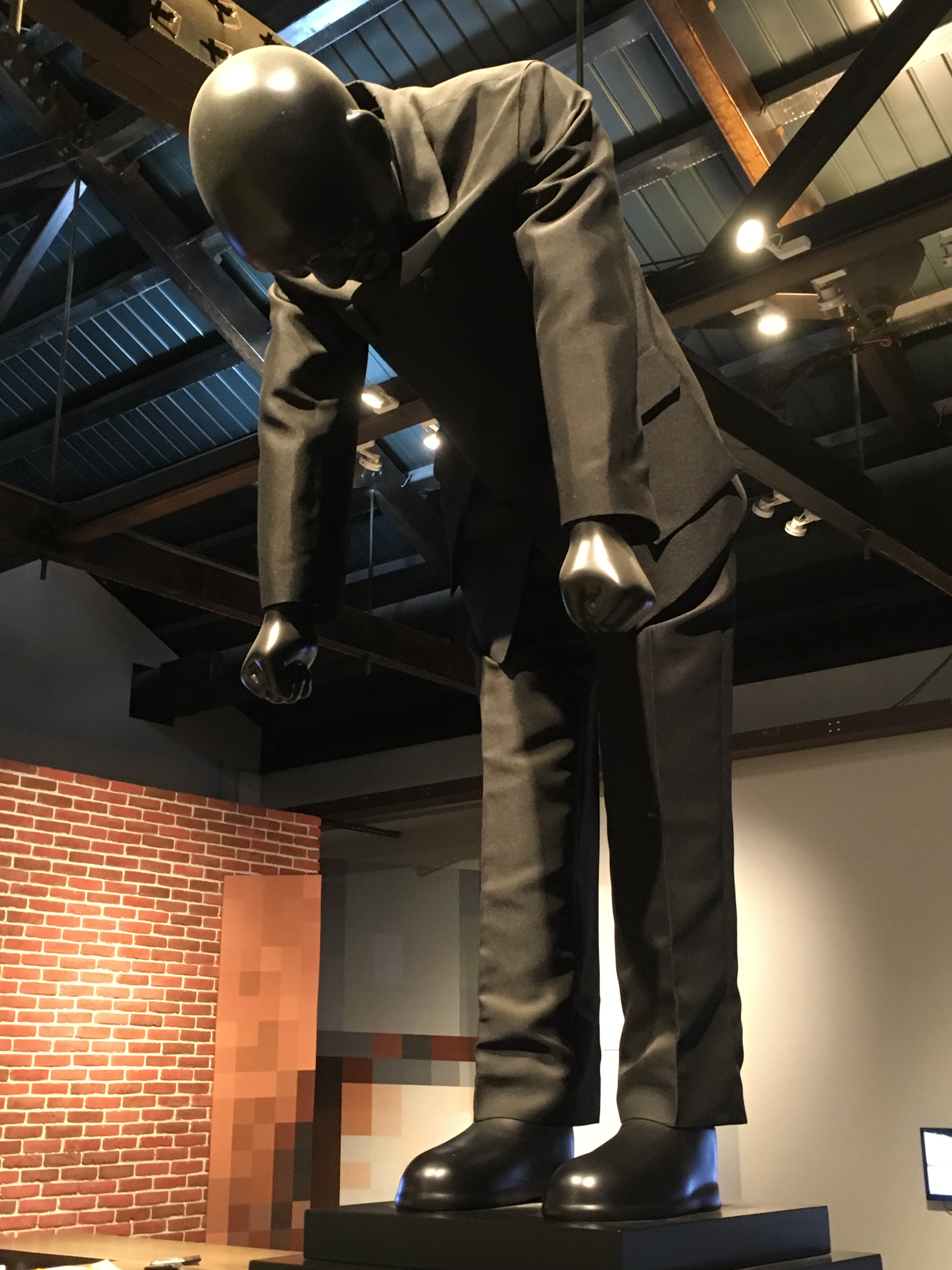
Similarly, this sculpture on a pedestal inside one of the buildings got me wondering about why sculptures never wear clothing … and also got me wondering what was under the clothing …

IMG_5054

I am not sure which of the things I saw today were permanent and which were part of an  art exhibition that just opened. And I’m a little embarrassed to not know the details of the artists, but it was not easy to find these. (I may know more when I return later. There are various art exhibitions available in the arts precinct, so I’m hoping to find time to see them.)

I thoroughly enjoyed my first afternoon in Kaohsiung, wandering around various works of art that had me wondering, admiring, liking, amused, excited, annoyed, puzzled, irritated, confused … and various other reactions. I have similar sorts of reactions to mathematics, by the way, which may account for why many of us regard mathematics as a form of art, too … except those who keep asking what ‘use’ it is.

As I wandered around the various art forms today, I hardly ever asked myself what ‘use’ anything was … so there’s a tale …