Nishi-Shinjuku

Nishi-Shinjuku, or the west side of Shinjuku, is often called Tokyo’s skyscraper district, for good reasons. It must surely be one of the most extraordinary urban environments on the planet. Perched forty stories up, as shown above, I thought I’d go down for a stroll to get some fresh air and to try to capture some of the amazing architecture and ambience to share.

I’ve been here often before and strolled around often, but it is always pleasurable. Tokyo was destroyed by the great Kanto earthquake of 1923, and was devastated again after WWII, but somehow the skyscrapers today in Nishi-Shinjuku seem to be making a defiant statement of some sort, that they are here to stay regardless. The earthquake codes are very strict here, and I understand that the buildings are erected to cope with severe earthquakes (but you never really know until they happen). Maybe irrationally, I’ve not felt unsafe here, even up high.

For me, the centrepiece has always been the Tokyo Metropolitan Government Building, from which there is a neat free observatory (in each of the two towers) 45 floors up. I’ve often taken friends – newcomers to Tokyo – up there to see the view, showing the city from horizon to horizon, with greater Tokyo now having some 37 million people or so. I happened to do that again today … here are a few quick snaps, giving a sense of the views. You can also see some green space: the huge Yoyogi Park nearby, for example.

The view from the tower also gives a good look at other things, such as the expressways (so-called … often not very express with commercial traffic!) snaking their way among buildings, such as these two:

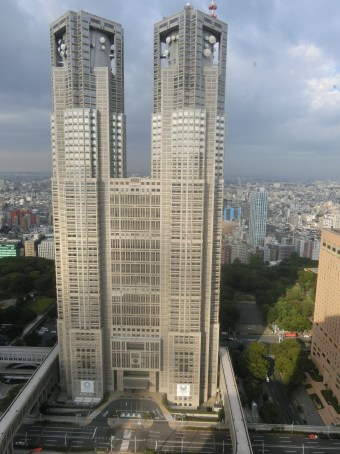
But I’m in Nishi-Shinjuku and the building itself is beautiful. Here’s a view from my hotel, up high:
CIMG0216

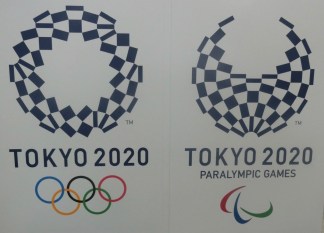
You can see the Olympic logos near the ground. This is the building from which Tokyo’s successful bid for the 2020 Olympic games came. I like the mathematical feel to the two logos, which you can see more clearly here:
CIMG0360

If you look more closely around the base, you can see some of the roads and walkways around it, as well as the companion buildings next to it and the park behind it.

CIMG0213

But let’s get down from the heights and look from below. The building just seems to go up and up …

And the courtyard below dwarfs anyone wandering around it … with an amazing feeling of spaciousness, in a  country where things often feel cramped. If you click on these photos, you’ll see larger versions.

You will already have noticed how hard it is to faithfully reflect large architecture in a photo, without doctoring the photos … the angles often look wrong, as if the world is leaning in. But I’m too lazy (and also lacking in skill) to fix the problems, so I hope you can get a sense of the environment anyway.

The TMG is but one of the many skyscrapers here. None are really really tall (typically around 40-50 floors high?), but walking around the TMG gives a sense of perspective of other buildings in the district. The first one below is actually taken from underneath the TMG, showing the immense colonnade:

None of the buildings is really really tall, but they are tall enough to give an impression of urban-ness, typically around 50 or 60 stories, I think. Here are a couple of examples of famous buildings, a little closer up:

I loved the huge intersections, too! The cocoon building looks especially spectacular, maybe because it is so different from its companions.

Walking around the Nishi-Shinjuku area, with skyscrapers all around, is remarkably pleasant, with wide walkways, devoid of rubbish usually and with lots of trees. Here are a few examples, to give you a sense of the ambience:

The first of these is right outside my hotel, and I have often enjoyed sitting in the restaurant at breakfast, watching the streams of people walking past, going to work. [These pictures were taken on Saturday morning, so the streets are all but deserted.]

There are also gardens associated with many of the buildings, so the whole area feels surprisingly green. Below are a few examples, including a couple where the green of summer is about to be replaced by autumnal colours. I’m not sure why the tree is tied down so securely, but I assume it’s to protect against typhoons?

There are also sculptures scattered around the area, such as the iconic Love symbol and the more recent (2017 – which explains why I had not seen it previously) Keimu Kamata statue called ‘Hand of peace’.

Near the Love sign is an interesting astronomical clock on a tower, reminiscent of the wonderful old clock in Old Prague square – albeit a modern version by Seiko – and associated with another nice piece of urban architecture, the I-Land building with its neat water features.

Cycling is a popular mode of transport around Nishi-Shinjuku, and the footpaths are wide enough to cope with it. I was impressed that this lady was taking two children for a ride on her bike, both protected from the elements.

Another striking feature of the area are the underground walkways. Last night, it was raining a little, but I managed to walk from Shinjuku station back to my hotel almost entirely under cover (using the first walkway shown below). Shinjuku station in rush hour in the mornings is still regarded as the busiest place on Planet Earth, so having an efficient way for people to walk from the station to their offices is obviously a good idea. It was a lot more crowded last night.

Walking around even revealed some unexpected things to me. I had noticed these odd architectural features in the street outside, but thought they were just decorative triangles. This morning, I found out – somewhat to my astonishment – that they were entries to the subway train underneath my hotel! The work crew (a small army, in fact!) were making sure everything was gleaming, while they had a chance, as you can see.

While it’s not surprising that there are subway lines under my hotel – after all, it is only a couple of hundred metres to Shinjuku station and there are many lines going through there – it’s surprising that I didn’t know, because I have stayed here four or five times previously!

At the edge of the skyscraper district, there’s a nice little park, called the Shinjuku Chuo Park. It’s very green, with lots of plants, and even a few animals such as turtles in a pond.

While breakfasting this morning, I noticed small group of a couple of dozen people down there, so wandered down to see what was drawing them there (I recall a few years ago finding a swap-meet!). To my surprise, I found a now very large number of people in the park, and wondered if it was a demonstration of some sort, unlikely as that might seem. I was intrigued at the chap taking photos from the shoulders of someone else (Did he really think he got a much better view??). Then they all started to move off in a sort of march, but the person to whom I spoke said it was for ‘exercise’, so maybe it wasn’t a demonstration? The people seemed to be out for a good time, as you can tell, too. All very mysterious.

Finally, I can’t help but comment about East Shinjuku (the other side of the train station). Notwithstanding the large exercise group, Nishi-Shinjuku is quiet, almost serene, stately and at times almost overwhelming, an urban architectural showcase with grandeur in abundance. Yet the ‘other side of the tracks’ is mad, crazy, noisy, brash and could easily be on a different planet:

And at night, the neon lights come out in East Shinjuku, while West Shinjuku is already sleeping:

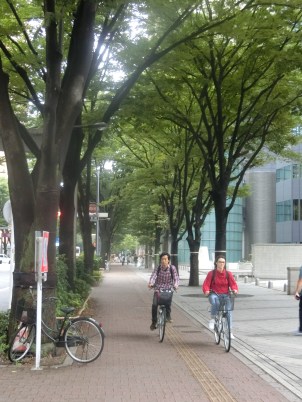
There must be few places in the world where everything changes so much with a short stroll, although I know there are some. I’d prefer to end this post with stately quiet, calm Nishi-Shinjuku:
CIMG0296

It’s a lovely spot. Even if you’re not staying there, should you get to Tokyo, at least go for a stroll, and soak it all in.


A walk in the bush

After a family picnic, I had a lovely walk in the bush in Kuring-Gai Chase National Park in Sydney’s north recently. It’s a funny word, ‘bush’. While it can be used to refer to a single small plant (such as a rose bush), in Australia it usually means something else, most likely an area of native plants that hasn’t been cultivated, and so is slightly chaotic. It also sometimes just means ‘not the city’ … one lives in the city or in the bush. And when someone ‘goes bush’, they’ve left the civilised parts and probably no-one quite knows to where they’ve gone.

It took us a long time in Australia to appreciate our bush. While Indigenous people always knew and loved it, we more recent immigrants were firstly besotted with the stereotypical views of the countryside of European painters. If you wander in an Australian art gallery, you’ll find landscapes early in the 19th century that could have been painted in Europe (but weren’t). Then late in the nineteenth century, we started to see the world differently and the Australian Impressionists, among others, captured the beauty that is the Australian bush.

Dorothea MacKellar captured this beautifully in her iconic poem (written in England), My Country. (If you’re not familiar with this, her short and iconic poem is at http://www.dorotheamackellar.com.au/archive/mycountry.htm and well worth a read. As children, we learnt it as a song, too, “I love a sunburnt country …” It is still the best description of how different our bush is from the English countryside (which is lovely, but in a different way). [It also deals with more than just the bush like Kuring-Gai Chase National Park.]

I enjoyed the lovely colours and the sunlight on trees and grasses and rocks, and the wild lack of order (such as you will find in a plantation). The grass trees looked especially spectacular. (We used to call them blackboy trees when I was a kid, but that is no longer appropriate.) Here are a few snaps, but I could have taken many more. You can click on them to see more, if you wish.

When you look a bit closer, there are all sorts of plants there, including a few flowers as well. It got me thinking how wonderful it must have seemed to a botanist like Joseph Banks in the early days of European insurgence into Australia, seeing so many plants that were familiar – but not quite – a whole continent full of new plants! Of course, the closer you look, the more visible is the mathematics … with the fractal-like ferns and the L-systems …

The Kuring-Gai Chase National Park is on the edge of northern Sydney, and so easily accessible. We were lucky on the day we visited that the picnic area was comparatively quiet, as everyone was at school or at work. So it was easy to find a table and enjoy the environment. I thoroughly enjoyed the family picnic, remembering many other family picnics, and also loved the light on the trees in the picnic grounds.

There was water around, with a river wandering off to the Pacific Ocean somewhere and also a lot of mudflats, with mangrove trees exposed for now by a lower tide. To get to a boardwalk and a walk in the bush, we had to cross a footbridge; somehow it seems OK to interrupt the bush with things like footbridges and boardwalks, as it gives us all safe access to it.

As we walked on the boardwalk, lots of little crabs popped back into their holes, waiting until we passed. This made it pretty hard to photograph them, but I caught this little guy enjoying the sunshine, and being a bit more daring than his (or her) companions:

CIMG0129

We encountered some other wildlife as well, including a bush turkey and a bird. The bush turkey was determined to not be photographed, and kept popping into shaded bits of bush. It’s funny how things that are new to us are interesting, but the familiar is easily ignored. My companions were puzzled that I was fascinated with a bush turkey of the kind that they saw every day. I suppose that visitors to Australia are fascinated with kangaroos, koalas and emus in the same way. The unfamiliar is more interesting than the familiar!

Taking a walk in the bush is probably less fun when it’s cloudy or raining, but we were lucky to have glorious sunshine, which made some of the trees stand out beautifully:

CIMG0138 2

It’s nice to have the bush so close to the city and I felt very lucky to have the time to go for a walk, and family to enjoy a picnic with, without worrying about the next deadline.

Beautiful temari and misuhiki in Kanazawa

I had not heard of either temari or misuhiki before I found them unintentionally today. What beautiful traditional crafts these are! But to start at the beginning, I was wandering in the Samurai district on my last day in Kanazawa – indeed my last day in Japan for a while – and enjoying the change of weather. Yesterday was raining all day, sometimes heavily, but today was lovely and sunny.

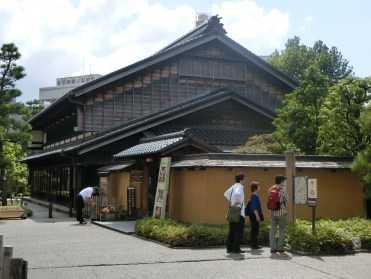
I popped into what did not look very interesting, but I knew it was a sort of museum of pharmacy in the old days: just an ordinary building (at least for here):

CIMG9972

Indeed, it did include a museum of pharmacy, just inside the entry, which was interesting, but not especially rivetting, and the descriptions were a little cryptic to a non-Japanese.

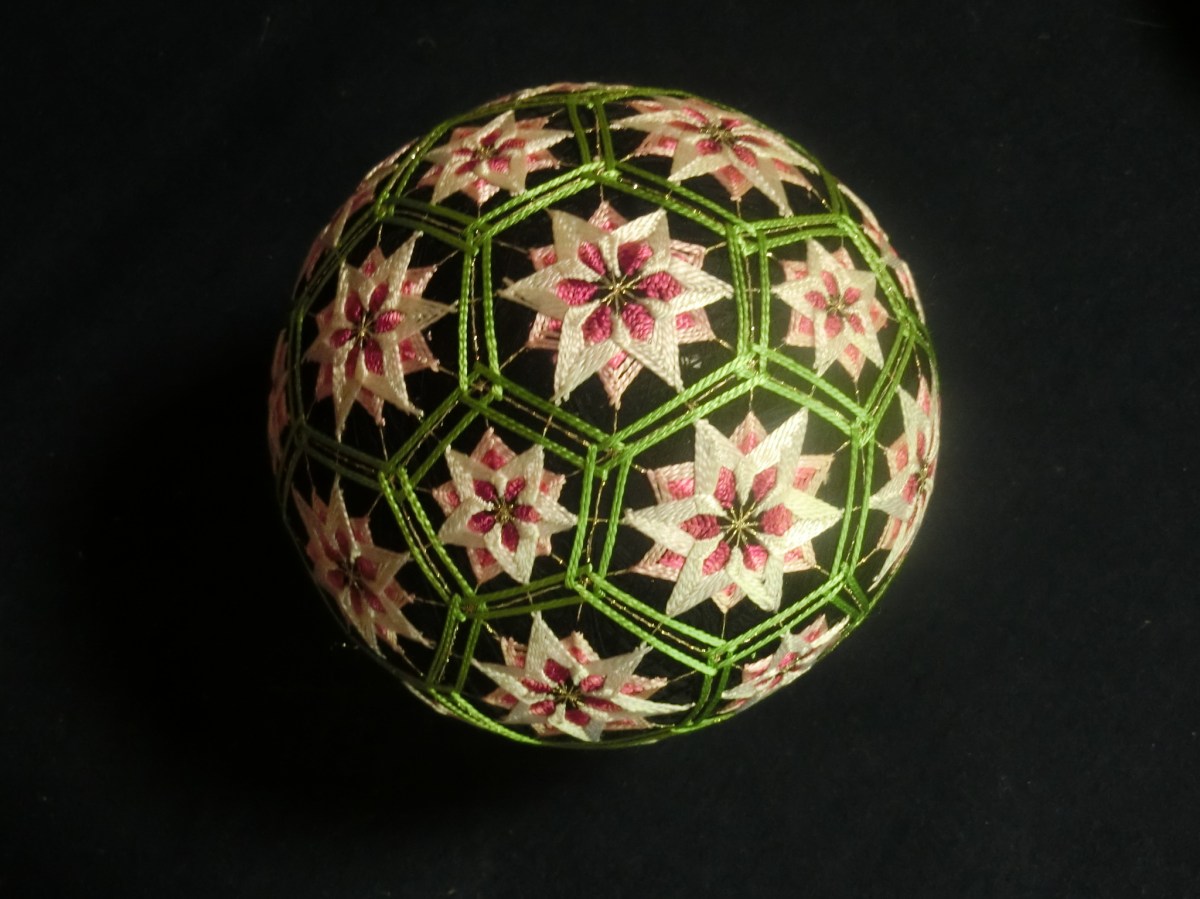
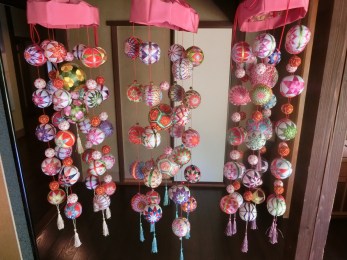
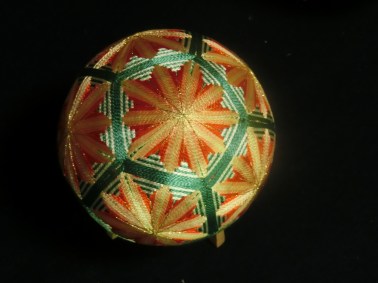
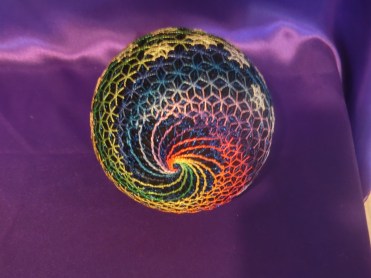
Then I turned the corner, and was astounded to see a collection of brightly coloured geometric objects with various patterns and sizes. No two patterns were the same: each was clearly made individually:

CIMG9932

There was some English description of these, which are called Kaga Temari, or, more colloquially, temari balls. Apparently, they are something of a local tradition, which I had missed as I’d not been frequenting shops (yet).

It seems that they were first made from silk as handballs a long time ago (from the 14th century) by the nobility, as an engagement present for a daughter, but they were so attractive that other people started making them also. When cotton became available, early in the 17th century, they became very fashionable, and it is still a tradition in Kanazawa that mothers make one of these for their engaged daughters.

Here are some other examples:

I was of course intrigued by the mathematics of weaving these beautiful shapes onto a sphere, and was instantly impressed with the level of craft competence that must be involved – to say nothing of the mathematical competence.

It seems that the balls are made from tightly bound yarn, which is then embroidered on the outside. It is no mean feat to get the shapes and sizes correct to produce a pattern that fits around a spherical surface, as you will appreciate if you try it for yourself. Here are some others, which were somewhere between a softball and a soccer ball in size:

There were smaller ones as well, clearly less intricate. Some of these were about golf ball size, and some even smaller:

CIMG9933

I didn’t tarry to look too closely at the mathematics (except to admire it), but geometric shapes were very evident. This one looked a bit like a dodecahedron (a solid made with regular pentagons on each face, all twelve of them), for example:

CIMG9937

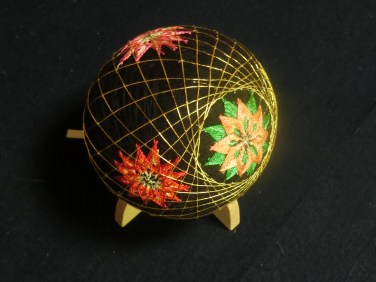
Others reminded me of ‘string art’, which we have sometimes done in mathematics classes, as it’s nice to see curves coming from straight lines:

CIMG9936

Here’s another that included spiral patterns:

CIMG9965

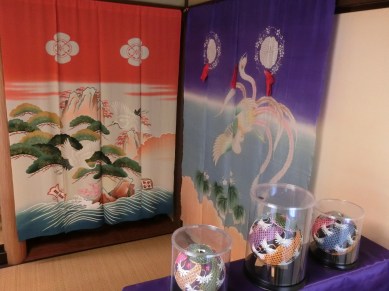
And here is yet another selection, this time in cases and with a pleasant background of traditional fabric printing:

CIMG9941

What a treat! I was quite excited and I think I made the day of the person selling tickets to the museum. He seemed very pleased that I seemed very pleased, although that may just be (typical) Japanese politeness and care for visitors.

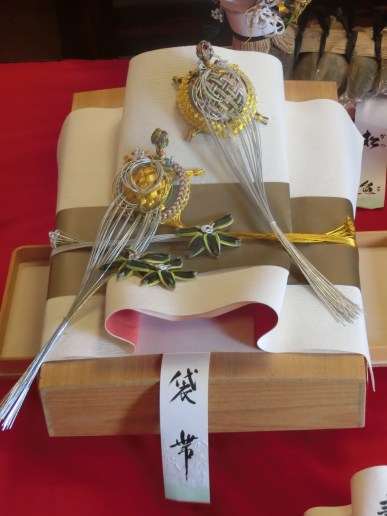
I would have been perfectly happy with my ‘discovery’ – a bit like Captain Cook’s ‘discovery’ of Australia, although the locals did not realise that it was lost ;-). But I went up to the next floor of the pharmacy museum and found some beautiful Japanese wrapping, called mizuhiki. Here’s an example:

CIMG9948

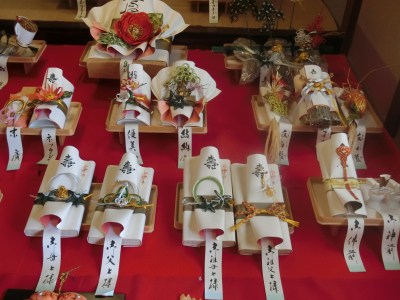
The wrapping in this (and the other cases shown) is for an engagement present. Regardless of what the present is/was (clearly not just the block of wood shown), the wrapping must be a major part of the gift, I think. The examples shown were absolutely beautifully done. Here’s another set of examples (click on it to see it more closely if you wish), showing that paper-folding as well as tying strings are both involved. (Not quite origami, however).

CIMG9947

I have long known that Japanese people pride themselves on wrapping things beautifully … buying anything in a department store, for example, will give you a sense of that pride. I recall once in the large Takashimaya store in Shinjuku, in Tokyo, counting no less than fourteen shop assistants working full-time at the wrapping counter on one floorIt was unacceptable to just buy something and pop it into a plastic bag. the wrapping is part of the transaction. But these mizuhiki seem to take the art form to a new level.

Here are some others, nicely arranged:

CIMG9950

… and a blown-up version of one of them, so that you can see the intricacy and the care with which it has been created.

CIMG9949

I learned a valuable lesson (already known to the rest of the world as “Don’t judge a book by its cover”. Sometimes as a traveller, you have to just go ahead and look at things, even if you are not sure about them, or taste or drink them, even if they look unfamiliar. Now, just as I am leaving Kanazawa, I am beginning to realise why it prides itself on its traditional arts and crafts.

The Pharmacy Museum made my day.


Kanazawa garden and castle

My first time in Kanazawa comprised being lost for a while – an unavoidable consequence of (independent) travelling, and rarely problematic. But when I was found again, I decided to have a look at Kanazawa’s famous Kenrokuen Garden, recognised as one of the three best gardens in Japan – and that’s saying something in a country with many beautiful gardens.

I did not expect Kanazawa Station to be such a magnificent new structure; my mental picture was of a small city station. As the snapshot of the exit below shows, my mental picture was completely wrong! I knew where I was at that stage, but the feeling soon dissipated, and I had some adventures finding my lodging. A story for another day.

CIMG9470

When finally I headed to the garden, I managed to find a nice entry path – which was not in fact to the garden at all, but to the adjacent castle. Oh, dear! One of those days … I was intrigued however at the lovely greenery, glistening in the drizzle that was falling, and the collection of statues, and at first thought that they were leading to the garden. I could not work out why (most of) the statues of women were naked and all the statues of men were clothed! Very strange, but perhaps some cultural mores are involved?

The sample of four (of many) statues here attracted my attention for other reasons, too. I was impressed to see a female nude not obviously showing a ‘perfect’ figure, for example. And I would have liked to know who the scholars (?) were, but all the annotations were in Japanese. And, anyway, I needed to find the garden before it closed, and I saw the top of part of what was clearly Kanazawa castle nearby, and realised I was lost again:

CIMG9491

When I did find the actual garden, shortly afterwards, I was not disappointed. It’s really beautiful, and I enjoyed strolling around it in the fading sunlight and the slight misty-moisty drizzle. The photo at the top of this blog shows a famous view.

I learned from the guidebook that a perfect landscape garden should combine six elements: spaciousness, seclusion, artifice, antiquity, watercourses and panoramas. This one succeeded in all respects, and it was lovely to walk around. [I was also pleased that this was one of the few places in Japan where I was given a Seniors’ discount and entered for free after proving my (advanced) age!]

Here are some assorted views of the garden, which hopefully speak for themselves. (You can tap on them if you wish to enlarge them and see the whole picture in most cases).

It was nice to see at least one lantern turned on (as it was now past five o’clock and getting dark):

The garden had lots of water in it, and so also had lots of bridges, as well as some workmen in the river:

Some of the water was vertical, rather than horizontal, too:

Of course, the selfie brigade were out in force, as were the kimonos. I am no longer surprised to see people taking pictures of themselves in what is quite likely the single most photographed piece of garden in Japan.

I did notice that quite a few of the (ancient) trees had logs supporting their branches, like these. I guess that’s necessary with seriously old trees, although the garden is not much more than 300 years old. [In fact, I found out later that the supports are there for the winter, so that heavy snowfalls do not break the branches.]

CIMG9508


Having already found Kanazawa Castle once, I decided to find it again, for a quick look before closing time. It was less impressive than the garden, which is what I expected, but was still worth a quick look. The castle gate through which I went was impressive:

Inside there was lots of lawn as well as attractive bits of castle. However, I knew that the castle (like most Japanese castles, which used to be made of wood) was a replacement for an earlier version, and hence really a sort of fake castle. Still, It looked impressive:

I have no idea why ravens seem to be attracted to castles, both in Shakespearean plays, in England generally and now in Japan. Very odd.

The sight of a trio of young women with their kimonos was more than I could ignore, so couldn’t resist a couple of snaps. (I reasoned to myself that the sole purpose of their wearing kimonos was to be photographed, and so I obliged):

So, it was a quick trip, and I took many more photos than are shown here, but I was satisfied that my first afternoon in Kanazawa was both pleasant and successful, despite the earlier navigational hiccups.

On the way home, still learning where the bus went and where I live, I enjoyed a stroll along the nearby river, which had some lovely older style houses as well as some interesting bridges.

It’s nice to walk somewhere when you first arrive, just to get your bearings, and I’m going for another walk tomorrow morning.

Traditional Takayama

It’s only been a short stop of two days in Takayama, in (or close to) the Japanese alps, but I have enjoyed it immensely. A change of pace from the cities, as Takayama is a  smallish city of about 60 thousand people, and it prides itself on maintaining some of the old ways of Japan. There are some sections of the city that are designated as areas to be preserved, so that the old architectural styles and associated customs can be experienced by all.

I’ve spent most of my time here just walking around, enjoying the ambience, the slow pace of life and the views of old Japan. It’s nice to walk slowly and soak it all in sometimes. Here are a couple more streetscapes to give you the idea:

Many artisans, such as wood workers, worked here, so it is unsurprising that so many buildings are wooden. Houses in the preservation areas look lovely, too, and many have an inviting front door area, festooned with flowers and plants. Here are a few examples:

The shops, too, have a traditional feel to them, as the random examples below show. Click on a photo to see more.

There is a morning market every morning; not quite a farmers’ market (although there are farmers there selling their produce), but a pleasant environment for strolling, shopping and chatting. I enjoyed some ginger-flavoured rice crackers and also my first experience with takoyaki balls, described at the stall as a “Japanese soul food, with flour, Welsh onion and octopus. They were delicious, and the young lady selling them was pleased to practice her English, finding Perth on her globe!

The morning markets seemed to be as much social affairs as commercial affairs, with a lovely relaxed feel, and lots of greetings and banter between shopkeepers and customers. Many stalls provided free samples to passers-by. I continue to be intrigued by the Japanese penchant for cartoon characters, not only for children.

Takayama is very proud of its annual festival, held twice a year and attracting enormous numbers of people to the city. the population apparently swells to around 300 thousand for the occasion. It’s been going for hundreds of years, and is regarded as one of the three most important festivals in Japan. So I felt obliged to visit the Festival Museum, which has four of the floats on display, as well as other information. You can see below some of the extraordinary floats (called yatai), as well as one of the hundreds of banners around town reminding people of the World Heritage status of the festival.

The yatai are very large and in my travels around town, I stumbled upon the occasional garage in which they are stored. (There are 23 altogether, and only four on display, so the other nineteen are somewhere else!)

I also visited a very nice display of traditional houses (the Hida Folk Village), which have been moved from elsewhere in the province to Takayama, to preserve a sense of how people used to live. The very peaked houses (called gassho, as they are reminiscent of the hands of people praying and named accordingly) were designed to withstand the heavy snowfalls in this region in winter. It was a very interesting park, and occupied me wandering for a couple of hours.

The folk village even has a small rice field, which is now almost ready for harvesting. Each of the houses had at least one central fire for cooking as well as heating (and lighting) in traditional times.  The thatched roofs were very complex, and were apparently usually built by the whole village when needed. There were also some lovely views of the nearby mountains from the village.

Takayama has a good collection of interesting temples, some of them hundreds of years old, and I enjoyed following the (sometimes cryptic) signs to get from one temple to the next. I’m sure that the directions were clear to whoever wrote them, but they often gave me some pause before knowing where to go next!

I was also able to visit a few old houses, which were open to the public. The tatami mats were very prominent in all of them. I learned that rooms can change character easily by putting something in them; a room is not necessarily designed as a bedroom for example, but clearly takes on that character when a bed is added. Similarly, a bare room can easily become a reception room of some sort by adding a table and chairs. Linking the house to the garden seemed to be important, too. I love the paper screens and the complete lack of clutter (not possible for me to emulate the latter, however!)

In my wandering around town, I was impressed to find how well toilets are provided. (This has been the case everywhere in Japan, unlike the case in some countries – especially European – where there seems to be an assumption that nobody needs to go to the toilet and, if they do, they are prepared to pay handsomely for it).  The Free Lounge was a wonderful example, providing both toilets, benches, a cot for a baby and space to rest, as well as tourist information and even a computer with advice on where to go … all for free! I resented paying sometimes as much as one euro in Europe just to pee or being expected to buy something in other countries for the privilege of relieving yourself; they have a lot to learn from Japanese hospitality!

In my travels today, I also visited a couple of sake breweries, apparently something else for which the region is famous. The large sake barrels are distinctive, and identify  an establishment as being involved with sake. I’ve tried sake several times before, even  a few times on this trip, but am still unable to tell one sake drink from another, unlike real sake drinkers. In fact, this evening, I noticed some sake bottles high on a shelf in an izakaya, shown below, and left there after opening, waiting until their owner next returns to continue drinking them; a clear sign of the trust Japanese people put in each other – in Australia, we would certainly be worried that someone else would be helping themselves to our drink in our absence!

Speaking of izakaya, of which I have written a blog previously, I enjoyed meeting up with some local Japanese people tonight at a couple of different places, firstly in a local pub and secondly in a Mexican restaurant (as the tempura restaurant at which I had intended to dine was full). As usual, it was nice to chat with the locals, despite the inevitable language barriers. People here continue to be very friendly to strangers. I was very impressed also with the automatic beer-pouring machine in the pub! (Which makes me wonder again, if it’s that easy, why Australian restaurants don’t offer draught beer …)

I got the impression that nothing much happens in a hurry here in Takayama. Cars seem hardly ever get out of second gear, and bicycles just generally glide along. For example, I was surprised this afternoon to see a lady park in the middle of the main street, leaving her vehicle with lights flashing, so that she could pop into a roadside stall for a couple of minutes and get some rice balls. Nobody seemed to mind: the traffic behind her just waited until she was finished, rather than blowing their horns impatiently! I had just myself eaten some of the rice balls, and discovered how delicious they were, so I understood her plan.

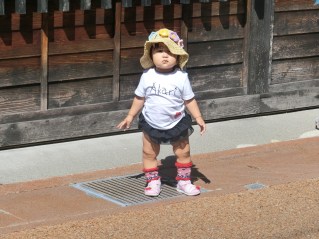
But this morning, on the other hand, I spotted a (very) young man out walking with his brand new squeaky shoes, who was certainly in a  hurry. It seems that he had just found out how to walk and was determined to cover as much ground as he could as quickly as he could. He stopped short on seeing me, as the picture below shows.

CIMG9051

But then he moved on, at his previous frantic pace. No doubt, in time, he’ll be socialised to slow down, take a deep breath, and enjoy the country lifestyle offered by this charming traditional city, as do his relatives, no doubt.

Last minute addendum … the first rain I have experienced since coming to Japan more than two weeks ago, and just a little drizzle. I loved watching the convoys of uniformed kids going to school, with the yellow umbrella apparently part of the school uniform for elementary school. Of course, the high school kids are too cool for that, and go by bicycle!

Finally, all over town are these Saurubobo dolls, which are good luck charms, coming in various sizes and colours. This is a large one, clearly, sitting outside a shop.

CIMG9402

Best of luck to all from Takayama … a really beautiful place. I hope to return here one day.


Photos from a train window

I’m enjoying train travel in Japan. It’s incredibly efficient and well-organised and almost everywhere is accessible by train. Sitting in a train allows you to see the world go by, always interesting in a country other than your own, but capturing it on film can be a challenge. So this blog is just to illustrate the challenge, as well as some of the solutions, on my trip today from Kobe to Takayama, just in case you want to try to do the same. At the risk of making a bad pun, the blog is intended to give you some pointers, as suggested by the photo above. (I apologise in advance to those who know more about this than I do; the advice is not directed at you!)

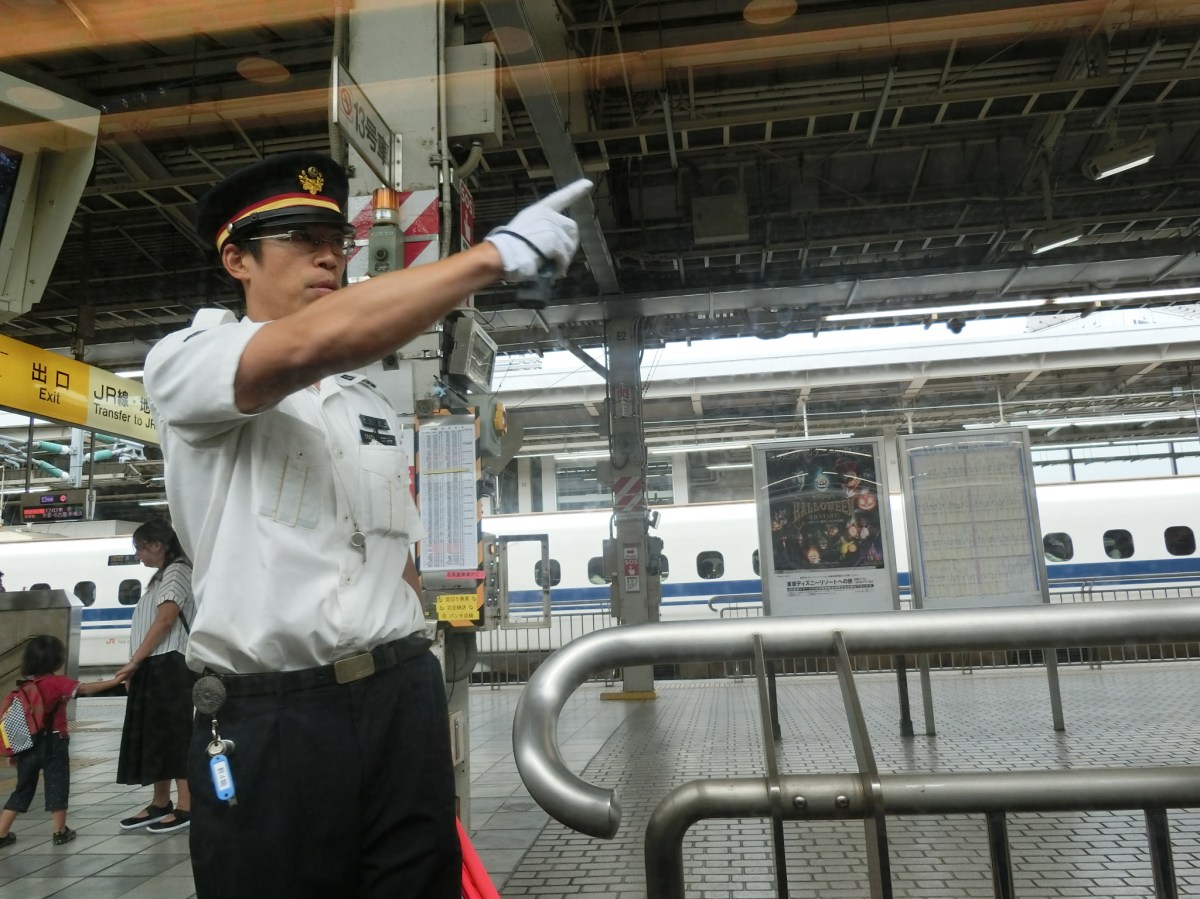
The trip began in a shinkansen (aka ‘bullet train’) from Kobe to Nagoya and then a regular diesel train from Nogoya up into the Japanese Alps to Takayama. The picture above shows a station officer sending the train off in Kobe. Staff always wear white gloves (as do taxi drivers), and take their roles very seriously. This chap is verifying by pointing that he has checked that all is OK in that direction, before waving the train off. Trains leave exactly on time and usually arrive exactly on time. Drivers go through a similar routine, I have noticed, to verify to themselves that they have checked the appropriate signals, etc. I feel very safe on Japanese trains, as human error has been reduced as much as possible.

The photo of the chap was made out my window, just as the train was leaving, so it was moving very slowly. Apart from the driver standing in front of the pole, which clutters up the picture, it’s not a challenge to take such a photo.

When the train is moving, it’s a different matter, of course. And shinkansen move pretty fast – although nowhere near as fast as a bullet. The technology is now quite old, and some high speed trains in other countries are much faster, but a typical shinkansen speed is around 220 kilometres per hour, fast enough to make photography challenging. So what can go wrong?

Firstly, when the train is travelling fast, photos will be blurred, unless the camera shutter speed has been made very fast. If you’re using your smartphone as your camera, you may find it hard to do much about that, as the camera will decide for itself what shutter speed to use (and will usually result in a blurred image, as it doesn’t know you’re going fast.) If you have a real camera, you may be able to set the shutter speed. On most cameras on which this is possible, you need to set the camera to S mode (for speed) and adjust the speed to suit the circumstances. The numbers are ‘backwards’, too, so that a setting of ’60’ means 1/60 th of a second, which is half as fast as a setting of ‘120’, which is 1/120 th of a second.

In the photo below, my camera was set to 1/160 th of a second – easily OK for normal photography, but not for a photo from a shinkansen, even when it had not reached full speed:

CIMG8738

This photo is obviously unacceptable, because of the blurring. Notice that it is more blurred closer to me in the train than it is further away. After posting it here, I have discarded it. When I noticed the problem (this was the first photo out of Kobe), I changed the setting to 1/640 th of a second, which is what I normally use for a shinkansen photo.

Another problem are the reflections in a window. These are worst on the sunny side of the train usually, and are often hard to avoid. The photo below shows an awful example, where I have managed to photograph myself as well as the scene out the window, so this one is a failure too. On one train today, I was able to switch sides of the train as it moved directions, when there were few passengers, but that is not always possible. Sometimes,  you have to wait for the train to change direction if you can’t move.

CIMG8795

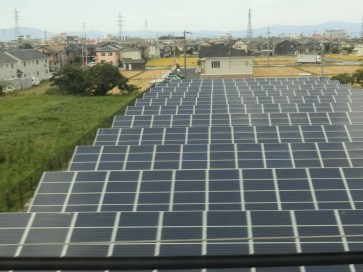
Another problem in trains in particular is that there are often poles outside, which appear exactly when you don’t want them, so a nice photo can be ruined because it turns out to be a photo of a pole, with a nice background. There’s an example below. I was interested in the regular use of solar panels in the Japanese countryside, but this pole appeared at precisely the wrong moment! The photo also has some window reflections in it, and is also to be discarded.

CIMG8769

Avoiding poles is not easy, especially at high speed, as you are not looking for them. But in fact, they are often quite regular, almost rhythmic, and can be avoided with practice for some kinds of shots (such as scenery); it’s harder for taking photos of objects like the solar panels, however.

Even getting what you want to photograph in the frame at speed is hard sometimes, especially when you can’t see far ahead. So this photo of some other solar panels just misses the panels, as I pressed the shutter a little bit too soon and also needed to zoom out a bit first. There’s no time to zoom at speed in fact, so you need to have the camera zoom already set to the appropriate width ready for a photo. Still, an impressive array of solar panels, but another discard!

CIMG8743

There are other ways to miss a photo, too. We passed this enormous solar panel by Panasonic (at least 100 m long, I think), but I was simply too slow to photograph it, so only caught a tiny bit and got the tree in front instead! Yet another disaster … and there were no other objects like this I saw today. You get only one chance, often, so have to be alert.

CIMG8760

Never content with making one mistake at a time, I often managed to make several at once, such as this disastrous photo, which misses the main object (the bridge), gets a pole in the road and has many reflections. Yet another failure!

CIMG8774


CIMG8844

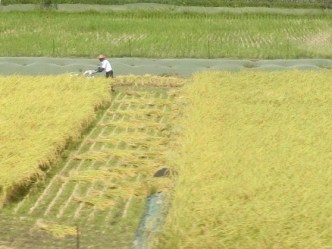
Some problems can be repaired afterwards, by careful cropping, fortunately. Here’s an example. I wanted to take a photo of someone working in the fields, not just of the scenery. The photo I took managed to do that, but the farmer is quite lost and only just visible in the photo (as I had been previously trying to photograph wide scenes).


Version 2If the photo is cropped, and is of sufficiently high resolution to permit that, it can be improved a bit. I usually take photos at 3 megapixels, which allows some zooming without losing too much resolution, as in this case. It is not always clear how (or even whether) you can change the resolution on camera phones, however. I’m not unhappy with this photo, which gives a sense of the enormity of the farmer’s task, without background clutter.

CIMG8844Zooming in even further may be problematic, as the photo will become quite grainy, unless it is was originally at a much higher resolution (say 10 or 16 megapixels). In this case, I’m unhappy with the graininess, although some might be less unhappy with it; it’s all a matter of personal preference and style at some point, of course. And, again, you may not be able to change the resolution on your camera if it is actually a smartphone.

Taking photos from trains often is difficult with things getting in the way, especially electrical wires, and physical barriers set up to keep noise away from communities with a train going through them. Sometimes, it is just not possible to take a photo at all; at other times, the photo will unavoidably include wires, and you have to accept that (or manipulate it later using software such as PhotoShop, which is probably too much hard work for casual holiday snaps. So, I will tolerate the wires in a photo like the one below, persuading myself that it’s actually part of the scene:

CIMG8796

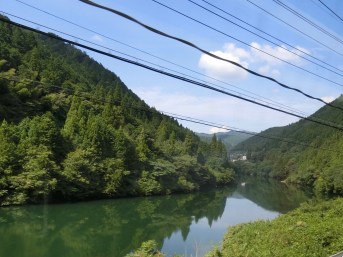
The scenery in the mountains was stunning, and there were many views like this that I enjoyed, despite my inability to capture them with my camera.

I remember many years ago having my portrait taken by a colleague (who was the photography teacher in the school), back in the days before digital cameras. He said that he discarded most photos he took, expecting to get one or two shots from a roll of 36 that he was prepared to print, a ‘hit-rate’ of less than 10%, which surprised me. He was an experienced professional (and not shooting out of a train window!) So I am not easily discouraged, and with a digital camera, it’s easy to discard failures with essentially no cost (unlike film). On my train trip today, I took around 100 photos, of which about a dozen are worth keeping … and it kept me amused for most of the trip!

Here are a few of the small number of photos I chose to keep. [You can click on photos to see larger versions, if you wish.] Of my several attempts, mostly abject failures, I liked the following two photos of solar panels, the first showing that they are often blended into the farmyard environment, as if farmers are growing electricity as well as rice, while the second was a lucky shot, showing a giant electrical company recognising the need to get electricity to use its products. It’s clear to me that Japan takes alternative energy sources very seriously, possibly more so after the Fukushima nuclear reactor disaster, and no doubt in accord with its signing of the Paris agreement on reducing greenhouse gases.

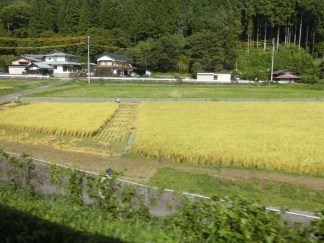
I saw many rural scenes, with crops in various stages of production, and it seemed to me that very little usable land was not being used for cultivation. So I enjoyed photos like the following:

I often saw cases where the crops came right up to the farm buildings and where a cemetery (clearly immovable) had crops growing all around it. I also liked some of the scenes later in my journey that showed the mountains as well as the fields and gave a sense of the wider landscape.

I saw many rice fields under cultivation, unsurprisingly as rice is commonly eaten in Japan (much more so than is the case in Australia). But there were other things cultivated as well. I was surprised, to see that tea was also grown, for example; after several attempts, I managed to capture a small plantation, as shown below. I should not have been surprised, of course, as tea is very popular in Japan, and grows well at higher altitudes, so is more likely to be seen as we got closer to Takayama and away from the plains of Kansai. Vegetables are also important and I saw some greenhouses apparently for that purpose as we got into the mountains, where earlier on lower land, vegetables were simply grown in fields next to the rice fields.

In the mountains, there were many lovely scenes involving rivers bubbling through the landscape. Here are a few examples:

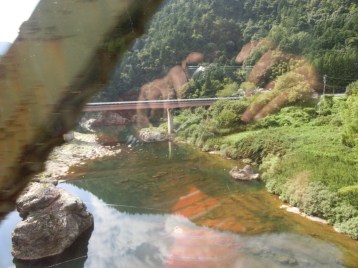
I also saw some interesting bridges en route, such as these (but failed miserably to photograph most of the bridges I saw!).

Although most of my photos were unsuccessful, I have long ago learned that you have to fail, and fail often, before you can succeed. This applies to lots of things, of course, not just to photography. Despite my many failures today, I thoroughly enjoyed the wonderful scenery passing all too quickly past my window, and I was pleased that I managed to catch a few bits of it on my camera. I will remember some of my journey later, as well as the visual delights of the Japanese countryside, by looking at the ‘surviving’ photos.

And if you are a beginner, hopefully some of my tips are of use, not just for trains but for other moving vehicles like buses and cars.


A corner of Kyoto

I wondered about visiting Kyoto, as I have been trying to do new things, and have already been there.But it is such a beautiful city – according to some, the most beautiful city in the world. That’s why it has (I think) sixteen UNESCO World Heritage Sites, more than any other city. Opinions will differ on that, of course, and first impressions of Kyoto make it seem like anywhere else in Japan. But it’s not like anywhere else; it’s the cultural heart of the country. And how could I live for five days only half an hour away by train and not visit at all?

So I decided to pop over briefly, and look at only a small corner, at Arashiyama, in the foothills, and walk slowly to soak it all in. (Kyoto sits in a basin surrounded by hills). There are three attractions there, only one of which I have previously visited. I knew in advance there would be a deluge of camera-carrying tourists – great cities of the world always are. But if we avoid the places full of tourists, we miss out on the reason they are there, don’t we? And, anyway, I am a tourist too. And I’ve got my camera. So I’ll just share a few impressions.

The Tenryu-ji Temple is a World Heritage Site just next to the famous bamboo forest, and was first built early in the fourteenth century. It has a stunning garden (which is not uncommon in this lovely city of gardens) which you can walk around or view from the temple, or both. I chose both.

Click on the pictures to see more. I loved the framing of the garden from the viewing seats, on tatami mats, and also loved the way the garden blends into the hills behind and even in the distance. The walking gardens go up the hill, and are meant to be strolled around, and to encourage meditation and admiring of the beautiful natural world.

I did some strolling, and (again) wished I was here in a few weeks time when the colours change or a couple of months ago, when the flowers were all out … but was thankful that I came at all. The greenery is extraordinary and, despite the tourist throngs, it’s quiet, and peaceful. And calm.

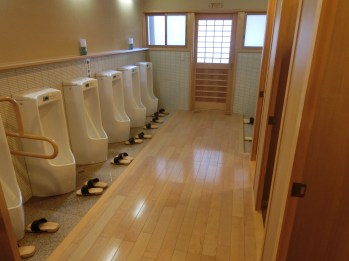
I also needed to visit the toilet in the temple. I very rarely take photographs of toilets, but when provoked, I can make an exception. I think this is the most beautiful toilet I have ever visited. I realise it wasn’t here in the fourteenth century, but it is a testament to the world of Kyoto that things should be made beautiful, whatever they are.

CIMG8423

I was intrigued to find a project at the temple for bringing back cultural treasures from abroad. These screens were made by digitally copying the originals, owned by and housed in a Boston museum, and transferring them here. They didn’t come from this temple originally, but from elsewhere in Kyoto (now lost); what a great idea for returning cultural heritage. Bringing together the old world with the new technology.

CIMG8410

Speaking of which, there were lots of people wandering around in kimonos, which I assumed were rented for the day, and I spotted many examples of the old world and the new like this one, with the ubiquitous smartphones evident:


CIMG8386

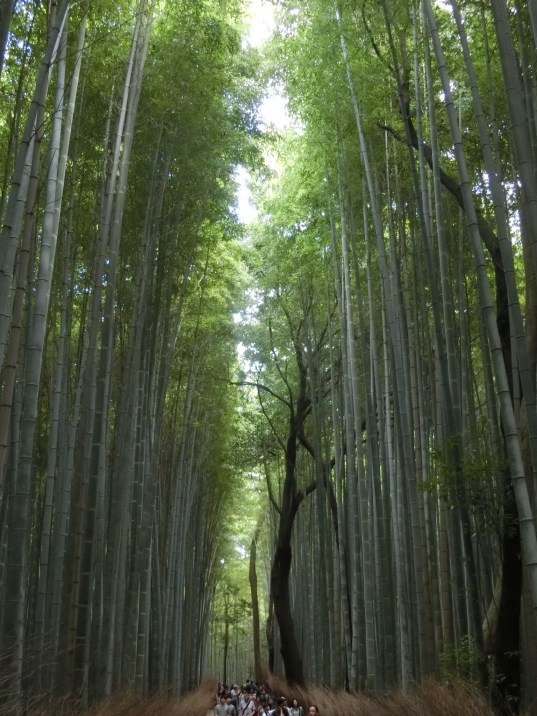
The Arashiyama Bamboo Forest is also a tourist magnet, and is adjacent to the temple. It’s a wonderful place to walk through, with enormous bamboos giving it an extraordinary feel. It was full of tourists, of course, but I kept reminding myself that I was one of them and that there was a reason we were all there. However, it would be wonderful to be here almost alone, and I made a mental note to do that next time I return to Kyoto, and to come very early in the morning.

CIMG8469

I was amused to see one bamboo going against the grain here and there, such as this one:

CIMG8466

Maybe a reminder that none of us lasts forever? And that the world around us will keep going after us.

An uncharacteristic noise (drumming and shouting) suggested to me that something was happening in the forest. And shortly afterwards, I encountered a procession of some kind, with police protection, probably headed to a temple somewhere I assumed. There was no way to find out and five minutes later they had all gone. I resisted the (strong) temptation to follow, as I had set myself on a close time to return to see something of Kobe.

It seemed that a priest was the most important character, although the lady being pulled at the rear on a pedicab was also obviously important. I was intrigued to see the sake barrel having an important role, and was a bit puzzled about all the connections. the marchers (pullers) were all chasing, bot of course in Japanese.

Just past the forest was the third attraction I had decided to visit, a villa and garden called Okochi Sanso, built and owned by a former silent movie star of Samurai films, who died in the 1930s.

The villa itself is lovely, but the gardens are the main attraction. A lovely garden for strolling, and arranged so that there are beautiful views out of the garden as well as lovely plants inside. I had no trouble imagining Okochi san going for a morning stroll around his garden, followed by an evening stroll later, as well as pausing to admire his views. I was thankful that it has been left for tourists to do the same.

These were a couple of my favourite views here, despite the crane in the foreground:

Here is a view from  viewing platform, also very attractive (to me, at least) and still ignoring that crane.

CIMG8514

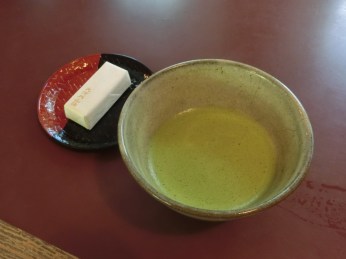
Part of the deal to see the villa and gardens was a cup of tea in the tea house, along with a Japanese sweet, both beautifully served, of course. Very refreshing, even though I don’t normally drink green tea.

CIMG8521


My time was almost up, but not quite, so I decided (with my heart and not my head) to have a look at another attraction, some distance away, the Funishi-Imari shrine in Kyoto’s suburbs. So I walked to the station, amidst a throng of tourists, and enjoyed looking at some of the many shops along the way.

Fans were a popular commodity of course, as was food, and I discovered one of the sources of all the kimonos. Many of the shops were very photogenic and I could have repeated this small collection of snapshots ten times over.

The Fushimi Inari shrine is an extraordinary vermillion complex on a hillside, that goes right up the hillside. Again, very popular with tourists, and very photogenic! This is the sight that greets you as you step out of the small Inari railway station (itself with many vermillion decorations):

CIMG8567

The shrine has many images of a fox, like this one, a large version near the shrine gate:

CIMG8572

There were dozens of fox statues all over the place, however, both large and small. In Japan, the fox was a symbol of good harvest (unlike in western countries where a fox is regarded as an savoury intruder and a pest to be hunted), and the key in its teeth is a key to the granary. These days, it has also become a symbol of prosperity generally (as in business, for example). An interesting cultural difference!

vermillion is evident everywhere in this shrine, as you can see. Even the little prayer votives are vermillion in colour.

Apart from the colour, the most distinctive thing about the shrine are further up from the temple area, requiring a few stairs to be climbed. Again, lots of people in kimonos as well as other camera-laden tourists:

CIMG8596

Not far from the station, you encounter lots columns of torii heading up the mountain! At this stage (the lower levels … I was in a rush!) they are full of tourists, but at higher levels, the tourist throng thins out. The first time I was here, I went up as high as I could (almost), until there was just me and the torii. An extraordinary sight; I understand that there are about four kilometres of passages!

In places, they branch out, like this, with one side for going up and the other for coming down. And you are not permitted to go up the down side, as advised by a large sign to keep right.

CIMG8585

A sight like I’ve not seen elsewhere. Extraordinary.

I had overstayed my (self-imposed) quick visit to a little corner of Kyoto by about an hour, but still left enough daylight to zip back to Kobe and to look around, thankfully. I was pleased that I decided to see somewhere I had previously visited.

I learned in Hiroshima that Kyoto was one of half a dozen targets considered for the first atomic bomb explosion. I am pleased and thankful that it was not chosen, as that would have been a senseless war crime of incomparable magnitude.

Kyoto is a wonderful city. A magical place. I realise that beauty is in the eyes of the beholder, but this beholder has never seen a more beautiful place. If you are ever in Japan, don’t miss it. Join the tourists: they know.

Having a bath at Arima Onsen

Can there be anything more quintessentially Japanese than bathing in an onsen, or natural hot springs? I’ve had several Japanese baths (e.g. in public bath houses, and recently in facilities at my capsule hotel), but not previously visited a natural onsen, which are widespread in Japan. Japan is naturally volcanic, with lots of mountains and so lots of hot springs, and people have been bathing in them for thousands of years, so I decided to do the same. An additional motivation was to ‘take the waters’ and give my feet and legs a rest!

Arima Onsen is a small town full of onsen about 20 km outside Kobe, and I gather quite a famous one. It’s a pretty little town, with lots of small shops in the central area and a number of small temples dotted around the steep streets. I decided to go for a stroll before my bath.

A river bubbles right through the town, and there are attractive bridges crossing it, as well as a warning to not be caught down there in flood conditions. The English translation for this important sign was clear. (Click on the photo to see it in full).

The town streets near the river and the station have some attractive little shops as well as a pleasant, unrushed ambience and even the beginnings of autumnal colours appearing. I saw a fruit I’ve not seen before, hanging from a vine, and I was intrigued at the public foot bath in the middle of town. I decided to not create a public nuisance of myself by trying the foot bath out, leaving that to my real bath. But this was clear evidence that I was in a spa town.

The town streets are small and steep, and there are many temples strewn amongst the houses, with not much traffic. I went for a stroll (if that’s what you describe as wandering up and down very steep hills) Here are some examples:

I love the beautiful designs often seen in Japan, where making things attractive seems to be a national obsession. These lovely containers outside a temple are a good example.

The small, windy and hilly streets must be a nightmare for drivers and pedestrians, although any traffic necessarily drives very slowly. I have seen little signs like this one before, warning motorists that there are pedestrians around (usually children, but not in this case).

CIMG8295

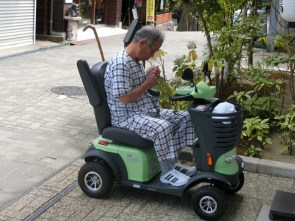
Older folks must struggle with the hills (and I think that Japan has amongst the highest proportion of citizens over 60 in the world) but this chap has the solution with his gopher. I was a bit surprised to see him out in his pyjamas visiting the local store, but it seems that kind of town. Smoking here is still quite common, and I guess he thought it would be easier to continue the habit, while getting around the hills without being too puffed out. Hard to tell, without chatting, which I didn’t try.

CIMG8282

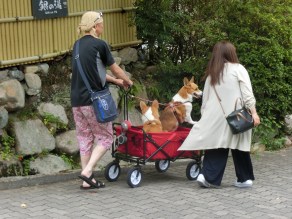
Walking the dogs must be tricky too with all the hills, but this solution seemed to me to miss the point of the exercise:

CIMG8274

I saw occasional confirmation that there were hot springs in town, such as the contraption below in what seemed to be somebody’s back yard (and out of which steam was coming), as well as the public drinking fountain advising users that it was drinkable water, not the hot springs water (with lots of minerals in it).

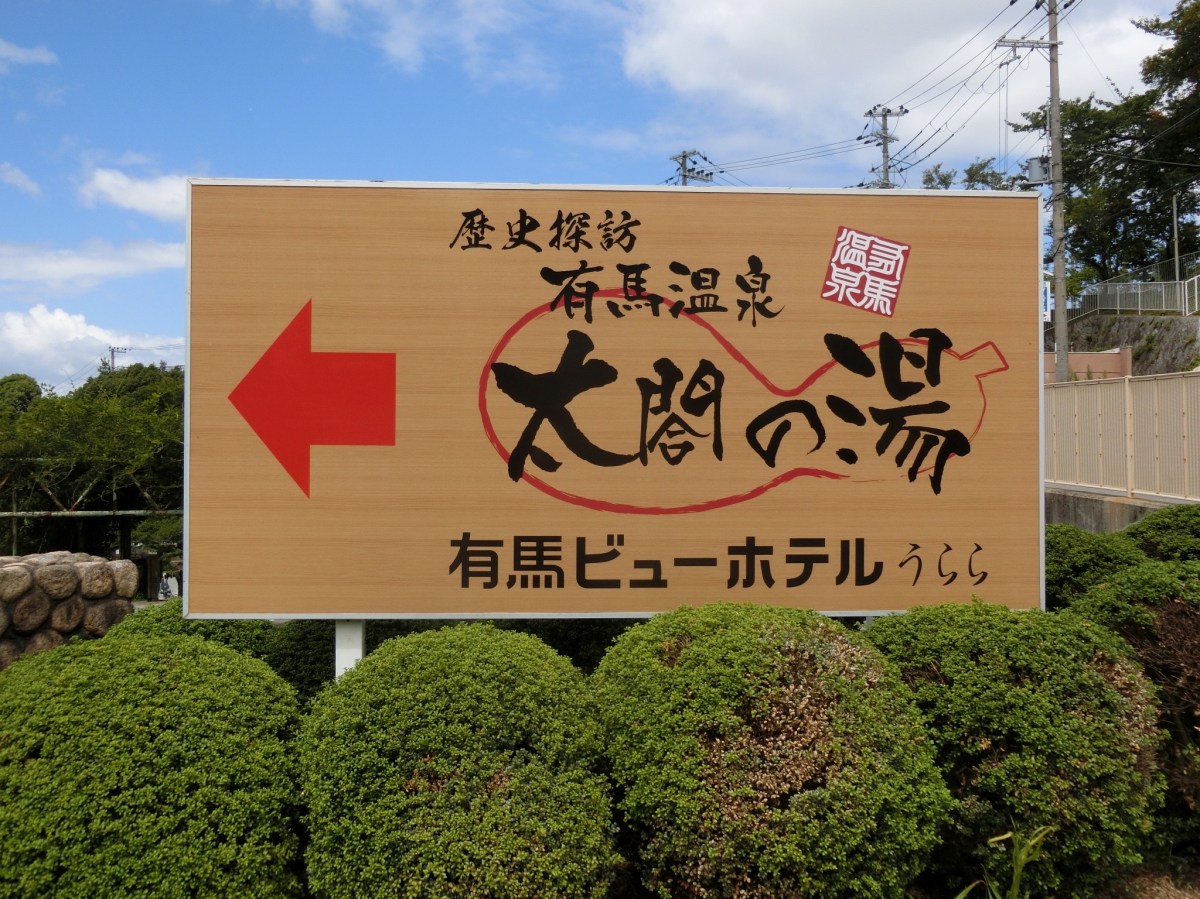
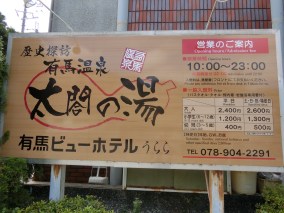
I had purchased a day pass to an onsen; when I eventually started looking for my onsen, called Taiko no yu, it was a little tricky. But I enjoyed the stroll, anyway, determined not to be in a hurry. There was even information to absorb, such as this lovely little sign about decorative tiles warding off evil spirits; what a shame that someone had covered it over with a wire! (So I’ve provided an uncluttered version on a wall for you to read instead.) Unless you are Japanese, you will see the communication problem is not only about the wire.

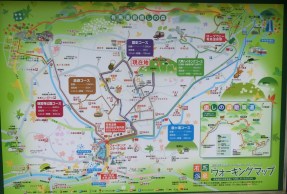
There were maps around, such as this one, but English did not feature prominently on it. If you click on the map, you’ll see a bigger version – which may not help, in this case!

CIMG8279

I had a town map with a little English on it, but, as these things often are, there was no scale on it, and it was not a very good guide to distances or even directions. [As an aside, in Kobe the other day, the lady in the tourist office pointed to two places, that were almost exactly the same distance from my starting point on a map. One of them she said was a short walk, while the other required a train trip of two stops! My attempts to persuade her that the map was unhelpful came to nought.]

While poor map construction is mathematically problematic, my feet were beginning to advise me that it was biologically problematic too! Eventually, using a combination of maps, my Ulmon app on my phone, asking directions and (mostly) luck, I found what might be a sign for my onsen shown at the top of the blog – at least the arrow was immediately decipherable, even if the rest of the characters were not. Nearby, I found another version of the sign, this time with the actual name of the onsen in English characters, as well as some information. Success!

CIMG8304

The first thing necessary when entering the onsen is to remove your shoes, and place them in a locker. When checking in, I gave them my locker key, which they kept until I checked out.

CIMG8311

I was then issued with everything needed: a robe (I got to choose my colour, so chose purple; the robe I got was brown, however) a towel and a small hand towel. I then went to a locker room, disrobed and put everything in my locker (except the hand towel), and headed off to the bath. I had a locker key on my wrist that allowed my to bathe, with my belongings secure, and also allowed me to buy things (such as food, beer, extras, etc) using a small barcode (that is, using mathematics). Of course, I could not take my camera into the bathing areas, for reasons of public impropriety.

It is necessary to thoroughly wash yourself before a Japanese bath; it is completely improper to use the bath to wash in, as it is for soaking in. All the facilities of soap, shampoo, conditioner, etc are provided (as described earlier on my capsule hotel blog, so I won’t repeat them here).
It was lovely. I tried out various bathing pools, which had hot water, some of them very hot, and there were also some saunas. I’ve downloaded a couple of images from the web to show you examples from this particular onsen:

(In case you leap to conclusions, men and women bathed separately!) The baths shown here are outside in the open air, albeit with some roofing, but there were several inside as well. I tried them all, of course, including the small tubs you can see. usually there were three or four others in a bath (but not in a tub!), but people for the most part completely ignored other people, but just sat in the bath and wallowed. The exception of course was people who came together (such as a group of young men and a father and son). The muddy bath did not feel muddy, but most of the others were crystal clear and delightful to sit in.
And the small towel? That mostly sat on people’s heads, and was used to wipe off perspiration (e.g. in a sauna) or used to dry you a little walking between baths. Some people used it to modestly cover themselves, too, when walking around, but most didn’t. Of course, it is quite improper for the towel to be in the water, as it will contaminate it … so I was mortified when mine fell off my head, but fortunately nobody was watching (I hope!) and I quickly grabbed it again and restored it to my head!

All kinds of males were in my half of the onsen: young, old, tall, short, fat, skinny, etc. Yet it seemed to me that nobody was even slightly concerned about others – their size or shape – but was just there to enjoy a bath. I have of course been in lockers before, but I’ve not seen such a large number of people wandering around naked, and not in the least concerned that everyone else was naked too. So I was very surprised on returning to the locker room on one occasion, a room with about a dozen naked men in it, to find a cleaner mopping the floor between all the men and generally tidying up the dressing areas (basins, mirrors, hair dryers, etc). She (yes, she!) seemed blissfully unaware that she was in room full of naked men, and they also completely ignored her, as they were busy getting dressed, or dried. It tells me a lot about the idea of the bath.

After a while luxuriating, and having tried everything at least once, I decided to have lunch, which required putting my pyjamas back on and going to the lunch room, which was mixed (so that people could eat with their partners or families). It was a lovely room with lovely food, and not too expensive. Everyone is wearing the same pyjamas, men and women alike (except for the choice of colour) and people all looked very relaxed, as I was. [I could take a few snaps here on my phone, on which I also enjoyed some free wifi]

The surrounds of the onsen were all spotless – indeed, gleaming – and it was a beautiful place to spend a few hours. There were also shops, of course, mostly selling food and other souvenirs of various kinds.

I am frankly surprised, given the amount of food that seems to be sold, that people here are not heavier than they are. Maybe it’s all the walking up and down hills?

What a wonderful experience! Thoroughly recommended, if you have the chance. I was completely refreshed and relaxed after it all, and pleased that I had ‘taken the plunge’. [But don’t misunderstand that! swimming in the baths is almost as unacceptable as washing in them!] It’s a terrifically democratic experience, too. you don’t know whether the chap next to you in the bath is manager of an international corporation, the local MP or a local street-cleaner. Without our clothes and other trappings, we’re all just human beings.

If you get to Japan, and even (or especially!) if you are anatomically unhappy with yourself as too tall, short, thin, fat or otherwise ‘unacceptable’, forget all that. Nobody will be even slightly concerned about that, and you can simply enjoy a decent bath. If you’re interested further in this little town, see this website.

I’ll do this again, I hope, one day.

Day trip to Koyasan

Although some of my travels have been decided at the last minute, others have been decided before I left home. Koyasan was one of these. It’s a lovely and famous mountain temple complex in the south of Kansai, based on the Shingon School of Buddhism, founded by the same person as Daishi-on in Miyajima, so around 806 AD. It’s been likened (by some) to Shangri-La … a long way away from the everyday world, but I think that’s overdoing it. It is a UNESCO World Heritage site (or at least some of the buildings and t he cemetery are, I think). Although one of the attractions of the area, high in the mountains, is that you can stay overnight at temples, that looked too hard and so I opted for a day trip.

Not that the day trip was easy … the trip involved zipping into Osaka and then catching  train for about 90 minutes, before a cable car to get up the mountain itself, and then a bus. The trip itself was interesting, as it was nice to see some rural and mountain scenery, although tough to photograph from moving trains. (We don’t have many mountains in Western Australia, so I’m always attracted to being in other people’s mountains.)

I did find out the difference between a cable car and a ropeway, en route to Koyasan. A cable car is pulled along by a cable at ground level, while a ropeway has a cable in the air from which the cars hang. In Australia, we call these both cable cars – incorrectly, I now realise. The cable car was needed for the last bit of the ride up the mountain; you can see for yourself how steep this was (click on a picture to expand it a bit).
The town was very pretty, with many temples in the area, as well as an extraordinary cemetery, described below. The first temple I visited was Kongobu-ji, which is the head of the (international) Shingon Buddhist group. It was a beautiful complex of buildings, but sadly I was not allowed to photograph the best parts, which were some beautiful rooms with painted sliding doors. I’m never quite sure why photographs are prohibited, but assume it’s a mixture of avoiding people flashing their cameras (as they don’t know how to avoid that!), (thus safeguarding the objects too), preventing people from irritating others (especially the selfie brigade) by upsetting the decorum of the place or making sure that they can sell their printed copies of the objects in question. Whatever the reason, it prevents me from showing you one of the day’s highlights …

I was able to take photos of other bits of the temple, and you can see that it is very beautiful:

The temple is entirely wooden (as are most parts of most temples in Koyasan), which makes me wonder why there is so much forest left. Many of the temples in the area have been burned down at some stage and needed rebuilding; wood looks beautiful but it’s high maintenance if you have to reconstruct it occasionally. You can see above the interesting rock garden … a raked gravel area with tastefully arranged rocks in it (not what I grew up thinking a rock garden was). Apparently, this is the largest one in Japan. I liked it …

At the end of my trip around the temple, I was offered a cup of tea in the main meeting room, which was very large and very splendid, and of course covered in tatami mats:

Again, to repeat a comment I media few days ago, the colours of autumn are just starting to appear; it’s a shame I’ll miss them because of my timing. In a few weeks from now, they will enhance the sight of otherwise glorious buildings like these:

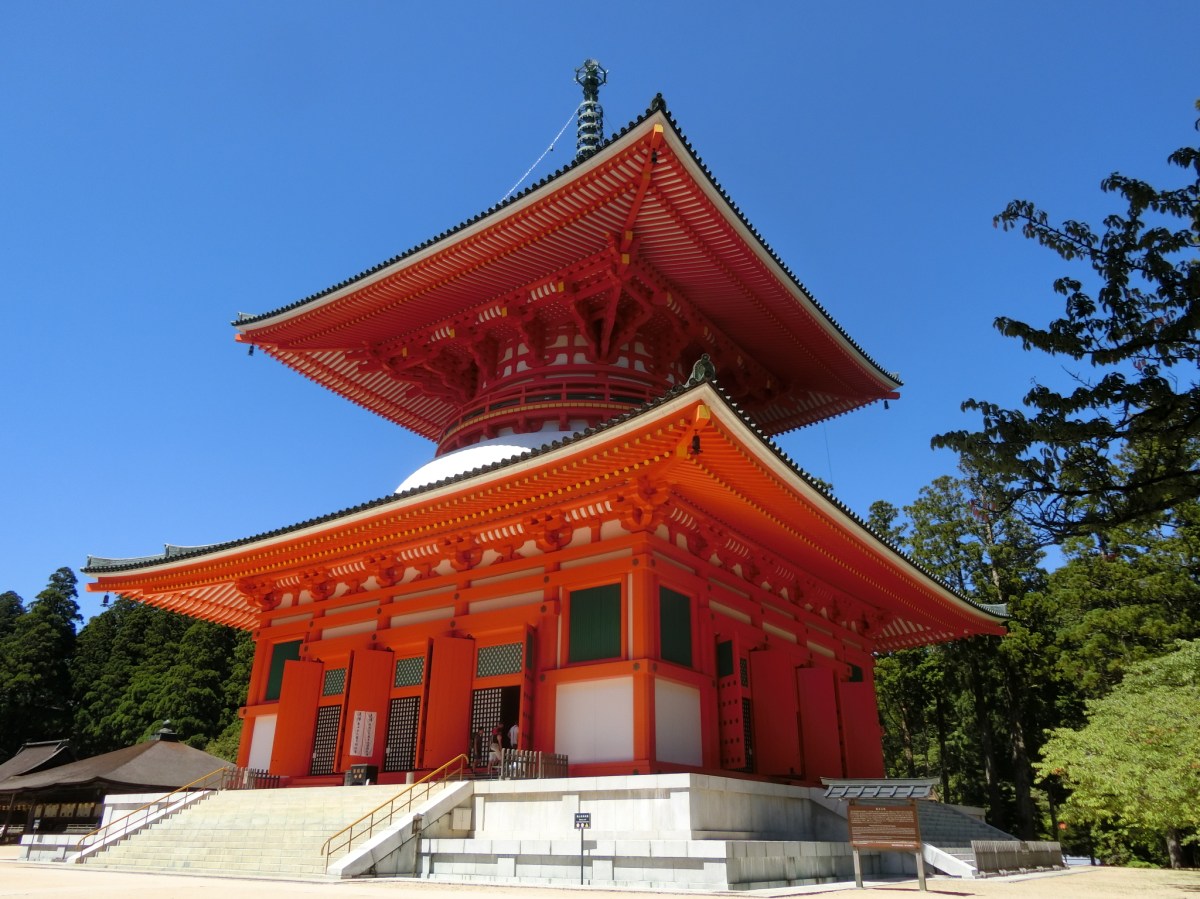
The most spectacular temple here is the vermillion-coloured Great Pagoda (Dai-to) showing at the top of this blog, but there are other lovely pagodas as well, as you can see. It was pretty quiet when I was there (school has now gone back after summer), and I found all of these majestic and beautiful.
CIMG8103Some of these buildings are very old, at least in one sense. For example, the Great Pagoda was first constructed by Kobo Daishi from 816 AD, but it took many years to build. (the same is true for cathedrals, of course, a spectacular recent example being Barcelona’s Sagrada Familia, still being constructed almost a century after Gaudi’s death!). Since then, it has been destroyed by fire several times and the last time it was rebuilt (in 1934), they chose to use a ferro-concrete base, for fire reasons.

I didn’t quite understand the little monk pictures here and there, but finally worked out that they were a symbol of the recent anniversary of the founding of the complex in 816, 1200 years ago last year!

With all the temples around, it’s not surprising that the occasional monk was evident too. I took snapshots of these two (from the rear, so as not to be intrusive on their raying activities):

Apart from lovely temples, pagodas and other buildings, there were other lovely sights around the town … way too many to document, but I thoroughly enjoyed strolling around for a couple of hours. here are a few snapshots of some nice or interesting things I saw:

The town’s main gate or daimon, looks pretty spectacular, and from that point you can see some of the nearby mountains, of which there are apparently eight:

Apart from temples and the lovely ambience, Koyasan is renowned for its amazing cemetery, very famous in Japan. Apparently, this is the final resting place of about 200 thousand people, most of whom have been cremated. The cemetery (called Okunion) is enormous, and very picturesque (if that makes sense for a cemetery). I think that the central path is a World Heritage site, but the whole area is pretty extraordinary. I walked from end to end, with a few snaps shown below:

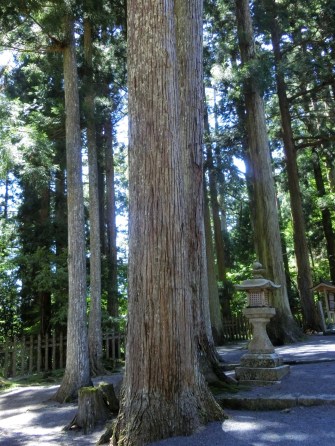
The central path is flanked by many lanterns and huge cedar trees, and indeed the whole cemetery has many huge cedar trees in it, some a thousand years old, as well as lots of greenery of various kinds.

CIMG8039

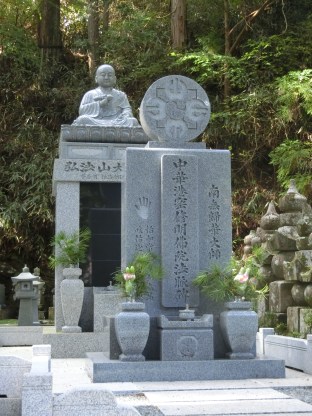
While most things look very old here (not unlike being in an Indian Jones movie!), it’s clear that the cemetery is in active use as there are some clearly more recent tombs, like this one:

CIMG8136

Both famous people and commoners are buried here, but the most famous is Kobo Daishi himself, who is in  a mausoleum at the end. It’s not possible to see the mausoleum, but there is a collection of deities in the general area, as well as an important temple:

CIMG8183

In fact the Shingo Buddhists don’t regard Kobo Daishi as dead, but merely as deep in meditation, and expect him to re-surface one day, when the next true Buddha appears.

If you get a chance, my advice would be to visit this lovely place, Koyasan, and to try to spend the night there at a temple if you can. I certainly enjoyed the whole experience.


Walking around Dotombori

The Lonely Planet Guide described Dotombori in Osaka in two ways. They said it was an example of “evolution: survival of the flashiest”, and also suggested that, if Lady Gaga was a city, this would be it. I think they got it right on both counts. As you can tell from the picture above, ‘flashy’ is an apt description.

But first, the process of getting there. I’ve not found Osaka as easy to navigate as Tokyo, but maybe that’s just my unfamiliarity. I stumbled upon the extraordinary Namba Walk from Namba Station that seems to go for miles (well, at least hundreds of metres!), and needs its own map to navigate. The walk comprises shops and shops and shops and restaurants and shops and restaurants … and lots of people going to and from train stations or to eat and drink and shop. (This picture is unusually empty)

CIMG7718

I was greatly surprised to see a few familiar paintings on the wall (reproductions, of course), and only then noticed that I was in the Chicago Gallery in Namba Walk, with reproductions from the Art Institute of Chicago, one of my favourite museums. (Click on the pictures to see them in full).

There are other walking arcades around the area, too, with wonderful high ceilings, as typical Japanese ‘shopping streets’ often seem to have. And lots of signs! More and more shops and signs and people and unusually (for Japan) noisy.

Many of the little side streets off the walking arcades  look OTT as well, such as these examples with their signs and lavish use of electrical cables.

But Dotomobori Arcade itself, a hundred metres or so of street, was completely over the top – a riot of restaurants, bars, shops, etc all competing (very loudly) for customers with spruikers everywhere and advertising banners like I’ve not seen elsewhere.

If you’re not some sort of showman, you’ll not survive here long in business, as the LP suggested, encouraging flashiness. Lots of the advertising actually moves, too! The crab legs, for example. The Fugu fish are a particular Japanese specialty and prominent in advertising; I’ve not tried them, but I think they can be poisonous if you’re not careful. (I’m careful.)

Behind the arcade is a small canal, and it looks a bit quieter and more refined (until you look up!)

At night, the lights come on and it looks like sideshow alley, with lots of neon lighting everywhere. It felt completely safe, however.

In the middle of all the madness, however, there is a little Japanese Temple, Hozen-ji, which seemed to be a slight relief from the mayhem around it:

Just in case you thought that everything in Japan is peaceful, quiet and restful; if you have such an illusion, come to Dotombori.

Unforgettable.