Shopping for Greens

I needed some greens, particularly some celery and some spinach – it’s minestrone weather. I normally shop at my local IGA supermarket, a short walk from home, although some say it’s more expensive than the larger chains. Just for a change, as I sometimes do, I drove to a nearby Woolworths supermarket, as they advertise themselves as “The Fresh Food People”. 

I found the celery, but had to make some choices, as you can see:
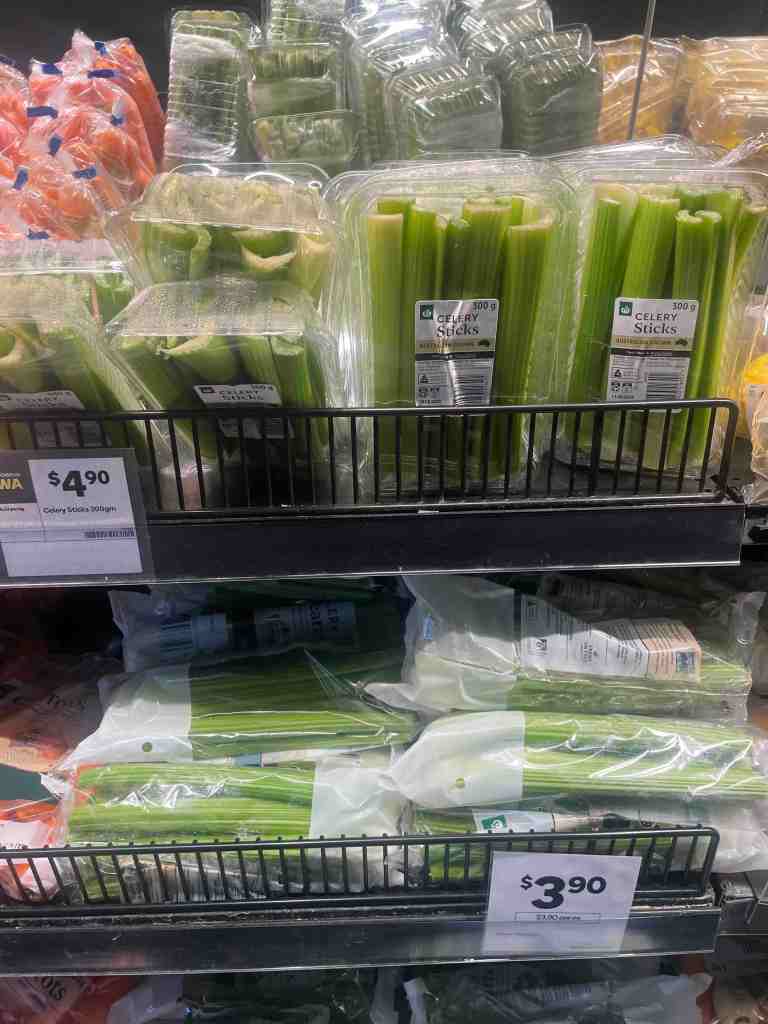
I was curious as to which of these was the best deal. Although I wanted only a few sticks, I was happy to buy a few more than I needed. Are they all of equivalent value? How do they differ?

The top one was the easiest, as it was a clear weight (300 g). It comprised only sticks, which someone had trimmed from a bunch, I assume; it must have been tricky to get exactly 300 g, I thought, but I guess the trimmer got skilled at this after a while. I could use these directly, without trimming them any further myself. But $4.90 seemed expensive; maybe that’s why people are talking about the high cost of groceries these days? I suppose I had to pay for the plastic container, too – although I already have too many plastic containers. 

Mental arithmetic is sometimes helpful, and I checked that this put the celery sticks at about $16 per kg. (I noticed only later that the small print on the label confirmed the celery sticks were $16.33 per kg.)

The packets of sticks below seemed to be the same to me – only a little cheaper at $3.90. Then I looked more carefully and saw that they were described as Celery Hearts. That is, they were sticks but still had the bottom bit of the celery bunch intact, so I would have to remove it myself. That seemed like a good deal (saving $1) for not much effort, but were they the same size? No weight was showing.

I grabbed a couple of bags and took them to a scale to check the weight. Unlike the results of the well-trained and careful celery trimmers that made the 300 g packs, they were all quite different weights – to my mild surprise. I checked five of them at random and got the weights of 480 g, 515 g, 540 g, 525 g and 440 g. The variation surprised me – as if nobody was trying to make them all the same. The average (mean) weight seemed to be about 500 g, so I estimated that these cost a bit under $8 per kg, about half the price of the sticks, although some of them would need to be discarded to just get the sticks. That’s a big difference.

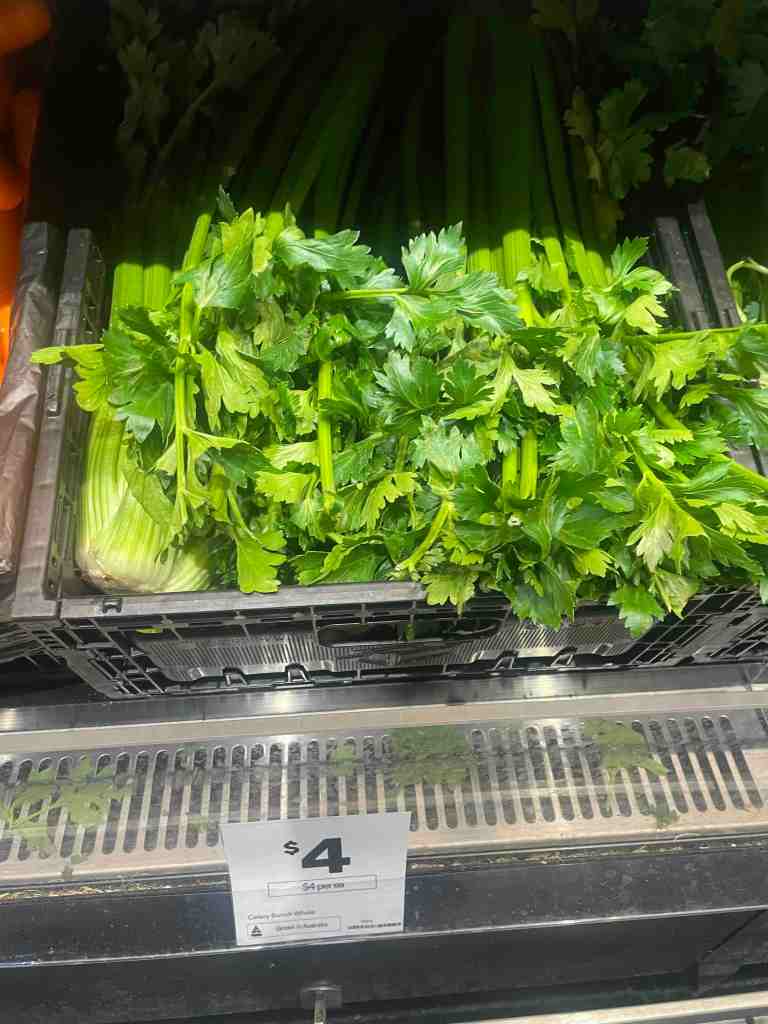
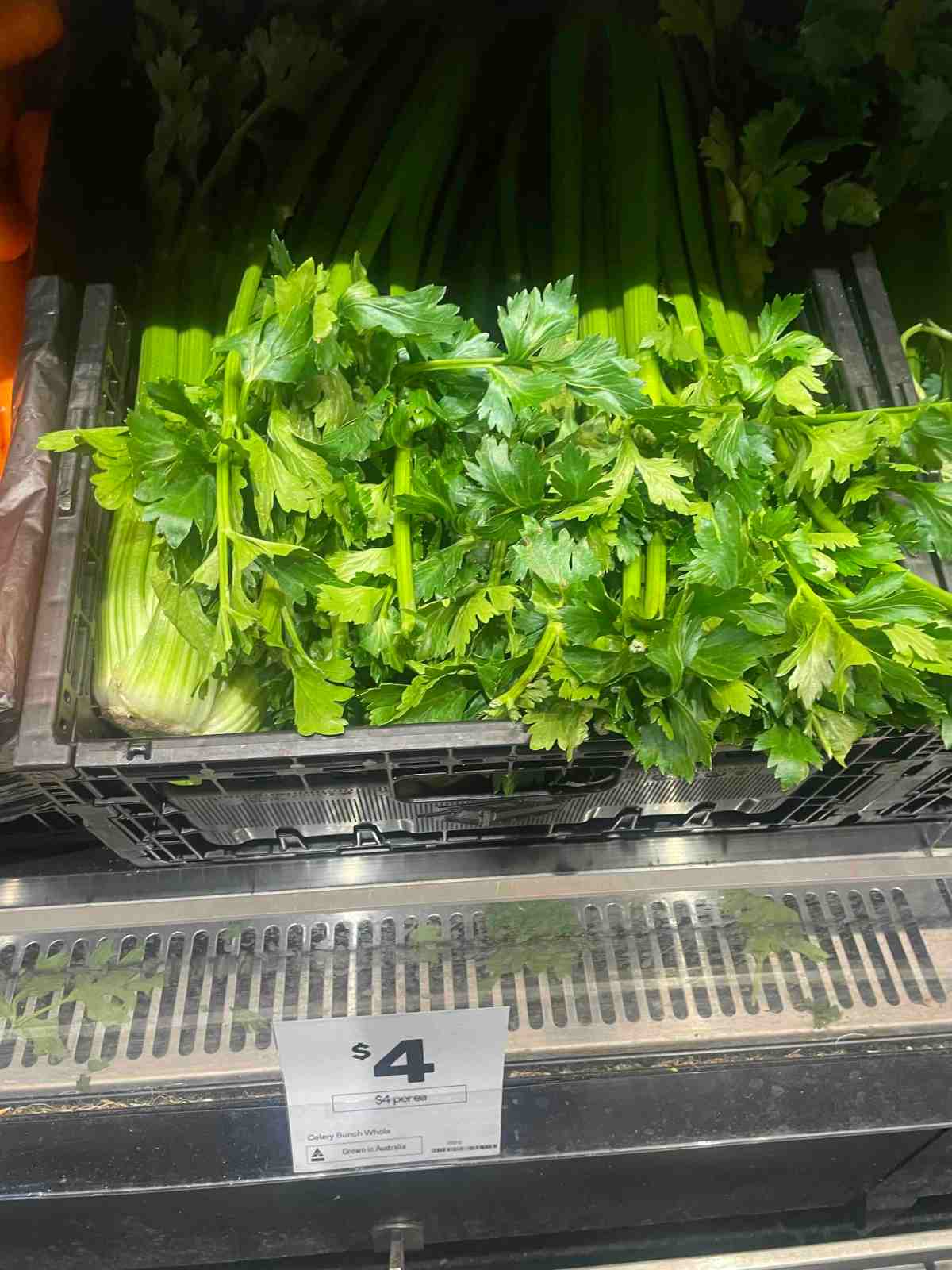
The final choice was a whole bunch of celery, as shown at the top of this page. They looked like a pretty good buy, even though they would need a bit of trimming – topping and tailing essentially. I mentally assumed they were the best buy and put one in my bag to take home. When I got home, I trimmed off the tops and weighed my bunch (including the bottom bit) and found that it was just over one kilogram. So it was about half the price of the heart sticks (which were about half the price off the sticks).

$16 per kg, or $8 per kg or $4 per kg is not much of a contest, even if there is a minute or so of work needed to trim them when I got home, especially if someone were concerned about food prices. I wondered whether other shoppers realised how different the various options were on their pocket. 

I wanted to buy some spinach too, but The Fresh Food People only provided it in plastic bags (not loose), which felt like a slight contradiction of their title. So I headed homewards to my IGA to do that.

When I went to the shop I noticed that the celery bunches were also $4 each – the same price as they were at the supermarket that people said was more expensive. They also had another option – buying celery sticks in smaller quantities (one at a time). This time, the price was $10 per kg, a lot cheaper than The Fresh Food People’s $16.33 per kg, which required me to buy 300 g, rather than just a few sticks.

Again, I had a choice of ways to buy spinach at the IGA. I could either buy a plastic bagful (as at Woolworths) or I could buy my own preferred quantity (and I wanted only a decent handful):
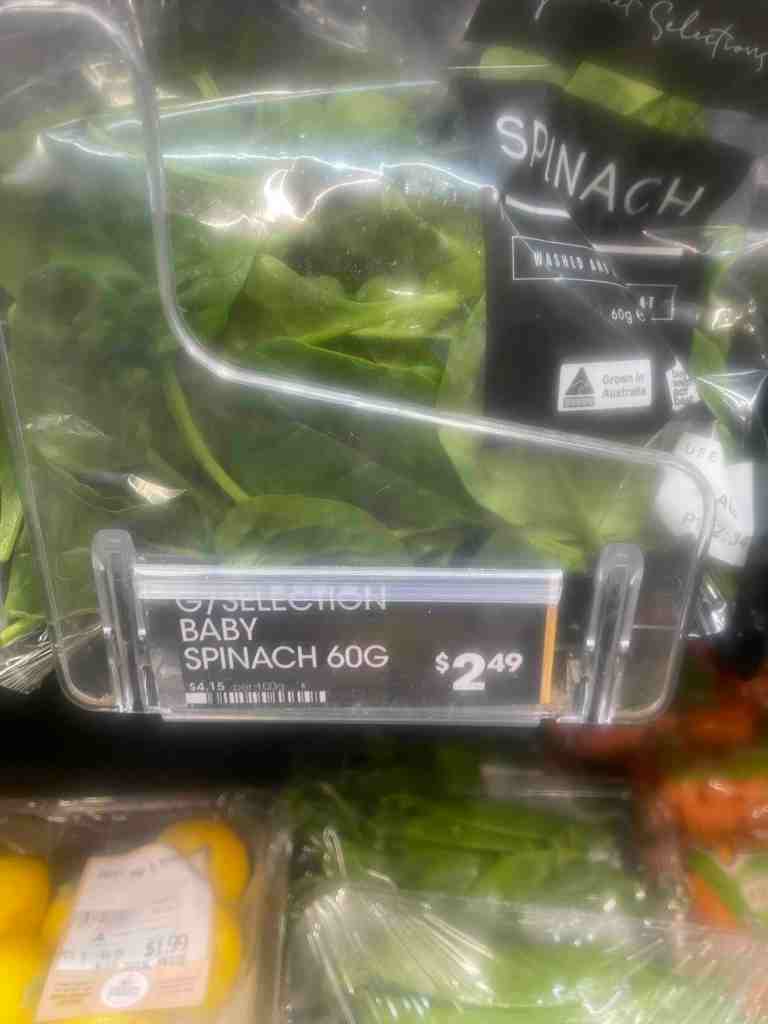
The plastic bagful wouldn’t suit me – it’s always too much or too little – but it always seems much more expensive than the bulk product. The small print on the label meant that I didn’t need to do too much mental arithmetic (although I confess I had done it before I saw the small print!) At $2.49 for a bag of 60 g, the spinach is described as $4.15 per 100 g, and thus $41.50 per kg. I guess they use the small unit of 100 g for comparison shopping as nobody at home is likely to buy a kilogram of spinach (except Popeye, maybe?) . 

In contrast, the bulk spinach is a bit less than half that price, showing as $19.99 per kg (suggesting – bravely – that someone might want to buy it in large quantities?) But, as in Woolworths, the huge difference in price is fairly easy to see, but I wonder how many people look for, or see, it.

I don’t doubt that groceries are costing us all more than we would like, and of course that becomes even more significant for people feeding a family, not just one person. But I wonder how carefully people choose their shops (based on their advertising or on popular opinion and hearsay) and how carefully they make choices amongst what is offered to them? I was not surprised that products are at different prices (something has to pay for the labour and the packaging and the advertising), but I was surprised at the scale of the differences. 

Are you?
Opening of Boorloo Bridge

Boorloo is the Nyoongar name for Perth, Western Australia. (The Nyoongar people are the traditional owners of the land in the south-west corner of Australia, who were here for around 60 000 years or so before the British colony was founded in 1829). So it is fitting that the new pedestrian/cycling bridge across the river, which opened today, is named after the city. I am of course pleased that public funds are being used for a pedestrian bridge, rather than further freeway extensions in this city, which is dominated by cars, so decided to attend the public opening ceremony today, despite the excessive heat.

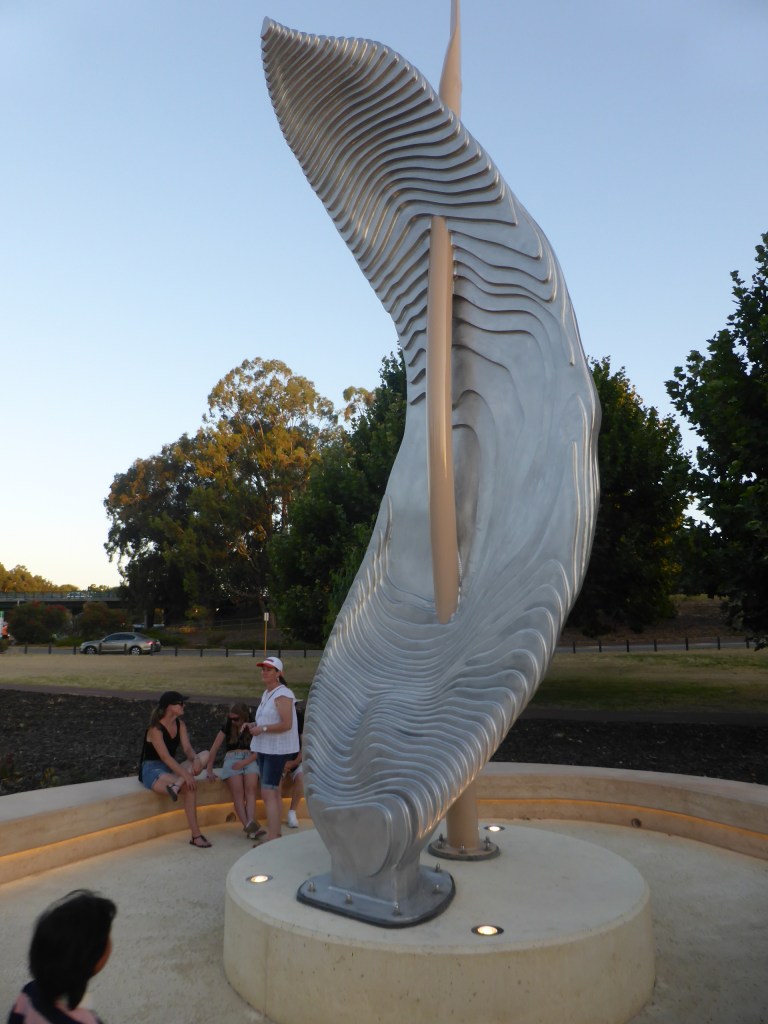
I arrived shortly before dark, to avoid the heat, and the first thing I saw was a sculpture depicting traditional objects – a digging stick (wanna) used by women and a booka (a cloak generally made of kangaroo skin). The first part of the bridge has very large versions of the wanna holding up cables, as you can see:

The bridge goes over what has always been called Heirisson Island as long as I can remember, although very few local people seem to know it was named after an obscure and otherwise insignificant Frenchman on a scientific mission up the Swan River around 1804 (well before the British arrived). A long time before that, in 1697, a Flemish explorer, Willem de Vlamingh, got as far up the Swan River as the islands, but no further. Little surprise that the area was known to the local Nyoongar people as Matagarup (which means ‘one leg deep’), which accounts for Vlamingh’s lack of progress I assume. [Probably a major reason for the British colonisation in 1829 was to make sure that they did so before the French, or even the Dutch.]

The island has had a chequered history, including recent Aboriginal protests, and most Perth people have never been on it. (I have been on it several times n recent years, however). A traffic Causeway across the island was critical for many years in the colony before the Narrows Bridge and the Freeway were built in 1959, finally providing a link between north and south of the river. Prior to the Freeway construction, southern suburbs like South Perth and Como (where I live) were hard to reach efficiently from the city and even regarded as a long way away by many people north of the river. The new bridge provides a link for pedestrians and cyclists, who rarely use the Causeway, and will allow people to easily, and pleasantly, walk or cycle around the entire Swan River area adjacent to the City.

I was pleased to see free drinking water stations available for the event, as most people these days carry a water bottle. The temperature had cooled down to about 37 C (from an earlier unpleasant maximum of 41 C) when I arrived around 7 pm.

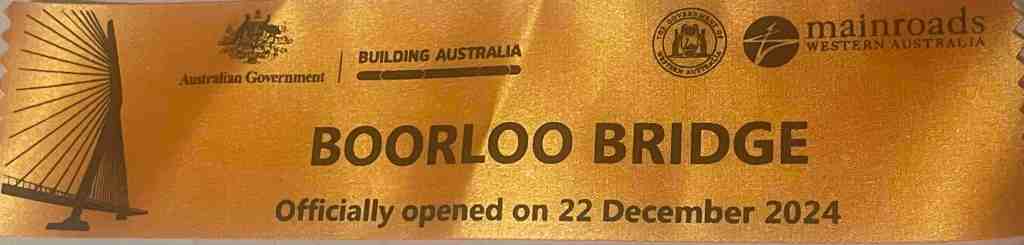
As well as a welcome drink of water, I picked up the commemorative banner of the occasion:


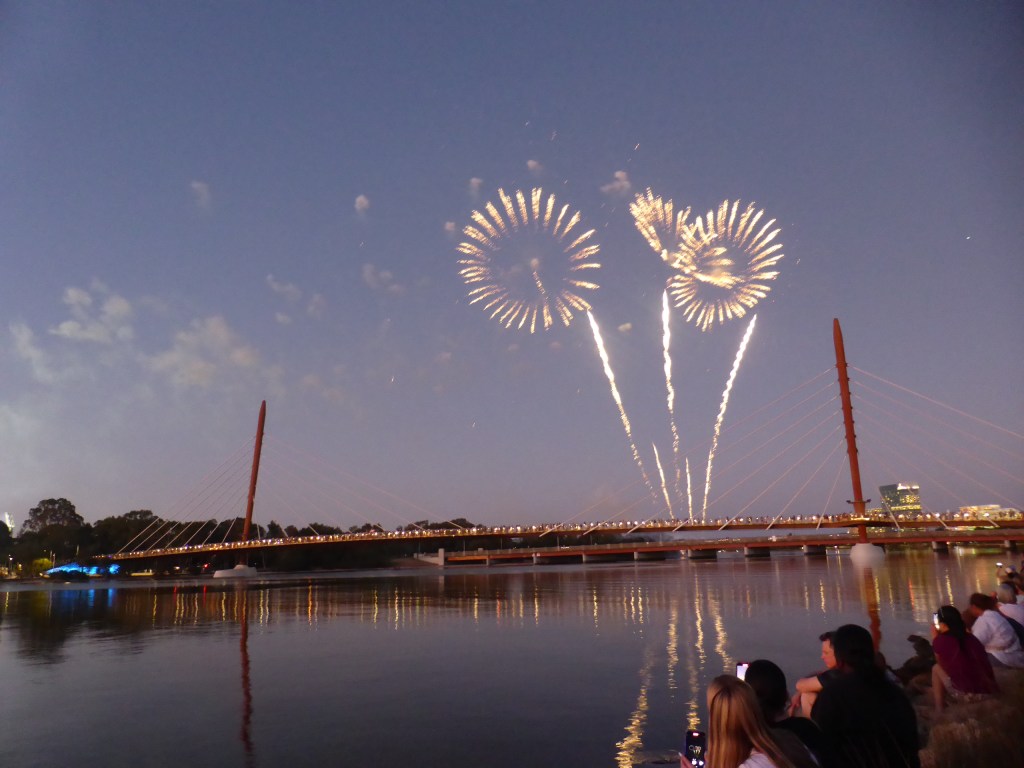
As the sun set, the bridge was opened with a fireworks display, appreciated by the crowd of picnickers assembled, including me. I’m not very good at photographing fireworks, but here is a sample of them to give a flavour of it. Clicking the mages will give you a better version, I think:

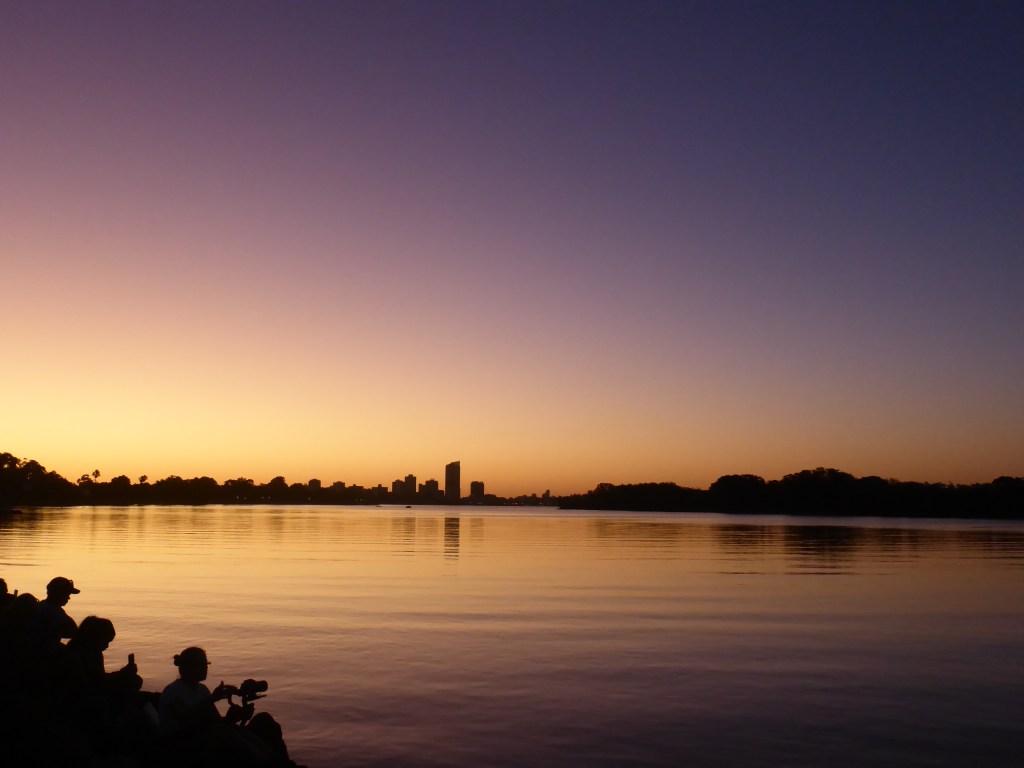
The fireworks distracted us a bit from the glorious sunset in the other direction: you can see the South Perth foreshore in the distance, with its new high-rise building sticking up. (The City of Perth is a bit right of this picture, and not shown here.) Beautiful colours … and expectant photographers waiting for the fireworks to start.

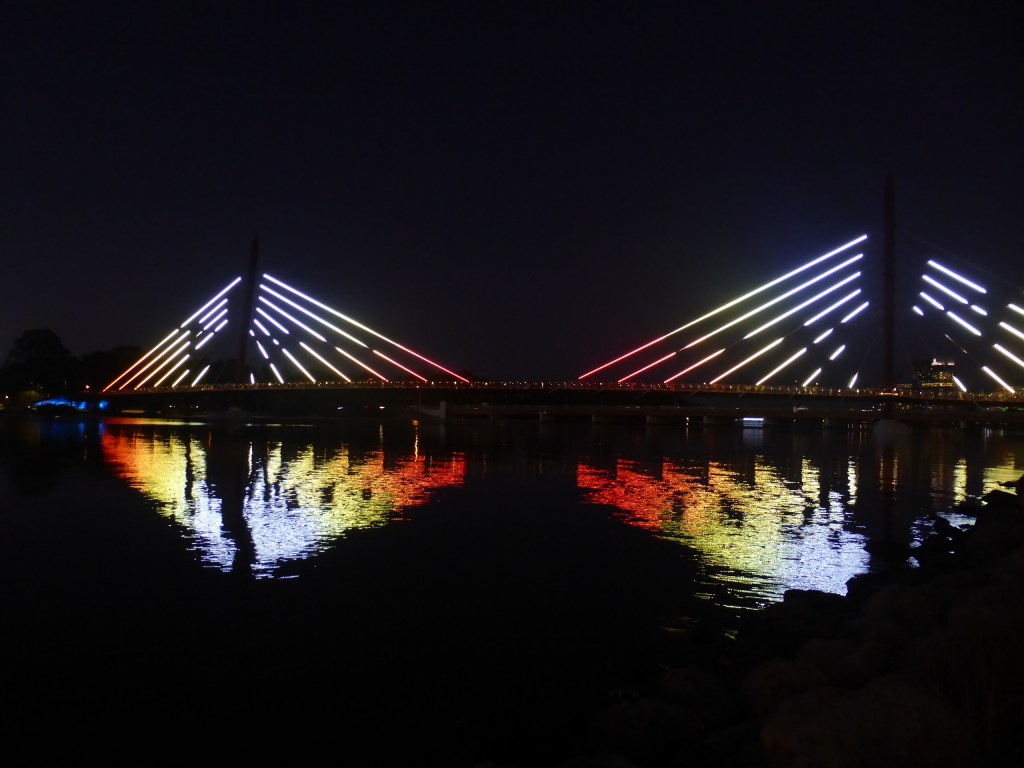
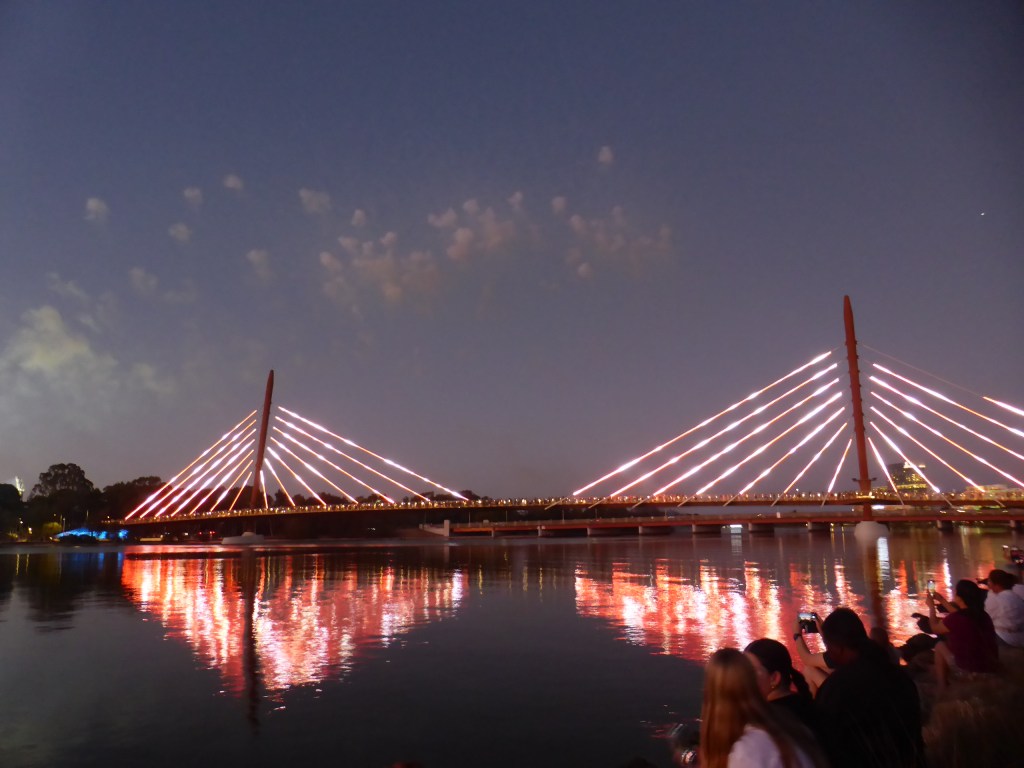
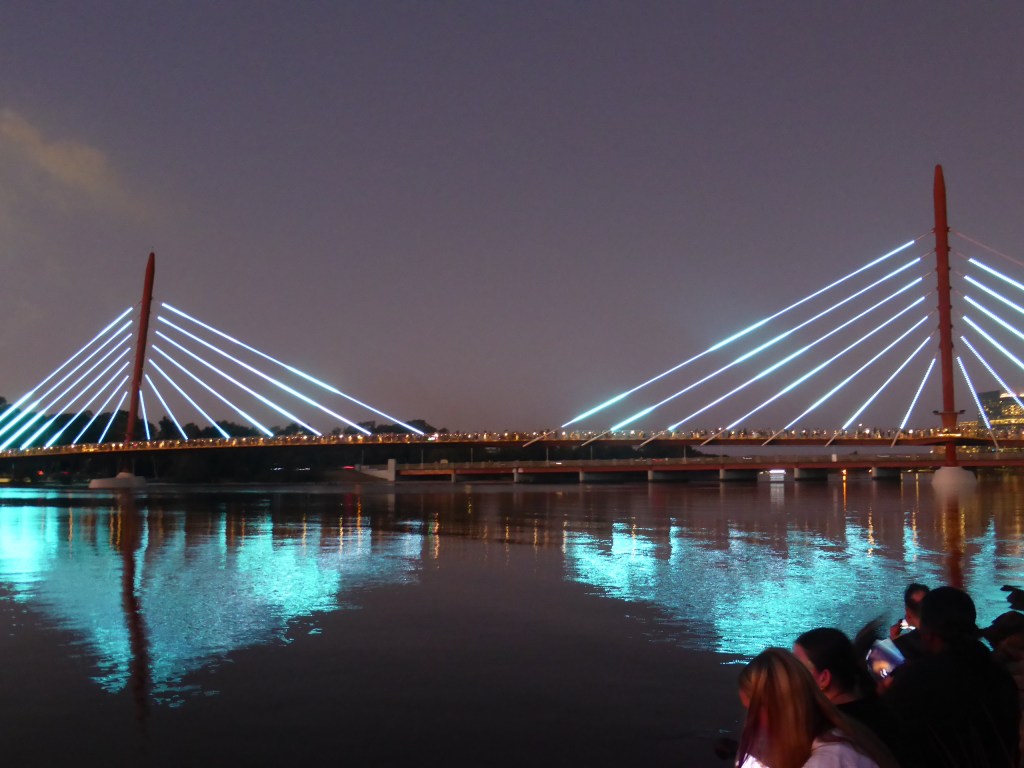
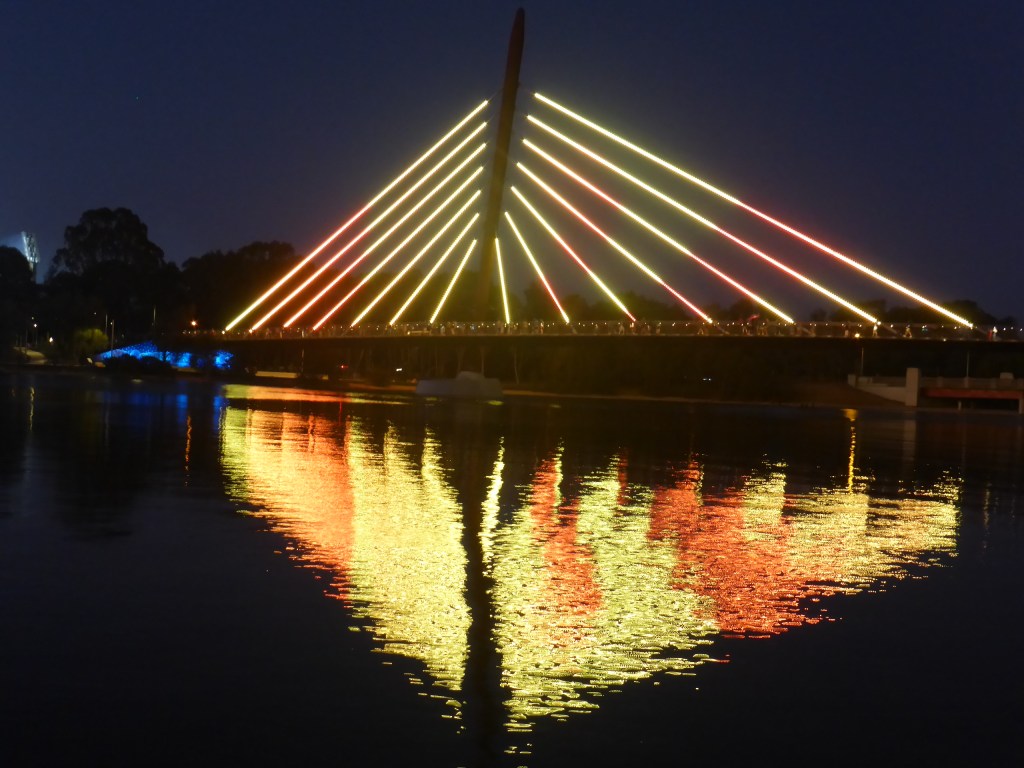
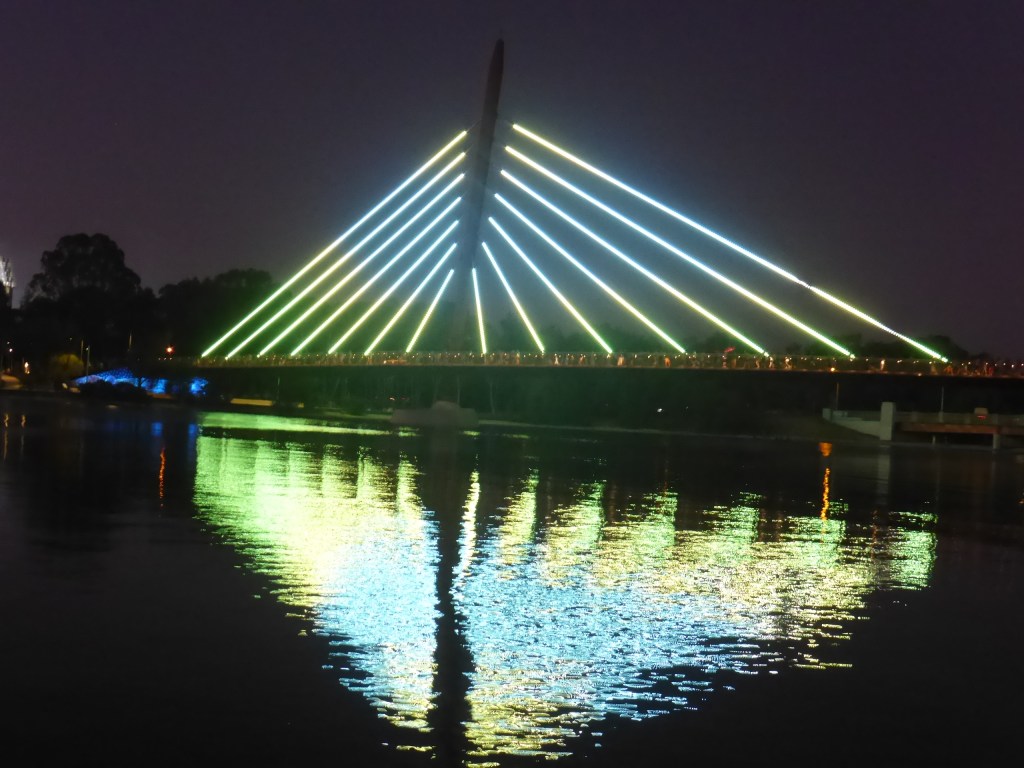
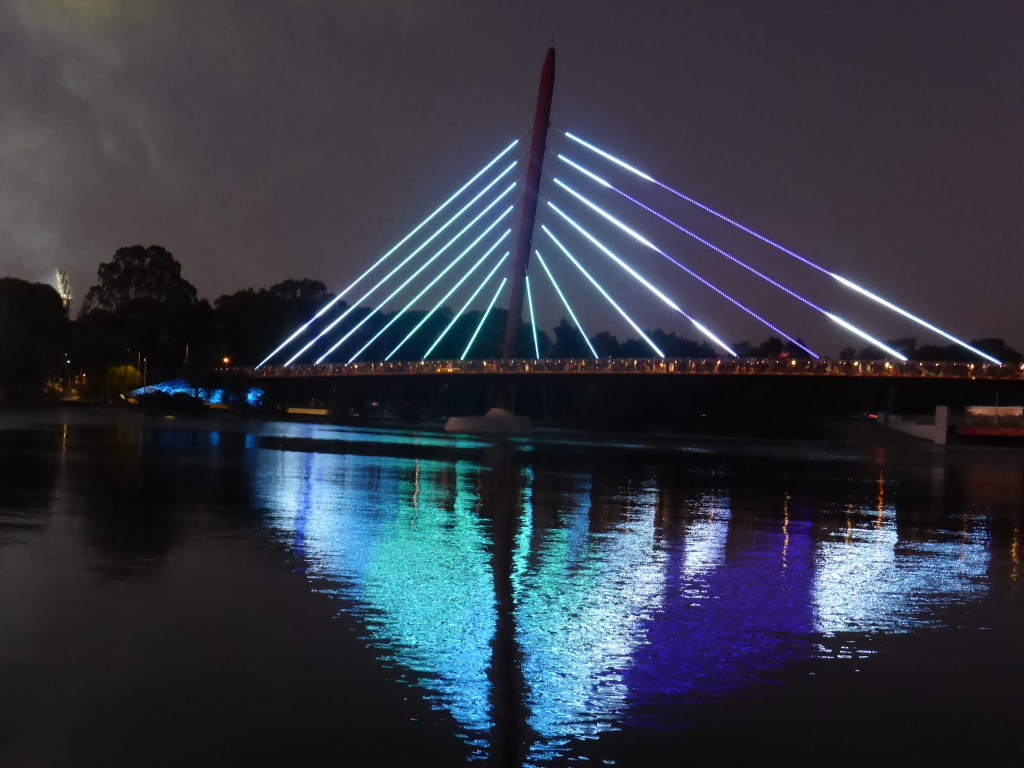
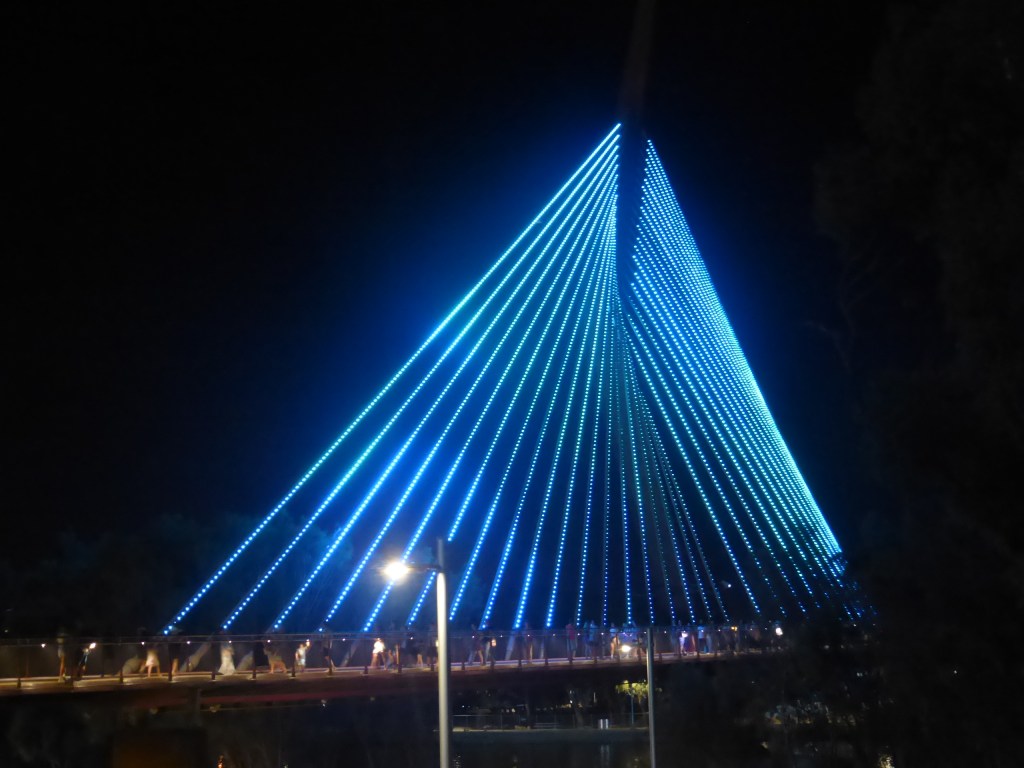
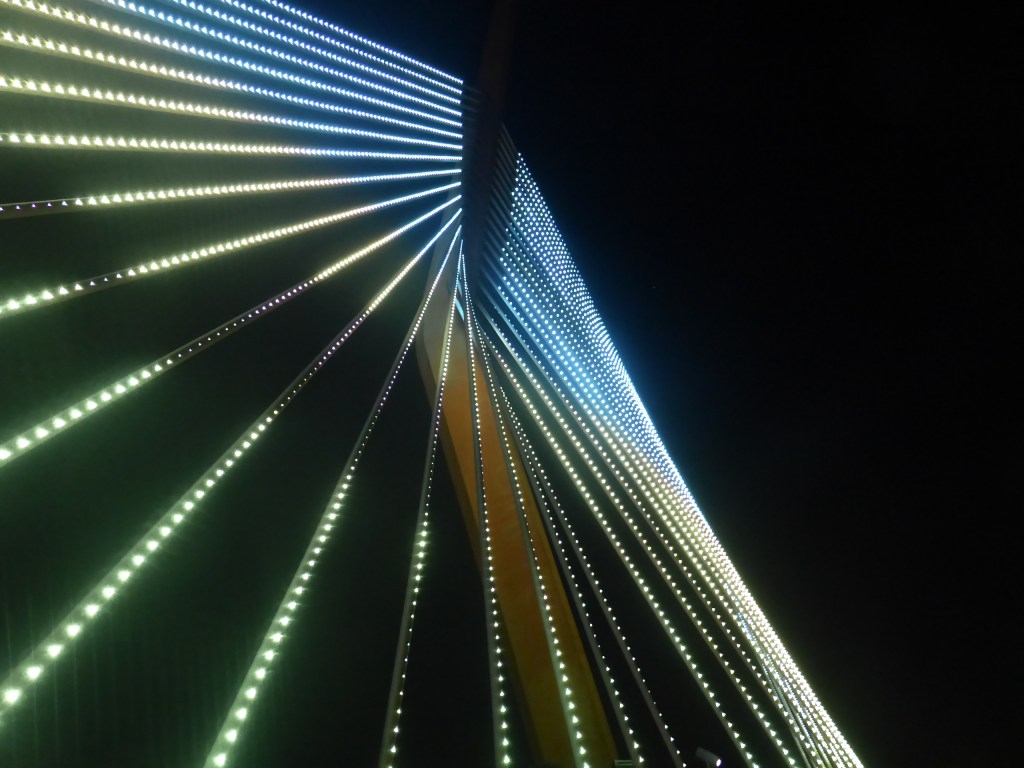
After the fireworks, we were treated to a lovely display of lighting on the various parts of the bridge. There are small LCD lights in the cables, which can be programmed in various ways to create lovely effects. (We are accustomed to this sort of thing with the Matagarup Bridge linking the Perth Stadium to the other side of the river.) Here is a sample of the lovely effects:

Here are a few more examples of just one part of the bridge, like the one shown at the top of this post, showing how the lighting system can create some lovely effects, helped along by their reflections of course.

I walked across the bridge, of course, along with others, and enjoyed doing so as well as seeing the second part of the bridge, linking Heirisson Island to the north bank of the river. Where the first part of the bridge has two vertical struts, the second has only one, in the shape of a boomerang (not very clearly photographed here, I’m afraid, although much clearer in daylight). Also not clear is the way in which there are some native animals (such as kangaroos, fish, reptiles, … ) depicted as moving shadows in the lights. If you’re ever in Perth, check these out for yourself, as they exceed my photographic capabilities to show well.

There were various other artistic works associated with the bridge, and several plaques helping people interpret these as well as to learn a few words of the Nyoongar language. The traditional owners have of course been carefully consulted throughout the project and I hope that these will help with ongoing efforts to increase recognition of (all) of our heritage. Here are some examples:

Despite the heat, I was pleased that I was there at this historic time. I’m sure that I will make good use of the Boorlo Bridge, as will others, and am pleased that it is finally finished. I have walked right around the river (called Perth Water locally, or Derbal Yerrigan to Nyoongar people) several times, and have never enjoyed the Causeway bit; that has now been fixed. Of course, it is expected that cyclists will also use the bridge to get to work in the city or for leisure (as they already do at the other end, via the Narrows Bridge), so I think the bridge is a good investment of government funds, both state and federal. Hopefully, it will help to encourage people to get out of their cars a bit more and enjoy their beautiful city a bit more.

Finally, the picture below on the bridge deck says welcome (Kaya) to Perth (Boorloo) and also shows our native symbol of a black swan (ironically shown here in white light!).

Welcome to Boorloo Bridge!

Araluen

Araluen Botanical Park is in the hills outside Perth, and has long been a popular place for locals to enjoy, especially in springtime. Most people associate it with the tulips planted there, but there are many other flowering plants as well, and some nice picnic spaces. Araluen has its own micro-climate making it a good place to grow tulips, which generally would not survive Perth’s warm Mediterranean climate. I visited the park – as I have often done previously – and enjoyed meandering around it. It was towards the end of the annual Tulip Festival, but there were still many beautiful specimens on display. The park was originally privately owned; however, when the owner was contemplating selling it (and it might then have become a housing estate), the Western Australian government purchased it so that it can be permanently a park. A small army of volunteers is responsible for the annual planting of tulips.

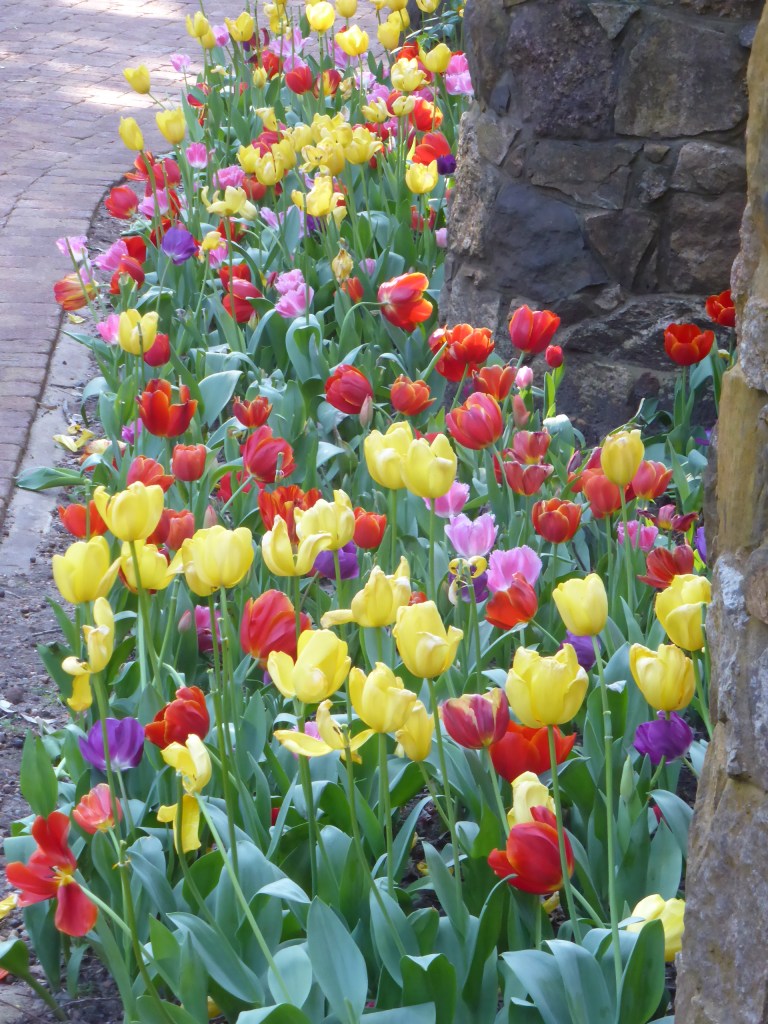
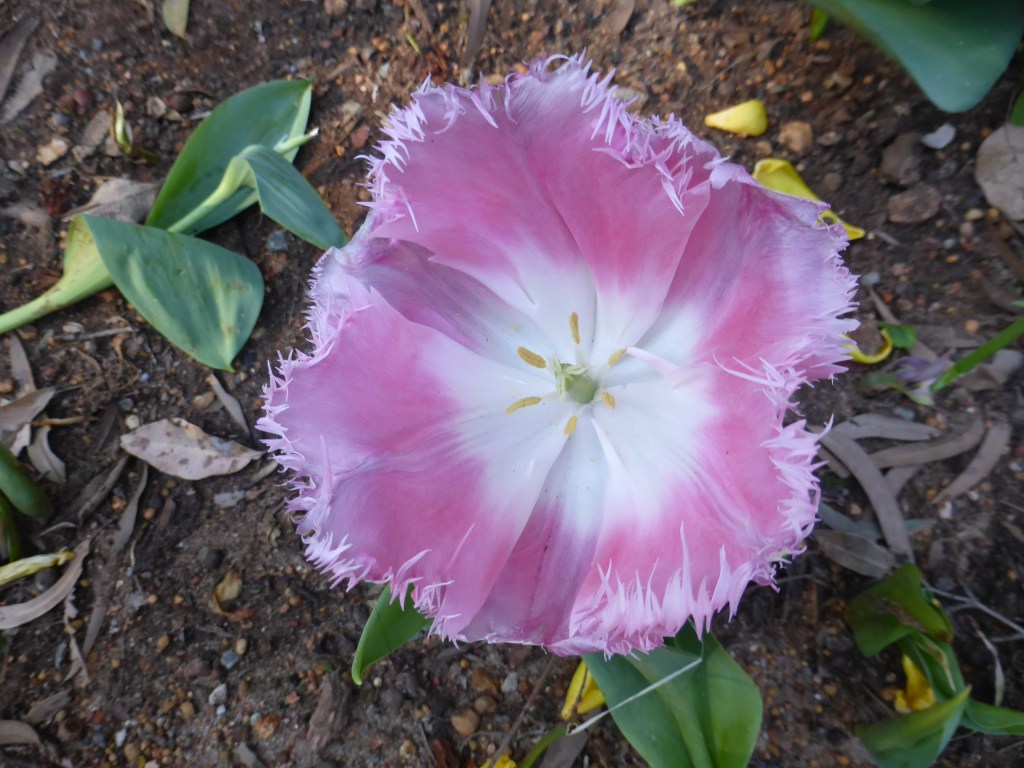
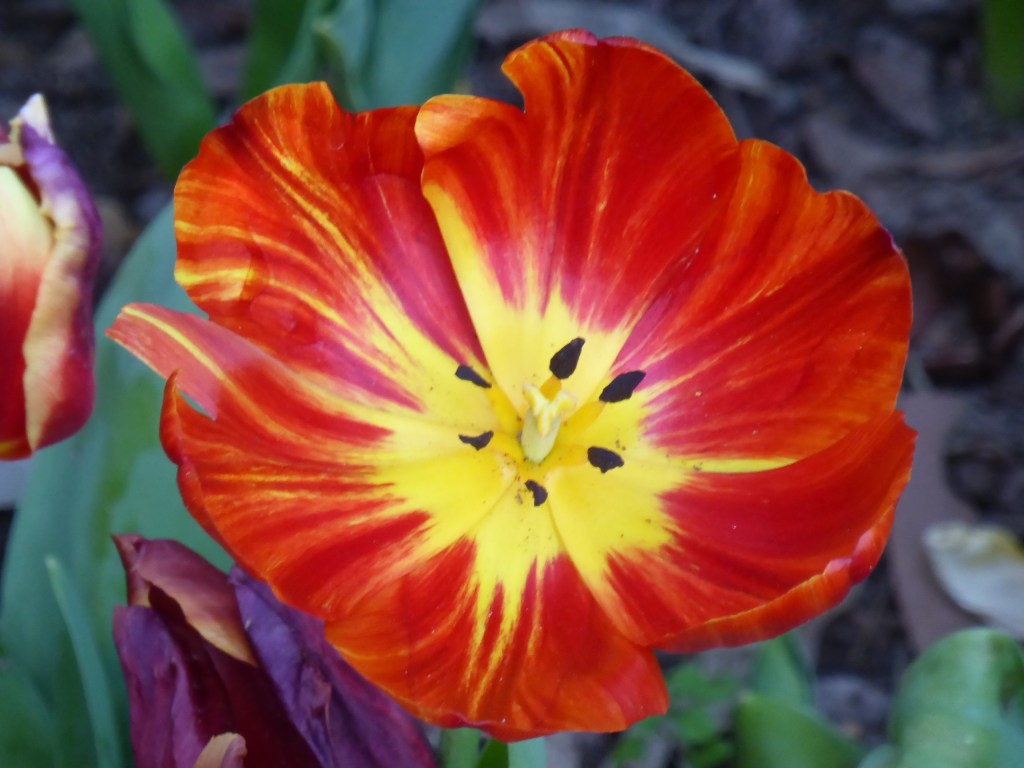
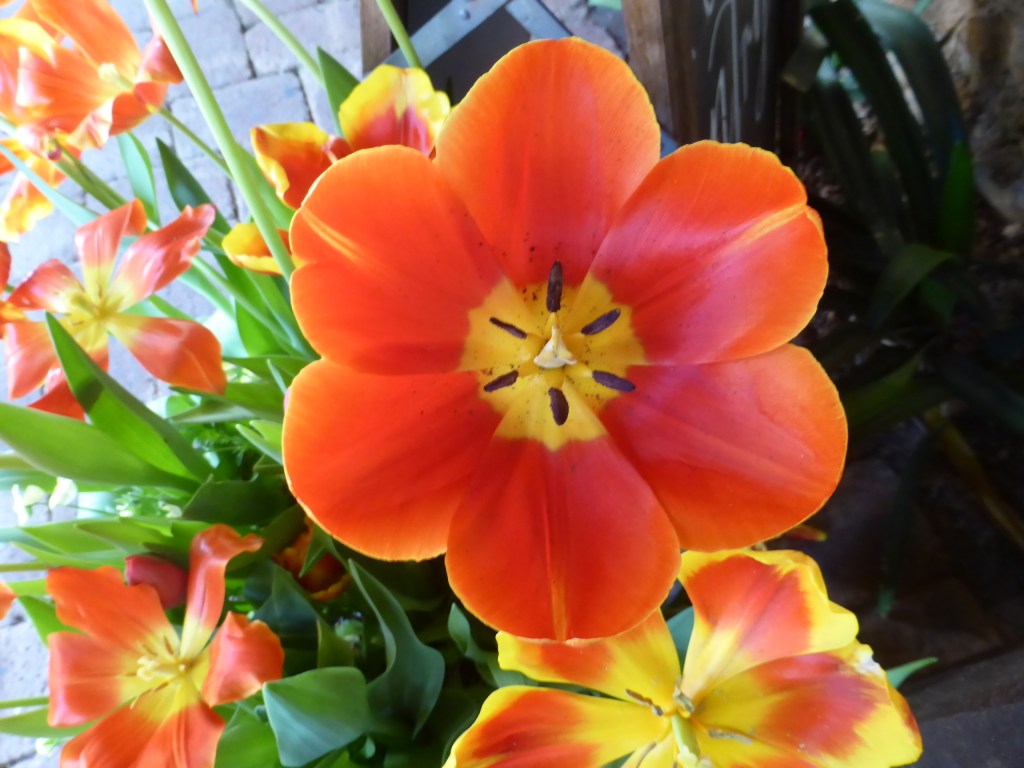
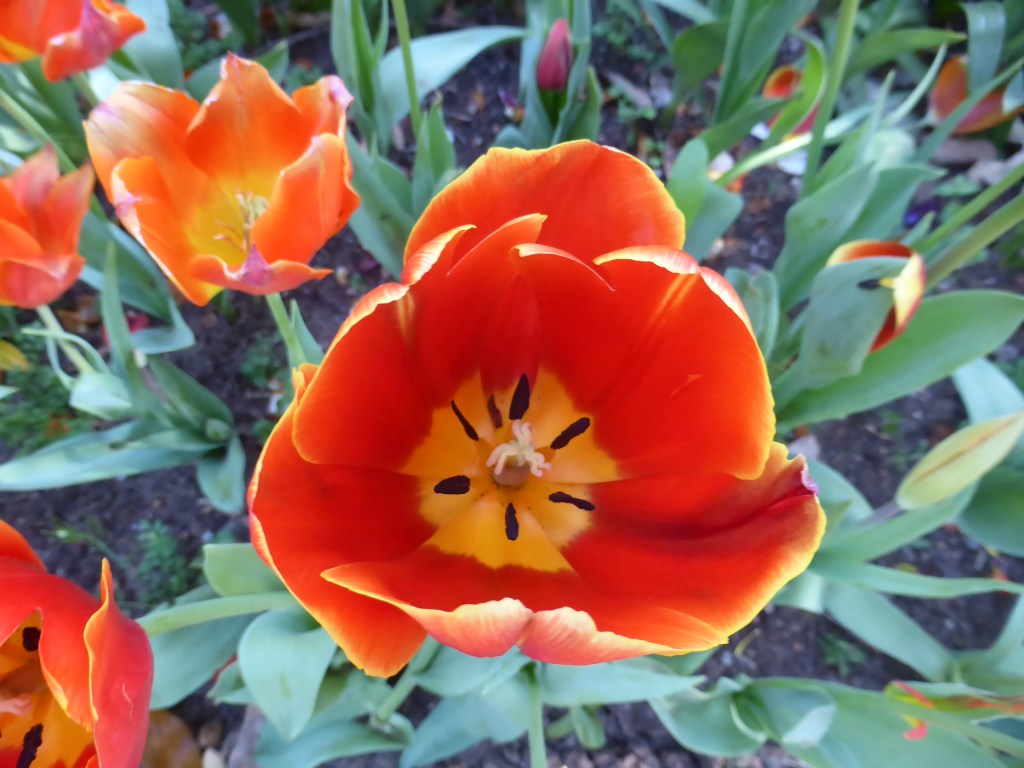
Here are a few photos of tulips from my visit. including some close-up shots. Tulips seem to come in many different colours and shapes. I can still recall seeing a bright red tulip coming out of the snow in Chicago years ago – and love the bright colours. If you click on a photo, you can see more of it.

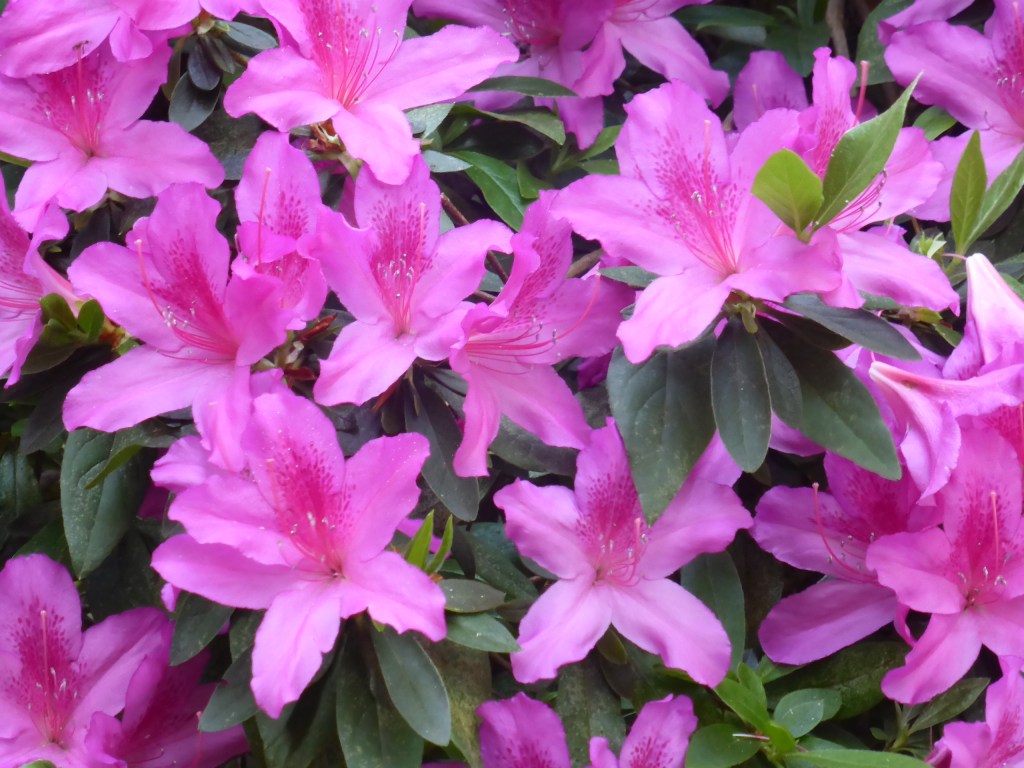
Although tulips are the most prominent (at least at the time I visited) there are other plants besides tulips at the park, including some lovely irises and blossoms. Here is a selection of them.

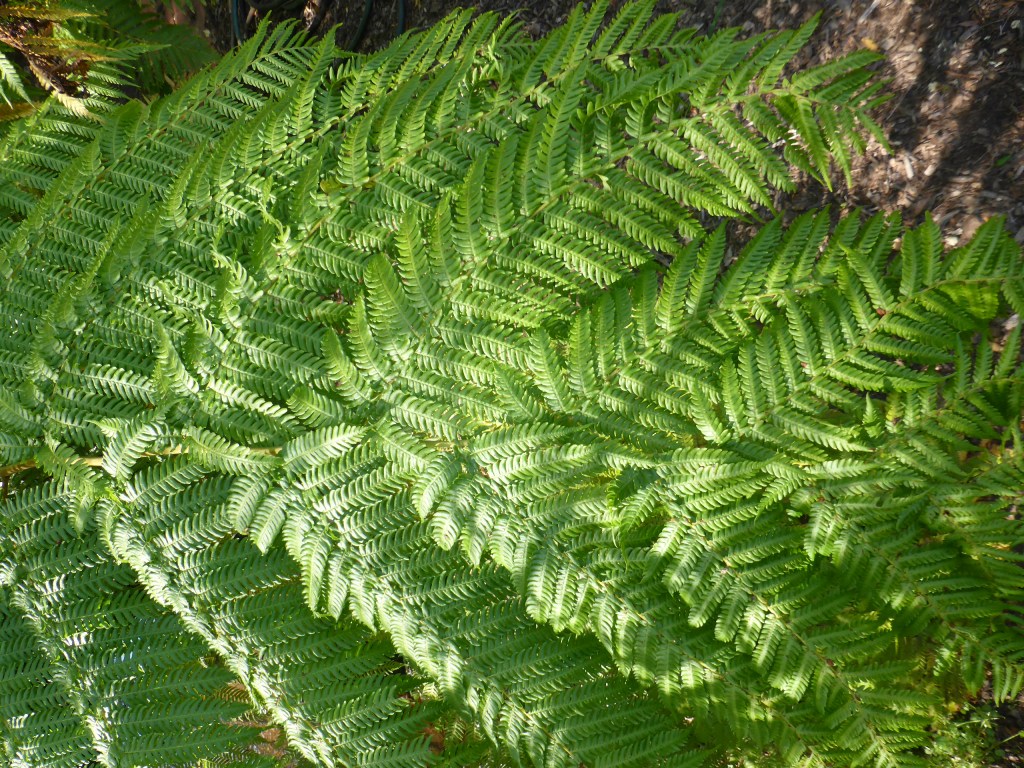
I love the wisteria on the small restaurant (Chalet Healy) at Araluen. The two photos are taken from outside and inside the restaurant. I also love the greenery around the park. The ferns below are good examples of fractals (these are mathematical shapes that are ‘self-similar’ in the sense that a larger frond is made up of smaller fronds of the same shape, which are in turn made up of smaller fronds of the same shape …).

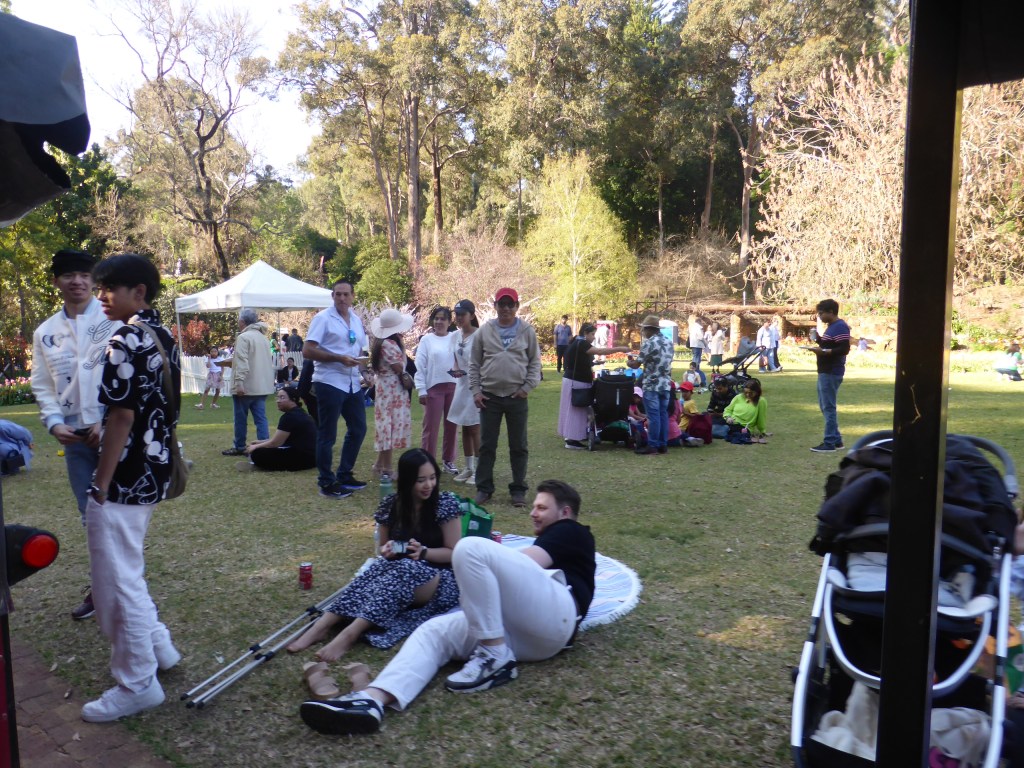
On the day we visited, I was a little surprised to notice that most of the other visitors looked as if they came from various south-east Asian or South and West Asian cultures; it’s impossible to tell without asking them of course: I expect many were (like us) local citizens enjoying a day in the hills, while some others may be tourists. Maybe many locals have visited Araluen many times before so that it is no longer a novelty? I don’t know, but think it would be a shame if locals didn’t visit Araluen at least once a year to enjoy the floral magnificence. And it’s a lot easier than gardening.


A lovely spot to visit, whether you are a local or a visitor, especially around August in Perth.

Meandering around Fremantle

I had a couple of hours to kill today, and used them to meander around Fremantle, which is Perth’s port. It’s long been one of my favourite (urban) places in Western Australia, and would certainly take several visits to explore thoroughly. In this blog, I mention only some of them …

One of the delights of wandering around Freo (as it is often known by the locals – Australians are notoriously prone to short handing names!) is the built environment. Although it dates only from the early part of the nineteenth century, the architecture often seems ‘old’ by local standards and many buildings have been lovingly renovated recently. The main impetus for the renovations was the America’s Cup yacht race, which was based in Freo in 1986. The images above show some examples, ranging over at least a century. Many fine buildings show some of the affluence of the port years ago, while others show the early influences of convict labour. (Western Australia was founded as a British penal colony in 1829.) A stroll around Freo will delight anyone interested in Victorian-era and early 20th century streetscapes.

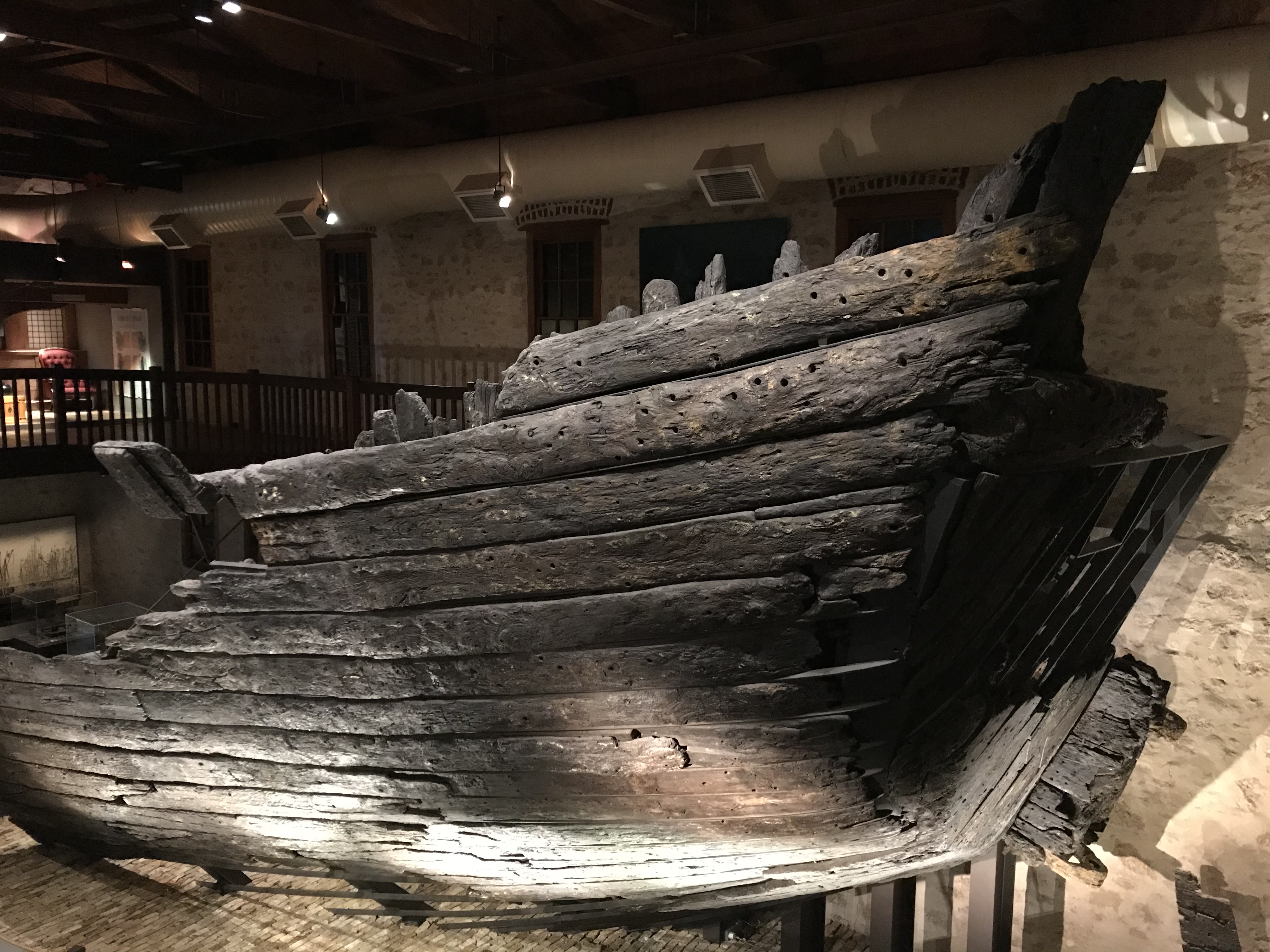
I also popped in to the lovely Shipwrecks Museum, a museum constructed and maintained by the state government, focusing on the many maritime adventures associated with early Western Australia. It’s a lovely museum with many aspects of the maritime world on display, and so it’s very easy to spend an hour or two there. Pride of place in the museum is a gallery housing some recovered parts of the Batavia, a vessel owned by the Dutch East Indies Company, which sank on Western Australia’s coast in the 17th century:

The first image shows a scale model of the Batavia, while the second shows a large part of the reconstruction. The ship sank in 1629 (a full two hundred years before the penal colony was founded), with details of the events still being found; a mutiny was involved, some evil events too place (murdering of men, women and children) and ultimately some ringleaders were executed. The ship sank en route to Batavia (the same name as the ship, but is a city today called Jakarta, in today’s Indonesia), and senior crew went there and back to get help. This area of the world was frequently encountered by the Dutch, as it was not far from the route from the bottom of Africa to the Dutch East Indies (known as Indonesia today), a major source of spices for Europe and wealth for the private company VOC.

As a child growing up in Australia, I was taught the patently false information that the English mariner Captain James Cook ‘discovered’ Australia. (Recently, there was even a plan by our Federal government to further exaggerate this mistruth by circumnavigating the continent in a replica ship!) The continent was inhabited by Aboriginal people for some 60 to 100 thousand years before it was ‘discovered’ and of course there was lots of connections made by those in the north of the country to nearby parts of southeast Asia. In fact, Cook was not even (close to being) the first European to ‘discover’ Australia, as the museum makes clear in many ways. The Dutch East Indies (private) company – known as VOC – made landfall many times on the Western Australia coast, partly because navigation in those days was not as successful as it is today:

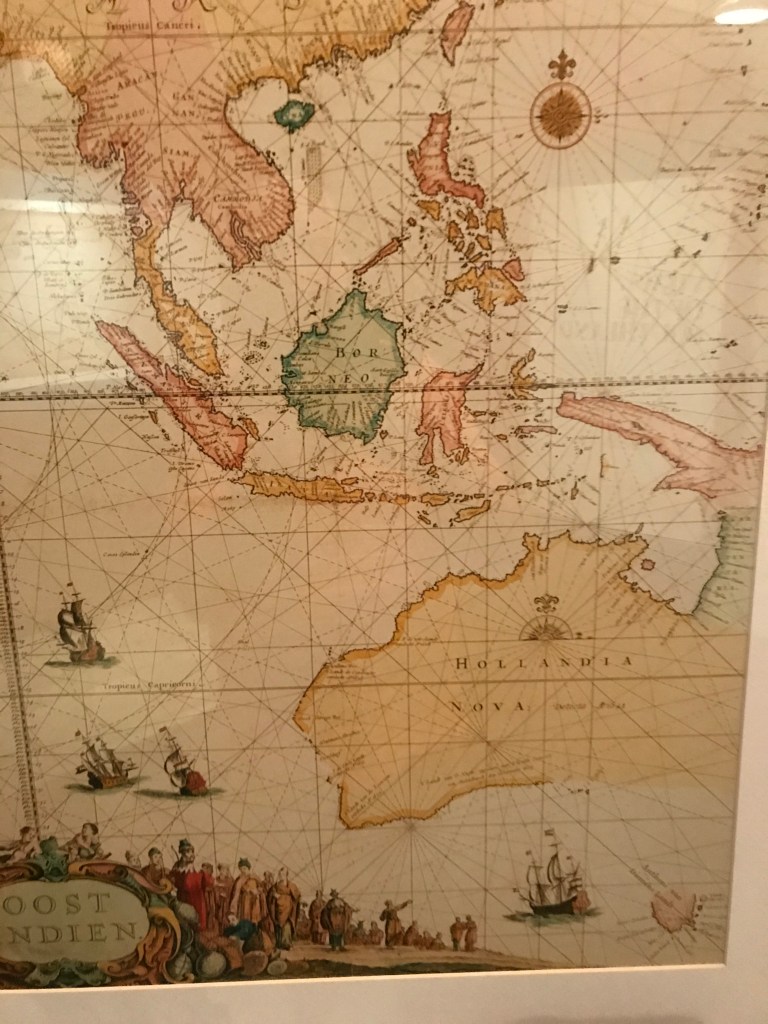
Over time, the western half (at least) of the Australian coastline was mapped fairly well by Dutch navigators, so that the following remarkable map of the East Indies by Pieter Goos that was available as early as 1660 (well over a century before Cook arrived). The ‘Great Southland’ aka ‘New Holland’ as well as most of Tasmania was well known to other Europeans long before the English arrived late in the eighteenth century. A good part of the map was the result of the work of the Dutch navigator Abel Tasman, after whom tasmania was later named.

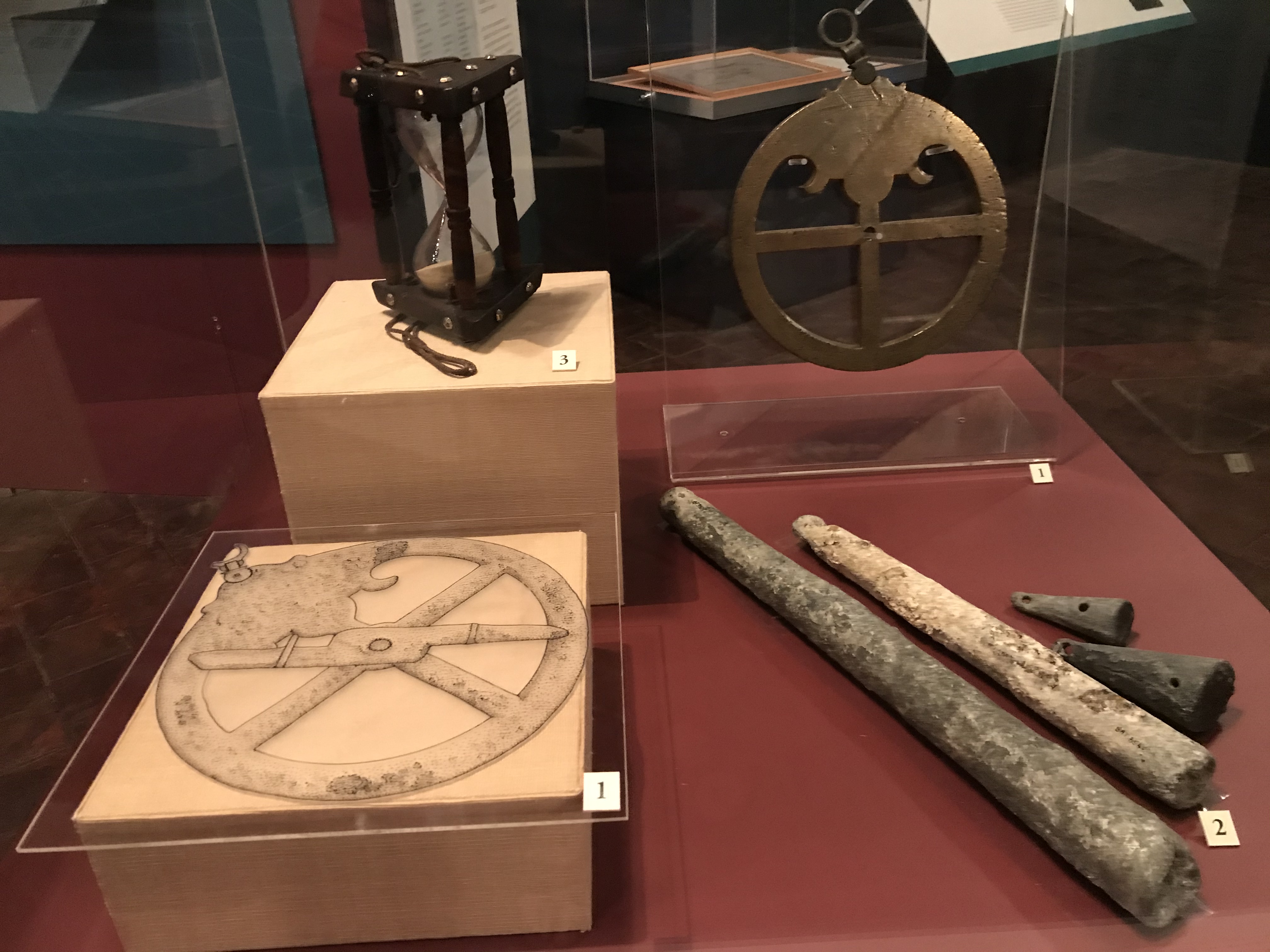
The Museum had some interesting displays of various kinds about navigation – a much trickier prospect in the 17th century than it is today (when my smartphone uses its GPS much more efficiently than any printed maps.) Here are some of them:

Mathematics was a of course a major tool used by navigators, but the photo shows some other kinds of tools: an astrolabe (to determine the location of the sun, and thus help to locate the latitude of the observer), an hourglass (to measure time, from which boat speed could be measured) and some weights (used with an attached string to determine water depths). I continue to admire the early seafarers and map-makers using such tools so well, on small ships in difficult sea conditions – a tribute to their mathematics, of course. At this stage, navigation had not mastered the art of determining longitude efficiently, as this required a good chronometer, measuring time very accurately, which accounts for the regularity of ships running ashore and sinking … in fact, Captain Cook’s ship was one of the first to be testing better navigation methods using a chronometer, but that was long after the Dutch navigators had mapped much of Australia.

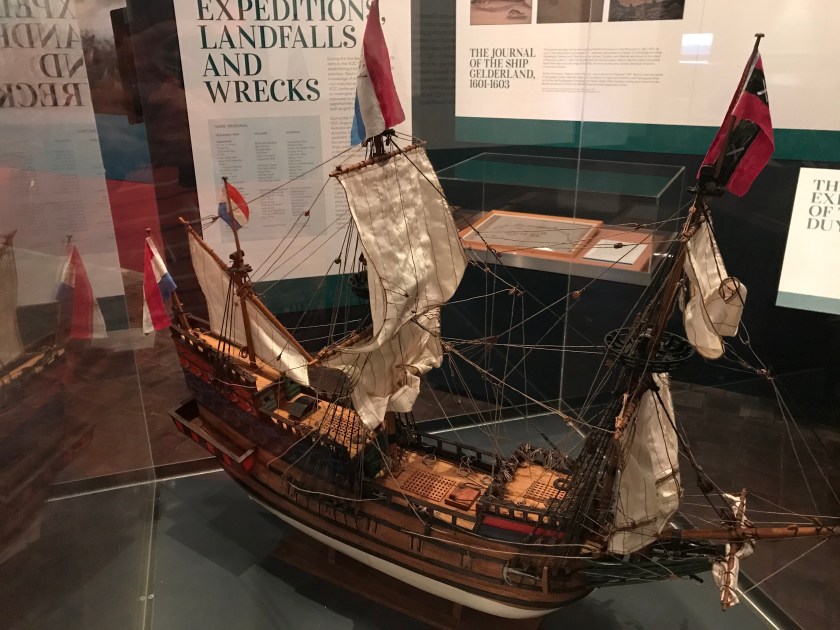
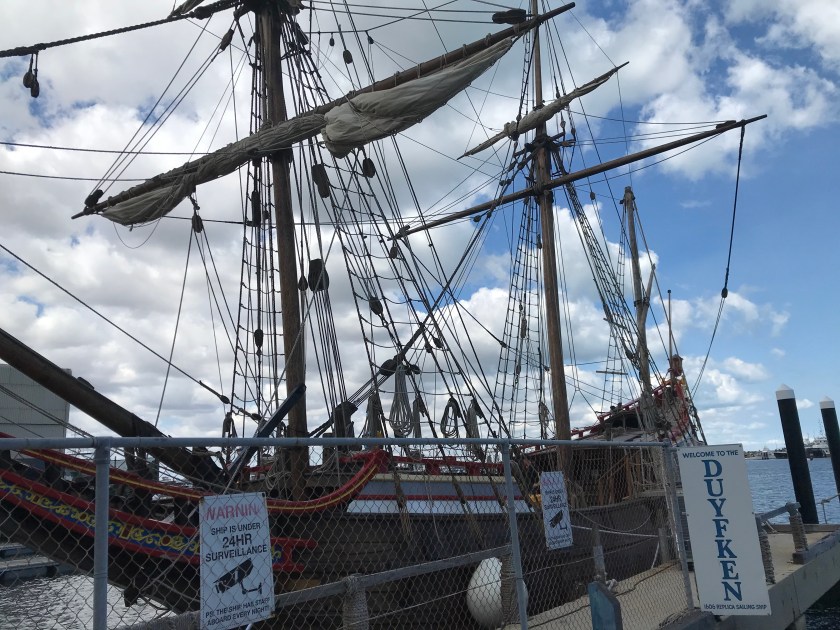
The Museum had several delightful models of early ships, including the Duyfken shown above, which was the first European ship to visit Australia (in 1606). These are painstakingly studied and constructed, and a delight to see. At the moment (for just a few more days) a replica of the Duyfken is actually moored in Fremantle, as the second photo shows. (More details are at https://www.duyfken.com) It is sailing away (forever!) in a few days from now, so I hope to see it more closely while there is still a chance. It continues to amaze me so that so many people could inhabit such a small vessel for so long and in such dangerous circumstances …

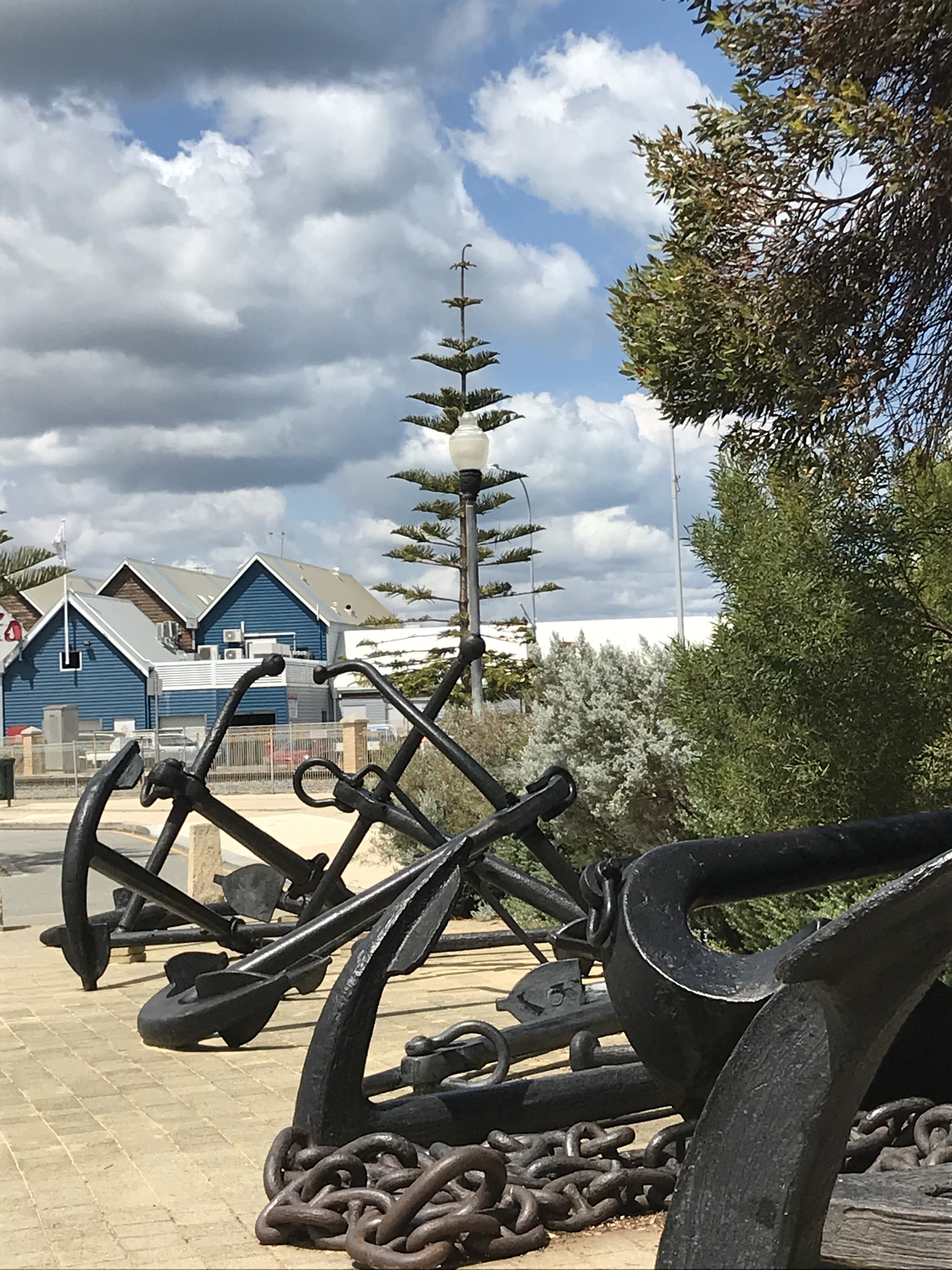
Leaving the Museum, it’s not hard to see the connection with the sea, which is a very short distance away. These days, of course, it is a much easier and safe matter to visit Fremantle than it was for the early seafarers, and the nearby shore is mostly used for recreation rather than for rescuing ships in trouble.

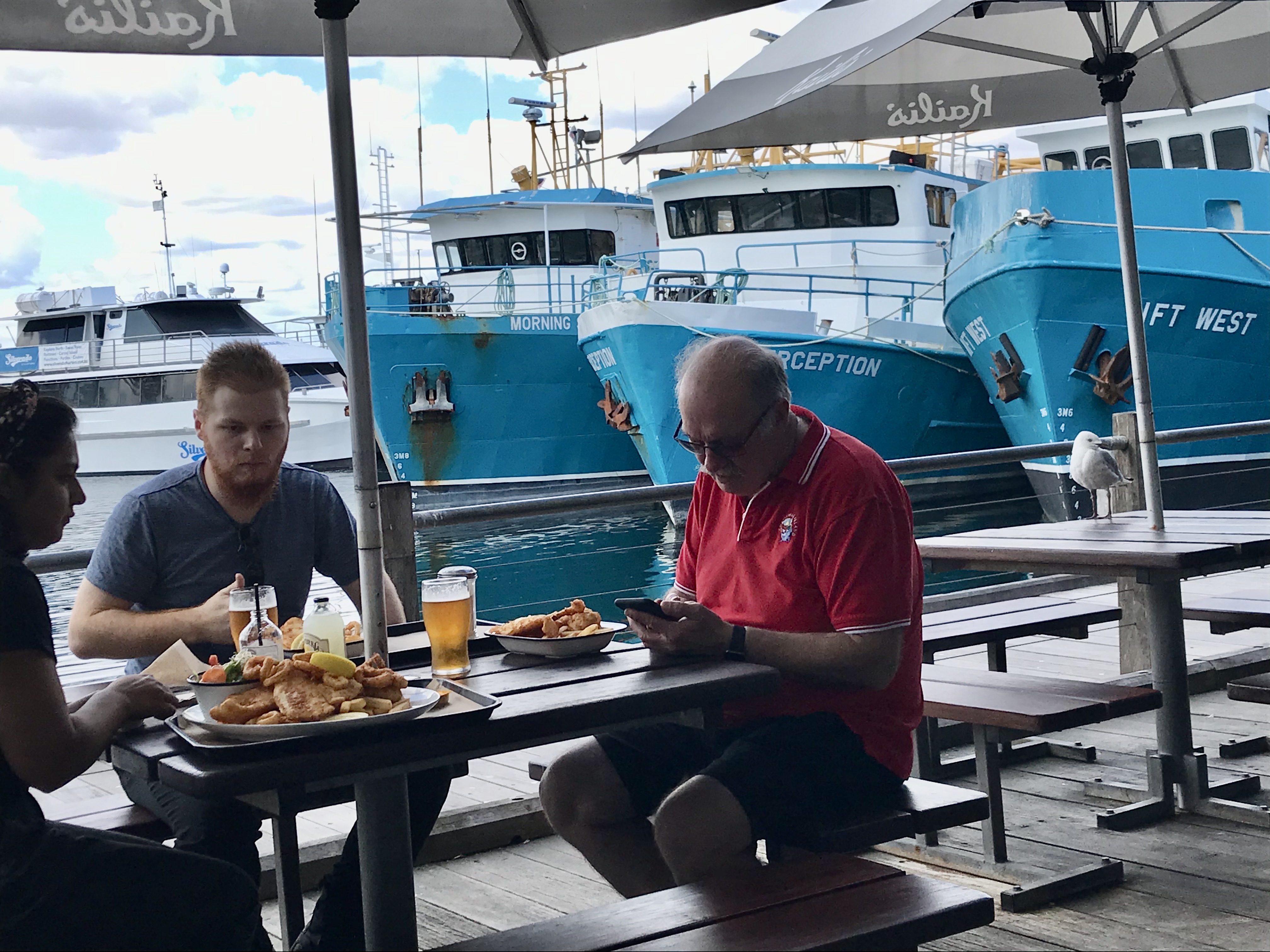
The nearby fishing boat harbour is still used for a small fishing fleet, but is known to many of us an area in which food and beverages are available in casual settings – most obviously various forms of seafood, including of course fish and chips.

The modern fishing industry was originally developed (I think) by mostly southern European migrants, and I love the sculptures recognising that past – one of which is shown here. I have eaten many times at Kailis’ outdoor eatery at the harbour, too, but usually had to fight hard to find a table (as well as fight hard to keep the seagulls at bay!). The Kailis family were of Greek origin and had a big influence on local fishing, as well as eating outlets like this one. Sadly, these days, the place is almost deserted, as the pandemic has kept tourists away and locals are busy at work. It feels strange to have so few people there, but it’s still a lovely place for lunch.

The early Italian influences on Fremantle are never very hard to find. A good example is Gino’s coffee shop, which has been here on a conspicuous corner for as long as I can remember, and long before it was fashionable to go out to have a cup of coffee with a friend. They still make great coffee, but the ‘cappuccino strip’ (as it came to be called) on which it is located is struggling these days from the effects of the pandemic, and the loss of tourist trade. It’s sad to see so many shops falling vacant, unable to survive … I hope that times will change before much longer.

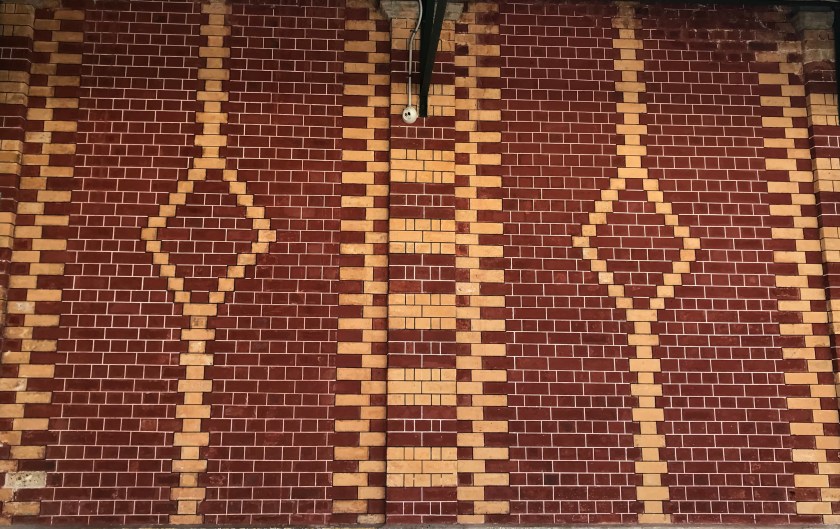
Elsewhere in Freo, all kinds of reminders of other times are evident. Too many to document here, but here are just two examples. A lovely old wall (in fact, right behind Gino’s), with an artistry in bricks that is never seen these days and a delightful grocery with the most amazing smells; the Kakulas Sisters sell all sorts of bulk spices, coffees, teas, sweets, and many other things that make it a delight to wander around. (Click on the images to see more of them.)

By its nature, a port city like Fremantle is connected to cultures elsewhere. While the Italian and Greek roots are evident, and there is increasing recognition of local Aboriginal (Nyoongar) people, Fremantle has always had a multicultural feeling. Indeed, the whole of Australia is multicultural, with around 30% of us born overseas. So I enjoyed the sign below, drawing attention to who we are:

‘Meandering’ has an intrinsic sense of ‘slow pace’. Fremantle is still a lovely place to meander around, and has many more attractions than the few things mentioned here.

If you’re nearby, its certainly worth a day trip … when we are all allowed to travel again.

Public art in Como Beach

I enjoyed learning about public art in my City of South Perth on a recent bus tour, which included a short stroll near my home in Como. Most of the public art on display was already familiar to me, but one of my comments during the tour was that it was poorly documented and little known. So I thought I would share some of my thoughts and some pictures. Como is a large suburb of South Perth, which is in turn immediately south of the City of Perth, Western Australia. My focus here is on Como Beach, adjacent to the Swan River (and a busy freeway) and all within a few minutes’ walk of my home. The picture below shows part of the beach, and the iconic jetty, the longest in the Swan River, once a playground for those living down here.

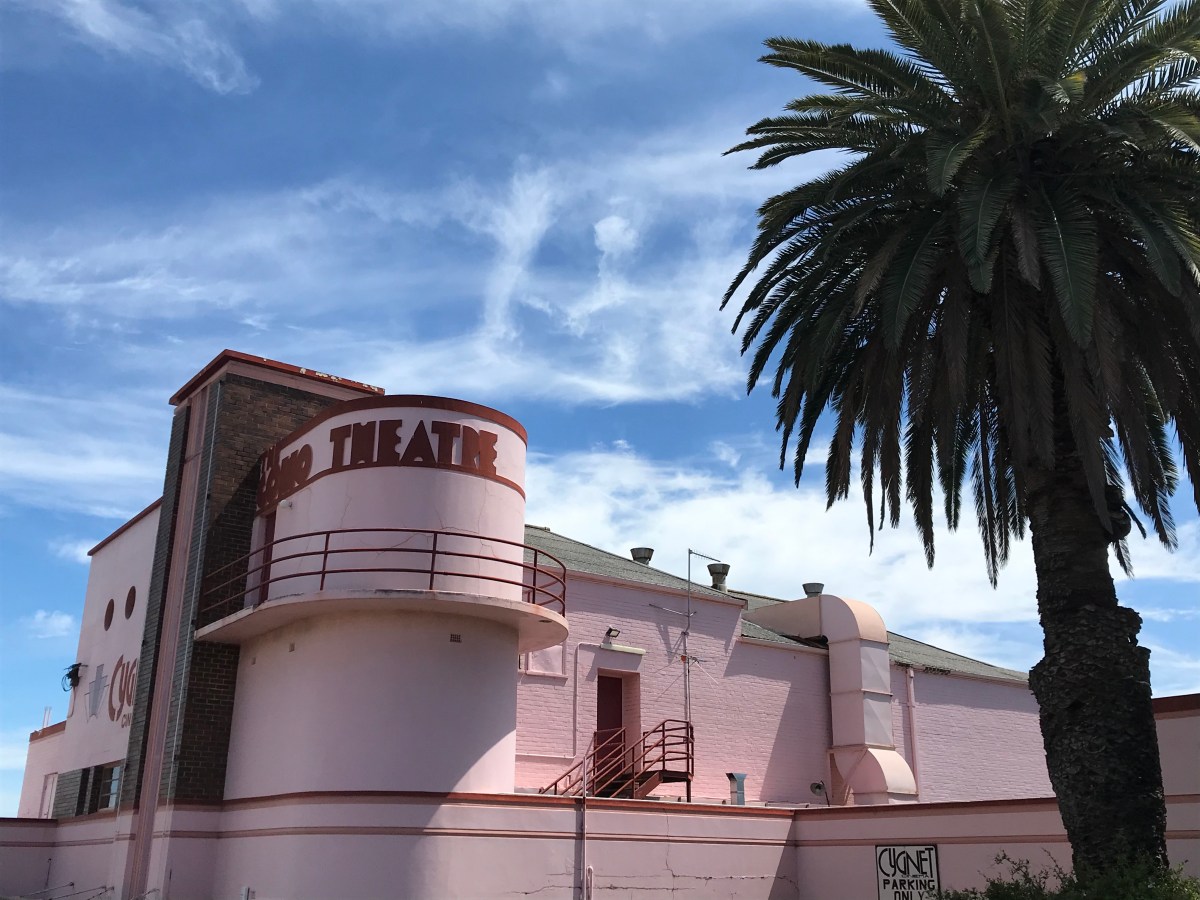
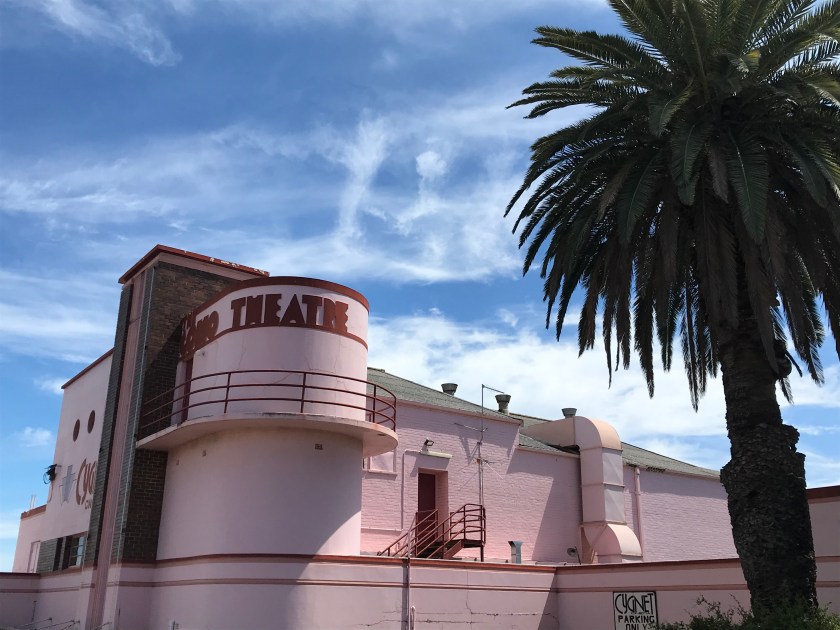
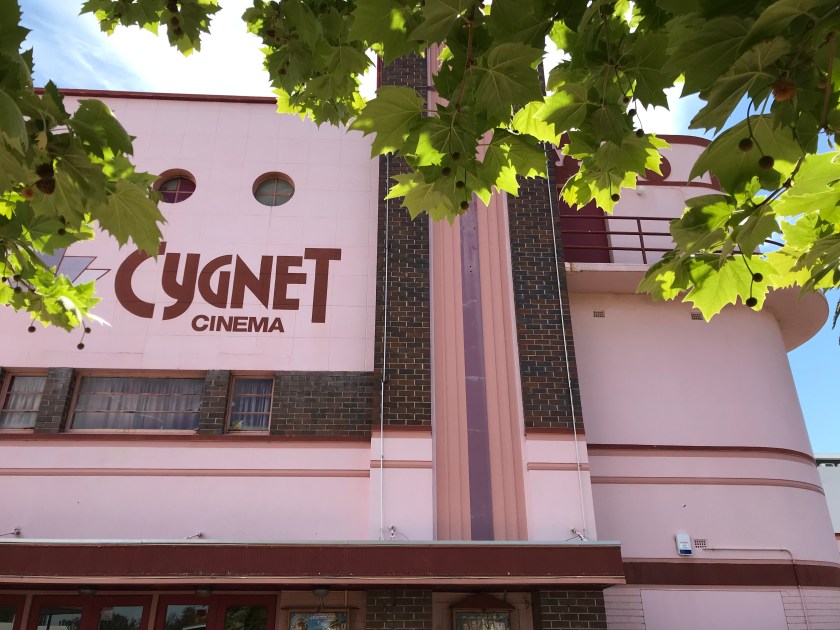
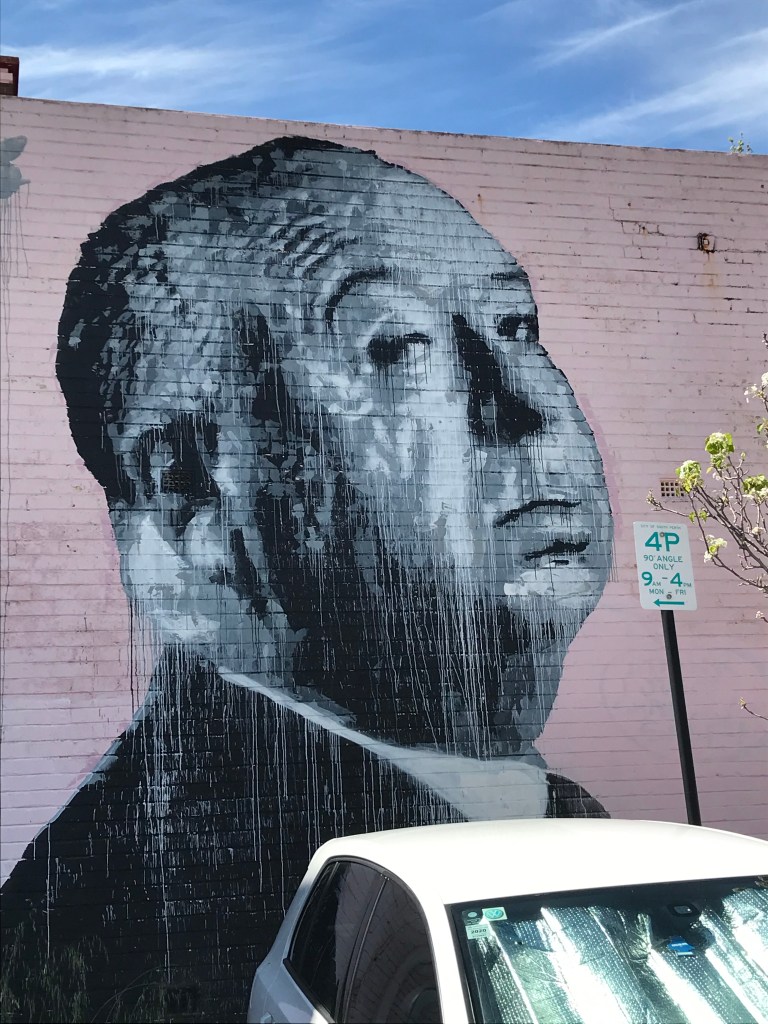
Strolling down the main street, Preston Street, the most obvious reminder of location is the Cygnet Theatre, long a landmark of Como and still a functioning cinema (or, at least, about to be again post COVID-19). This wonderful, pink, heritage-listed art deco building is not technically described as ‘public art’ – as it is architecture, not art – but it comes pretty close to that in my opinion.

So, what is ‘public art’? In a nutshell, it seems to comprise works of art that are available for the public to enjoy. There is a surprising amount of it around, once you open your eyes a bit, and this is especially so in the City of South Perth, which now requires builders of large projects to devote 1% of their budget to some agreed public art (and they, in turn, devote 2% of their budget for large projects to public art). There are, of course, works of public art around that have been provided gratuitously, rather than as a direct result of the City policy. If the Cygnet Theatre is not an example of public art, then certainly the murals on its wall is an example:

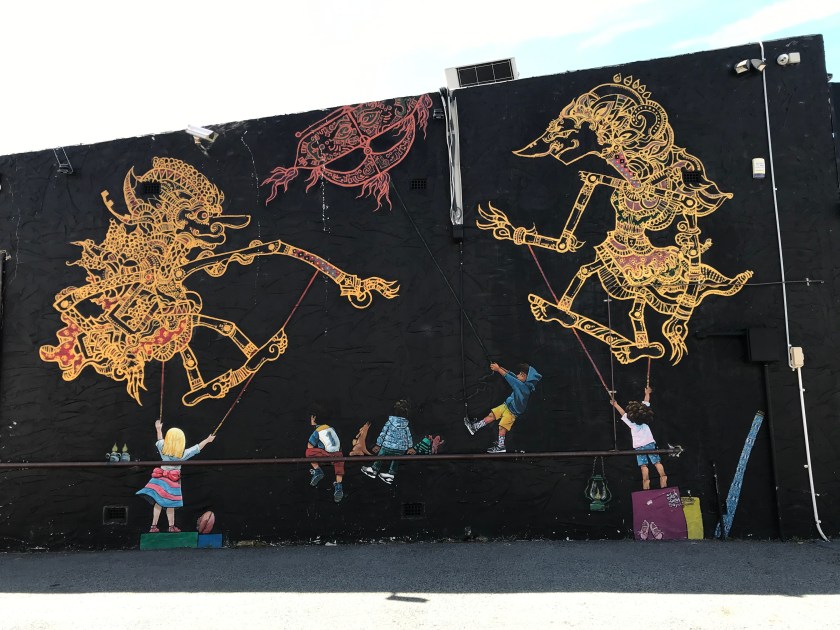
The unmistakable portrait of film director Alfred Hitchcock adorns a wall of the theatre, nestling among the parking area, the foliage and the cars – looking down on them with that famous sneer. Murals have become more common these days, and I really like this one. There is another mural nearby, in fact, which also certainly qualifies as public art, on the wall of a Malaysian restaurant adjacent to the theatre:

An otherwise ugly wall on the Nasi Lemak restaurant has been transformed into a playful and colourful piece of art work. I like the large Wayang Kulit (shadow puppets, used in Java for plays, with the puppets used to cast shadows on a white screen. The characters are from the ancient Hindu tales, such as the Mahabarata, and are all well-known to Javanese people.) But I also like the addition of the kids, playing with the puppets, and acting as puppet masters. I learned in Valparaiso, Chile (explore my website to see the details) that murals are used to deter graffiti, as street artists are unlikely to despoil the work of other artists; seems to be a win-win strategy for enhancing the environment.

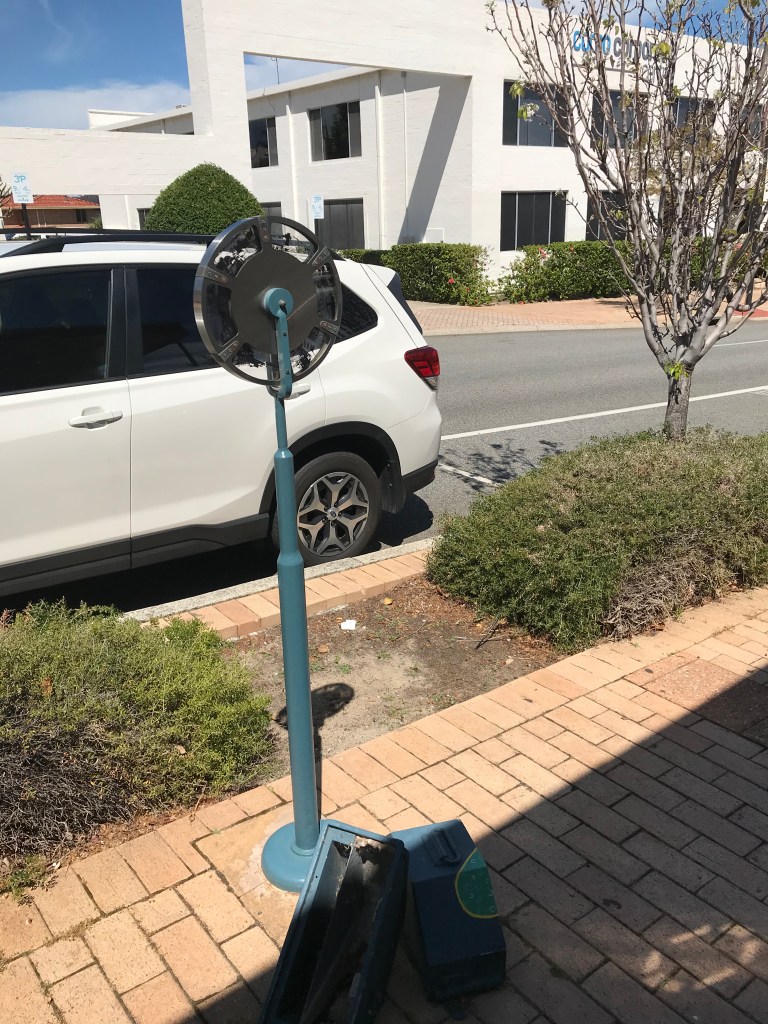
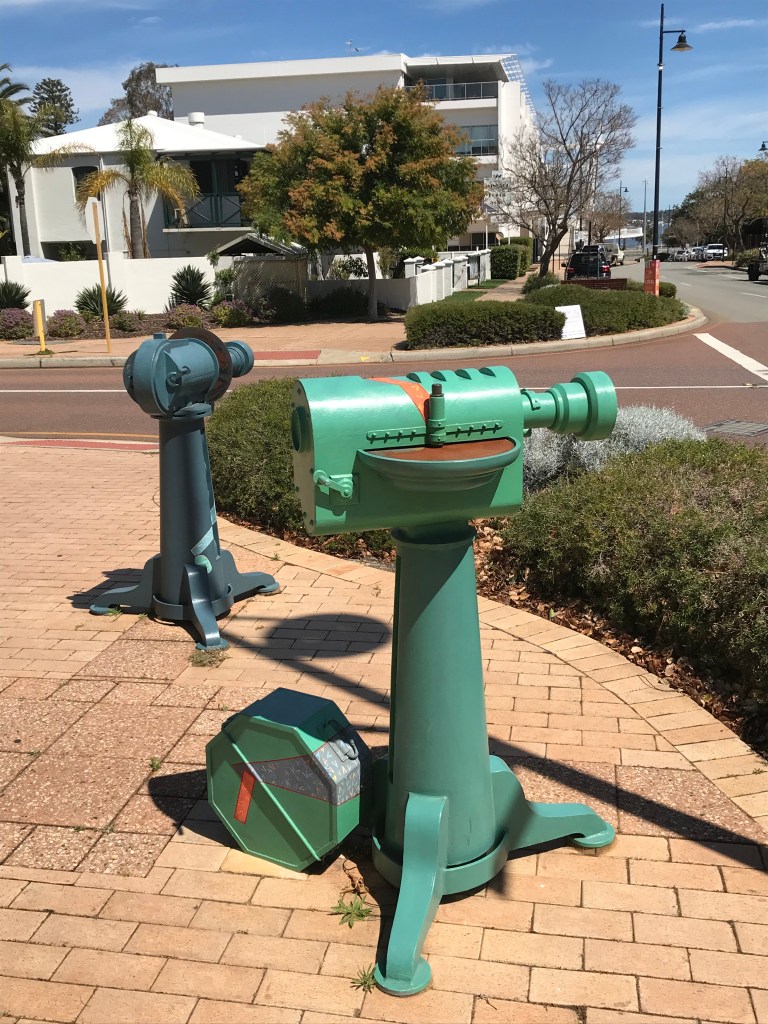
Continuing down the street a little, there are some strange-looking objects (which I learned that some people had mistaken for parking meters!) in various places. Here are some of them:

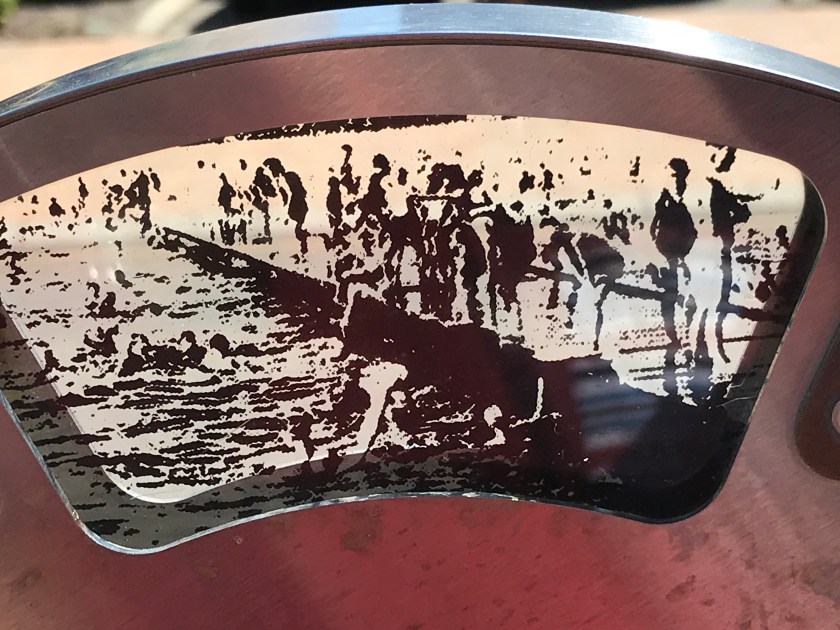
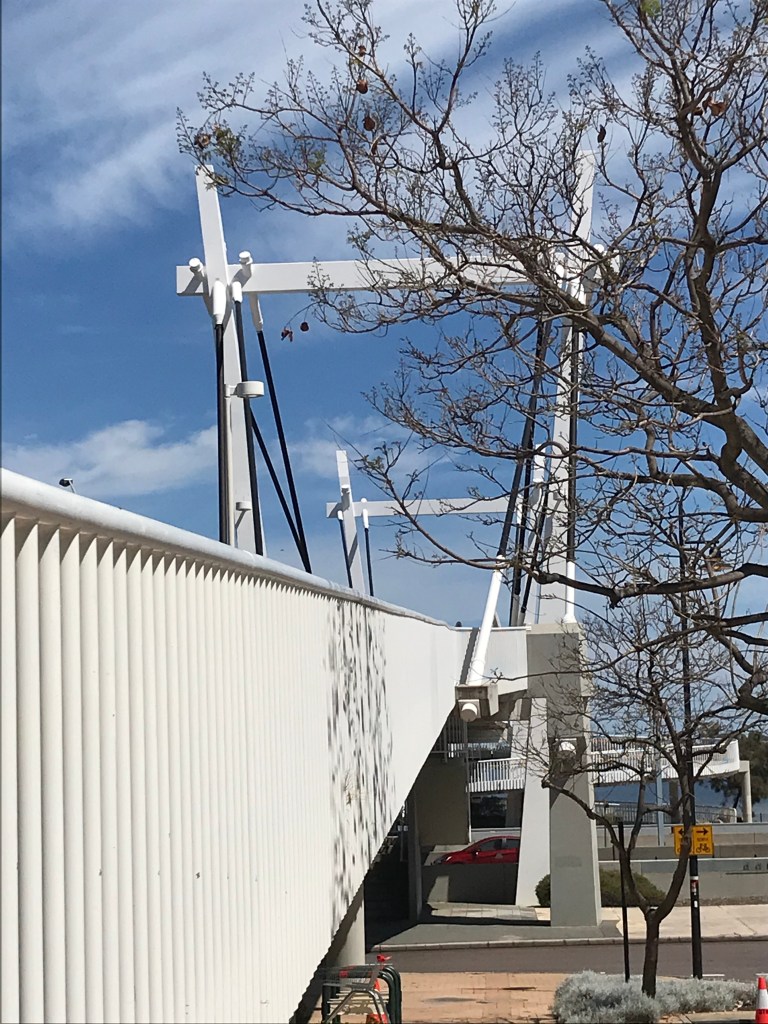
On closer inspection, it becomes clearer that these artworks are connected to the history of the area, and in particular the nearby theatre. I heard one local observing that his children thought the green objects were guns, but they are in fact reminders and representations of the olde world film projectors once used by the nearby theatre. Close inspection of the film reels also gives a reminder of the historical past of Como Beach, with its jetty a popular swimming spot, long before people had easy access to Perth’s beaches. Indeed, the path to the swimming spot is nearby, with a gleaming white bridge over the freeway:

Is this an example of public art? Apparently not, as it’s architecture, not art, but it certainly tweaks some of my aesthetic impulses, especially with the blue Perth sky as background. But before we cross the bridge, there are some public art works near its base:

The shell shown here is a reminder of the days in which Como Beach was a playground, and children could collect shells from the river shore. It has been erected gratuitously by the people who built the adjacent small apartment building, presumably for others to enjoy and to pay some homage to the locale. I had seen it before – and enjoyed it – but had not noticed the artists’ inscriptions carved in the base. Anne Neill and Steve Tepper produced this for others to enjoy, but I did not realise that until recently. Makes me wonder about how artists get recognised adequately.

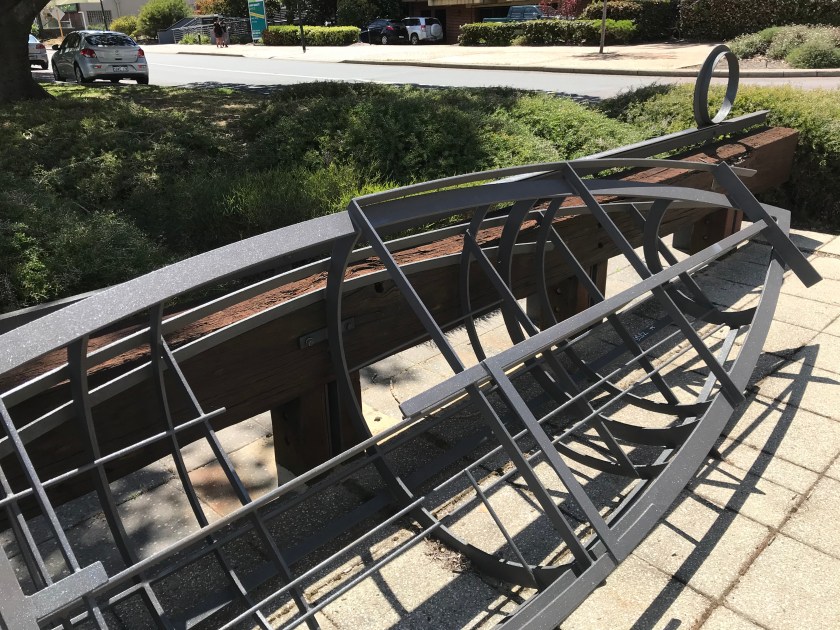
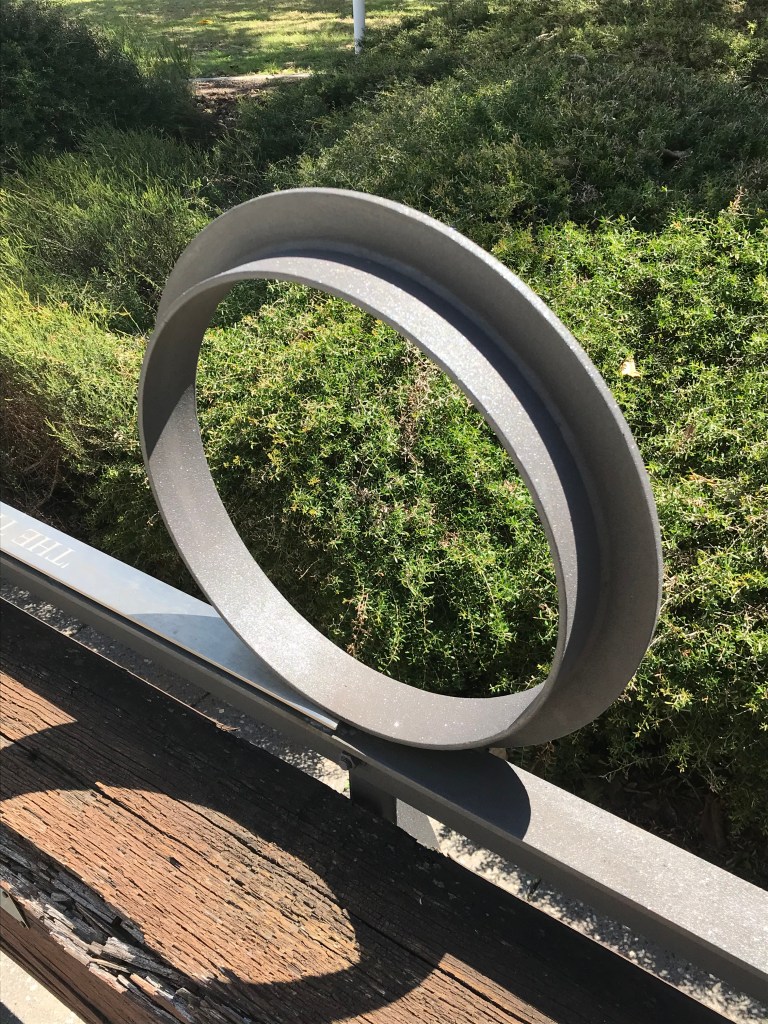
The other two images here show some sculptures at the base of the bridge, also reminding us of the past. The boat represents the many boats that used to visit this spot in the river, both locals and ferries, while the wheel is a reminder that trams used to come to this place, bringing people to a family swimming. picnicking, fishing and prawning spot, long before other forms of transportation. (I had also seen these often, as I walk over the bridge often, but not really connected them to the past. How can that be easily done, unobtrusively and aesthetically? There is an inscription on the work – not shown here – that I had not previously read.) There’s something ironic about these memories of a bygone age sitting quietly next to a freeway full of racing traffic … But let’s go over the bridge …

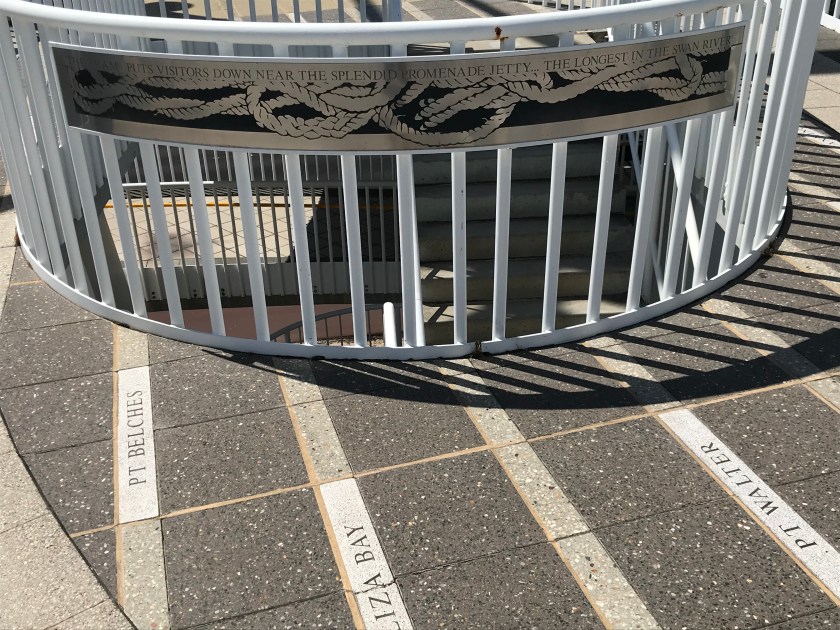
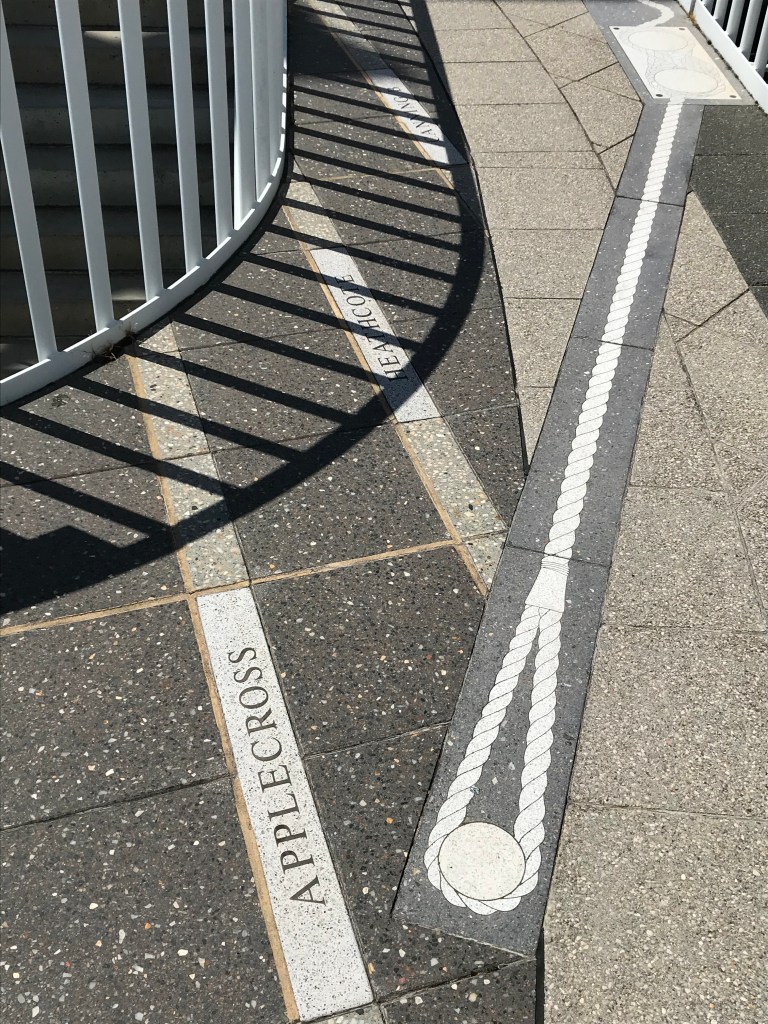
The bridge itself contains some public art works, representing in various ways the ferries and the jetties around the Swan River, as Como Jetty used to be a ferry stop and the jetty itself is still visible to all in the river, or driving past on the freeway. The names of the actual ferries are all there, so that a stroll over the bridge is a walk down memory lane. Well, not quite: most people strolling over the bridge are not actually ‘remembering’ those days, but hopefully learning about them. This bridge was constructed with government funds, so the art works were an agreed part of the project. Crossing over the busy freeway, we get to Como Beach itself:

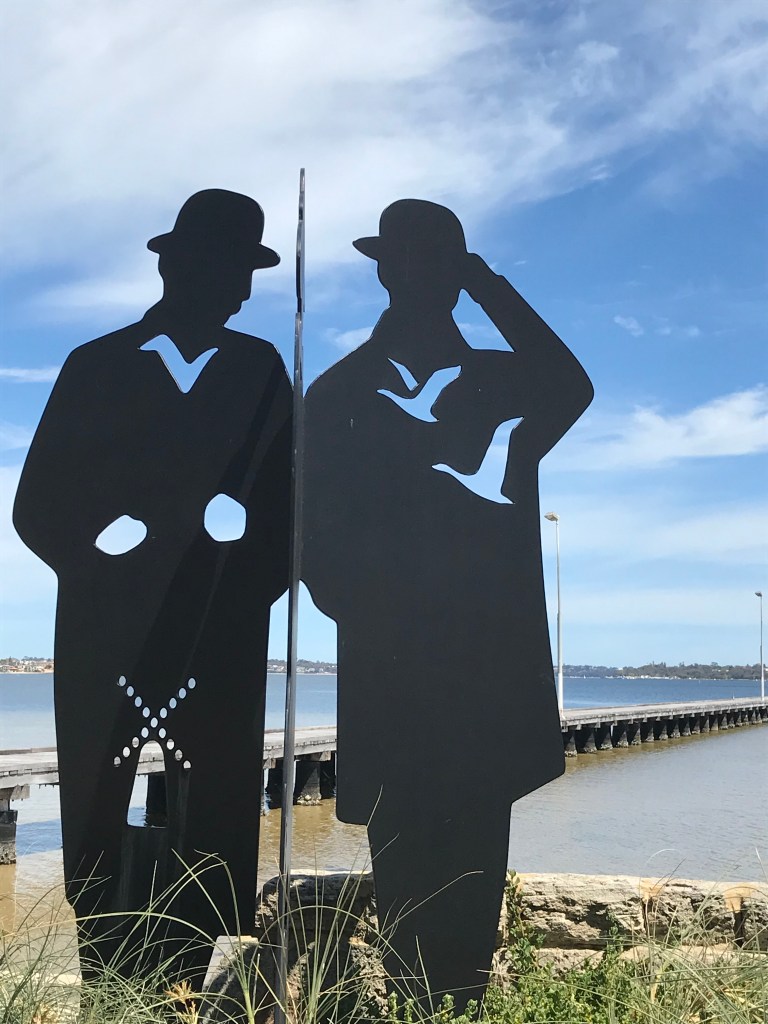
The silhouette sculptures on the beach are reminders of an age gone by, when people travelled to Como Beach to meet up with friends, and children played on the shore. The jetty is still there, of course, but the crowds have diminished … funny how planting a freeway can discourage people to stroll down to the river. But all is not lost, as there are now playground and sandpit renovations being completed, new seating areas and the picture at the top illustrates that picnic space is returning; so watch this space. A pleasant spot to watch the sun go down, ride a bicycle into the city or just sit and think about the passing traffic – cars, yachts or pelicans …

Back over the bridge is the most recent addition to the local collection of public art, a beautiful statue commissioned by the owners of a new building a block away from mine:

A statue is more like what is normally regarded as ‘art’, and I think this is a lovely statue by Anna Ruwhi, whom I think is a local Iraqi immigrant, was completed just a few months ago in 2020. The Inscription in the base notes, “The two human figures, a man and a woman, pay homage to the multicultural tapestry of the South Perth community, and how its blend of people live, love and interact.” I couldn’t put it better myself, except to note my delight at the pelican joining the man and the woman, as pelicans are emblematic of the Como Jetty – and I have often marvelled at their patience in sitting atop one of the light towers. A lovely statue, which would probably not exist but for the City policy of requiring some public art contributions by developers to the local environment. I am pleased that such a policy is in effect.

Statues can be problematic, of course, as recent events in the USA have illustrated, but they can also enhance the environment wonderfully for the general public. I recall reading once that, other things being equal, a city was likelier to be better if it had more statues, and my meanderings around London, Paris, New York and many other places attest to this. Statues of old dead men can be problematic if they reflect a colonial, racist or oppressive past (remembering the statue of Saddam Hussein toppling or the agonised debates about Cecil Rhodes in Oxford), but somehow I think that lovely statues like this will be safe from the tides of political or social change. I hope so, anyway.

Wandering home from my stroll, I can’t help but wonder about what is, and what isn’t ‘public art’. Public art can remind us of our past, as well as our present, can tell stories or just enhance our outlook. So building decorations, verge plantings and even plants visible to the public all have aesthetic elements to them, even if they don’t come within the City’s definitions of ‘public art’. It all reminds me of how lucky I am to live here, as well as how pleased I am that public art is part of my surroundings, and that the City of South Perth is working to keep it that way, and improve it.

I hope that you enjoyed my tour; but it’s more fun to do it for yourself, if you happen to live close enough to do so.

A drive in the bush

Growing up in post-war Australia, like many others, I was aware of a view that the countryside in Europe, depicted by the nineteenth century landscape painters, was ‘beautiful’, depicting mountains, lakes, ordered fields and greenery. There are many examples of these in our art galleries and even in travel brochures. It was not at that stage fashionable to see beauty in the Australian countryside, and those (like my mother) who described it that way were regarded a little strangely. We’ve changed, of course, now, and I hope these these few photos of a recent drive in Australia’s south-west corner show that we live in a beautiful part of the world.

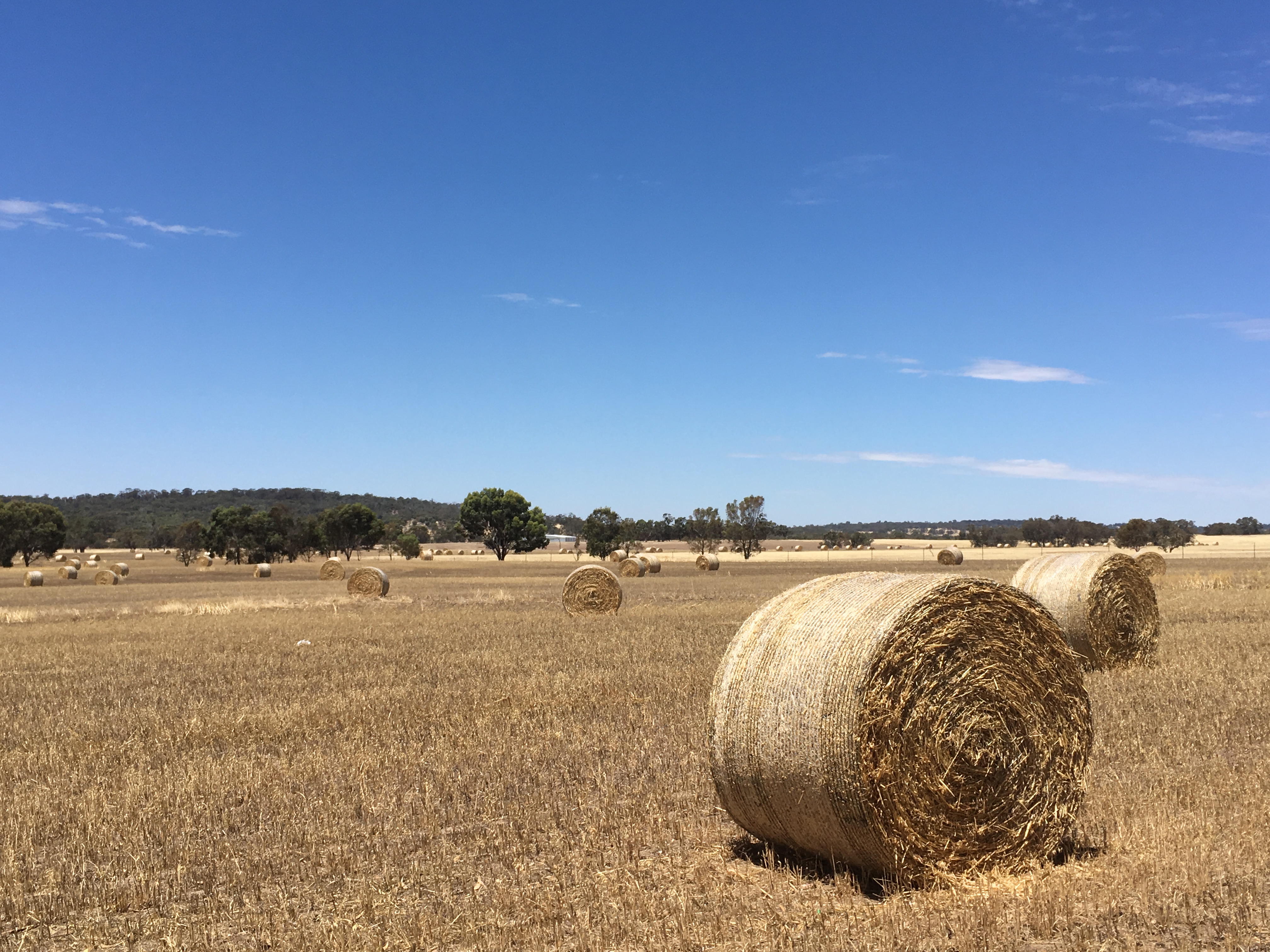
One of the things I have found surprising in the northern hemisphere is that summer is associated with green, where I have always associated winter with green and summer with brown. At least in Western Australia, rainfall is almost entirely a winter affair, so that dry scenes like this farm in January are common in summer time:

IMG_6529

Driving in the populated south-west often is through farmland, but quite different from farmland in the UK or the USA, as the relative lack of rain here means that farms are much larger, so that it is rare to see a farmhouse and almost never can one see two different farmhouses at the same time.

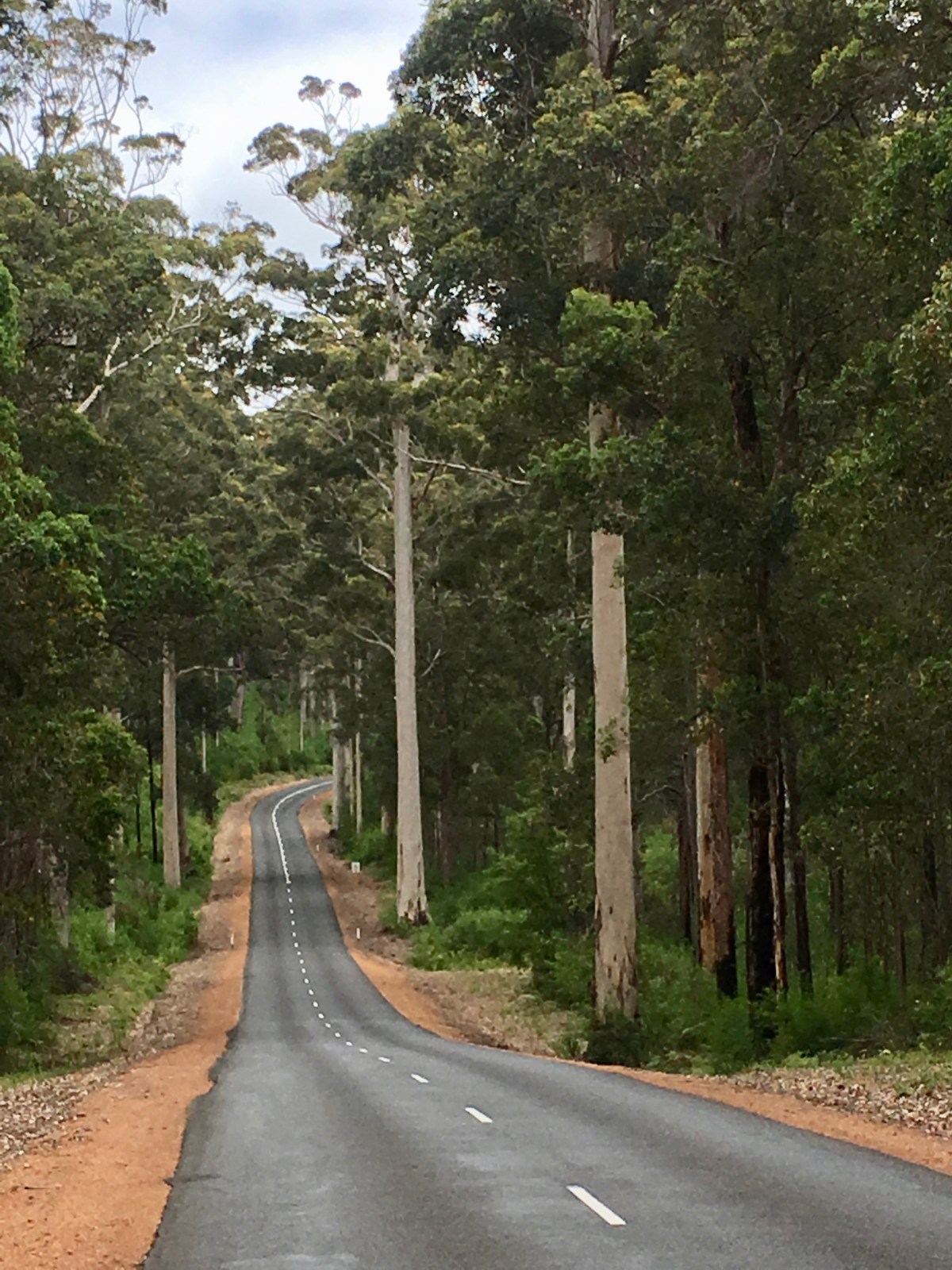
As the photo at the top of this blog shows, some country roads go through lovely (evergreen) forests. There is still a timber industry in our south-west, although increasing concern about the environmental consequences of cutting too much old growth forests for commercial reasons. Fortunately, it is still possible to drive through lovely forested areas like these:

While the roads look small, at least by international standards, they do not carry as much heavy traffic as in more populated parts of the world. The roads shown here are nonetheless the main highways in the area, and I drove a total of about 600 km on roads of this size. Not all of them drove through forests like these, however … many were in large flat spaces through farmland, from which trees have long since been cleared, as in the hay bale photo above. The small white posts on either side of the road are wonderful for night driving, making corners easy to see. I had not appreciated how useful they were until driving overseas in places that do not have them, and which are much less safe accordingly.

The forest (which is generally described in Australia as ‘bush’, not ‘forest’, explaining the title of this blog) is a rich ecosystem, with many native species there, when one looks hard enough. There are also many signs of fires, a serious problem for local inhabitants, but at the same time an important part of the process of regeneration of the bush for thousands of years. Balancing the needs of people and land is always tricky.

There are also fauna, of course, not shown here. One of the hazards of driving in our bush is the prospect of hitting kangaroos coming out of the bush across the road, especially at dawn or dusk. Such a prospect is quite dangerous, often because people swerve to avoid hitting the animals, and lose control of their vehicles, in the worst cases hitting other things like trees instead. Indeed, many local residents have a ‘roo-bar’ on their vehicles to minimise risks.

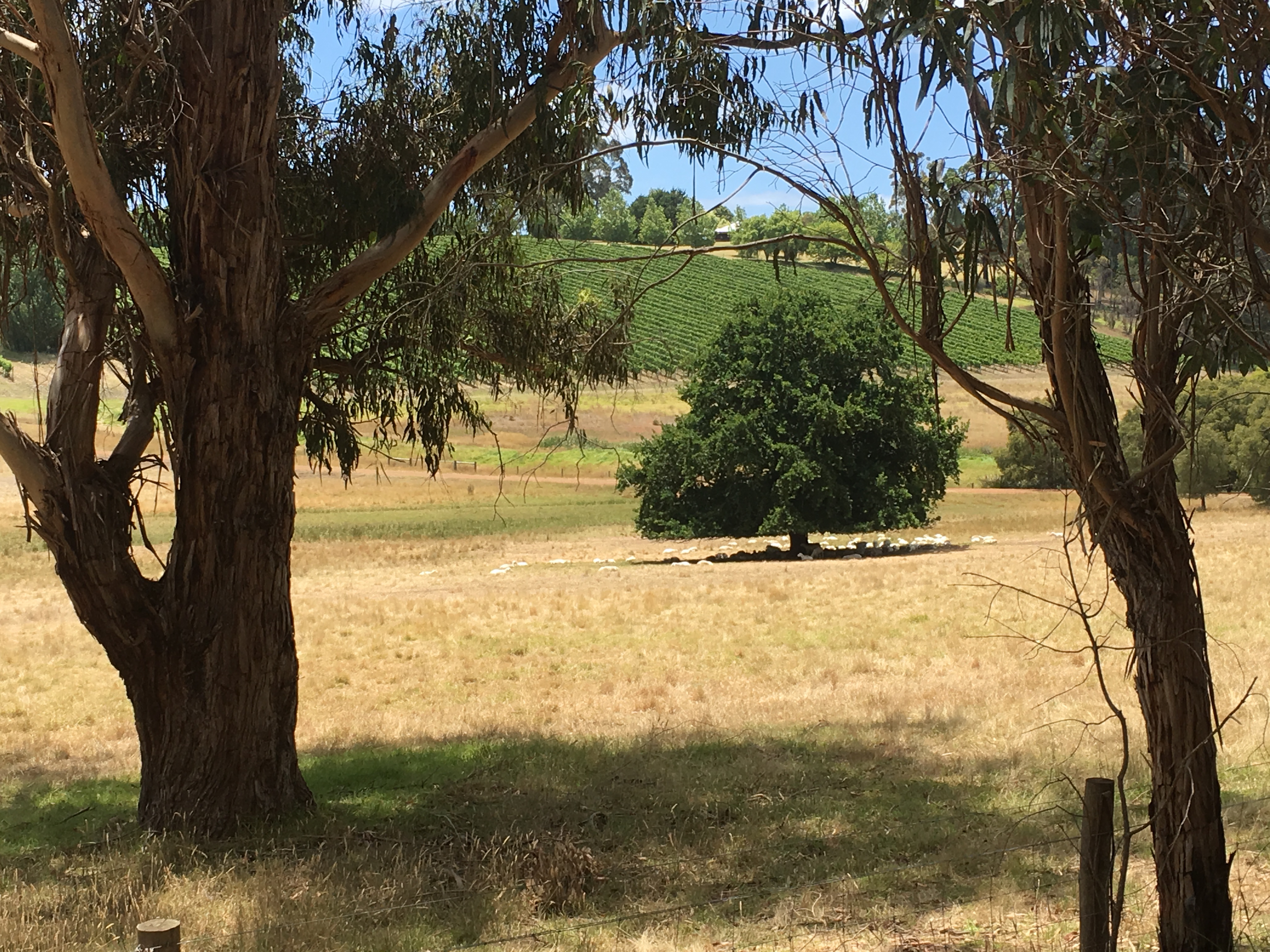
Away from forested areas, some farmland scenes are also attractive, such as this one near Pemberton, showing grape vines and sheep (resting under the tree) as well as some trees that have escaped clearing for grazing of animals. There are about three sheep in Australia for every person, which might account for our national dish – if there is one – to be sometimes described as roast lamb; it also accounts for the phrase from an earlier time that ‘Australia rides on the sheep’s back’, referring to a once very important wool industry.

IMG_6631

The south-west of WA is justifiably famous for its flora, with thousands of examples of indigenous plants (here called ‘wildflowers’) that are unique to the area. here are a couple of examples:

A walk in the forest at any time of the year will reveal many examples of these kinds, if one looks hard enough (in summer, especially); it is not necessary to look too hard in some places at other times, where the countryside is covered in flowers. Even when flowers are not evident, the bush has some spectacular indigenous plants, perhaps none more so than the widespread (and spiky) grass trees shown here:

IMG_6634

Driving in the country is not restricted to farms and forests; it also can involve the lovely oceanside. Western Australia’s coast is more than 20 000 km in length (around 13 000 miles), most of it uninhabited. Most of the coastline borders the Indian Ocean, although the south coast is regarded (by Australia) as bordering the Southern Ocean, separating Australia from Antarctica.

The wind farm shown above comprises the turbines shown and provides about 80% of the electricity needs of Albany, a major town at the bottom of the state. It overlooks a lovely stretch of coastline. In fact, the whole coastline is lovely, but in changing ways. In many places, there are hundreds of kilometres of pristine beaches, unlike the photo above that shows hills and rocks. The citizens of Western Australia (most of whom live near a beach) have long taken our beaches for granted, thinking (mistakenly) that beaches are like that all over the world.

This blog has shown no people at all, although there are signs of their presence, with roads, farms, vineyards and turbines. But rest assured, there are people here as well. The population density of Western Australia is around one person per square kilometre, but it varies greatly between Perth and the rest of the state. The density of greater Perth (in which there are about 2 million people living) is about 315 persons per square kilometre, while that of the rest of the state is about 0.2 persons per square kilometre, or about one person for every 5 square kilometres (roughly one person for every 2 square miles). So people are pretty thin on the ground, but you will find them friendly to talk with when you come here.

I’ve deliberately kept this blog short, with just a few photos, to induce you to come look at the bush for yourself and get the bigger picture.

I hope you can make it soon!

A walk in the bush

After a family picnic, I had a lovely walk in the bush in Kuring-Gai Chase National Park in Sydney’s north recently. It’s a funny word, ‘bush’. While it can be used to refer to a single small plant (such as a rose bush), in Australia it usually means something else, most likely an area of native plants that hasn’t been cultivated, and so is slightly chaotic. It also sometimes just means ‘not the city’ … one lives in the city or in the bush. And when someone ‘goes bush’, they’ve left the civilised parts and probably no-one quite knows to where they’ve gone.

It took us a long time in Australia to appreciate our bush. While Indigenous people always knew and loved it, we more recent immigrants were firstly besotted with the stereotypical views of the countryside of European painters. If you wander in an Australian art gallery, you’ll find landscapes early in the 19th century that could have been painted in Europe (but weren’t). Then late in the nineteenth century, we started to see the world differently and the Australian Impressionists, among others, captured the beauty that is the Australian bush.

Dorothea MacKellar captured this beautifully in her iconic poem (written in England), My Country. (If you’re not familiar with this, her short and iconic poem is at http://www.dorotheamackellar.com.au/archive/mycountry.htm and well worth a read. As children, we learnt it as a song, too, “I love a sunburnt country …” It is still the best description of how different our bush is from the English countryside (which is lovely, but in a different way). [It also deals with more than just the bush like Kuring-Gai Chase National Park.]

I enjoyed the lovely colours and the sunlight on trees and grasses and rocks, and the wild lack of order (such as you will find in a plantation). The grass trees looked especially spectacular. (We used to call them blackboy trees when I was a kid, but that is no longer appropriate.) Here are a few snaps, but I could have taken many more. You can click on them to see more, if you wish.

When you look a bit closer, there are all sorts of plants there, including a few flowers as well. It got me thinking how wonderful it must have seemed to a botanist like Joseph Banks in the early days of European insurgence into Australia, seeing so many plants that were familiar – but not quite – a whole continent full of new plants! Of course, the closer you look, the more visible is the mathematics … with the fractal-like ferns and the L-systems …

The Kuring-Gai Chase National Park is on the edge of northern Sydney, and so easily accessible. We were lucky on the day we visited that the picnic area was comparatively quiet, as everyone was at school or at work. So it was easy to find a table and enjoy the environment. I thoroughly enjoyed the family picnic, remembering many other family picnics, and also loved the light on the trees in the picnic grounds.

There was water around, with a river wandering off to the Pacific Ocean somewhere and also a lot of mudflats, with mangrove trees exposed for now by a lower tide. To get to a boardwalk and a walk in the bush, we had to cross a footbridge; somehow it seems OK to interrupt the bush with things like footbridges and boardwalks, as it gives us all safe access to it.

As we walked on the boardwalk, lots of little crabs popped back into their holes, waiting until we passed. This made it pretty hard to photograph them, but I caught this little guy enjoying the sunshine, and being a bit more daring than his (or her) companions:

CIMG0129

We encountered some other wildlife as well, including a bush turkey and a bird. The bush turkey was determined to not be photographed, and kept popping into shaded bits of bush. It’s funny how things that are new to us are interesting, but the familiar is easily ignored. My companions were puzzled that I was fascinated with a bush turkey of the kind that they saw every day. I suppose that visitors to Australia are fascinated with kangaroos, koalas and emus in the same way. The unfamiliar is more interesting than the familiar!

Taking a walk in the bush is probably less fun when it’s cloudy or raining, but we were lucky to have glorious sunshine, which made some of the trees stand out beautifully:

CIMG0138 2

It’s nice to have the bush so close to the city and I felt very lucky to have the time to go for a walk, and family to enjoy a picnic with, without worrying about the next deadline.

Australia from the air

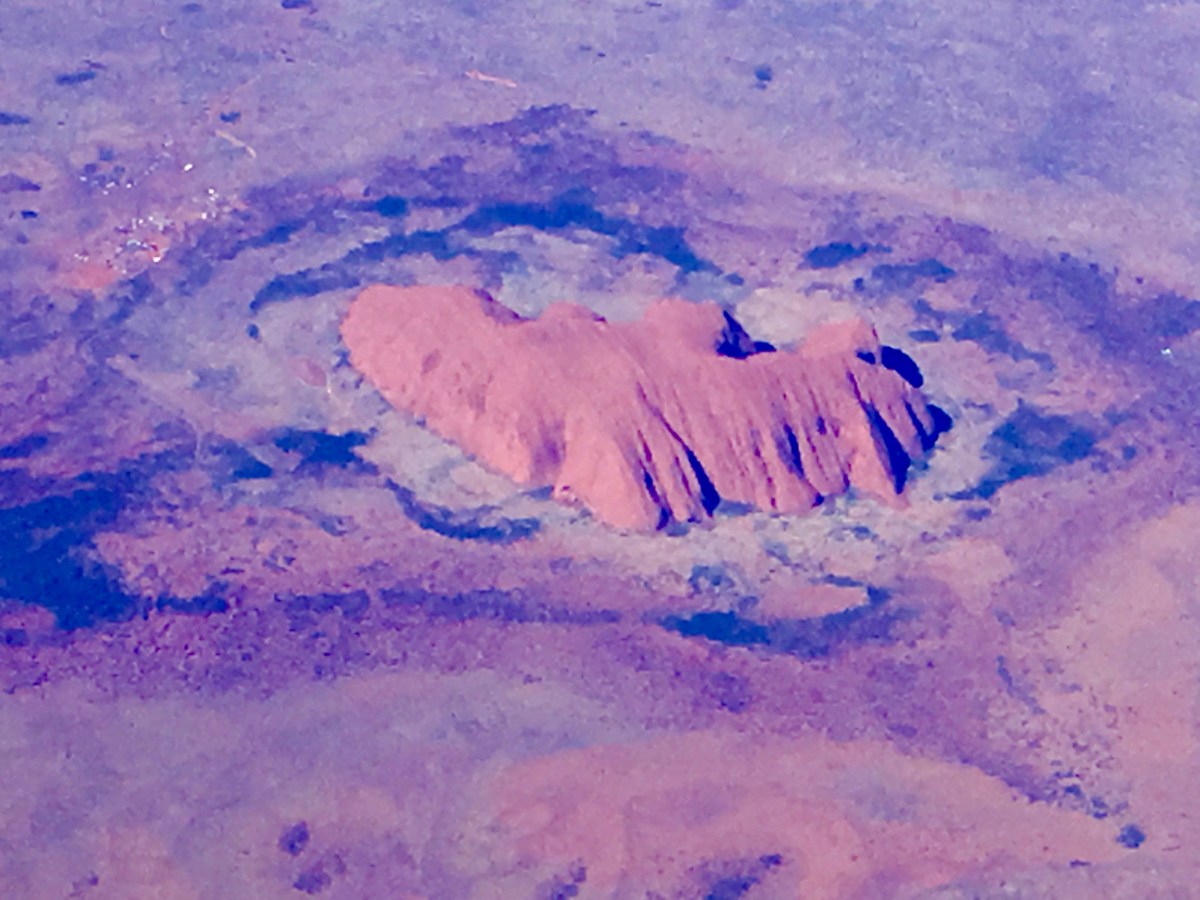
When you live as far away from everywhere as Perth is, air travel is necessary to get to many places. I generally prefer aisle seats so that I can get up and stretch my legs easily, especially for longer flights. But on my recent short trip (just a little over three hours), I chose to sit by the window, partly hoping to see Uluru from the air. I was not disappointed, as there were few clouds (but lots of haze) that day.

Uluru is a large rock in central Australia. Of course it’s been there a long time, and has great significance for local Indigenous people. It was officially returned to them around 30 years ago, having previously been known as Ayer’s Rock. It’s a popular tourist destination for visitors to Australia, as well as locals like me.

The reddish landscape made it clear to me why the phrase ‘Red Centre’ is appropriate, but I was also struck by the lovely natural patterns of various kinds you can see from up high. It made me wonder how Indigenous artists have long represented such patterns in paintings, for thousands of years before anyone took to the air.

As I got closer to Perth, the land is more developed, with farmers growing wheat crops, and lots of lines in the patterns suggesting that the land has been tamed for humans. Many years ago, I worked in what is described in Western Australia (WA) as the eastern wheatbelt, helping collect wheat harvests as a vacation job, so the site of fledgling crops reminded me of how tough it is for many farmers perched on the edge. This shot was taken near Narambeen, where my maternal grandparents were farmers almost a century ago. So far this year, rainfall has been too low for many to even bother to sew a crop. Let’s hope it improves.

Simpson’s gap

We visited Simpson’s Gap on the way from the airport in Alice Springs to the townsite. The gap is a gap in the West MacDonell Ranges, a very long mountain range in this desert-like environment in the centre of Australia.


It’s a lovely environment, including a small colony of rock-hopping wallabies. I loved the colours of the rocks and the grass and the sky, reminding me of the wonderful paintings of Albert Namatjira which I first saw in my childhood. As it is fairly close to town, there was a school excursion there: I always admire teachers who have the courage to take their students out of the classroom, as I know it’s always difficult.

Introduction

I started this blog in 2017, unsure if it’s a good idea or not, but thought that the best way to find out is to try. I thought it may be a nice way to record a travel diary, perhaps as an alternative or supplement to using FaceBook. We’ll see what happens.

CIMG6253

Travelling alone is different from travelling with friends or family, so I was attracted to the idea of writing a blog for myself to record my thoughts and feelings and observations, in the spirit of “How do I know what I think until I see what I say?”, a little notice that I used to have taped to the bottom of my computer screen. I enjoy taking and sharing photos too, to somehow capture the experience for myself and for those not able to be here.

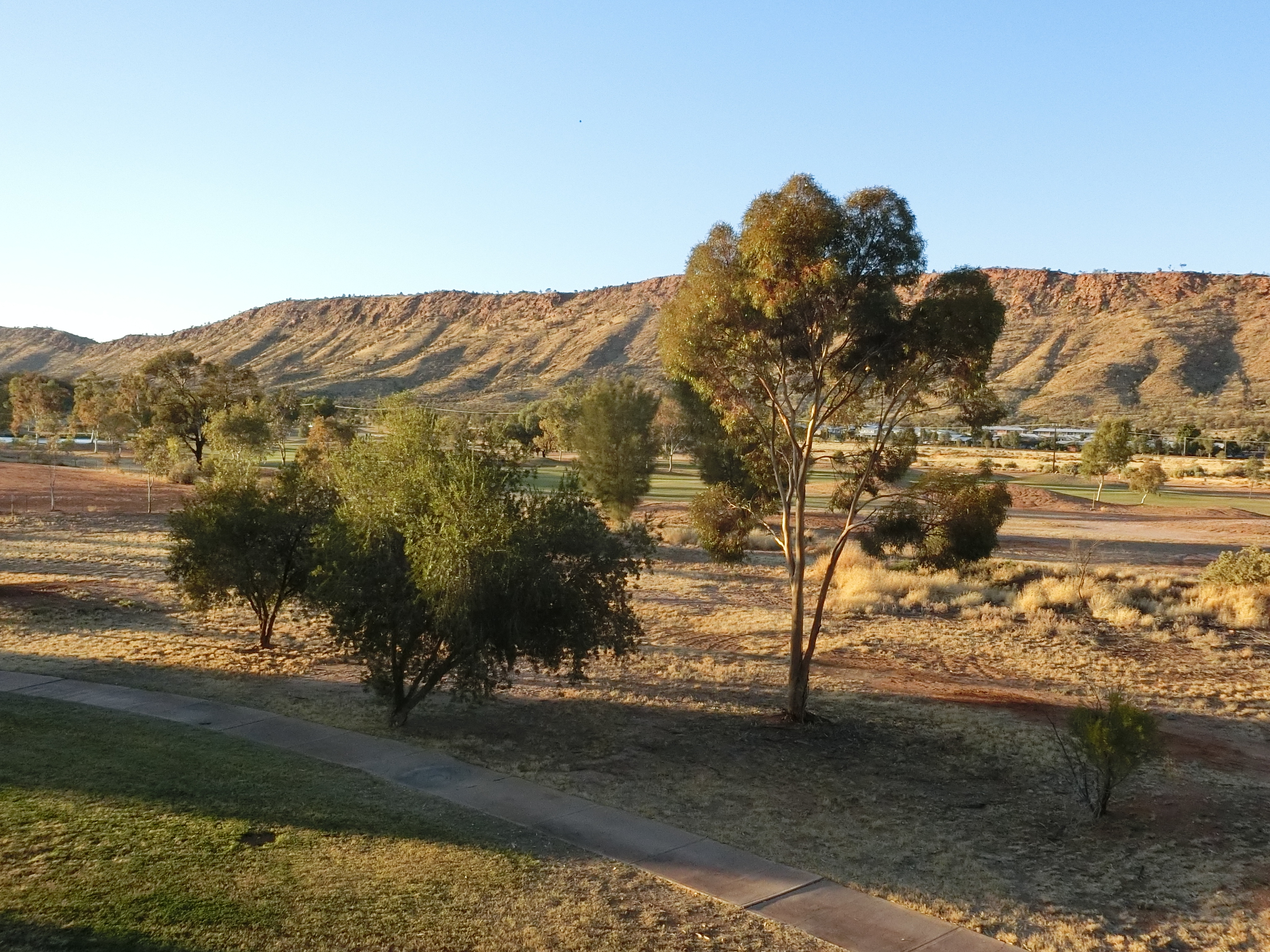
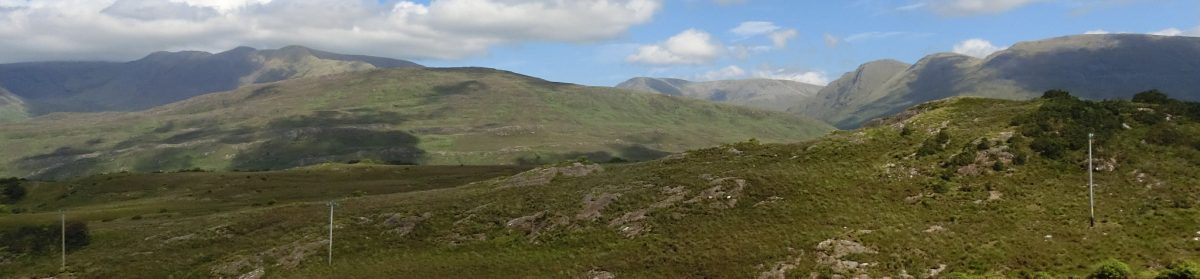
For example, I loved the early morning view out my hotel window in Alice Springs in 2017, and it’s nice to have the above photo as a reminder. (If you’ve not had the good fortune to go to Alice Springs, I hope you like the photo too.) The other picture at the top of this post is of the lovely Connemara National Park in Ireland, which I was lucky enough to visit in 2016 with little sister Cherrie Searle. Irish countryside is lovely, but in a different way. I expect only very rarely to include photos of myself, however; I guess I’m still not part of the selfie generation.

I expected my blog posts to be short, with a selection of relevant photos, but also thought that sometimes they may be longer (e.g., when I don’t have time to make them short). Only time will tell. My posts stopped for a few years after a computer mishap in Switzerland and then were interrupted by the chaos of Covid, so only a some of my recent adventures have been recorded here.

You are welcome to follow and interact with my travels if you wish. Either pop in to this site when you feel like it, or subscribe to it via the link on the right and get an email alert about a new post. I’ll do my best to respond to constructive feedback, as I’m just learning how to do this and will mostly learn by my mistakes, as we all do. But as they say, or at least they ought to, when you stop learning, you’ve stopped living …