Most museums are closed on Mondays, so I decided to visit two recommended places on Sunday, as well as travelling out of the city a bit to the suburbs to see how the other half live.
The Chilean Museum of Pre-Columbian art is a fantastic collection, and in my view so far the best museum in Santiago. The world changed when Christopher Columbus brought European colonialism to Latin America, but there was a lot of interesting activity before he arrived. The museum is not only about Chile but about Latin America more broadly, and I enjoyed exploring it. I knew about, but had not previously seen a quipu, the large collection of knotted pieces of string used to record extensive information, and I enjoyed lots of material on tapestries, textiles and weaving.


There were also lots of wonderful pottery examples, and I even got used to AC being the abbreviation for what we in the English-speaking world call BC. I was intrigued by the many geometrical designs and nice symmetries evident, long before the Europeans arrived, as the typical examples below suggest. I also enjoyed an interactive section of the museum (for kids), amongst which was an interesting area to explore the many different images of Chileans, to help kids see themselves in it all.


I was interested to learn, too, that early Chilean communities saw familiar objects in the sky, just as early Europeans did. But instead of going the stars up with lines to make objects, they saw the objects in between the stars! Now that’s a cultural difference!
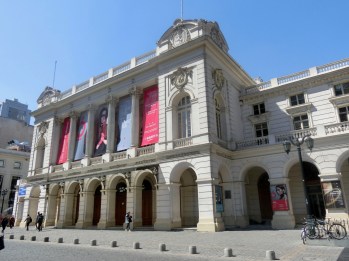
After leaving the museum, I noticed a dog-walker, apparently necessary as there are very many dogs in Santiago. I also saw some impressive neoclassical buildings downtown, such as those below, showing the strong European influence on high architecture here, slightly ironically next door to the pre-Colombian museum.


But I was off to the suburbs, away from the centre of the city, firstly in quest of a Museum de la Moda (a museum of fashion) but then to go further afield. The museum took some finding (mostly as my Lonely Planet Guide directed me to a bus service who’s number has changed!), but I eventually managed through a mixture of helpful locals and my ever-trustworthy Ulmon app on the iPhone. I gave up on the bus and walked, which was more interesting anyway.
The museum in a well-to-do suburb has a large collection, but only a small part is ever on display. On this occasion, there was an exhibition on Princess Diana, including a replica of her wedding gown, movies of the wedding and several original versions of her outfits. I was intrigued to see this as a topic so far away from Great Britain, but I guess she was always a fashion icon.


The museum itself was beautifully laid out, in lovely garden setting, and had many lovely things in it, apart from the Diana exhibition, including some lovely local designs shown above and some beautiful interior decorations:


It even had some interesting and stylish cars, and I discovered by accident that I was one of the few people in Santiago that did not recognise one of them as the car from Back to the Future. I couldn’t figure out why other visitors were so interested in it, which is slightly embarrassing (but only slightly), and had to ask the lady at the reception desk (who was also surprised that it was necessary for me to ask). In fairness, there was no sign attached to it (presumably because someone thought it unnecessary?).


Frankly, I preferred the other car, a wonderful old Ford, anyway!
It was clear to me, wandering in the suburbs, that there is another world out there, far removed from the world of central Santiago. It’s a middle-class (and above) world, with new apartment buildings, lovely suburban streets, lots of greenery, lovely parks and boulevards, up-market shopping, fancy cars, flash restaurants, heavy domestic security and not much graffiti. Certainly where the other half (or some other fraction) live. The metro isn’t convenient to get there (as most people have cars, I guess), so I did a fair bit of walking, all of which was quite pleasant. But I did not come to Chile to visit middle-class suburbia. There’s no shortage of that at home; indeed, I even inhabit one myself.


It all got me wondering about the divisions in Chile, as it already looks to me to be a big gap between the haves and the have nots, no doubt also between urban and rural people, and between the Indigenous people and those more European. I wonder how all this played out in the military takeover in 1973, when arch-conservative Augusto Pinochet ousted the socialist President Salvador Allende (maybe with some gentle support from the CIA?). I wonder who was on whose side? And ho did the people in these suburbs fare? Way too early for me to tell, of course, and naturally it’s all very complicated, but it was hard not to wonder about it.
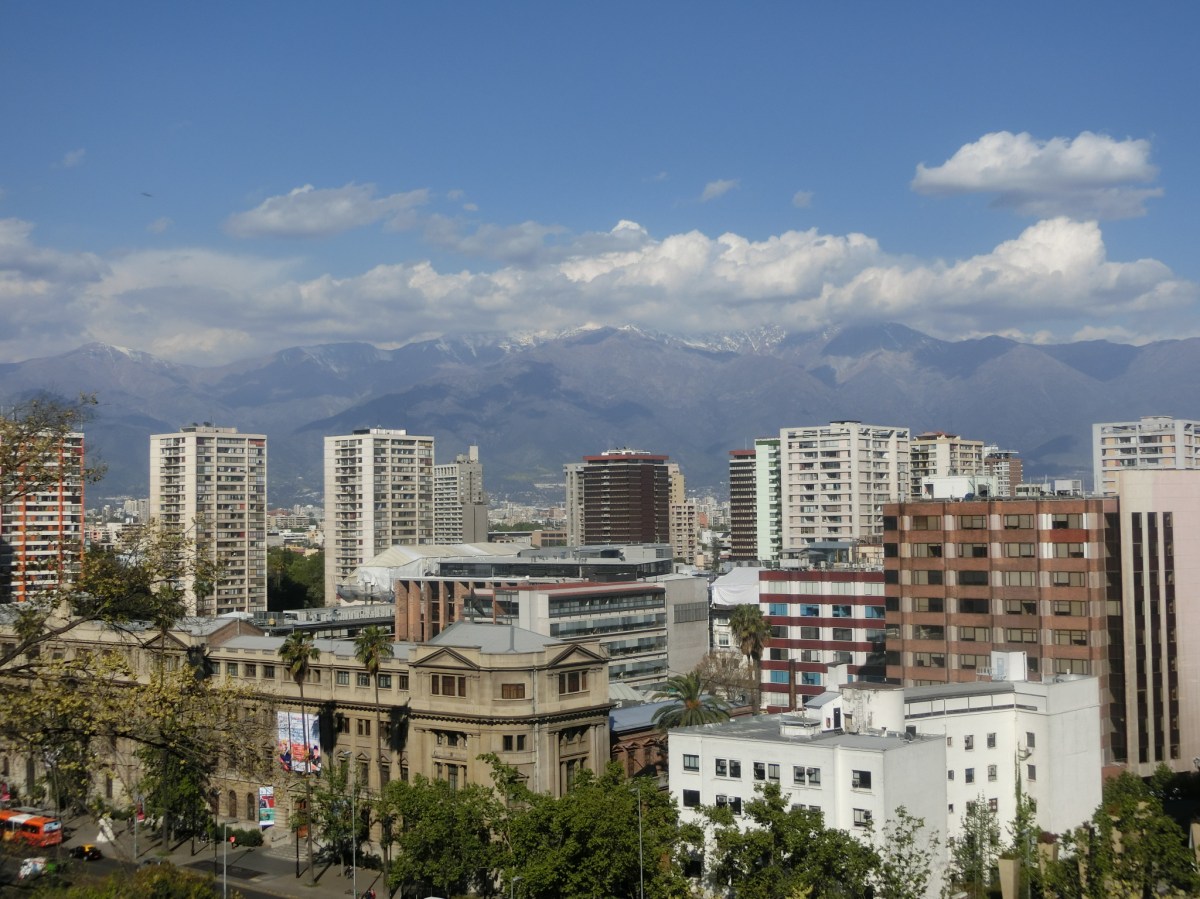
I went in search of the Bicentennial Park, which was a large and lovely space, full of families enjoying a Sunday in Spring, in full view of the nearby Andes. Football, bicycles and dogs were all prominent, but the most striking thing was the family picnics. Family is clearly very important in Chile, unsurprisingly.


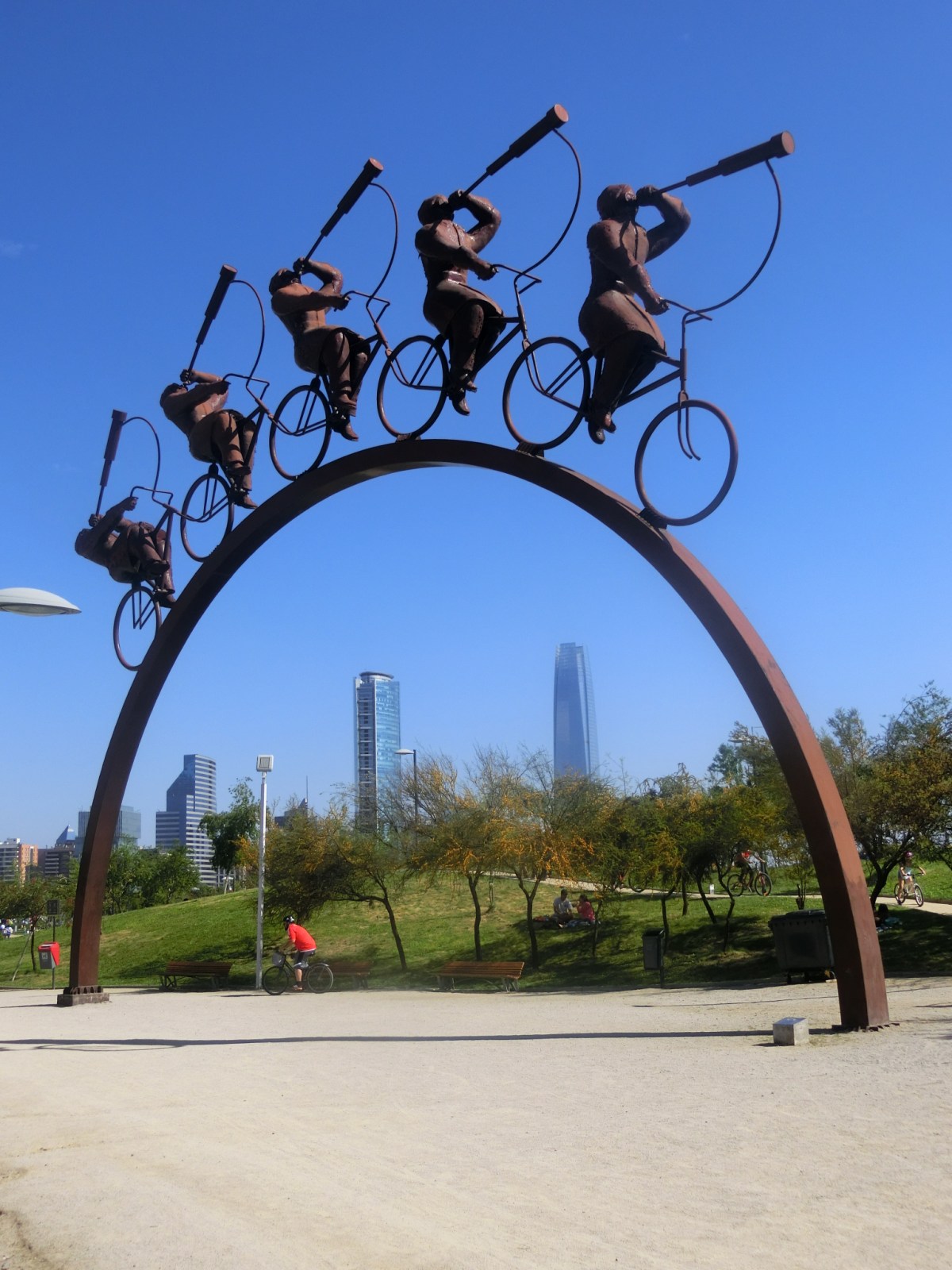
I especially liked this spectacular sculpture in the park, and took lots of photos of it from various angles. One of them is shown at the top of this blog, with the newer buildings in the background. here is a second version:

There were some nice flowers around, too, one of which looked to me like wattle:


I had seen a sign in my travels in suburbia (looking for the museum) regarding an exhibition of Salvador Dali photographs and determined to find the exhibition before it closed. This proved a little challenging, as I had only a little information to go on (the sign!), but not impossible; after several conversations, my trusty Ulmon app, a bus trip and a bit of walking, I found it. Getting lost is always part of the fun of travelling, I kept reminding myself.


The exhibition was very interesting, a large collection of mostly black and white photos of Dali and friends. A very quirky chap, as were some of the photos!
Finally, I decided to go to the end of the metro line in this part of Santiago, to Los Domenicos. This was slightly tricky as there was no metro station anywhere nearby, and my Ulmon was struggling to locate one, but the security guard at the exhibition helped me to locate a bus (which I would never have found by myself) that took me there. (The bip! card, as it is called, for public transport I bought a few days ago has been very useful, as it works for buses as well as metros, as in Perth.)
Los Domenicos is almost in the Andean foothills, so I enjoyed being so close to the mountains. Again, there was a large park with lots of families enjoying each others company. Not just families, but also lots of courting couples (as there is very little privacy in Chile, with people staying home until quite late in life, I gather … 30 years and beyond?).


There was a touristy area (but for locals, it seemed) with a few cafes and some caged birds and souvenir craft shops near the church you can see above. I even managed to get some snapshots of a couple of interesting birds, as well as some traditional scenes (you’ll need to click the pictures to see them properly). One of the displays came from the island of Chiloe, which I may visit when further south towards the end of my trip.


As the sun was beginning to wane (although it’s daylight saving time here, so it doesn’t set until around 730, I headed for home. Some of the metro stations here have some interesting decorations inside, as you can see below, and I saw another street juggler just near my apartment when I got home. Maybe he only does this on Sundays?
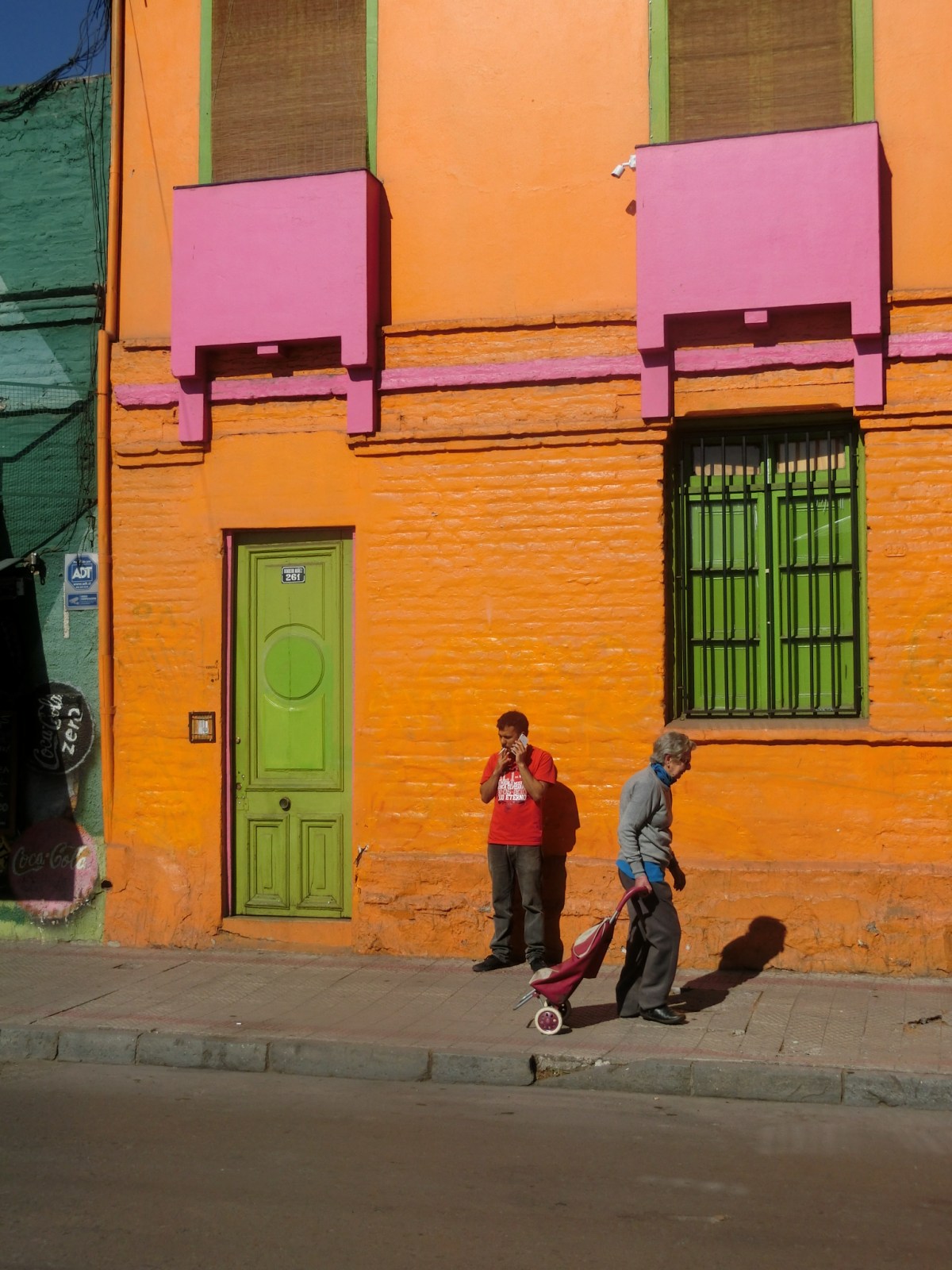
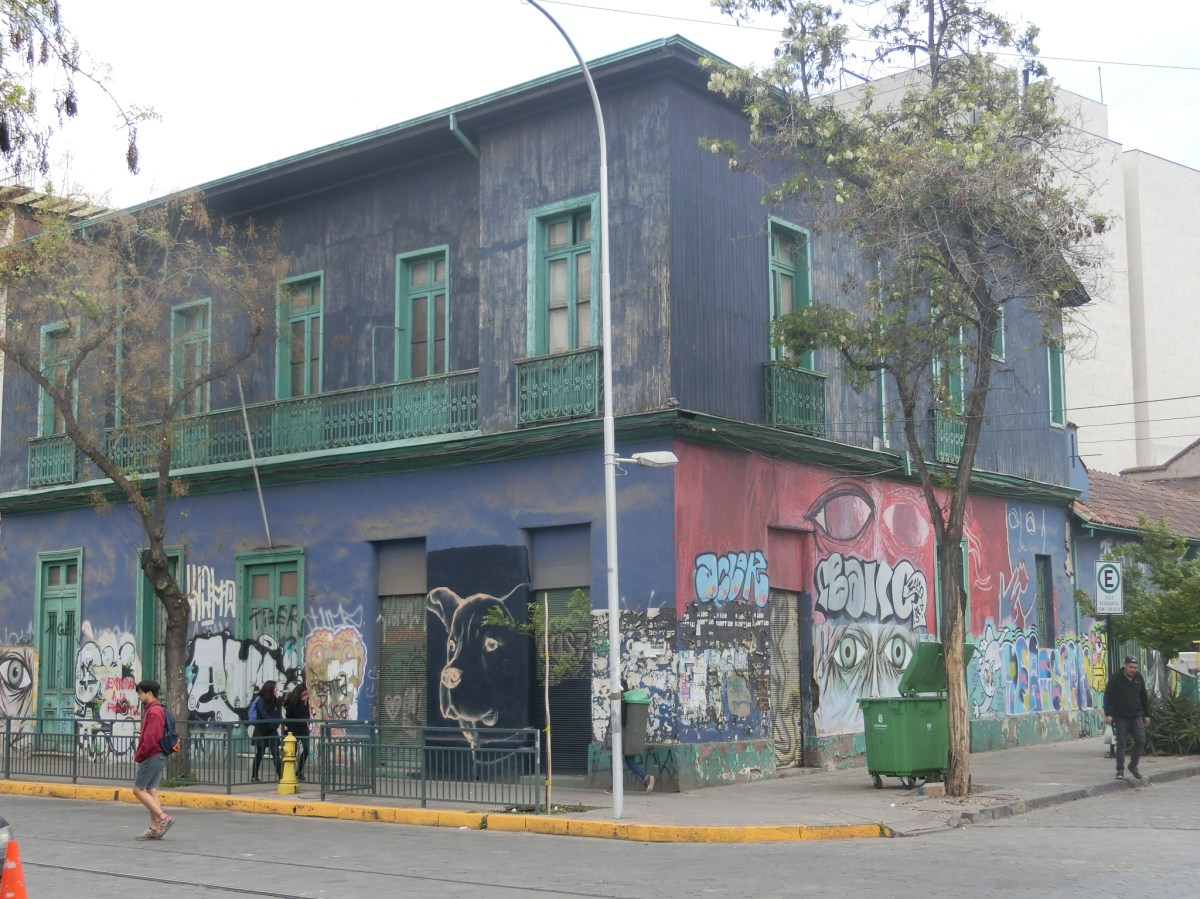
I also saw the front of the shop from which I bought a can of beer last night … through the grill! – as they were presumably concerned about security. A stunning contrast to the world I left behind a little while ago in the suburbs!


I also saw the sun setting on the Andes from just outside the same place, a stone’s throw from my apartment.
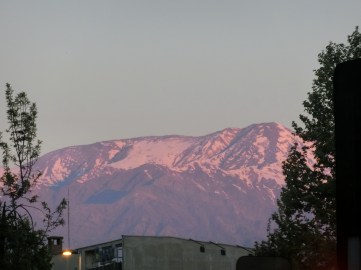
Another lovely – albeit different – day ends in Santiago.
I am very lucky, I keep reminding myself.












 Barry's travel blog