Daisho-in Temple on Miyashima Island

There are several cultural attractions on Miyajima Island, one of the main ones being an ancient temple, founded in 806 AD by Kobo Daishi, after whom it is named. (It’s an important Japanese temple in the associated sect of Buddhism it seems.) I thought that 806 AD seemed a long time ago! Clearly, the temple has changed over the years, but I was attracted to a temple that is more than 1200 years old, so thought I would have a look. It looked lovely from the gate, as you can see above, but I was a little disconcerted at the steps I could see … or at least how many of them there seemed to be, as it was a hot day.

Undaunted, I decided to have a look, and my attention was caught by this cute little stone monk at the gate:

CIMG7124

When I saw the steps, I was a little uneasy … but ploughed on. I am pleased I did, although at the time, the steps became a bit hard to handle, as there were a very large number of them. I’ll bet the monks who lived here were pretty thin and fit (unlike the statue). Some of the steps had prayer wheels in them, and I think that spinning them around is meant to bestow a blessing of some kind on you. Here are a couple of examples:

I did wonder how often people would actually read all the characters on all the wheels … but perhaps that’s a good meditation practice; I don’t know.

On my travels, I encountered further stone monks. Not far inside the gate, I found this set (each one different):
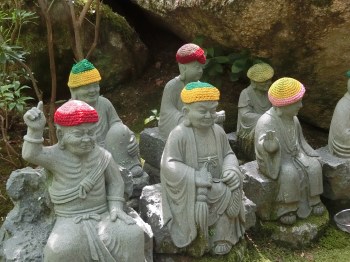
CIMG7133

To my great surprise, a little further on, I found an even bigger collection (I’m not sure what is the collective noun for stone monks, I’m afraid):
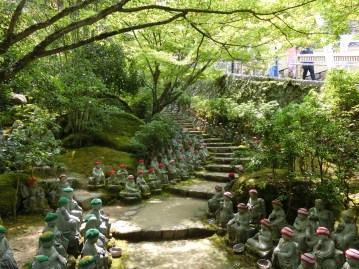
CIMG7136

At this point, I stopped counting them, but a brochure told me that there are about five hundred of them. They looked very interesting, as if waiting for their master. I loved all the greenery too, so much so that I kept climbing up the steps.

There were various small temples dotted up the hillside, important for different temple purposes. Some of them looked spectacular inside, such as these two:

The temple on the left had a wonderful sand mandala (inside the case), such as the Nepalese Buddhists produce, and it was no coincidence that there was a photo of the Dalai Lama nearby, on the occasion of a visit of his, and hence probably the source of the mandala.

I saw many many statues in the temple grounds, of various kinds. It made me wonder if anyone actually knows how many statues are in the temple, in fact. Some of them were absolutely wonderful, made with great skill. Here’s a selection of them; if you click on a picture, you’ll see the whole picture:

I was intrigued by this large statue just at the base of (yet another) set of stairs, however, as it reminded me of Pinocchio, in the children’s story, whose nose extended when he told a lie. I’m sure that is not the case for this statue, but failed to find any information on why his nose was extended.
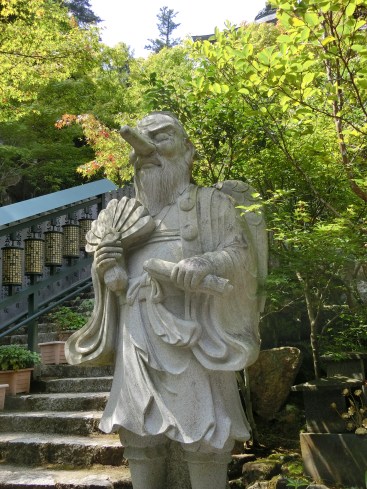
CIMG7168

There were of course many Buddha statues, sometimes popping up in strange places, unexpectedly. I enjoyed these two (well, four actually), including the “See no evil, hear no evil, speak no evil” trio:

An especially impressive set of eighty eight statues was in a cave, right at the top of the temple (hundreds of steps from the bottom). They depict the principal icon of each of a set of 88 temples on a prestigious pilgrimage route on Shinjuku (the large island south of Honshu). It seems that they give the same blessings as the temples on the route (which would save a lot of time and effort, I guess.).

CIMG7184

I confess to being fairly ignorant of Buddhism (and its various sects), but do know at least that it’s not really a religion, but rather a set of practices, so people don’t pray to a Buddha, but hope that the Buddha will guide their spiritual practice. Without knowing a lot, I guess it’s hard to really understand what you see in a temple like this; I assume it’s just as hard for Japanese Buddhists to make sense of a Christian church and its various practices, or a Jewish synagogue or a Muslim mosque (although in those three cases, religion is actually involved). I generally try to treat places like this respectfully, even in my ignorance, but certainly enjoyed the beautiful things and the surroundings in this ancient temple.

Again, as noted in an earlier post, there is just a hint of colour changing happening here, as summer is fading, making me wish I was here a few weeks from now to see the effects.
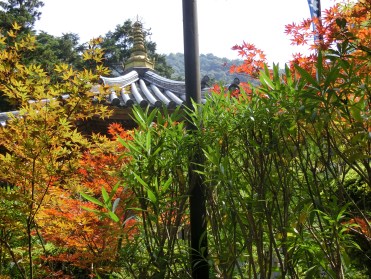
CIMG7175

But the steps? I managed to get to the top, of course. And, since I am no longer there, repeated the performance to get to the bottom again. But it was very draining in the heat. You’ld think I’d get a bit thinner – like the monks – with all that climbing, but it has not happened.

Beautiful Shukkeien, Hiroshima

I needed to write something more positive after writing about the atomic bomb in Hiroshima, if only to record that it is a nice city, and that there are lots of good things to do here that don’t mess with our minds so much. I didn’t know about Shukkeien Garden until I was on a free bus that happened to stop there, so the next time I went on the bus I decided to visit. Funny, really: I’ve never been a gardener, but I enjoy other people’s gardens!

I’m slightly embarrassed to be surprised that some things in Japan are very old, too. In Australia, we think of things that happened early in the twentieth century as ‘old’, but here (as in Europe and elsewhere with recorded histories), old means hundreds of years – if not thousands. Anyway, this garden was first constructed around 1620, some 400 years ago. It was a ‘strolling’ garden: you strolled around it, as I did on my visit. But it was constructed to shrink scenery, so that it provides a sort of miniaturised landscape (apparently of the famous West lake in Guangzhou, which Marian and I had the pleasure of visiting – and walking around – some years ago.)

I was so impressed with my stroll that I used the above photo on my FaceBook home page, thinking it was about time I changed the scene.

Like most other things in Hiroshima, the garden was effectively destroyed with the atomic bomb in 1945, and has been rebuilt faithfully since then. Here’s an old and new picture that shows how effectively that’s been done (click on the images for a closer look):

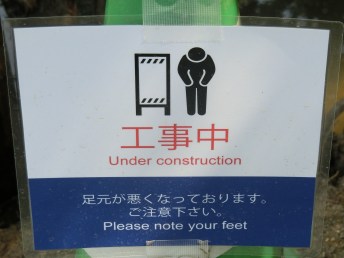
In fact, it’s still undergoing renovation – I guess gardening is a relentless sort of activity. But I was amused by the distinctively polite Japanese apology (including a bow) for the work in progress on a small bridge:

CIMG7380

The park is beautiful and is beautifully maintained so that I thoroughly enjoyed strolling around it, despite the heat. It was one of those places where you would get a nice enough postcard just by pointing your camera anywhere and keeping it horizontal. Here are a few randomly chosen examples (you can click on the photos to see them in full):

I’m not sure how they get the small trees to look like they are big trees seen from a distance (the Bonsai effect, I guess), but it all looked lovely. The distinctive features of Japanese gardens seems to me to be the green, the rocks and the water, although that is likely to be because I have mostly visited Japan in the summer time. (The colours of changing leaves in autumn look lovely and of course the spring flowers – such as cherry blossoms – are rightly famous, while trees draped in winter snows look different again).

Here are a few more pictures of similar kinds:

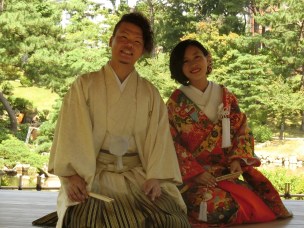
In my wandering around the (comparatively small) garden, I noticed some tea-houses and one of them included a marriage ceremony – or at least the photographs of it! Of course the bride and groom were happy to be photographed by a wandering ancient tourist. I loved the traditional costumes, although did not envy them wearing them in the heat. (It was at least 35 degrees C at that stage).

CIMG7404

Not normally one for selfies, I succumbed to a request by the groom to be photographed with him, despite my slightly dishevelled appearance!

I reciprocated by taking his photo on an attractive bridge nearby!

I felt a little sorry for the bride, who must have been drained in perspiration in her beautiful costume, despite her attendants working on keeping her cool, but she bravely was happy to be photographed again.

It’s a beautiful little garden, and I was pleased that I decided to tarry a while there, although the phrase, “Mad dogs and Englishmen go out in the midday sun” was buzzing around my head for much of the time. I was especially pleased to do so after the unavoidable melancholy of the graphic reminders of the city’s past.

I have also made a mental note to try to find  a way to return to Japan in different seasons. They have all four seasons here (unlike Australia, where many of us get at best two different seasons), and I’d love to stroll around the same gardens in all four seasons, but still prefer them to be other people’s gardens.

Peace Memorial Park, Hiroshima

Peace Memorial Park is close to the epicentre of the first nuclear weapon used in war, when an atomic bomb was dripped on Hiroshima. I came here once before, several years ago, on a brief visit. It’s not really the sort of place you want to come back to, but I did anyway; I was staying only a ten-minute walk away.

Life for the people of Hiroshima, and for the people of the world, changed beyond measure in an instant. The Park has many kinds of detailed information about the event, including pictures of the area and of the people beforehand. Here is an old picture of the area, including the famous dome, as well as of a local primary school and its children before the bomb was dropped:

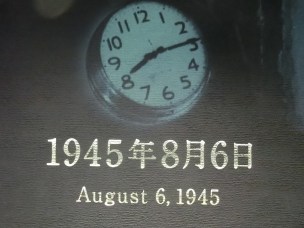
As you probably know, the instant of change was in the morning of 6 August 1945, celebrated these days as Hiroshima Day:

CIMG7331

There are pictures of the aftermath, and many moving stories from people affected, located in various parts of the Park. They are all very harrowing and hard to cope with. This is a very sombre place, with people walking around but not talking much. The photographs below show the domed building (which has been left in its bombed state) as well as some of the people affected by the bomb. Those closest to it (including the primary school class above) simply were vaporised by the intense heat of the explosion.

The park has been constructed as a monument to peace and to love, and has been the centre of world anti-nuclear movements and peace movements for some time. It’s a pleasant looking place – until you get too close to it. For example, the mound below looks attractive in the sunshine, but contains the remains of tens of thousands of people, who could not be identified and had to be cremated.

CIMG6946

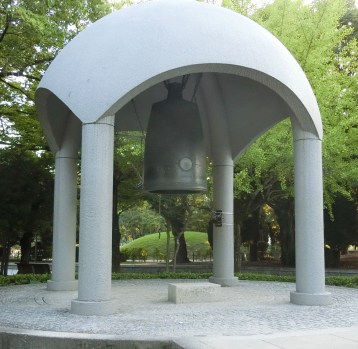
There are often groups of children here, attracted particularly to the monument with a bell in it, ringing the bell to commemorate the children who died as a result of the world’s first nuclear bomb. There are many many paper cranes around the park, too, of the kind that kids get taught to fold (in Japan, but certainly elsewhere), and you can see them next to the bell.

The cranes are related to the story of one of the Hiroshima ‘survivors’ who later contracted cancer and died, even though she folded a thousand paper cranes (hoping that her with would be fulfilled). It’s a well-known story, but in case you’re not familiar with it, here is a little detail (you can click on a picture to enlarge it enough to read it).

Since then, the cranes have become symbolic of something hopeful, and the city continues to be besieged by papers cranes. I noticed them mentioned in the new railway station in Hiroshima when I arrived a few days ago (again, click the image to see the messages).

CIMG7014

The cenotaph commemorates the dead at Hiroshima. Numbers vary as it depends in part on how you count them. At least 140 000 people but there are many after effects …

The view through the cenotaph in the centre of the park shows an eternal flame, which the City of Hiroshima promises will never be extinguished. [I discovered later that the flame was lit from a flame burning on Miyajima Island since the ninth century AD, so there’s a fair chance the promise will be good.]

There are some lovely monuments around the park, too. I had read that this Buddhist bell, to be rung for peace, was enclosed in a map of the world without borders; that is, no countries are identified, but just a world for humans without their politics. I’m sure John Lennon would have approved (got me thinking about Imagine again). However, I was unable to see the detail claimed on the monument; maybe I didn’t look hard enough? Still, the sentiment appealed to me.

CIMG6942

I’m not sure it was there on my previous visit (and it looked new, so that’s possible), but I also saw the Hiroshima National Peace Memorial Hall for the Atomic Bomb Victims, an impressive underground building:

The (tiny) tiles on the wall represent the 140 000 victims of the bombing, displayed according to where they lived in Hiroshima. If you click on the middle picture, you may just see the small square tiles, one per person. the small fountain in the middle depicts the time of 8:15, and the water is offered in memory of those who died begging for it. It’s beautifully done, but I could not stay there long …

Holidays are supposed to be ‘fun’ – at least according to some world views. But sometimes, the world is not fun, and deserves our attention too. Like most Australians, I was taught only one version of the Hiroshima bombing, but of course it’s never as clear cut as we would like it to be. And I long ago learned that history is always written by the winners. So I don’t want to tangle with the conflicted past, but hope that the world can move on from this awful event, and avoid repeating it. Modern nuclear weapons are, I gather, around 100 times as powerful as the bomb that was dropped on Hiroshima. Surely no political or military problem will be solved through use of such a weapon? There must be a better way to resolve conflict, deal with aggression, settle differences.

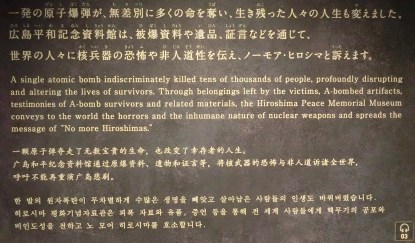
And that’s the message of the Peace Memorial Park. Let’s learn from history and not repeat it. The following message captures the intention of the Park well, I think:

I have not seen a message offered in more languages before, including both braille and sign language (via the touch screen).

Indeed, the message of the Peace Memorial Park is that we should have “No More Hiroshimas”.

CIMG7340

I agree. We must never do this again. I hope that any world leaders with their fingers on their buttons visit this site and think about the consequences for the thousands upon thousands of ordinary people who might be involved.

The City of Hiroshima seems to have moved on from this event more than 70 years ago. Or at least it seems that way. It’s a nice place, and of course much has been rebuilt. But it can never entirely forget its past, which is respectfully recognised in this park, in my view. The tram stop next to the park is called “A-Bomb Dome”, which makes it fairly unlikely that locals can ever forget. And maybe none of us should forget.


Itsukushima shrine on Miyajima island

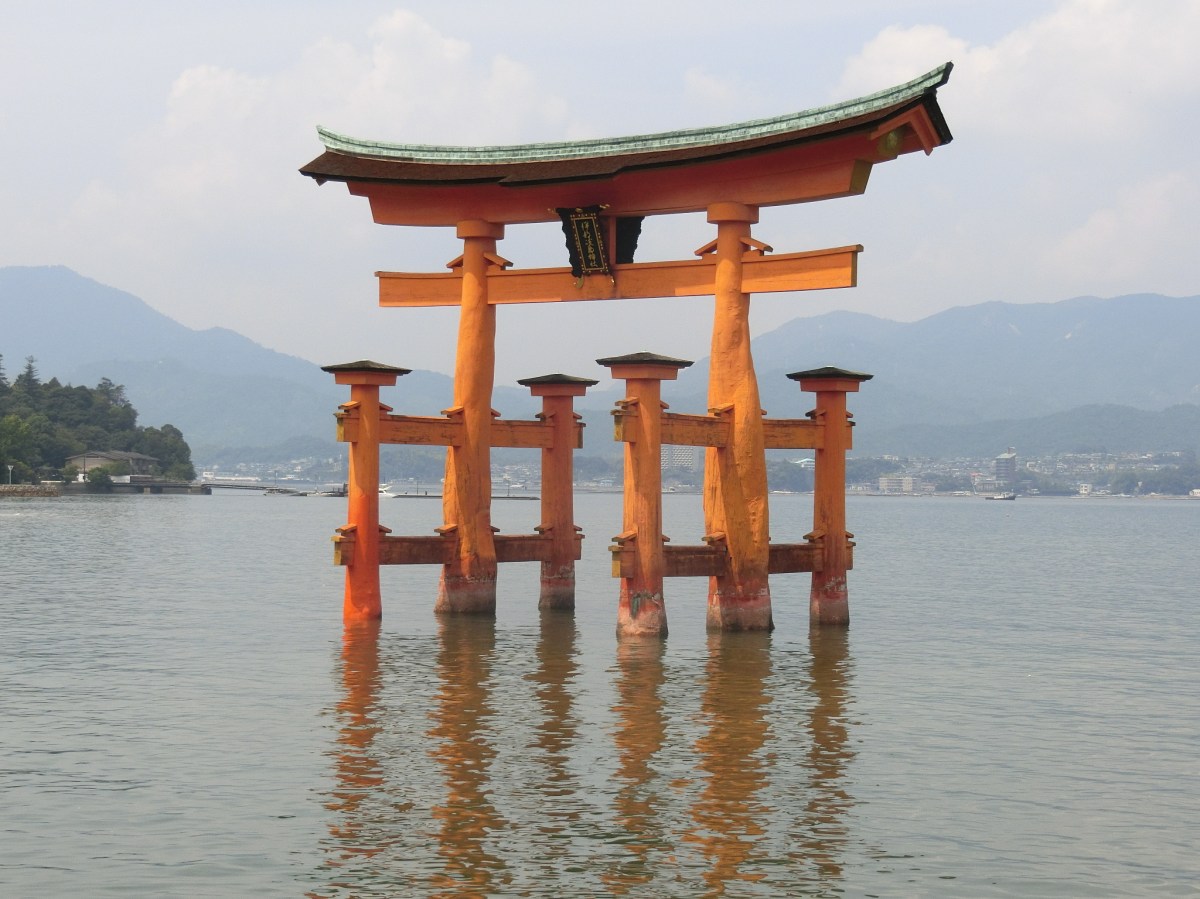
One of my main reasons for coming to Hiroshima was to visit Miyajima, as my previous visit here a few years ago was too short to do that. Miyajima is on every package tour to Hiroshima, and the wooden structure (called O-torii) shown above is one of the distinctive Japanese sights. The Itsukushima Shinto Shrine was declared a World Heritage Site in 1996. Several hundred years ago, in 1643, Miyajima was recognised as one of the “three most scenic spots in Japan” … so how could I resist?

It’s a short train ride and then an even shorter ferry ride to the island, and the island is close enough to the mainland that the O-torii can be seen before boarding the boat (although not in this snapshot of the boat). The island has several attractions, but this post is only about the shrine.  (More posts to come later).

CIMG7016

On arriving at the island, I was surprised to find that there is a very large deer population, wandering amongst the tourists. While not aggressive at all, they are of course looking for food, and are fond of paper, it seems. I didn’t see anyone molesting or molested by a deer. There were also some helpful signs in English (always appreciated), but some seemed a little unnecessary. Also lots of stone lanterns, and I imagine that a festival here (at night time) would look spectacular.

The shrine itself is painted a brilliant vermillion, as is the O-torii, apparently to ward off evil spirits. (The colour reminded me of the spectacular Fushima-Inari shrine just out of Kyoto that I visited years ago.) I spotted a couple of priests (not sure that’s the word) and lots of tourists enjoying walking the extensive shrine corridors – as did I. I was a little surprised to see the large collection of used sake bottles and sake casks, giving me the impression that the priests like a tipple (as for English monasteries). Maybe not; I’m not sure how to interpret such largesse.

The tides vary quite a bit here, and the best time to be here is high tide. (I had planned to do that, and tide tables are easy to find online, but I arrived early and then went exploring elsewhere on the island before the tide came in!). So there is no water lapping the shrine in these pictures, but you can see the mountainous island behind as well as the special wishes written on paper.

Tourists are interesting to observe too. They went out by the boatload, bedecked in conical hats, to get closer to the shrine (which must have irritated other tourists trying to photograph it!). Actually, it seemed to me that other tourists were mostly photographing themselves and their friends! The selfie-generation! I am always impressed with the capacity of Japanese people to queue politely and patiently, in this case, waiting to be photographed in front of the O-torii from a good vantage point.

As the tide was drifting in, it was good pickings for the local birds, herons I guess. And there were lovely photo opportunities of stone lanterns everywhere.

It’s a lovely spot and well worth a visit. I spent several hours on the island – longer than I expected – as you can see from my parting photo of the O-torii. Shinto shrines in Japan are easily found by their O-torii, but this is the only one located in water, I think. (Mathematics teachers like me cannot help but think of them as large Pi signs!) Sunset through the structure is especially lovely, and it is popular for people to actually stay at hotels on the island, no doubt partly to enjoy that experience.

CIMG7283


Okonomiyaki!

Although it might sound like a place, or even a person, okonomiyaki is a food, regarded as the special food of Hiroshima. Apparently it became popular in the 1950s in postwar Hiroshima at a downtown food stall, although it was also a children’s snack just before the war. But now it is very popular and so I decided I could not leave Hiroshima without trying it.

That wasn’t too hard, with almost a thousand places serving okonomiyaki in the city. They generally look like this, with people seated around a teppanyaki-like counter (hotplate) on which it is cooked (and eaten). All kinds of people: younger people, older people, business people after work, groups of people, single people and even tourists …

Making it is half the fun, and a good chance for banter between chef and clients. It starts of course with a beer, but also a pancake mixture. Followed by a handful of cabbage. In some places, you cook your own, but in my case, the chef did it for us. the beer was very welcome after my day trip.

Next comes the next ingredients, placed on top, comprising firstly some tempura chips and then some bacon.

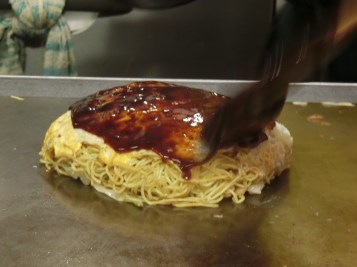
After a while the mixture is flipped over (which looked pretty tricky and I was pleased that I was not doing the cooking). Some soba noodles (thin spaghetti-like noodles) are lightly boiled and then fried, and while that is happening there is even time to capture a photo of my skilful chef:

Then comes the egg – which I missed photographing, too interested in my beer. But here is a photo of an adjacent chef, cooking three okonomiyaki at once at the egg stage. (As well as doing that he was able to engage in conversation with his three clients and with me about the forthcoming football match between Japan and Australia … multi-tasking!) The soba noodles are put on top, and the pile flipped again, ready for the egg to be added after it is cooked a bit.

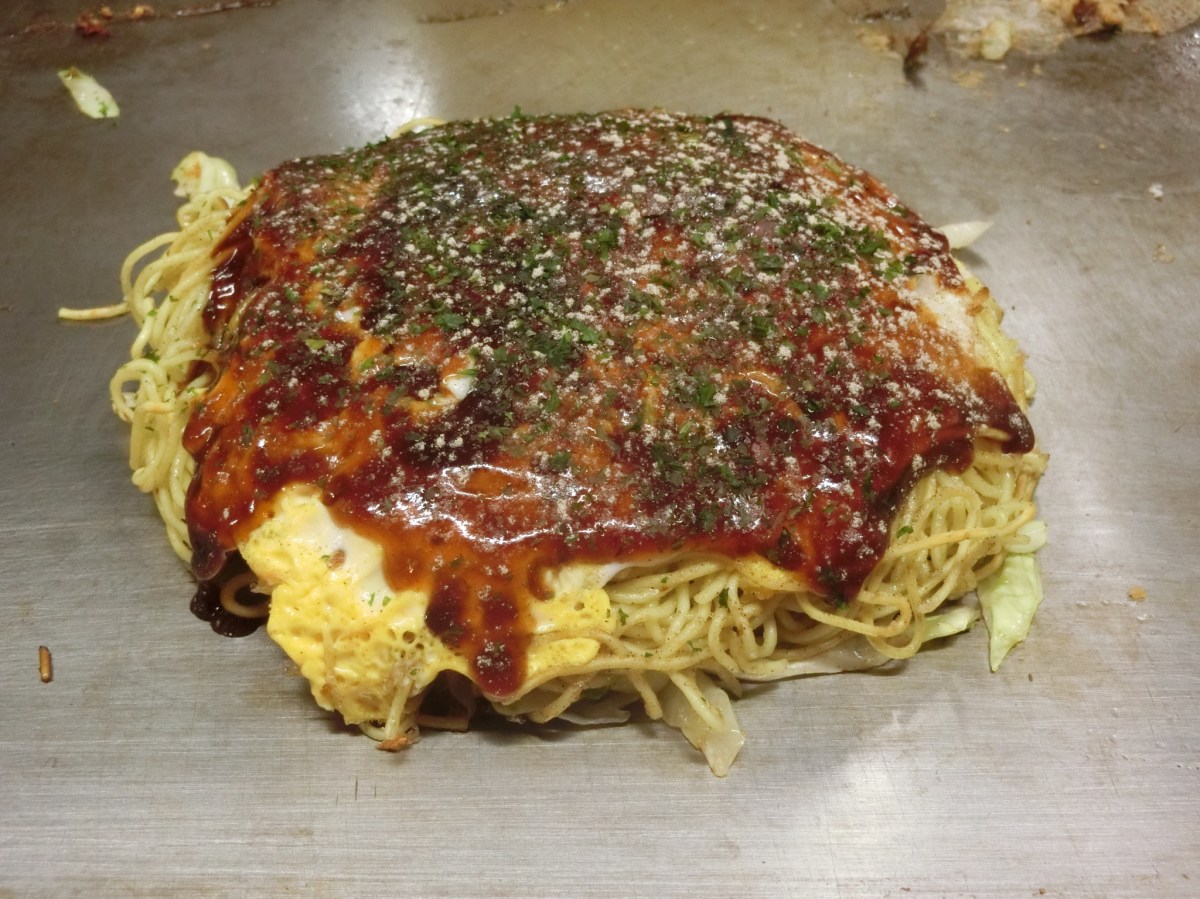
The last steps involve adding a distinctive rich brown sauce and a sprinkling of seaweed or other stuff on top, to get the finished product shown in the picture at the top of this blog.

CIMG7594

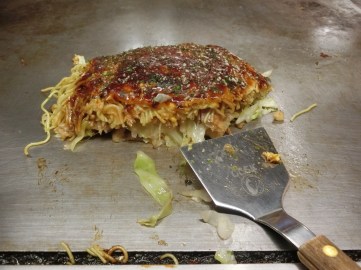
Then comes the adventure of eating the okonomiyaki. The implements provided are a hera and chopsticks. I had read that the hera is used both for cutting off bits (like a pizza knife) but also for eating them (like a spoon), although some people cut off bits and placed them on their plate and then used the chopsticks. There did not seem to be strict rules of etiquette fortunately, and people are very tolerant of the incompetence of beginners and visitors.

CIMG7596

Here is my meal, part-way through. It was absolutely delicious, or, as they say here in Japan, oishi! I won’t show you my plate, however, which was a bit messy!

Mine was just a basic okonomiyaki … but more than enough to fill me up and a nice complement to my beer. More elaborate versions have other things added on top it to them, such as oysters (very popular here), more eggs, cheese, etc. The chef next door was making one with egg and two with cheese for a group of three young men sitting next to me. The cheese needed melting (with  a blow torch):

CIMG7602

Haute cuisine? Certainly not, but great fun and pretty nutritious, as well as being very delicious. Close to what some would call ‘peasant food’, but an excellent meal for me!  I guess you could ‘try this at home’ but it’s much more fun in a group and I was pleased that I managed to experience it here before I left Hiroshima. Thoroughly recommended if you are ever in these parts. The last snap is of my chef and a couple of other customers, all reflecting the generally friendly and bubbly atmosphere.

CIMG7605


Eating and drinking in an Izakaya

Although I’m not long into my travels in Japan, I have already become fond of the Izakaya as a place to eat and drink. Not really a restaurant, but more like a pub, Izakaya are lovely places for solo travellers, although they are also very popular with groups of local people to spend time together, sharing a meal and a few drinks. Often identified by the lantern outside, Izakaya are everywhere in Japan and very popular.

On arrival, you can be seated at a table or at the counter; travelling solo, the counter is the best choice, as it’s a good place to find people to chat with, watch the cooking process and even chat with the staff.

In this place in Kurashiki, the counter was nearly full, but I managed to be seated next to a lovely couple from Yokohama on one side and a lady from Kyushu on the other side, but conversations could include other people too, as people are very friendly here.


I have also visited a couple of places in Hiroshima, which were more clearly local Izakaya rather than catering mainly to a travelling clientele of tourists (I think …). In one of them, the baseball was the main attraction at the time, and everyone was a supporter of Hiroshima Carp, the local team. I had a lovely chat with two of them and also enjoyed the game, which Hiroshima lost (but it was exciting and close at the end!).


Sitting at the counter allows you to see what’s happening with the chefs, and (if they’re not too busy) chat with them too.


Beer is a popular beverage of course, and always available in draught form, which suits me just fine. Much nicer than bottles (which is the only alternative in most Australian restaurants, unfortunately). Comes in different sizes, and is generally served with a noble of some sort. The green beans are delicious, but I have had alternatives too, even pumpkin.


Later in the evening, a drop of sake is a good night-cap, but moderation is advisable. Sake is served cold or warm, according to preference (both are nice) and is often shared. In one Izakaya, there were sake bowls on the counter for customers to use as they wished, for example.


As far as food is concerned, having an English menu is helpful, but not really essential (you can always point to what someone else is having!). Skewers are very popular, and come in all kinds and comprise all sorts of things. I have not yet had any that were not delicious, so it’s hard to make a mistake, I think.


Skewers are always beautifully served in ceramic trays, which I have often seen in Japan,  but not really appreciated their purpose.


There are other dishes of course. Being an island nation, fish is very popular, but I have even managed to find potatoes here already … I thoroughly enjoyed the potato dumpling, served in a lovely sauce with radish on the side, for example.


Of course, groups of people can have a good time in Izakayas (indeed, that’s what they’re for!) and I have often enjoyed doing so in the post with friends and colleagues.


But, travelling alone, they represent a good (and affordable) place to eat, drink and chat with local people.

A day in Kurashiki

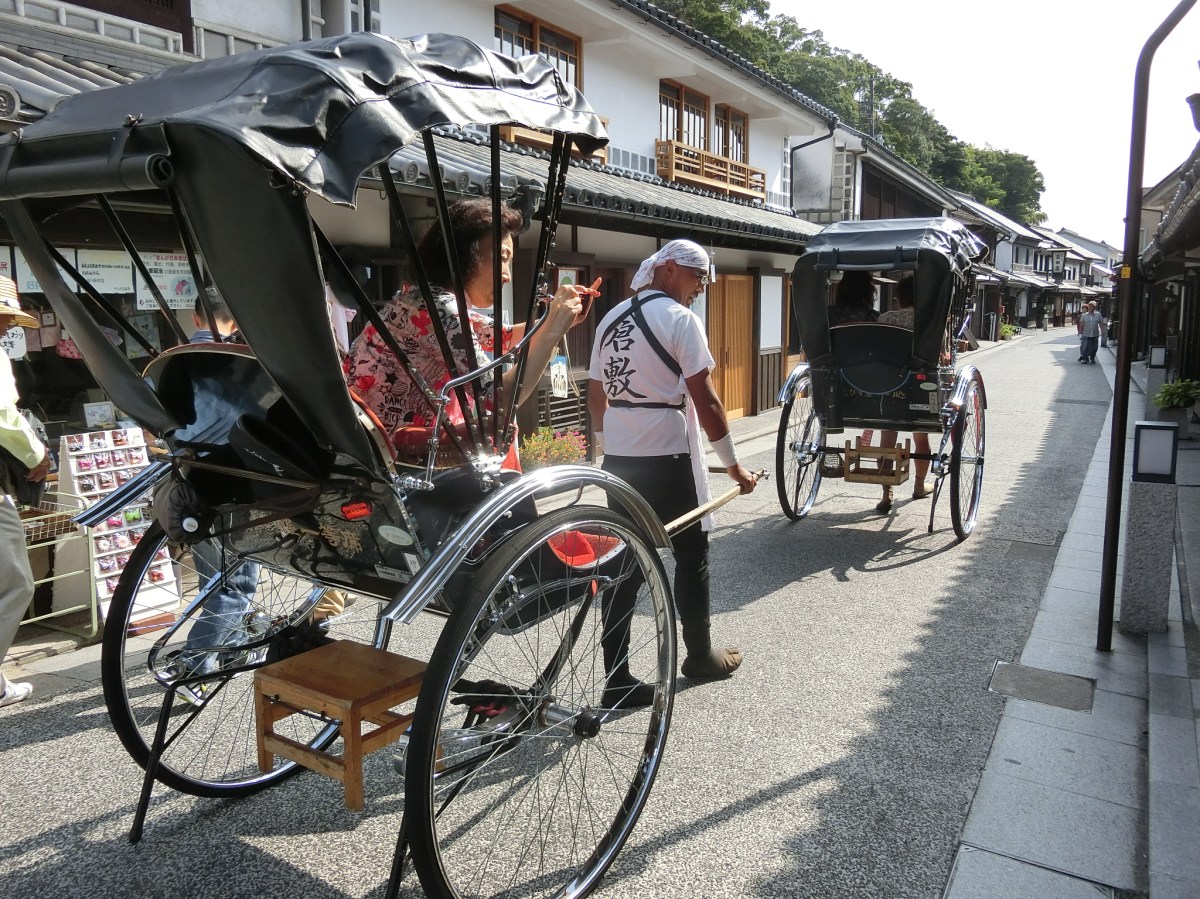
Kurashiki is a small city near Okayama, but distinguished as it has an old quarter with traditional houses. I spent a night here and had hoped to visit the old quarter, but it was too late to do so, so I enjoyed a wander around in the morning (before it was choked with (mostly Japanese) tourists.

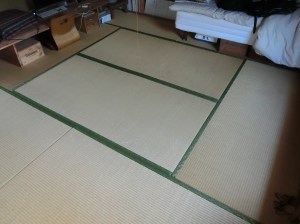
But first, a mathematical note: I have heard of tatami mats before, used as floor coverings in many houses (most houses, I suspect). They are made of a straw-like substance and lined down the longer side. The mathematical interest is that they are always in the ratio of 2:1, being twice as long as they are wide. Rooms are measured in tatami, in fact! The room I stayed in (with my AirBnB family) was huge, being an 8-mat room. Japan often has small rooms, as small as 4-mats, I think; I have certainly stayed before in many small rooms.

CIMG6704

The old quarter of Kurashiki is located close to a canal, which looked really beautiful, with willow trees and lovely clean water. The black and white motifs of many of the buildings, as well as the traditional woodwork and ceramic tiled roofs helped the ambience as well, as these few snaps suggest.

When I was wandering around, preparations were underway for another day of tourist influxes: many Japanese people come here to remind them of days gone by, it seems. I was pleased to be able to escape before it was all overrun with tourists.

CIMG6767

I was intrigued to read the guide sheet from the JNTO (Japanese National Tourism Organisation), which publishes an extensive range of really helpful material free online. They had a wonderful sentence regarding a walk along Honmashi-Higashimachi Street, which previously contained many tradesperson’s houses, but these have now been converted to other things: “A walk along these streets will bring you into close contact with the people living there, and inspires a curious feeling of nostalgia for a time you never experienced”. I love it! I didn’t see many people (too early), but understood the JNTO meaning.

CIMG6753Kurashiki is a beautiful place and well worth visiting. Apart from lovely old buildings in a serene environment (before the tourists invaded), I encountered some unexpected things too, such as these water lilies in Ivy Square. (The square was previously a textile factory, but has changed function now and even has a hotel.) The water lilies were planted directly from some lilies in Monet’s garden at Giverny in France, and were donated by the local O’Hara Museum! [The museum is a world-class museum modelled after the Greek Pantheon, with a very good collection of paintings from famous painters, both Western and otherwise, and probably the main attraction here.]

There are new things in Kurashiki as well, of course. I enjoyed a stroll through a typical Japanese shopping street, with very many small shops in a long (hundreds of metres) undercover walkway. I’ve seen lots of plastic food in the windows in Japan (very helpful for tourists ignorant of Japanese), but the plastic ice creams caught my eye!. I also loved the display of boots in a shoe shop just getting ready for the day. I could have posted many more photos from lots of small, distinctive, often quirky, shops, but restraint is a virtue.

I was also intrigued to see the manhole covers (not sure if that’s what they are …) in Kurashiki, including their own distinctive pattern and the comic book character also. Japanese people seem to really like small cute things – as do many others of course – and the manhole cover is a nice example of this. I’ve never really noticed manhole covers in Australia; maybe I’ve just neglected them or maybe they are just not so interesting?

Wandering around town can sometimes be problematic, but Kurashiki is as good as I’ve seen anywhere as far as information is concerned. There seemed to be many signs (with both English and Japanese), and one of these information boards with a map on almost every corner. That’s really helpful to visitors, and stands out as some places are much less diligent in that respect, especially to foreigners (Thank you, City of Kurashiki!) It reminds me of course at how poorly we in Australia signpost things for Japanese tourists.

I was also pleased to see an escalator to get up to the road crossing to go to the station; maybe I’m getting tired more easily, but I notice myself choosing escalators (and elevators with my luggage) instead of stairs these days! Still, I had walked a fair way and it has been quite hot …

Finally, I loved the greenery and the trees here; I’m beginning to wonder if Japan doesn’t deserve the phrase, The Emerald Isle, as much as Ireland does, as it’s been spectacularly green so far …

CIMG6749


An Okayama stopover

En route to Kurashiki, I chose to stop for a couple of hours in the city of Okayama, mostly to see the famous garden, but also to stretch my legs and to see Okayama Castle.

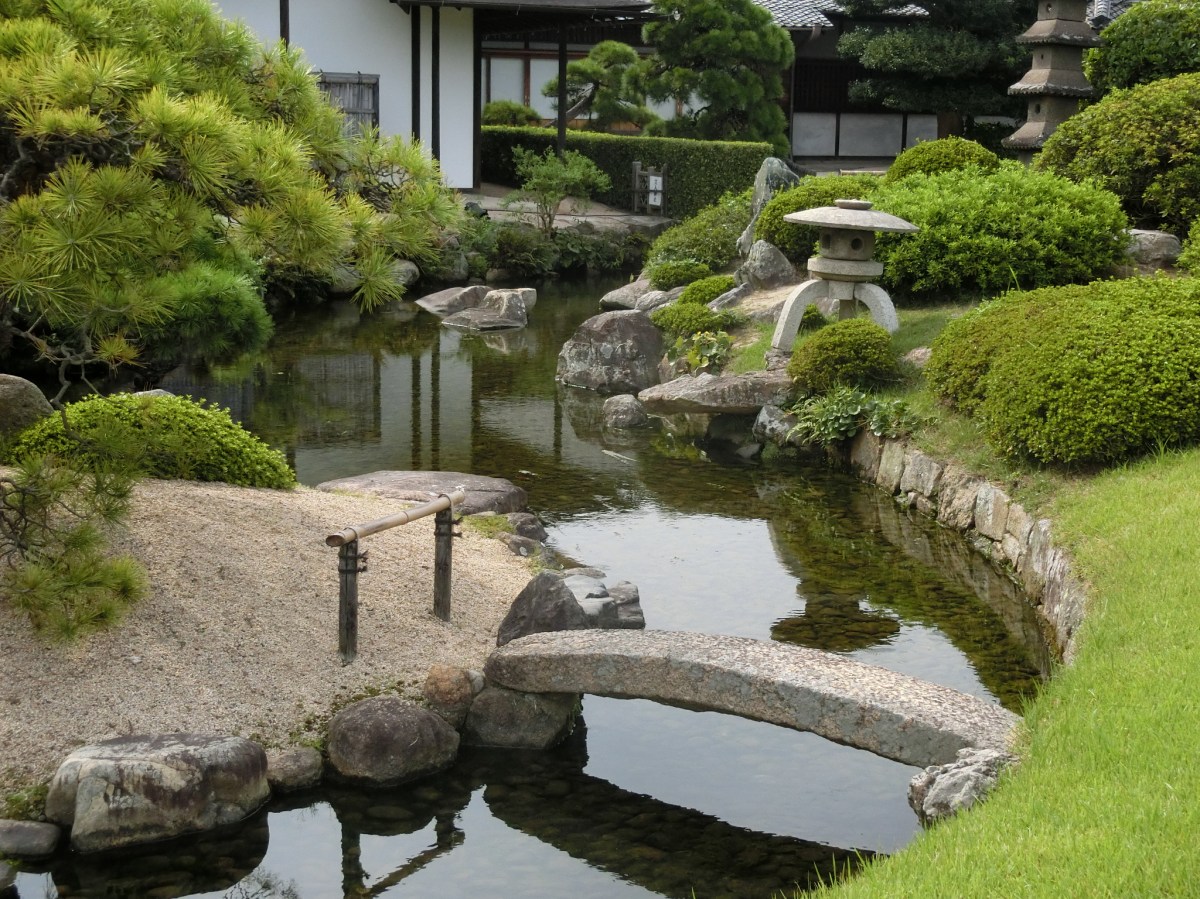
Japanese folks are fond of ranking things, and the Korakuen Garden in Okayama is ranked as one of the three most beautiful in Japan (I am not sure by whom). Since it’s only about a 30-minute walk from the train station, I decided to stop and see why it was rated so highly. Of course summer is not the best time to see Japanese gardens – probably the worst of the four possible seasonal choices in fact, but one has to take the chances offered.

The garden has lots of lawn (which very green at present), and of course lots of rocks and lots of water, typical of many traditional Japanese gardens. (The photo at the top reinforces this suggestion.) It was first opened in the year 1700, when it was used by the local nobility, but has been open to the public since the  1880s. It seems that it hasn’t changed much down the ages, and was a lovely place to wander around (despite the heat). There were some surprising features of the garden, as well as the traditional green, rocks and water, as shown in the images below.

The garden has a few small orchards (a cherry orchard for the cherry blossom season, e.g.), but I was surprised to find a tea plantation. I was also a little puzzled by the bamboo decorations on some lawns – possibly for a night time display? I was pleased to see the bird sitting serenely on a perch … always a god sign that a garden has fitted into the local environment.

As well as tea and fruit, the garden had a rice plantation. Rice is very important in Japan, and Japanese people are pretty fussy about their rice. (Some Australian rice is sold in japan, I think, but mostly it isn’t, as it doesn’t satisfy the Japanese expectations. I’ve not checked this claim recently … hope it’s not Fake News!) The crop is getting ready to harvest soon, I think, as the blown-up images suggests:

The garden had some nice walks, some of them through small forests and up and down small hills. It got me thinking that it would be very difficult for someone to navigate the paths with a wheelchair, despite their attractiveness:

Next to the garden was Osaka Castle, which looked splendid – at least from a distance:

Japanese castles were built by feudal lords in the old days, but few of them remain in their original condition unfortunately. Okayama Castle was completed in the sixteenth century, and is adjacent to the Karakuen Garden. It was destroyed in an air raid just before the end of the second world war, however, so that today’s version is a concrete facsimile built in the 1960s. Nonetheless, it looked splendid from a distance. I took a closer look, climbing to the top, which gave a good view of the golden roof objects.

CIMG6644

These were gleaming in the sunshine and looked even more impressive up close than they did from a distance.
I had not realised from below hat they were fish-like creatures, and they certainly made a good contrast with the dark tiles.

The castle is sometimes known as the ‘Black Castle’ because of its external colouring (although it looked more like grey than black to me).


CIMG6652


Most, but not all, the people I saw today appeared to be Japanese, some fairly clearly so, such as this couple below heading up the hill to the castle.


Walking back to the train station to resume my journey was interesting too. I was impressed with the street markings, effectively giving a separate lane to pedestrians and to cyclists going in each of the two directions. Pedestrians get their own zebra crossing, too. We often have problems with cyclists and pedestrians sharing footpaths in Perth, although this solution requires a rather wide footpath! Speaking of cyclists, I was intrigued by the sign (which I may be misreading), suggesting that bicycles cannot be parked here.

These signs might be good ideas, but I saw many examples of people not adhering to the commands, with the bicycles parked above a spectacular example, and the bicycles riding the wrong direction a less spectacular one. Japanese folks are very law-abiding (e.g., wait for a pedestrian light to turn green before crossing, unlike, say, residents of Manhattan), so these breaches were a surprise to me.

I also liked the little manhole covers (if that’s what they are):

CIMG6662

All in all, a pleasant break of my journey, before heading to Kurashiki, just a few kilometres down the road (or down the rails in my case).


Strolling around Yanaka

Many parts of Tokyo have been rebuilt since World War II, following extensive damage and also with the rise of Japan as a modern industrial country. But some parts of old Tokyo remain, where you can get a sense of the pace and nature of life in the first half of the twentieth century. One of the best of these is Yanaka, where I took a leisurely stroll for a few hours. Yanaka is adjacent to Ueno and close to Asakusa, both of which reflect traditional Japanese culture.

The pace of life in Yanaka is slow, with bicycles and walking both popular forms of transport and with streetscapes that look very different from areas like the skyscraper district of West Shinjuku, from which I am writing this. The area has many small temples, but also many residents, and I found strolling around the small streets to be the best way to wander around. There are small shops, too, like the one above, in which the shopkeepers live above the shop. I liked the way people decorated their front doors, with flower pots often featuring prominently. In some cases, however, front doors just somehow looked picturesque. In fact, as it is summer time now, there are lots of flowers evident around the streets of Yanaka.
The most striking thing about Yanaka for me was the large number of small (and some not-so-small) temples in the area. Many of these showed lovely craftsmanship and had beautiful gardens around them, so it is not surprising that Yanaka has been called  the “town of temples and slopes”, and in 2007 was apparently named as “One of the Top 100 Historical Views of Beautiful Japan”. Most of these are described only in Japanese, so I am struggling to name them, but the selection of pictures here shows some lovely traditional Japanese temple architecture, with extensive use of wood, tiled roofs and gardens of rock and greenery.

The little wooden tiles (called ’ema’) are for people to write down their wishes and leave them at the temple, in the hope that they will be fulfilled by the relevant deities, and are common throughout Japan.

Temples also have statues prominently displayed (usually outside in the garden), and there were some lovely examples around the temples in Yanaka. I especially liked the large seated Buddha, very similar to (but much smaller than) the famous seated Buddha at Kamikura, just out of Tokyo.

There were also other statues around, such as the following two. The seated man was perched high on top of the Asakura Museum of Sculpture while the smaller statue of an interesting – almost comical – rock amused me, and was located in a small park I passed by.

I saw many examples of lovely trees, often around temples. Some of them had clearly been manicured and carefully shaped, to beautiful effect. (Somehow, they seemed to fit the stereotype of Japanese garden trees, in fact!) Because it’s summer, everything is very green; I tried to imagine what it would look like in winter, especially with snow falling on them. Here are a few examples, including some nice bamboos (which were much less common).

Temples often have cemeteries associated with them and I was struck by how different these seemed from the various ‘western’ cemeteries and graveyards I have seen. Some of them looked relatively new, but maybe they were just well-cared for (like the temples themselves). The large Yanaka Cemetery (with the big trees) is different from the smaller cemeteries around temples. I was not quite sure of the significance of the wooden plaques (about the size of skis) which were often evident. Maybe a Japanese person can enlighten us?

Cemeteries notwithstanding, the pace of life is definitely slow around much of Yanaka, with very little motorised traffic and a mixture of pedestrians and bicycles. Unlike my experiences in Perth, none of the bicycles went fast; they are built for comfort and efficient transportation of goods and children, and seemed to move at a leisurely pace. They were clearly used for shopping, ferrying children around or just going visiting a friend rather than racing along in lycra in a peloton. In Australia, it’s pretty common to build suburban houses with two-car garages, so I was a bit surprised to see the six-bicycle garage shown below.

Unlike other parts of Tokyo, the electrical system in places (especially busier places) seemed to be a chaotic bunch of wires, reminding me of similar things in South-east Asia, such as in Bangkok or Hanoi. I tried (but failed) to imagine what it would be like to undertake routine maintenance of the wires. Here are a few examples:

There are many small shops, cafes, restaurants etc around the streets of Yanaka, many of them quite picturesque. For example, the old coffee shop below has only a few tables inside – notice the benches outside for waiting customers to sit (extremely common in urban areas in Japan). The last two people on the bench were allowed inside just after I took this photo, and I was too impatient to wait until someone left to go in myself, but it looked like an authentic place inside. The Indian restaurant is a timely reminder of the extraordinary ethnic diversity of foods here; if you can imagine it, there is a restaurant serving it somewhere. [Just down the road from here was a restaurant proclaiming that it was serving “Turkish, Persian and Uzbekistan cuisine”!]

There were very many other signs of old Japan around the streets of Yanaka, and lots of old shops, but there are also signs of more recent Japanese life. A few snaps below show some examples, with iconic Japanese scenes, including some sake barrels, one of the ubiquitous slot machines (there must surely be millions of these in Tokyo!) and a modern looking izakaya (pub) on the corner (or maybe a restaurant … with seats for a queue outside). The insides of a couple of shops in Yanaka Ginza (a local shopping area) show an interesting shop devoted to cat paraphernalia and another selling strange cat-like objects; quirky things like that are pretty common in Tokyo.

Finally, I became intrigued by, but have not yet unravelled, some of the interesting street markings I saw in my travels. They seem to be sewer manhole covers or otherwise connected with plumbing systems; I’m really not sure. But they reminded me that it pays to look down as well as up and ahead when strolling around somewhere new:

In all, I thoroughly enjoyed my stroll around Yanaka, got lost regularly, took heaps of pictures (of which these are just a small sample) and was pleased to have been able to let time pass by in old Tokyo, before heading back to the madness of peak-hour trains and the skyscraper world of Shinjuku.

A night in a Tokyo capsule hotel

Capsule hotels began around 30 years ago in Japan, mostly as a way of providing salarymen (businessmen in offices) who had been out having a few drinks after work a way of spending the night in the city and going back to work in the morning. The trains stop fairly early (around midnight) and taxis are very expensive – even more so in the wee small hours – and in addition, men might be either too embarrassed or too drunk to go home. [Since then, there are also capsule hotels that include women and there are other categories of people who stay in them, including the homeless and even (in my case) tourists]

They are called ‘capsule’ hotels, as the ‘bedroom’ is well described as a self-contained capsule, usually stacked in twos in a dormitory arrangement, as the picture above shows. I stayed in an upmarket version, right next to Shinjuku Station, very conveniently. It was my first time in a capsule hotel – but I suspect won’t be my last!

On arrival, before entering the hotel, I had to remove my shoes and replace them with slippers. I was reassured to find some English:


Inside, I had also to remove my clothes and replace them with brown ‘pyjamas’ (which were all one ample size!) Everything was securely stored in lockers, and I was given my (‘deluxe’) capsule key. Staff spoke enough English to deal with a newcomer like me, and even had a sheet of instructions for first-timers, which was helpful.

After a day’s travel, I was looking forward to a bath, and chose this hotel in part because it offered good facilities. In case you are unfamiliar with them, Japanese baths are communal, and you need to thoroughly (very thoroughly, it seemed to me, as some of my

wash
Washroom for communal washing before bath

companions spent a long time doing that!) wash yourself before getting in the bath. (The bath is for soaking in after you are clean … it’s unthinkable and very bad manners to use a bath to wash in.) Of course, I didn’t take photos (for obvious reasons!), but the two photos here are from the hotel website, showing the cleaning bays and the hot spa bath. The cleaning bays I used didn’t have chairs, but had tiny stools, which were tricky to get down to, but I managed! Everything was provided in abundance: soaps, shampoo, conditioner, razors, etc.

bath
Lovely hot spa bath

The bath itself was wonderful … just what I needed after a day travelling! I was surprised to see some of my fellow bathers with a small towel on their head, until I realised that there was nowhere else to store it … for getting partly dry when you get out, and before using a real towel. there was also a sauna available.


Then I headed off to my capsule. I chose a top bunk (with advice from a friend), which involved scaling the steps. My locker key allowed me to enter the dormitory, but the shutter in front cannot be locked (by law).

I had ample room and a comfortable bed in an air-conditioned space. I could reach the ceiling (but only just), and had a TV set (with Japanese stations), a choice of videos to watch (I didn’t) and even a little tablet for getting help and advice if needed. And of course wifi everywhere. I very rarely try to reach the ceiling at home, so it didn’t bother me that it was close!
 

There were lots of signs and advice in English (perhaps because I chose an upmarket version?), but I think the sign in the (communal) toilet telling me about the hook was a little excessive.

I had been warned that the hotel would be very noisy with people snoring, full of drunks, etc … none of which was the case. [Earplugs were supplied, but I didn’t use them. Maybe I was lucky or was already asleep before the noisy people arrived?] There were strict prohibitions about talking on phones, playing music, listening to TV (there were headphones instead), so the experience was very quiet and I had no trouble sleeping at all.

In the morning, thoroughly rested, I washed and shaved in the very nice facilities available, and then had another bath, which was just as pleasant as the first one, and availed myself of free ‘breakfast’, which consisted of some nice buns and lots of free drinks (teas, coffees, soft drinks, water, etc.) I could also have bought other things from several coin in the slot machines, but chose to not do so. [There was a beer slot machine I could have used the previous night too in our communal area.] Several of my fellow travellers were at breakfast at the same time, all dressed like monks, and nobody talking (maybe Trappist monks?). Everyone was using their device, of course … it is 2017, after all, and the wifi was very good. Several of them were reading the manga (Japanese comics), which were provided in abundance.

The verdict? A terrific experience. The hotel was spotless throughout. The staff were very helpful. I had everything I needed for a comfortable night’s sleep. I was safe. It was much less expensive than a hotel. My belongings were safe, once I mastered the succession of keys and lockers etc. The hotel had lots of other nice features (e.g. a laundry) and is part of a chain. You can find out more here if you are interested.

Would I do it again? Certainly!