Santiago museums and suburbs

Most museums are closed on Mondays, so I decided to visit two recommended places on Sunday, as well as travelling out of the city a bit to the suburbs to see how the other half live.

The Chilean Museum of Pre-Columbian art is a fantastic collection, and in my view so far the best museum in Santiago. The world changed when Christopher Columbus brought European colonialism to Latin America, but there was a lot of interesting activity before he arrived. The museum is not only about Chile but about Latin America more broadly, and I enjoyed exploring it. I knew about, but had not previously seen a quipu, the large collection of knotted pieces of string used to record extensive information, and I enjoyed lots of material on tapestries, textiles and weaving.

There were also lots of wonderful pottery examples, and I even got used to AC being the abbreviation for what we in the English-speaking world call BC. I was intrigued by the many geometrical designs and nice symmetries evident, long before the Europeans arrived, as the typical examples below suggest. I also enjoyed an interactive section of the museum (for kids), amongst which was an interesting area to explore the many different images of Chileans, to help kids see themselves in it all.

I was interested to learn, too, that early Chilean communities saw familiar objects in the sky, just as early Europeans did. But instead of going the stars up with lines to make objects, they saw the objects in between the stars! Now that’s a cultural difference!

After leaving the museum, I noticed a dog-walker, apparently necessary as there are very many dogs in Santiago. I also saw some impressive neoclassical buildings downtown, such as those below, showing the strong European influence on high architecture here, slightly ironically next door to the pre-Colombian museum.

But I was off to the suburbs, away from the centre of the city, firstly in quest of a Museum de la Moda (a museum of fashion) but then to go further afield. The museum took some finding (mostly as my Lonely Planet Guide directed me to a bus service who’s number has changed!), but I eventually managed through a mixture of helpful locals and my ever-trustworthy Ulmon app on the iPhone. I gave up on the bus and walked, which was more interesting anyway.

The museum in a well-to-do suburb has a large collection, but only a small part is ever on display. On this occasion, there was an exhibition on Princess Diana, including a replica of her wedding gown, movies of the wedding and several original versions of her outfits. I was intrigued to see this as a topic so far away from Great Britain, but I guess she was always a fashion icon.

The museum itself was beautifully laid out, in  lovely garden setting, and had many lovely things in it, apart from the Diana exhibition, including some lovely local designs shown above and some beautiful interior decorations:

It even had some interesting and stylish cars, and I discovered by accident that I was one of the few people in Santiago that did not recognise one of them as the car from Back to the Future. I couldn’t figure out why other visitors were so interested in it, which is slightly embarrassing (but only slightly), and had to ask the lady at the reception desk (who was also surprised that it was necessary for me to ask). In fairness, there was no sign attached to it (presumably because someone thought it unnecessary?).

Frankly, I preferred the other car, a wonderful old Ford, anyway!

It was clear to me, wandering in the suburbs, that there is another world out there, far removed from the world of central Santiago. It’s a middle-class (and above) world, with new apartment buildings, lovely suburban streets, lots of greenery, lovely parks and boulevards, up-market shopping, fancy cars, flash restaurants, heavy domestic security and not much graffiti. Certainly where the other half (or some other fraction) live. The metro isn’t convenient to get there (as most people have cars, I guess), so I did a fair bit of walking, all of which was quite pleasant. But I did not come to Chile to visit middle-class suburbia. There’s no shortage of that at home; indeed, I even inhabit one myself.


It all got me wondering about the divisions in Chile, as it already looks to me to be a big gap between the haves and the have nots, no doubt also between urban and rural people, and between the Indigenous people and those more European. I wonder how all this played out in the military takeover in 1973, when arch-conservative Augusto Pinochet ousted the socialist President Salvador Allende (maybe with some gentle support from the CIA?). I wonder who was on whose side? And ho did the people in these suburbs fare? Way too early for me to tell, of course, and naturally it’s all very complicated, but it was hard not to wonder about it.

I went in search of the Bicentennial Park, which was a large and lovely space, full of families enjoying a Sunday in Spring, in full view of the nearby Andes. Football, bicycles and dogs were all prominent, but the most striking thing was the family picnics. Family is clearly very important in Chile, unsurprisingly.

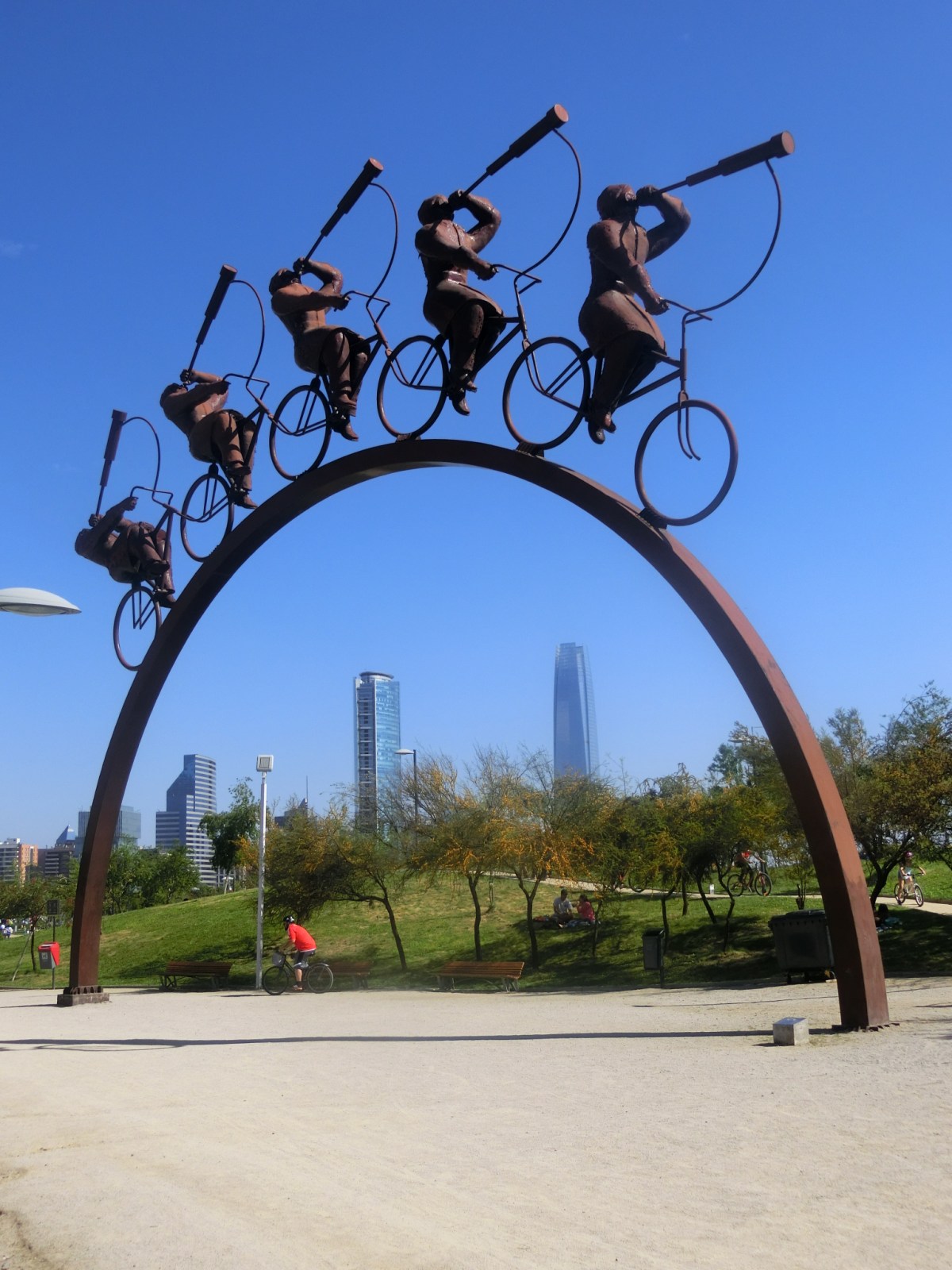
I especially liked this spectacular sculpture in the park, and took lots of photos of it from various angles. One of them is shown at the top of this blog, with the newer buildings in the background. here is a second version:

CIMG1730

There were some nice flowers around, too, one of which looked to me like wattle:

I had seen a sign in my travels in suburbia (looking for the museum) regarding an exhibition of Salvador Dali photographs and determined to find the exhibition before it closed. This proved a little challenging, as I had only a little information to go on (the sign!), but not impossible; after several conversations, my trusty Ulmon app, a bus trip and a bit of walking, I found it. Getting lost is always part of the fun of travelling, I kept reminding myself.

The exhibition was very interesting, a large collection of mostly black and white photos of Dali and friends. A very quirky chap, as were some of the photos!

Finally, I decided to go to the end of the metro line in this part of Santiago, to Los Domenicos. This was slightly tricky as there was no metro station anywhere nearby, and my Ulmon was struggling to locate one, but the security guard at the exhibition helped me to locate a bus (which I would never have found by myself) that took me there. (The bip! card, as it is called, for public transport I bought a few days ago has been very useful, as it works for buses as well as metros, as in Perth.)

Los Domenicos is almost in the Andean foothills, so I enjoyed being so close to the mountains. Again, there was a large park with lots of families enjoying each others company. Not just families, but also lots of courting couples (as there is very little privacy in Chile, with people staying home until quite late in life, I gather … 30 years and beyond?).

There was a touristy area (but for locals, it seemed) with a few cafes and some caged birds and souvenir craft shops near the church you can see above. I even managed to get some snapshots of a couple of interesting birds, as well as some traditional scenes (you’ll need to click the pictures to see them properly). One of the displays came from the island of Chiloe, which I may visit when further south towards the end of my trip.

As the sun was beginning to wane (although it’s daylight saving time here, so it doesn’t set until around 730, I headed for home. Some of the metro stations here have some interesting decorations inside, as you can see below, and I saw another street juggler just near my apartment when I got home. Maybe he only does this on Sundays?

I also saw the front of the shop from which I bought a can of beer last night … through the grill! – as they were presumably concerned about security. A stunning contrast to the world I left behind a little while ago in the suburbs!

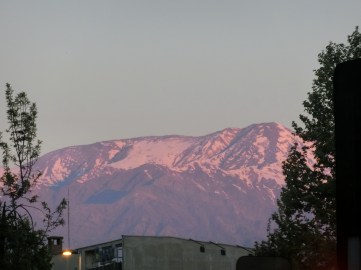
I also saw the sun setting on the Andes from just outside the same place, a stone’s throw from my apartment.
CIMG1822

Another lovely – albeit different – day ends in Santiago.

I am very lucky, I keep reminding myself.
Out and about in Santiago

I had a good day of wandering and wondering about daily life in Santiago, an easy city to stroll around and of course, as a visitor, a source of surprises and challenges. I’m pleased I decided to spend long enough here to relax and not have to hurry from one attraction to another.

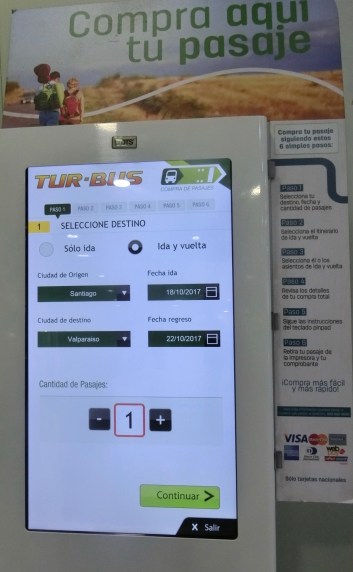
My day started with buying some bus tickets for the next legs of my journey in a few days’ time. I was pleased to find an automatic ticketing system, which was very good, at the large bus station; the machines were almost my height, too. Long-distance buses are very prominent here, and a good deal more affordable than air travel, if a lot longer. But I am in no hurry. I was very pleased with my self to be able to navigate my way right through ticket purchases (without even using my dictionary), but annoyed that the machine failed at the last step, refusing to accept my credit card! The joys of travelling … so I had to then repeat everything with a human operator, where the language barriers are more trying, and there is a queue of people waiting behind. [My card is fine, as I verified later … it was just the machine.]

CIMG1259

My AirBnB host (who has been absolutely delightful, despite our large language differences) told me that I could get into the museum for free before midday. Never one to pass up such a bargain, I checked it out and found an Andy Warhol exhibition showing. Most captions were in Spanish, but I can get by reading captions fairly well, so was pleased I had taken her advice. Hopefully you too can read the (very famous) quote below as well as recognise the two ladies.

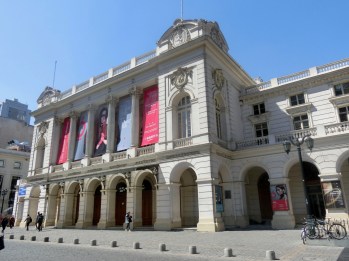
As it was a sort of getting organised day, I wandered to nearby Teatro Municipal, which houses the opera company, to see if I could get some cheap opera tickets while here. It’s a lovely building from the outside, reminding me a bit of the opera house in Budapest, but again I struck linguistic problems. The chap at the ticket desk seemed to be trying to tell me something about not coming to the opera tomorrow, but I didn’t understand it. We eventually (well, I eventually) decided to abandon the ticketing attempt temporarily.

CIMG1284

But I was interested in going, even if it was Shostakovich, partly because the opera was called Lady Macbeth del District Mtsensk, which I assumed was about a problematic Russian women with Lady Macbeth type symptoms – the usual cheery stuff of an opera! I did not expect it to be Shakespearean. So I returned and tried again, this time with my Google Translate app (which is brilliant), and was then passed to an English speaking person! Success! It turns out that the chap had been trying to tell me that the opera was being performed without sets or costumes, because there was a strike taking place! (That was too hard for the him and me to navigate linguistically when I am restricted to tourist Spanish). While disappointed – as the staging is part of the joy of opera – I got my ticket anyway and look forward to the event tomorrow, but now with a few misgivings.

Here are a few quick street snaps of things that caught my eye. The traffic here is pretty clogged at times, so deliveries are often done without delivery vans. I am intrigued to have seen several deliveries of toilet paper; I’m not sure why I am intrigued, but I have seen several of these so far, and I don’t think I’ve ever seen any at all before anywhere! Happenstance, perhaps? I was impressed with the avocado delivery man, too: also my first ever spotting of this process, maybe less surprising as avocados are pretty popular here. I couldn’t determine what transgression the motor cyclist had done to fall foul of the law, but the impressive Carabinieri de Chile were on the scene. They are always very smartly groomed, including with the guns and bullet-proof vests, so I intend keeping them on my side. They clearly earn the respect of locals, too. (You may have to click on the pictures to see detail.)

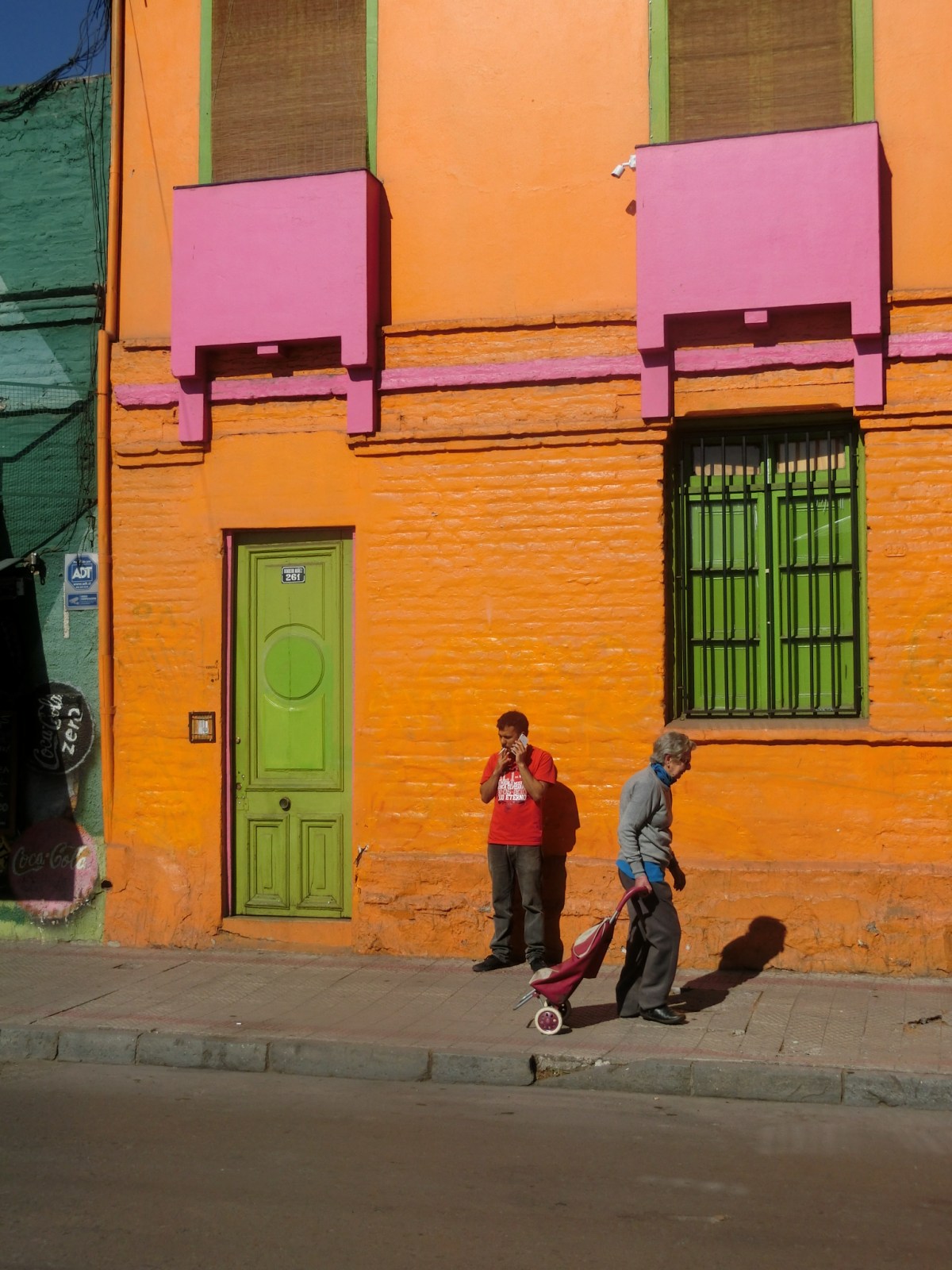
I had chosen to go up Cerro San Cristobal, a large hillside park in Barrio Bellavista, and enjoyed strolling the streets to get there. The picture at the top of this blog is of one of the many colourful scenes in this neighbourhood, the centre of nightlife in Santiago. Here are a couple more snaps of streets and other things:

The entrance to the park (via funicular railway, for those like me unwilling to ascend 800 metres or so on foot!) was of course tourist central, with llamas for kids to be photographed upon and lots of souvenir things. There is a zoo part way up, swimming pools and picnic places on top, etc and so this is a favourite family place for locals, not just for tourists. The line to buy tickets was very long, and hardly moving, so I decided to return earlier tomorrow. Mañana, as we say here in Chile (often).

I also visited the Santiago home of the esteemed poet, Pablo Neruda, which was nearby. Neruda was a very accomplished poet, being Chile’s second winner of the Nobel Prize for Literature, and one of only a handful of Spanish writers to achieve this fame. He had three houses (and wives, coincidentally), and built the eccentric house, La Chascona, in Santiago for his mistress, who later became his last wife for 25 years. (It’s complicated …). As well as being a poet, he was a diplomat, holding several foreign posts, so a really interesting chap. He died a few days after the military coup in 1973, perhaps precipitated by the awful events of the time. His burial service was one of the first public acts of resistance against the military regime, it seemed.

The house was a delight, helped by an English audioguide, but internal pictures were prohibited (unfortunately … it was a really quirky place and it was also my first look at a Nobel Prize, which was on display). The snaps below show one of the outside pictures of the (multi-level) house, some painters working on renovating the outside and a lovely new mosaic elsewhere in Bellavista showing a familiar portrait of the artist.

I decided to eat in Bellavista, which was overflowing with options. I chose a traditional Chilean dish called chorrillana, which would have been just fine had I brought along a few friends, as it was an enormous dish with French (or are they now Chilean?) fries, grilled meat, cheese, onion and egg. It was delicious, as was the beer, but way beyond my capacity. It is rare for me to not eat what is put in front of me – especially potatoes! – but I managed only about half. I did drink all of the beer, however. Lunch is the main meal here in Chile, although we tourists are accustomed to dinner being the main meal.

I am accustomed from previous adventures to see the large E sign for parking (standing for estacionamiento, or parking, which was close to my restaurant table on the street; this makes perfect sense as estacion means stationary and mientras means while, so the word means stationary for a while! Now try to make as much sense of the strange English term, ‘parking’ …!)

Leaving Bellavista, I crossed Santiago’s ‘river’, which would be put to shame by most other great rivers, including the Torrens, the Yarra and the mighty River Parrett in Bridgwater. As you can see, it flows very fast (making me wonder what was at the other end), but is struggling to reach its borders at the moment. certainly not Santiago’s most impressive sight. Much more interesting was the display by the two chaps shown here every time the traffic was stopped by the lights! They danced wonderfully to energetic music, attracting pennies from the stopped motorists. I loved it, even if the photo doesn’t do it justice. The other snap here is of the large Plaza Italia, which is next door to the theatre in which I am attending the ballet tonight and which gives a lovely view of the Andes.

I also popped into the large central market, where lots of fresh fish were sold, where there were also some posh restaurants (for tourists, it seemed). As I had already failed to eat my lunch, it was not time to try again – and the wrong place, anyway. In the centre of town I found lots of chess games going on – entirely a male affair, it seems, and also had my first encounters with the indigenous mapuche people, who had a small stall with some craft work. I’m expecting to se much more of them when I travel south.

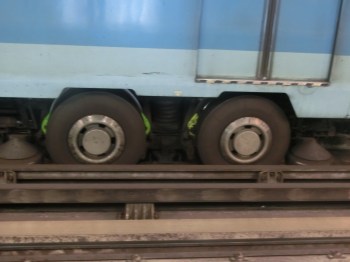
I have now become accomplished at travelling the metro, which is usually pretty crowded, but seems safe enough and is a good way of getting around efficiently when it’s too far to walk. I was very surprised to notice that the trains seem to run on tires, however. The train tracks are shiny, which suggests to me that the trains have normal metallic wheels, but I cannot see them anywhere! Very strange.

CIMG1306

It’s funny how you start to become accustomed to things after just a few days, and I am thoroughly enjoying the experience of wandering the streets of Santiago.

There are many things to do before I leave, also. Cerro San Cristobal, the opera, other parts of the city …


Climbing Cerro Santa Lucia

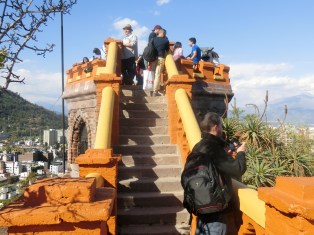
Cerro Santa Lucia is a small hill in the centre of Santiago that is a popular and pretty city park; it allows for good views of the city and the nearby Andes. So, even though my iPhone doesn’t register steps, I decided to climb it and see for myself. (‘Cerro’ is Spanish for hill.)

The buildings at the foot of the hill look distinctly neoclassical in style, and I even wondered if the statue of Neptune came from Rome somewhere. The palm trees gave it a tropical feel, too. I think the buildings were built a little over 100 years ago, although the hill itself was founded (if that makes sense) by city founder Pedro de Valvidia in 1541.

Although it’s only a small hill, there were lots of steps to climb, and many of them were quite slippery – a good thing it wasn’t raining or snowing. The views kept changing as I got higher, and the garden ambience was very pleasant, so it was all quite manageable.

The city buildings gradually emerged into view, some of them providing mirror-like reflections of views too. As well as buildings, I could also see Cerro San Cristobal, Santiago’s other main hill, which is a bit higher than Cerro Santa Lucia. (I’ll climb that one too before I leave.)

Near the top of the climb, there are some religious items, including a chapel and a statue of the first archbishop of Santiago. And lots of that beautiful blue sky, too!

Finally, the last set of steps appeared, leading to a small lookout on the top of the hill, with splendid views of the city and of the nearby Andes.

CIMG1192

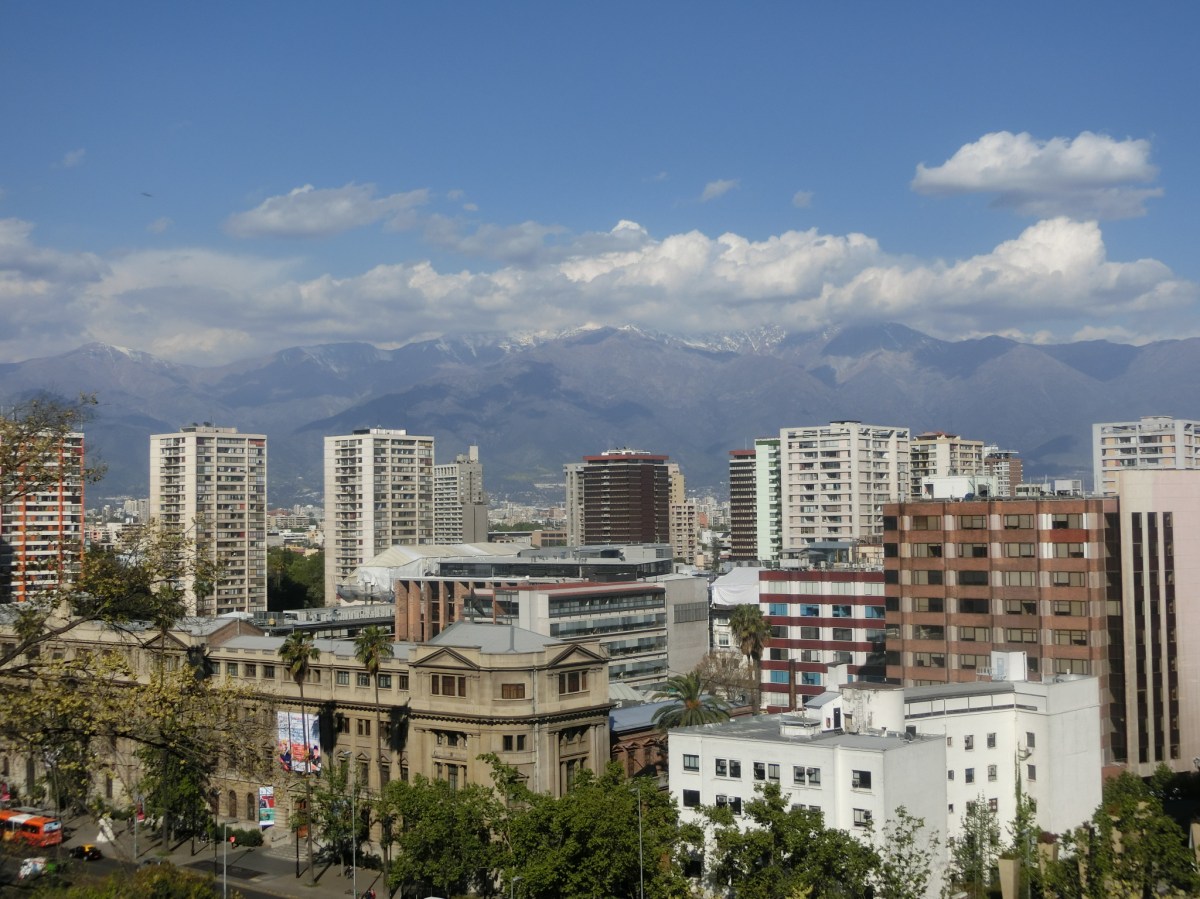
The photo at the top of this blog was taken from the top of the hill. Here are a few others of a similar kind, to show the spectacular nearby mountains. Still a bit of snow-capping, despite the warm spring weather (as the mountains are a good deal higher than the city).

There were lots of flowers around the park, such as these examples:

After my climb, I needed some nourishment, and so wandered nearby to nearby Barrio Lastarria, which was mostly centred around one street, but with lots of interesting walls and eating places. I saw these lovely murals, not yet graffitied, so obviously quite new (you may need to click on the photos to see them properly):

The largest of these murals was huge and is dedicated to Gabriela Mistral, the poet who was Chile’s first winner of the Nobel Prize for Literature. The other murals shown here were very cleverly done I thought, especially the one with the trolley bus – using part of the actual walls in the murals. The people in the street almost look to be part of them in fact.

I indulged in an ice-cream in Emporio La Rosa, which was described as one of the twenty five best ice-cream shops in the world. That seemed a good enough recommendation to give it a try. The ice-cream was OK, and I enjoyed it, but I did not think it was especially wonderful; maybe the other twenty four shops might be even better?

I also noticed a small movie theatre and indulged myself even more, as they were showing the recent film Loving Vincent, which is constructed entirely from hand-paintings in the style of Vincent van Gogh. We had a communication breakdown when I purchased my ticket, however, as the ticket seller was trying to get me to use the device shown below.

I thought at first that it was some kind of lucky dip, but eventually I realised that he was asking me (in fact, demanding of me) to choose my seat. Each little roll of paper had the associated seat number … a neat bit of low technology, once you understand it! Somewhere in the back of my mind I remembered the word pantalla for screen, fortunately, which was a pretty big clue to the whole thing.

And the film? It was wonderful, describing Vincent’s life (but mostly the events surrounding his untimely death). Hand-painted by a dedicated team of around 100 artists, certainly a new direction in film-making that I thoroughly enjoyed. It finished with the haunting song, Starry Starry Night, one of my favourites, too.

Another thoroughly enjoyable day in Santiago.


First impressions of Santiago

First impressions are always a bit risky, but having arrived in Santiago, Chile, after quite a long flight and limited sleep, I needed a stroll to stretch my legs and get a sense of where I was. So it was a pretty aimless stroll around downtown (ish), with some aimless snaps of things I don’t yet understand. But you have to start somewhere, I guess.

There’s always a few things to do when arriving somewhere new, such as finding an ATM (and checking that my cards work), getting a metro card, looking for easy landmarks to find my way home, working out which map to use, making sure the phone works, checking out food and beverage sources and local shops, getting a sense of language, etc. etc.

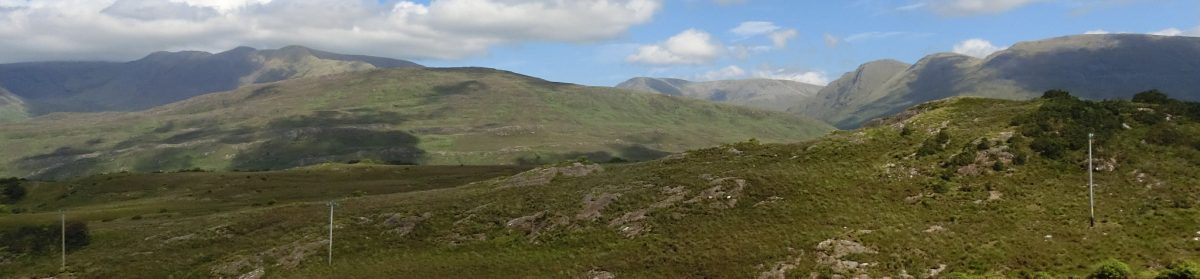
My very first impression was out the plane window as we descended, reminding me of how close to the Andes the city is – and indeed, all of Chile is. Even on the ground, in the bus to the city, the nearby mountains were evident.

I have had some trouble successfully arriving at places recently, so this time I was more careful with my planning and the bus I chose got me to my AirBnB without any problem. Except that I was anxious about luggage and, since nobody else seemed to put luggage under the bus, I assumed that it was insecure; when a nearby chap asked me something in Spanish I didn’t understand I kept moving in the line: in hindsight, he was probably offering to put my case underneath. So I took it on board and was embarrassed for the entry trip at being a self-indulgent tourist, taking up an extra seat for his case! I at least learned how important Spanish is going to be here!

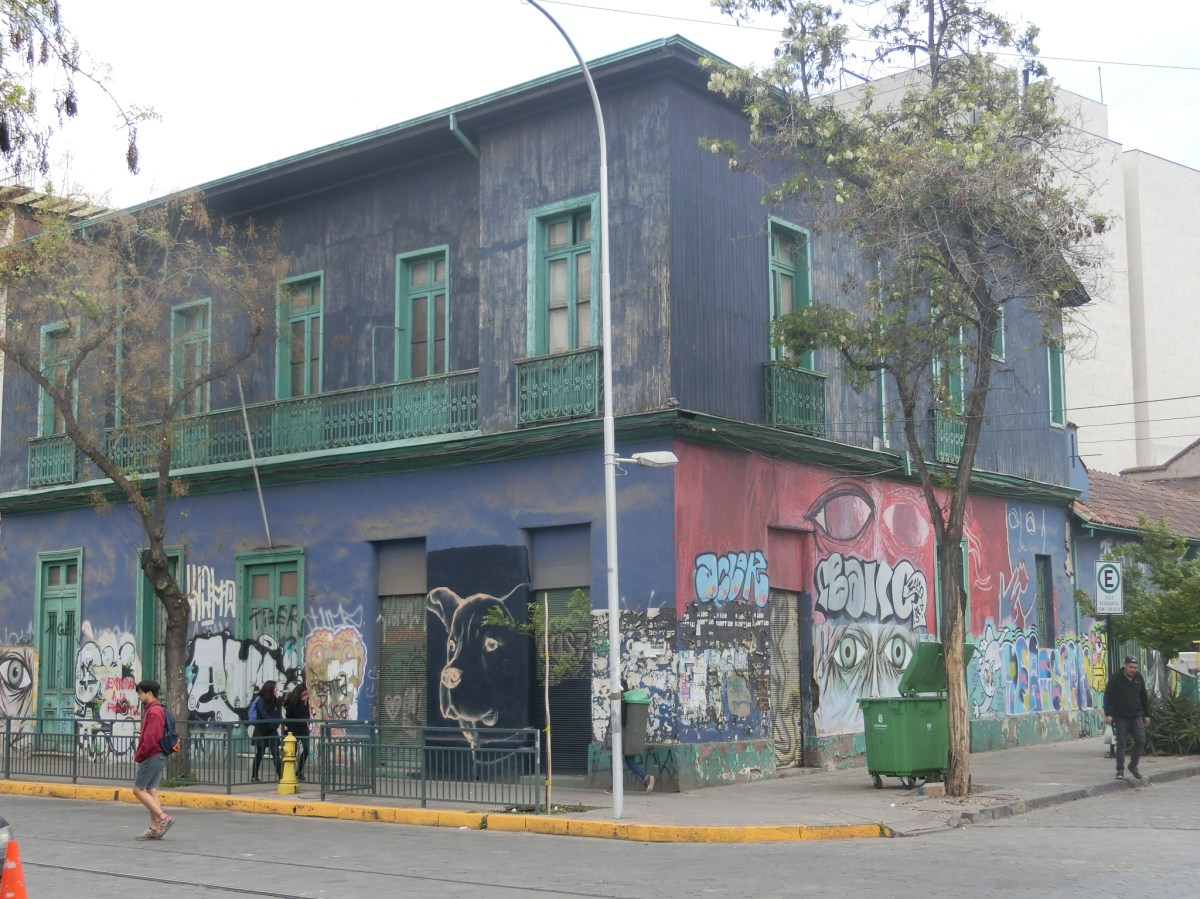
Strolling around the block in which I am living, I took the photo at the top, which technically counts as my first impression of actually living in Santiago. Some colours, some greenery, some graffiti, some people, … Feels a little edgy for the night, but feels perfectly safe for the daytime. Phew!

I bought a metro card and went a couple of stops to make sure I could do it, and came out near a palace, with police guards and lots of flags around. In the course of my stroll, I saw many flags, so Chileans (like many others) are fond of their flag. I’ll have to find out what it symbolises. I will also find out what he palace is later. I also saw lots of traffic along the Alameda (a main road through the city, called Liberatador Avenida Bernado O’Higgins, which sounds a little odd for a Chilean patriot, but I already had heard of him.

There were many police around town, not just at the palace, all very armed and conspicuous. I’ve never quite known whether seeing lots of police makes me feel safer (because I’m protected) or less safe (because people think I need protection). We’ll see. …

I also heard lots of music as I walked around; there was even a band on my short metro trip, reminding me of New York subway. (BTW, I also noticed that Chilean pedestrians have the same view as New Yorkers regarding traffic lights, regarding them as suggestive or adviser, but not coercive. When in Rome …) The chap below was on a stage in Constitution Square, behind the palace. I’m not sure what was being celebrated.

Buildings in this part of town had a distinctly European look, with many neoclassical examples, such as those below. It was also very clear that the church is important in Chile, with some large church buildings evident.

The cathedral above is prominent in the large Plaza de Armas, the historical and cultural heart of the city, while the reddish church above (whose name I’m not yet sure of) also looked lovely. I went into each of them briefly, and found typical Spanish churches, with many decorations, statues, pictures and not a lot of light (so it takes time for the eyes to adjust). The snapshots below give you an impression.

There is clearly a level of excitement being generated with the impending visit of the (Latin American) pope early next year.

The large corner building above is a fine arts museum, which I wandered briefly into. I was very impressed, as those of you who know me would understand, to find a large statue of a potato outside the building! This is clearly a very civilised country I am going to enjoy!

Around the museum there were some lovely green spaces … and indeed I saw lots of greenery on my stroll. I’m sure I’m going to enjoy walking around these sorts of places and it certainly didn’t feel unsafe to do so.

The Plaza de Armas itself was interesting to wander through, again just getting a first impression. It was large, with many seats, most of which were occupied. I could easily imagine lots of political events happening here over the years and was not too surprised to see a couple of events going on. One chap was giving an impassioned speech about something (again, my lack of Spanish fluency is a clear problem!), without having too many listeners, while the large circle of men was listening intently to a man in the middle. I was struck by the gender composition of it all: most of the people seated and most of the people at these two events were men. That may be an important first impression; who knows?

Around nearby streets, there was a hustle and bustle of commerce, with lots of people (not obviously tourist people, as I think it’s early in the season).

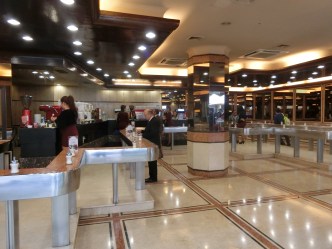
The little booths selling cigarettes, magazines, sweets, etc were reminiscent of many European cities and the street stalls reminded me of Asian cities as well. I saw lots of shoe-shiners, too. I was surprised to see the large stand-up coffee parlour below, however, as well as other stand-up places. I’ve not quite seen something like this before – at least as big as this one – although this was clearly not rush hour.

CIMG0964

One thing that was hard to miss as I wandered around was the amount of graffiti. Don’t misunderstand me: I think some graffiti is attractive and it’s a legitimate art form, but other graffiti just seems a bit senseless and damages, rather than improves, an environment. Sometimes, there’s a fine line between street art or wall art (murals) and graffiti, too. I’m expecting to see more, of course, so will reserve my judgement for now. It would also help to be more fluent in Spanish, of course.

I spotted many statues as I strolled around; the following two were along a park along the large Alameda. The statue of the heroes below is important for me, as I am living near the station called Los Heroes (which I have had to carefully re-learn how to say in Spanish, quite different from English!); I will have to find out who they are and why they are heroic, however. The Easter Island statue nearby was interesting too. I’m note sure why it is there (yet). So much to learn …

I passed the University of Chile, en route, with a large banner outside proclaiming support for a law to strengthen state universities, reminding me that the problems of Australian universities are not unique to Australia.

CIMG0971

It also reminded me both of the importance of having your say, and also of the need I have to improve my command of Spanish! No doubt over the coming days, I will improve my understanding of the problems of Chileans having their say over recent years and the reasons they needed to do that.

I’m looking forward to the adventure, and maybe of correcting some of my first impressions!

Singapore – green and clean

How lovely to stroll around Singapore, with its surprising greenery, and everywhere clean and tidy. Today I enjoyed a walk on Dempsey Hill, a large green area right next to the CBD and opposite the Singapore Botanic Gardens, where previous army barracks have been restored to create lots of eateries, shops, environments to enjoy. Especially nice to enjoy a walk with locals John and Gen, making it all interpretable.

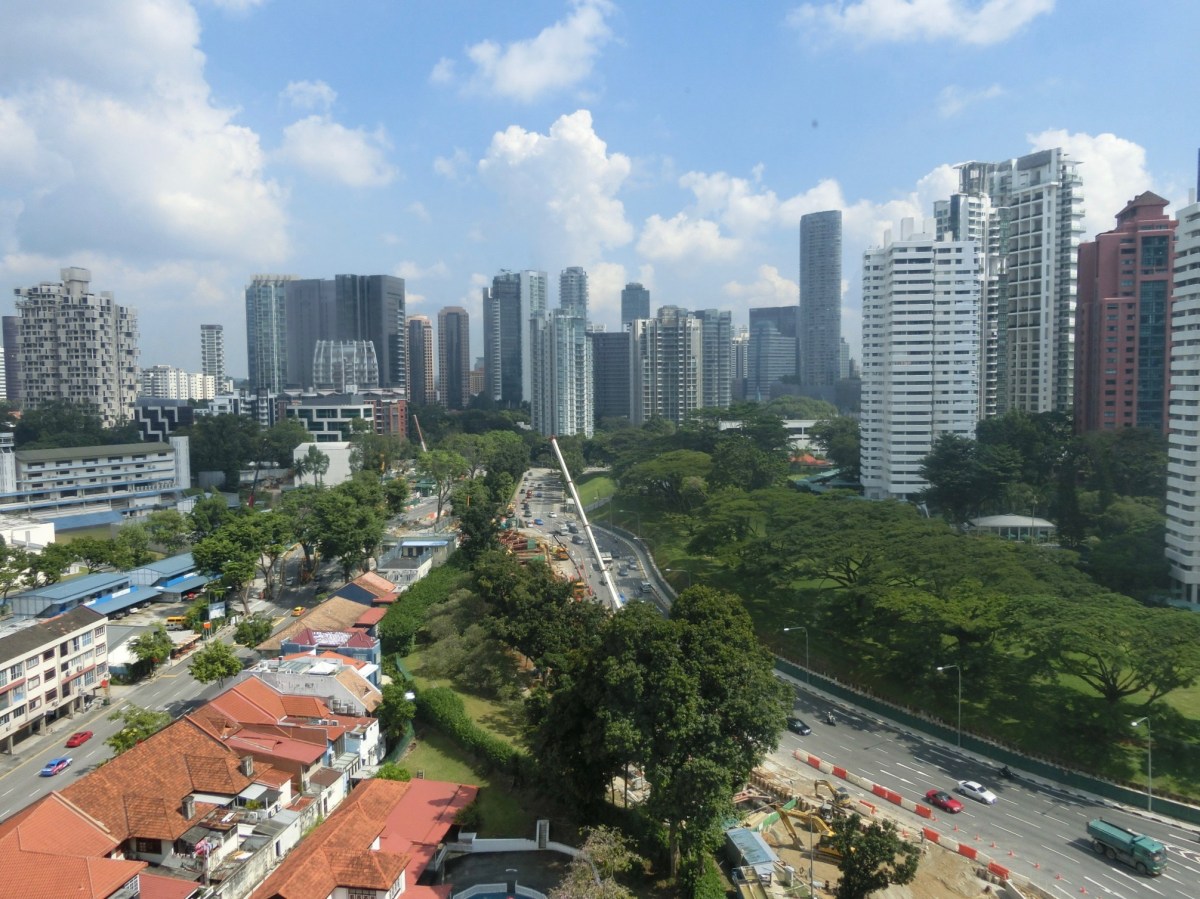
It was clear from the photo above that it was a splendid day for a morning walk. I always enjoy the greenery of Singapore and its orderliness, even when a massive new subway development is underway, as the picture above shows.

The trees and grass on Dempsey Hill all seem especially green and luxuriant, as you can see from the leaves below:

Some of the trees are huge, and many of them have alls sorts of plants growing on them – so many that it seems likely that they just landed there, rather than having to be cultivated:

Dempsey Hill used to contain many army barracks in a large green area. Miraculously, the green area is still there, and now the army barracks have been retained and renovated to be a popular spot, in its green surrounds. These relics of bygone days added to the ambience:

It is a huge area (apparently larger than  Perth’s Kings Park) and there are a lot of previous army barracks that have been renovated and are now popular food and beverage places, amidst other uses. Here are a couple of examples, showing high rooves and wide colonnades.

We popped into one of these,  Jones the Grocer shop, one of the previous barracks that has now been transformed into a very chic place with great coffee, cheese, food and ambience, as you can see below. The shop has enormously high ceilings … maybe they used to have two floors?

We even spotted the pavilion for the Singapore Cricket Club among our wandering, looking a little forlorn, but maybe waiting for the season to start. As a former British colony, and with a large Indian community, of course cricket is still a respected activity here, but I suspect it’s mostly played elsewhere now:

We also had a quick window shop in a very up-market butcher shop (Huber’s), mostly patronised by expats, it seems. It was a spectacular piece of butchery, with a small army of staff, neatly decked out in their uniforms, and a lovely place to wander for a little while. As you can see, however, shopping here is not for everyone: one of those places that, if you need to know the price, you shouldn’t be shopping there! The prices are on public display, however, and we chose to not invest in any of the Australian Wagyu beef, displayed on the sign below for $148 per kg (and so sensibly priced for every 100 g instead of every kg).

Speaking of signs, the life-sized cow sign outside the butchery, explaining the cuts of beef, was written in English, presumably because only English speakers shop there. But Singapore generally does a better job of catering to different languages and celebrates its multiculturalism, using it in part to promote its tourist industry.  We were especially impressed with the sign in five languages shown below, which we saw on first entering the Dempsey Hill area:

CIMG0771

Those who speak English, Malay, Chinese and Tamil get explicit advice, while any others can make do with the fifth language of a picture. They say that a picture is worth a thousand words, which seems to be a numerical overestimation in this case. We chose to not attempt to enter the protected place that had been fenced off.

Walking out of Dempsey Hill into the Orchard road area, we were still surrounded by lots of green-ness. The pedestrian crossing on the right goes over a busy road to the Singapore Botanic Gardens (Singapore’s UNESCO World Heritage Site) on the opposite side of the busy road.

Nearby, the Australian, British and US embassies were prominent, along with those of other countries. Singapore has certainly come a long way in a short time, and is well-connected politically, from its wonderful vantage point. As well as powerful political connections now, it also seems that many of the powerful people in Singapore’s history also lived around these parts of town in the past, and to some extent still do.

We were not far from the famed Orchard Road and were a little surprised to find that the  Christmas lights are already beginning to appear, with a motif of ‘Endless Wonder’. The Christmas lights on Orchard Road are an annual spectacle, but are not actually lit until early November (which is just a few weeks away), helping to maintain the status of this as one of the world’s great streets – especially for anyone interested in shopping (which seems to be the entire population of Singapore).

Orchard Road is always lovely to walk along, with some spectacular buildings and lots of greenery; of course it is all spotless, too.

There’s always some interesting new things too, rather like Changi Airport. At present, there is a range of huge sculptures on the footpath, as well as more fixed sculptures at places like hotels (the example above). I enjoyed seeing a nice Fernando Botero sculpture of a reclining woman outside one hotel, as well as a sculpture by a local imitator nearby. (I originally thought Botero was Brazilian, but in fact he is Colombian). I have seen at least one other of his large chunky bronzes in Singapore, so presumably some locals like his work as well.

The statue of the horseman up high reminded me of the Man of La Mancha, but may well have no connection with Don Quixote. I remember hearing once that someone claimed that cities with public works of art are much better places to live in; maybe it’s because there are people around willing and prepared to invest in public art, or perhaps there is tolerance for public funds to be spent on works of art; these kinds of things say something positive about a city. A few temporary (but huge) works by Manolo Valdes from Spain were on display along Orchard Road. (Click on them for a closer look).

While these might not appeal to all – I was less impressed by the butterfly heads than the needle head, for example – the very fact that they are there at all adds a bit of interest to the walk down Orchard Road. And next time I go, there will be different things …

Of course, there are always people around in Singapore, especially near shops and food. There were even people enjoying a cafe at street level, as shown below, reminiscent of Paris (but without the dogs!)

CIMG0869

In Singapore these days, you often see motorised pedestrians, too. There are many motorised scooters on footpaths, for example. The couple below on their Sedgways zoomed past me before I had time to photograph them, but I managed to capture the unicyclist as he sneered past. I was unable to resist The photo below, observing that, unlike we mere mortals, this new form of pedestrianisation still struggles with steps.

Walking in Singapore. Always feels safe, lots of green, always clean and always interesting.

If you find yourself here, make sure you go for a walk.

Popping into Phnom Penh

A very short visit to the Cambodian capital, the first time for about five or six years. There seems to have been lots of building going on, since I was last here, although there are still traces of the older Cambodian buildings.

There are also lots of reminders of the French colonial past, with balconies like these often visible. And modern Cambodia still uses US dollars for many transactions, as it has done for many years, a reminder of the world outside.

The new building is especially evident from up high, with lots of condos being constructed and some quite high buildings on the skyline, which I don’t remember on my last visit. Clearly a time of great change, much of it fuelled by foreign companies (especially Chinese?):

Lots more people live here in this rapidly expanding city of now almost two million people, and of course that means lots more traffic. The infrastructure is struggling to cope with the traffic, which was especially heavy at peak hours (mistakenly described as ‘rush’ hours, although everything moved at a snail’s pace … a slow snail.

Indeed, it was often hard to tell which side of the road traffic was on and which was the correct direction. Hard to find people moving in the same direction. The car I was lucky enough to be in had a very impressive camera that showed some of the traffic around and beeped regularly as it all got close to us, but there were no collisions that I saw.

CIMG0689

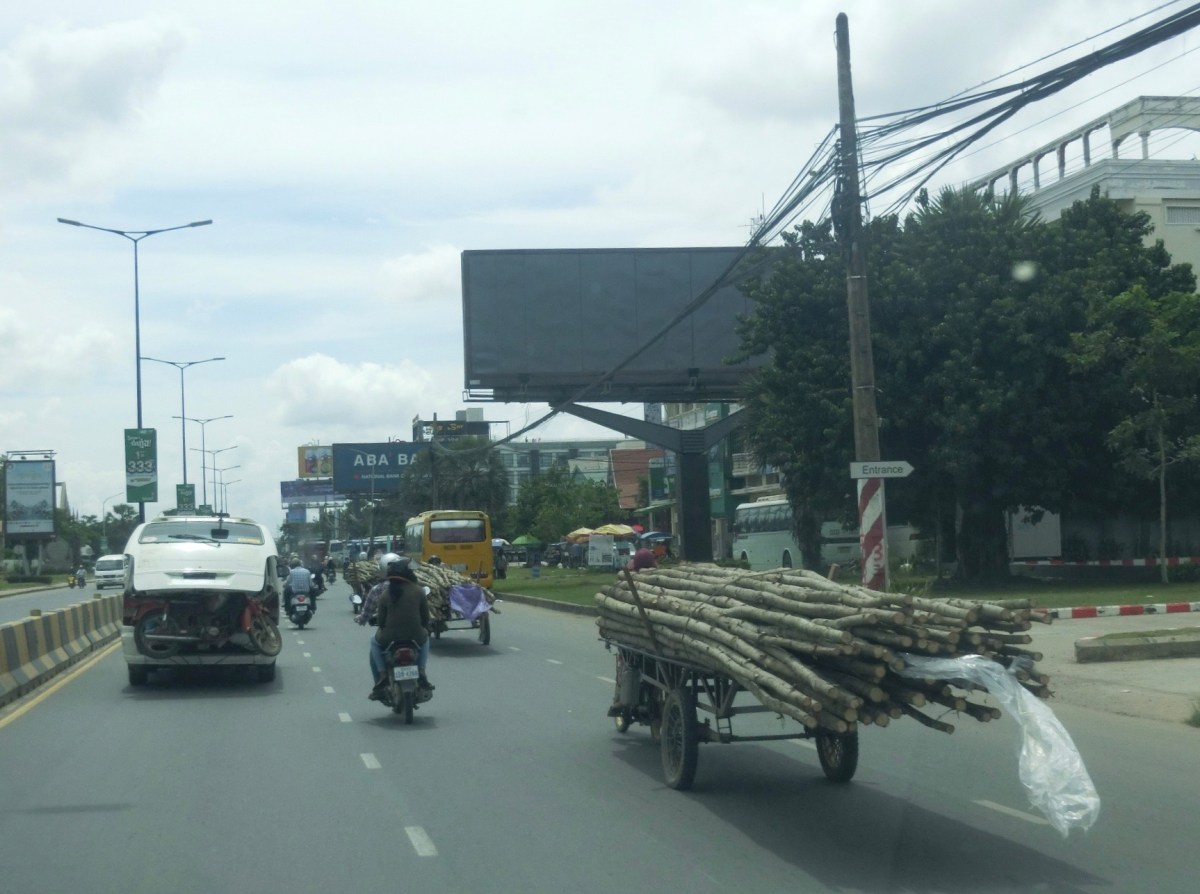
Traveling on the roads in Phnom Penh was always interesting, with lots of life taking place on the side of the road and lots of interesting traffic on the road, even when there was no traffic jam. The picture at the top of this blog is but one example. Click on the pictures below for a closer look. (All photos taken from inside a car, and so rather defective, but they capture the ambience, I hope).

It struck me that people managed to get along with each other very well, despite the awful traffic conditions. It all depends on cooperation between drivers, and not mechanised by road rules, traffic lights and policemen, as it is in my country. Somehow, it seems safer, strangely enough, and not only because of the slow pace of the traffic. There seems to be a lot of mutual respect on the road, tolerance for people going the wrong way, doing U-turns in unbelievable situations, etc.

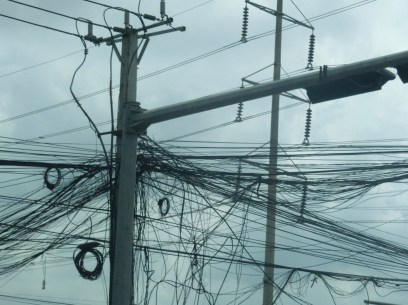
I’m always amazed to see the electrical systems in countries like Cambodia, making me pleased that I’m not a linesman looking for the other end of a wire!

CIMG0752

The Cambodian people I met – mostly mathematics teachers – were delightful, friendly and welcoming. So my short visit was also very pleasant.


Navigating subways to Happo-en

As I had a spare morning, I decided to go by subway from my hotel in Shinjuku to Happo-en, with its delightful garden. Subway travel can look daunting at first, but is remarkably easy because of all the signage.

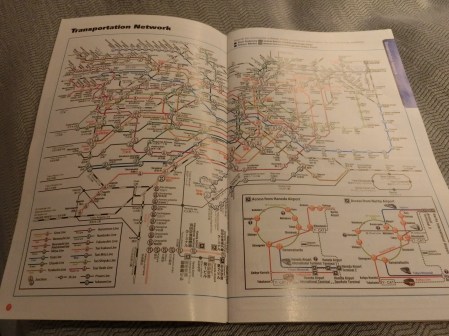
Whether you look at a map book, as shown below, or at an automatic ticket machine area, as shown at the top of this blog, it can at first look a bit daunting to foreigners, especially those like me who come from a city with only a few train lines. But the basic navigational skills relevant to many other world cities work in Tokyo as well, and, indeed, the system is planned well to make it easier than in many other places.

CIMG0609

It’s much easier than it might at first seem. These days, many of the ticket machines have an English button, and you can avoid the machines altogether by using a pre-purchased card, which lets you in and out of stations, deducting the fare automatically from the stored balance. To see where to go, a closer look at a map shows that you can even avoid trying to read the writing, but just read the numbers:


In this case, my subway station under my hotel is Tochomae (number E-27 on the Oedo Line), and the guide book advised me that the Happo-en is at Shirokanedai (number N-02 on the Namboku Line). Following the coloured line shows me that I needed to change lines at Azabu-juban (Number E-22 and N-04). It is much easier to follow the numbers than the names! Mathematics to the rescue again! E-22 is five stops from E-27 and then N-02 is two stops from N-04. Easy!

Along the way, trains usually offer some form of information regarding where you are, what the next station is, which lines you can change to at the next station, etc. Much of this is in Japanese, but there is some English announcement and often good signage. As an especially good example, the Oedo train showed in real time at each station (inside the carriage) what to expect when you got off!

CIMG0458

I’m in carriage 6, as we arrive at Kokuritsu-Kyogijo (or E-24 for short!). There will be stairs and an escalator where I get off, or a lift to the left opposite carriage 5 or further stairs and escalators at carriage 3. Brilliant! (especially if you’re carrying luggage).

Once you get off the train, There are usually maps and signs in abundance, telling you how to get to many places. In this case, there were many signs directing me to the Namboku line I needed to change to (tap the images to see the whole sign):


Some of the connections between lines are a fair distance apart in reality, as well as some levels apart, even if contiguous on the printed map, so you can even get a bit of exercise transferring! But you’re unlikely to get lost.

It’s not hard to get lost if you leave the station via the wrong exit, however, so it’s worth paying attention to the maps showing local features and advising which exit to use. In this case, it was easy enough to find Happo-en required Exit 1, and as soon as I left the station and surfaced in the street, there was another map to follow, as shown below. All very helpful to people unfamiliar with the area:


In this case, there are only two exits – so only one way of getting it wrong – but some stations have many more than that. There are many other signs in stations allowing you to find your way to particular attractions and exits without too much problem. All remarkably easier than you might think, in fact.

I was rather surprised to see that the crosswalk to Happo-en, not far from the station, had a crosswalk attendant, who sprung into action as soon as the walk light turned green. Unlike, say, New Yorkers, Tokyo citizens wait for the light to turn green before walking and the cars all stop for pedestrians (unlike, say, Beijing drivers), so it was not clear to me why this chap was needed at all, but he did his job with great diligence, and I crossed the street without incident:


What is Happo-en? It’s a delightful garden of about 30 000 square metres, hidden near Shinagawa in Tokyo. It’s about 300 years old and is a lovely place, with many attached dining options, so is a popular place for functions, like banquets, weddings, etc. I had not heard of it until the previous night, when I was lucky enough to attend a nice dinner there. I returned in the day time because it was hard to see the garden properly in the night.

I was pleased I came back, as the garden was truly lovely and very green:


Like many Japanese gardens, there were some lovely lanterns and some nice water features, in this case including even some waterfalls:


Interestingly, the Happo-en garden included a lovely collection of Bonsai trees, some of them more than 500 years old (i.e., older than the garden itself). [I was concerned that all of the ages ended in 0, suggesting to me that they were incorrect, and making me want to return next year to see if they were all increased by a year … So I was a bit skeptical about the ages shown.] Here are a couple of Bonsai examples:


While I saw some of these features at night, they were much better in the daylight. My dinner last night was delightful, showing again how much attention is paid to presentation of food in Japan. We had a succession of courses, all of which were delicious:


While in the area, I decided to further test out my navigational skills to find Sengakuji Temple, which was nearby (according to maps and guidebook). This proved to be a bit trickier than navigating the subway. I found myself walking through small lanes with relatively few signs to help. Japanese addresses and street signs are rarely of much help, in fact, unlike my own country, where they are a reliable guide.


To my surprise, however, I rounded a corner and there was the temple, with no earlier signs warning of its impending arrival!


It was a nice little temple, and I knew almost nothing about it until I arrived. It turns out to be quite famous as the burial site of the forty-seven Ronin (a set of Samurai who were loyal to their master and exacted revenge on a Feudal Lord who was responsible for his death by suicide). The story was even made into a film recently – unbeknownst to me.


The Buddhist temple revered one of its famous monks, shown here, and had some lovely plants. (The images above show one example, together with a blown-up version to see the detail.)

The forty-seven Samurai warriors are buried in the temple grounds, and are the reason that the temple is quite famous and visited by many Japanese people. Here are some of the set of grave markers … the 47 are all buried near their Feudal master, also buried at the temple.

CIMG0558

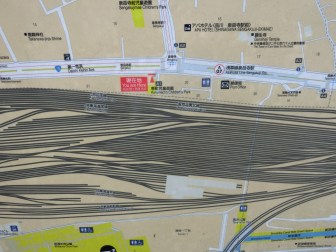
I wandered on a bit further, looking for Shinagawa JR station, not far away, to make my journey back to the hotel. I encountered this extraordinary map on the street, which made it emphatically clear how large and complex the station is:

CIMG0571

When I entered the station, which was as large as the collection of lines would predict, I was intrigued to find a massive bridge over the lines:

CIMG0583

But, despite the size and scale of the station, it was easy to navigate and I had no trouble getting back to my hotel in time for a scheduled meeting.

The Tokyo transportation system is unequalled in the world. Easy to navigate, covering an immense area and servicing a population of about 37 million people as well as lots of tourists, it is reliable and safe, with frequent trains all day long and much easier to get around with than anything else here in Tokyo.

It’s always hard going back to Perth, where public transport is at best meagre, and the navigational skills I have developed here are usually of no value at all.

Nishi-Shinjuku

Nishi-Shinjuku, or the west side of Shinjuku, is often called Tokyo’s skyscraper district, for good reasons. It must surely be one of the most extraordinary urban environments on the planet. Perched forty stories up, as shown above, I thought I’d go down for a stroll to get some fresh air and to try to capture some of the amazing architecture and ambience to share.

I’ve been here often before and strolled around often, but it is always pleasurable. Tokyo was destroyed by the great Kanto earthquake of 1923, and was devastated again after WWII, but somehow the skyscrapers today in Nishi-Shinjuku seem to be making a defiant statement of some sort, that they are here to stay regardless. The earthquake codes are very strict here, and I understand that the buildings are erected to cope with severe earthquakes (but you never really know until they happen). Maybe irrationally, I’ve not felt unsafe here, even up high.

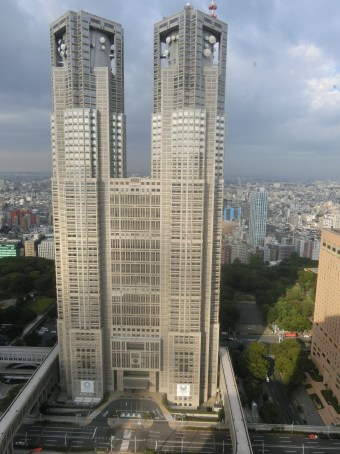
For me, the centrepiece has always been the Tokyo Metropolitan Government Building, from which there is a neat free observatory (in each of the two towers) 45 floors up. I’ve often taken friends – newcomers to Tokyo – up there to see the view, showing the city from horizon to horizon, with greater Tokyo now having some 37 million people or so. I happened to do that again today … here are a few quick snaps, giving a sense of the views. You can also see some green space: the huge Yoyogi Park nearby, for example.

The view from the tower also gives a good look at other things, such as the expressways (so-called … often not very express with commercial traffic!) snaking their way among buildings, such as these two:

But I’m in Nishi-Shinjuku and the building itself is beautiful. Here’s a view from my hotel, up high:

CIMG0216

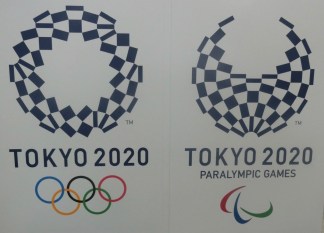
You can see the Olympic logos near the ground. This is the building from which Tokyo’s successful bid for the 2020 Olympic games came. I like the mathematical feel to the two logos, which you can see more clearly here:

CIMG0360

If you look more closely around the base, you can see some of the roads and walkways around it, as well as the companion buildings next to it and the park behind it.

CIMG0213

But let’s get down from the heights and look from below. The building just seems to go up and up …

And the courtyard below dwarfs anyone wandering around it … with an amazing feeling of spaciousness, in a  country where things often feel cramped. If you click on these photos, you’ll see larger versions.

You will already have noticed how hard it is to faithfully reflect large architecture in a photo, without doctoring the photos … the angles often look wrong, as if the world is leaning in. But I’m too lazy (and also lacking in skill) to fix the problems, so I hope you can get a sense of the environment anyway.

The TMG is but one of the many skyscrapers here. None are really really tall (typically around 40-50 floors high?), but walking around the TMG gives a sense of perspective of other buildings in the district. The first one below is actually taken from underneath the TMG, showing the immense colonnade:

None of the buildings is really really tall, but they are tall enough to give an impression of urban-ness, typically around 50 or 60 stories, I think. Here are a couple of examples of famous buildings, a little closer up:

I loved the huge intersections, too! The cocoon building looks especially spectacular, maybe because it is so different from its companions.

Walking around the Nishi-Shinjuku area, with skyscrapers all around, is remarkably pleasant, with wide walkways, devoid of rubbish usually and with lots of trees. Here are a few examples, to give you a sense of the ambience:

The first of these is right outside my hotel, and I have often enjoyed sitting in the restaurant at breakfast, watching the streams of people walking past, going to work. [These pictures were taken on Saturday morning, so the streets are all but deserted.]

There are also gardens associated with many of the buildings, so the whole area feels surprisingly green. Below are a few examples, including a couple where the green of summer is about to be replaced by autumnal colours. I’m not sure why the tree is tied down so securely, but I assume it’s to protect against typhoons?

There are also sculptures scattered around the area, such as the iconic Love symbol and the more recent (2017 – which explains why I had not seen it previously) Keimu Kamata statue called ‘Hand of peace’.

Near the Love sign is an interesting astronomical clock on a tower, reminiscent of the wonderful old clock in Old Prague square – albeit a modern version by Seiko – and associated with another nice piece of urban architecture, the I-Land building with its neat water features.

Cycling is a popular mode of transport around Nishi-Shinjuku, and the footpaths are wide enough to cope with it. I was impressed that this lady was taking two children for a ride on her bike, both protected from the elements.

Another striking feature of the area are the underground walkways. Last night, it was raining a little, but I managed to walk from Shinjuku station back to my hotel almost entirely under cover (using the first walkway shown below). Shinjuku station in rush hour in the mornings is still regarded as the busiest place on Planet Earth, so having an efficient way for people to walk from the station to their offices is obviously a good idea. It was a lot more crowded last night.

Walking around even revealed some unexpected things to me. I had noticed these odd architectural features in the street outside, but thought they were just decorative triangles. This morning, I found out – somewhat to my astonishment – that they were entries to the subway train underneath my hotel! The work crew (a small army, in fact!) were making sure everything was gleaming, while they had a chance, as you can see.

While it’s not surprising that there are subway lines under my hotel – after all, it is only a couple of hundred metres to Shinjuku station and there are many lines going through there – it’s surprising that I didn’t know, because I have stayed here four or five times previously!

At the edge of the skyscraper district, there’s a nice little park, called the Shinjuku Chuo Park. It’s very green, with lots of plants, and even a few animals such as turtles in a pond.

While breakfasting this morning, I noticed small group of a couple of dozen people down there, so wandered down to see what was drawing them there (I recall a few years ago finding a swap-meet!). To my surprise, I found a now very large number of people in the park, and wondered if it was a demonstration of some sort, unlikely as that might seem. I was intrigued at the chap taking photos from the shoulders of someone else (Did he really think he got a much better view??). Then they all started to move off in a sort of march, but the person to whom I spoke said it was for ‘exercise’, so maybe it wasn’t a demonstration? The people seemed to be out for a good time, as you can tell, too. All very mysterious.

Finally, I can’t help but comment about East Shinjuku (the other side of the train station). Notwithstanding the large exercise group, Nishi-Shinjuku is quiet, almost serene, stately and at times almost overwhelming, an urban architectural showcase with grandeur in abundance. Yet the ‘other side of the tracks’ is mad, crazy, noisy, brash and could easily be on a different planet:

And at night, the neon lights come out in East Shinjuku, while West Shinjuku is already sleeping:

There must be few places in the world where everything changes so much with a short stroll, although I know there are some. I’d prefer to end this post with stately quiet, calm Nishi-Shinjuku:

CIMG0296

It’s a lovely spot. Even if you’re not staying there, should you get to Tokyo, at least go for a stroll, and soak it all in.


A walk in the bush

After a family picnic, I had a lovely walk in the bush in Kuring-Gai Chase National Park in Sydney’s north recently. It’s a funny word, ‘bush’. While it can be used to refer to a single small plant (such as a rose bush), in Australia it usually means something else, most likely an area of native plants that hasn’t been cultivated, and so is slightly chaotic. It also sometimes just means ‘not the city’ … one lives in the city or in the bush. And when someone ‘goes bush’, they’ve left the civilised parts and probably no-one quite knows to where they’ve gone.

It took us a long time in Australia to appreciate our bush. While Indigenous people always knew and loved it, we more recent immigrants were firstly besotted with the stereotypical views of the countryside of European painters. If you wander in an Australian art gallery, you’ll find landscapes early in the 19th century that could have been painted in Europe (but weren’t). Then late in the nineteenth century, we started to see the world differently and the Australian Impressionists, among others, captured the beauty that is the Australian bush.

Dorothea MacKellar captured this beautifully in her iconic poem (written in England), My Country. (If you’re not familiar with this, her short and iconic poem is at http://www.dorotheamackellar.com.au/archive/mycountry.htm and well worth a read. As children, we learnt it as a song, too, “I love a sunburnt country …” It is still the best description of how different our bush is from the English countryside (which is lovely, but in a different way). [It also deals with more than just the bush like Kuring-Gai Chase National Park.]

I enjoyed the lovely colours and the sunlight on trees and grasses and rocks, and the wild lack of order (such as you will find in a plantation). The grass trees looked especially spectacular. (We used to call them blackboy trees when I was a kid, but that is no longer appropriate.) Here are a few snaps, but I could have taken many more. You can click on them to see more, if you wish.

When you look a bit closer, there are all sorts of plants there, including a few flowers as well. It got me thinking how wonderful it must have seemed to a botanist like Joseph Banks in the early days of European insurgence into Australia, seeing so many plants that were familiar – but not quite – a whole continent full of new plants! Of course, the closer you look, the more visible is the mathematics … with the fractal-like ferns and the L-systems …

The Kuring-Gai Chase National Park is on the edge of northern Sydney, and so easily accessible. We were lucky on the day we visited that the picnic area was comparatively quiet, as everyone was at school or at work. So it was easy to find a table and enjoy the environment. I thoroughly enjoyed the family picnic, remembering many other family picnics, and also loved the light on the trees in the picnic grounds.

There was water around, with a river wandering off to the Pacific Ocean somewhere and also a lot of mudflats, with mangrove trees exposed for now by a lower tide. To get to a boardwalk and a walk in the bush, we had to cross a footbridge; somehow it seems OK to interrupt the bush with things like footbridges and boardwalks, as it gives us all safe access to it.

As we walked on the boardwalk, lots of little crabs popped back into their holes, waiting until we passed. This made it pretty hard to photograph them, but I caught this little guy enjoying the sunshine, and being a bit more daring than his (or her) companions:

CIMG0129

We encountered some other wildlife as well, including a bush turkey and a bird. The bush turkey was determined to not be photographed, and kept popping into shaded bits of bush. It’s funny how things that are new to us are interesting, but the familiar is easily ignored. My companions were puzzled that I was fascinated with a bush turkey of the kind that they saw every day. I suppose that visitors to Australia are fascinated with kangaroos, koalas and emus in the same way. The unfamiliar is more interesting than the familiar!

Taking a walk in the bush is probably less fun when it’s cloudy or raining, but we were lucky to have glorious sunshine, which made some of the trees stand out beautifully:

CIMG0138 2

It’s nice to have the bush so close to the city and I felt very lucky to have the time to go for a walk, and family to enjoy a picnic with, without worrying about the next deadline.

Beautiful temari and misuhiki in Kanazawa

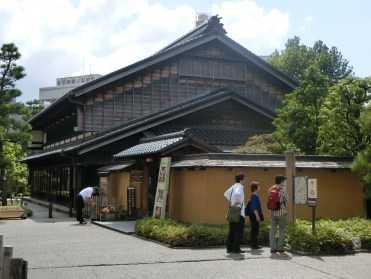
I had not heard of either temari or misuhiki before I found them unintentionally today. What beautiful traditional crafts these are! But to start at the beginning, I was wandering in the Samurai district on my last day in Kanazawa – indeed my last day in Japan for a while – and enjoying the change of weather. Yesterday was raining all day, sometimes heavily, but today was lovely and sunny.

I popped into what did not look very interesting, but I knew it was a sort of museum of pharmacy in the old days: just an ordinary building (at least for here):

CIMG9972

Indeed, it did include a museum of pharmacy, just inside the entry, which was interesting, but not especially rivetting, and the descriptions were a little cryptic to a non-Japanese.

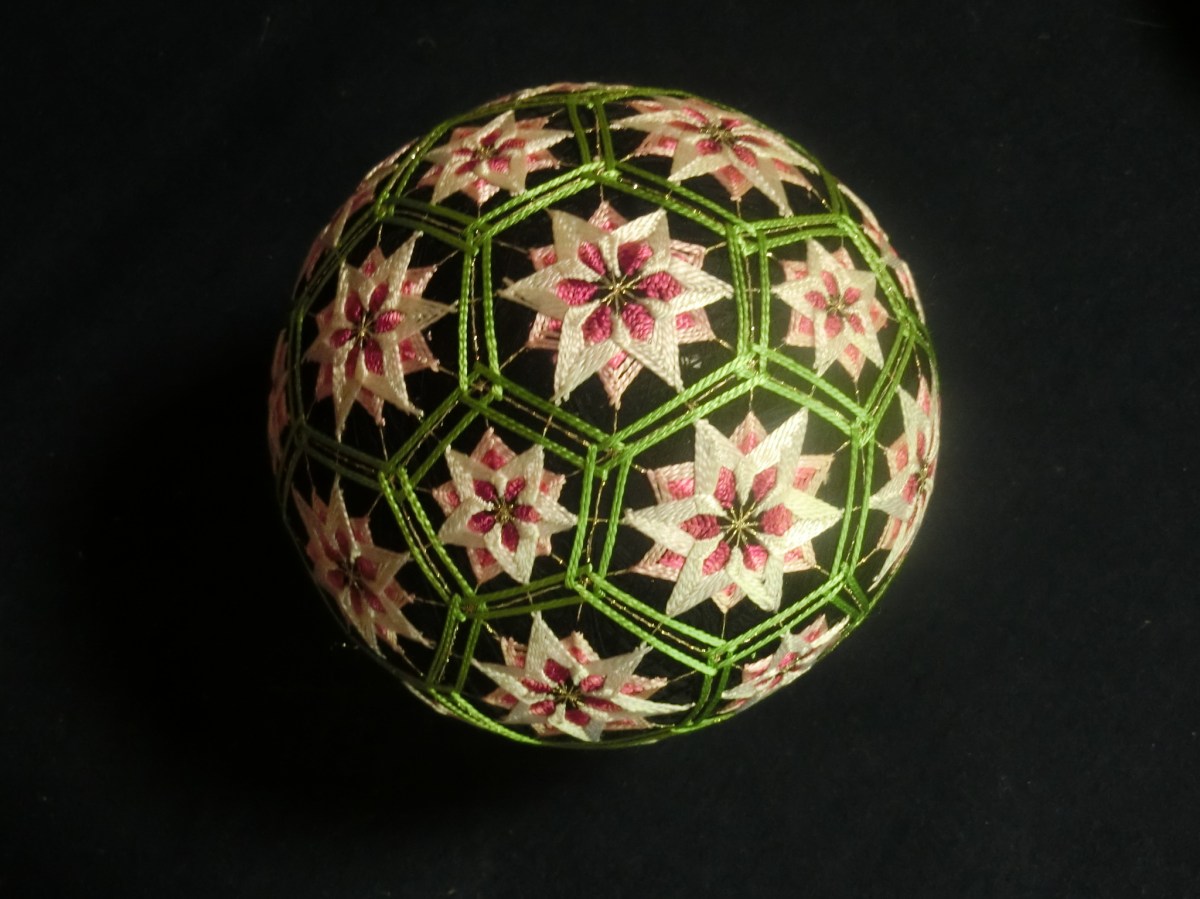
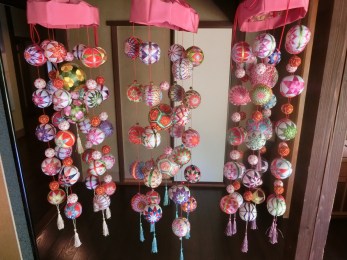
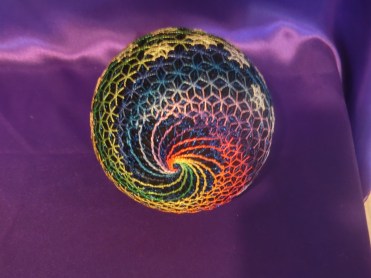
Then I turned the corner, and was astounded to see a collection of brightly coloured geometric objects with various patterns and sizes. No two patterns were the same: each was clearly made individually:

CIMG9932

There was some English description of these, which are called Kaga Temari, or, more colloquially, temari balls. Apparently, they are something of a local tradition, which I had missed as I’d not been frequenting shops (yet).

It seems that they were first made from silk as handballs a long time ago (from the 14th century) by the nobility, as an engagement present for a daughter, but they were so attractive that other people started making them also. When cotton became available, early in the 17th century, they became very fashionable, and it is still a tradition in Kanazawa that mothers make one of these for their engaged daughters.

Here are some other examples:

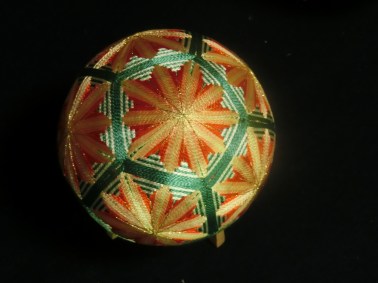
I was of course intrigued by the mathematics of weaving these beautiful shapes onto a sphere, and was instantly impressed with the level of craft competence that must be involved – to say nothing of the mathematical competence.

It seems that the balls are made from tightly bound yarn, which is then embroidered on the outside. It is no mean feat to get the shapes and sizes correct to produce a pattern that fits around a spherical surface, as you will appreciate if you try it for yourself. Here are some others, which were somewhere between a softball and a soccer ball in size:

There were smaller ones as well, clearly less intricate. Some of these were about golf ball size, and some even smaller:
CIMG9933

I didn’t tarry to look too closely at the mathematics (except to admire it), but geometric shapes were very evident. This one looked a bit like a dodecahedron (a solid made with regular pentagons on each face, all twelve of them), for example:

CIMG9937

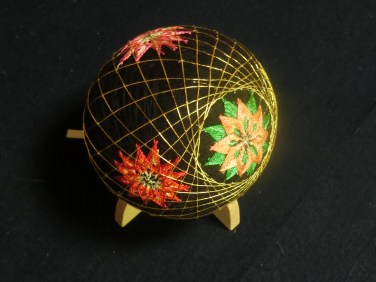
Others reminded me of ‘string art’, which we have sometimes done in mathematics classes, as it’s nice to see curves coming from straight lines:

CIMG9936

Here’s another that included spiral patterns:

CIMG9965

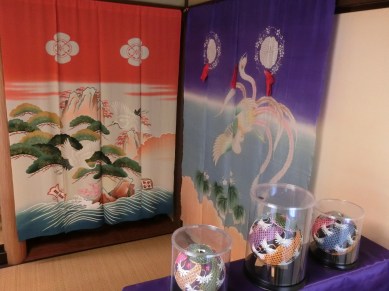
And here is yet another selection, this time in cases and with a pleasant background of traditional fabric printing:

CIMG9941

What a treat! I was quite excited and I think I made the day of the person selling tickets to the museum. He seemed very pleased that I seemed very pleased, although that may just be (typical) Japanese politeness and care for visitors.

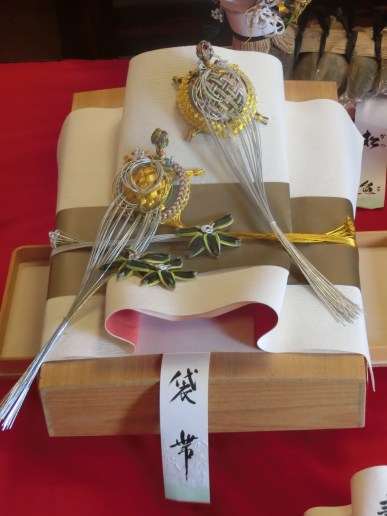
I would have been perfectly happy with my ‘discovery’ – a bit like Captain Cook’s ‘discovery’ of Australia, although the locals did not realise that it was lost ;-). But I went up to the next floor of the pharmacy museum and found some beautiful Japanese wrapping, called mizuhiki. Here’s an example:

CIMG9948

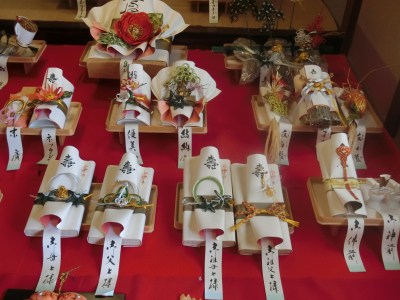
The wrapping in this (and the other cases shown) is for an engagement present. Regardless of what the present is/was (clearly not just the block of wood shown), the wrapping must be a major part of the gift, I think. The examples shown were absolutely beautifully done. Here’s another set of examples (click on it to see it more closely if you wish), showing that paper-folding as well as tying strings are both involved. (Not quite origami, however).

CIMG9947

I have long known that Japanese people pride themselves on wrapping things beautifully … buying anything in a department store, for example, will give you a sense of that pride. I recall once in the large Takashimaya store in Shinjuku, in Tokyo, counting no less than fourteen shop assistants working full-time at the wrapping counter on one floorIt was unacceptable to just buy something and pop it into a plastic bag. the wrapping is part of the transaction. But these mizuhiki seem to take the art form to a new level.

Here are some others, nicely arranged:

CIMG9950

… and a blown-up version of one of them, so that you can see the intricacy and the care with which it has been created.

CIMG9949

I learned a valuable lesson (already known to the rest of the world as “Don’t judge a book by its cover”. Sometimes as a traveller, you have to just go ahead and look at things, even if you are not sure about them, or taste or drink them, even if they look unfamiliar. Now, just as I am leaving Kanazawa, I am beginning to realise why it prides itself on its traditional arts and crafts.

The Pharmacy Museum made my day.