Visiting Taiwan

What a lovely time I have had in this interesting and diverse country! It’s hard to capture it in a single blog, but I’ve pasted a few impressions of various kinds here to have a first attempt at that.

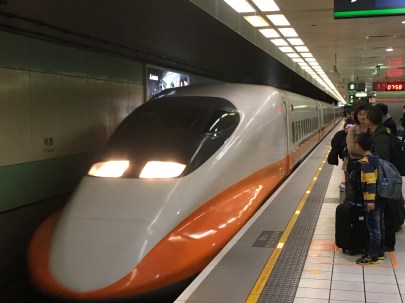
My travels around Taiwan have been easy, thanks to a great public transport system. I’ve ridden on the newish High Speed Rail lines, other long-distance train lines, various MRT systems in cities, local buses and special tourist buses, inexpensively and generally without any problems. The High Speed Rail lines are especially fast – as their name suggests, and reminded me of the Japanese shinkansen:
IMG_4782

They run efficiently, precisely on time and the only (slight) problem was that the new stations are sometimes not in the middle of cities, so you need to use other means of transport as well (which was never difficult, however). You could navigate the ticketing systems with English, and stops are announced in English as well.

Other trains, such as the MRT (similar to Singapore’s and just as good) have English signage inside stations and the trains too, so I didn’t get lost often. Even when it was tricky, it was fun to learn, as in the example below, where the Tourist Information Service had shown me how to go to a museum with a handwritten note, but not quite written down all the information. So I knew the station started with Bo and had the Chinese characters to match. The note was enough for me to buy a ticket and, as you can see, the Chinese characters for Bao’ an in the train itself were interpretable if you looked hard enough! I got there without a hitch – although with a little anxiety!


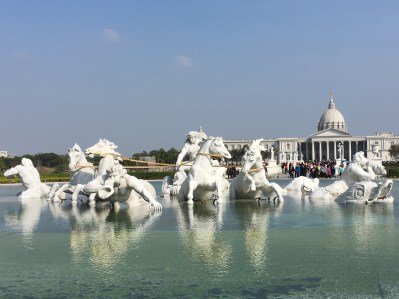
The museum I visited at Bao ‘an (a suburb of Tainan) was the extraordinary Chimei Museum, newly built and reminded me a bit of Versailles from the outside! Inside was very interesting too, and I and sure that it will become better known in time.
Chimei

The premier art museum in Taiwan, however, which I had also been lucky enough to visit previously, was the National Palace Museum in Taipei. When the Chinese Nationalists fled mainland China after the civil war was lost to the communist party, they took the art treasures as well, so that the museum now houses the best collection of Chinese art in the world. It is huge, and displays rotate, so it’s worth returning. I spent several hours there, but offer here only four snaps, to give an idea of it all:


The large lion statue is reminiscent of such statues all over Taiwan, while the traditional drawing/painting is one of a large number of (very old!) paintings held, some over a thousand years old. There were lovely jade carvings, and lots of beautiful metallic ornaments (some influenced by the Silk Route and Chinese trade with India and the Middle East, long before the European renaissance. I also saw many lovely ceramics, porcelains, tapestries, carvings, … but the space here is limited!

There are many many temples in Taiwan, in fact thousands of them, each one different from the rest and many of them stunningly beautiful and detailed. It’s easy to get ‘templed out’, just as it is easy to get ‘cathedralled out’ in parts of Europe, but I enjoyed visiting many temples and admiring the fine work. Here some recent examples from Taipei:


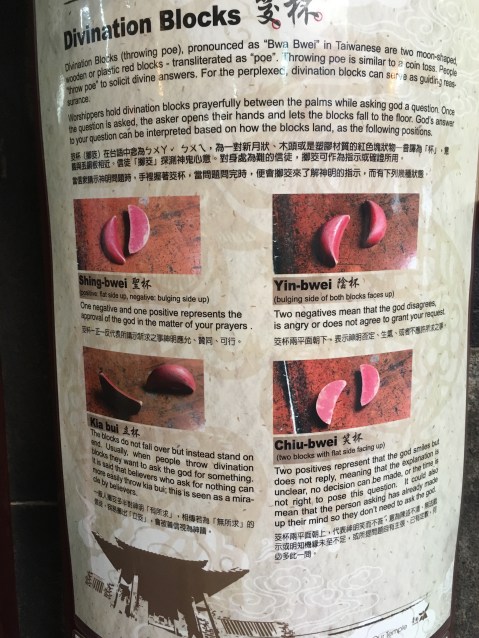
Temples are mostly less ‘reverent’ and more relaxed places than are Christian churches or Islamic mosques, but are places where people’s deeply held beliefs are practiced and made public. Of course, these always seem slightly strange to others (just as a Catholic church will seem slightly strange to a non-Christian, I guess). Ancestors are more revered than is the case for Western traditions, but there is no shortage of gods to appeal to and petition. Nowhere was this more evident than in the tossing of wooden dice-like objects (called bwei) to seek advice from a higher source, as nicely explained here in a temple in Tainan:
temple

I heard the clatter of these on the tiled floors often in my travels. Of course, I was respectful enough to not be too intrusive, but just to add a context, here is a typical scene in a temple in which people are getting advice in this way:

IMG_5371

Despite being mostly a Chinese country, in addition to the original Indigenous people,  there were Christmas decorations in the cities I visited, perhaps more a reflection of the commercial impact of Christmas, rather than its religious significance. (And I am not convinced that it’s much different from that in Australia for many people, of course, where Christmas is mostly about presents, holidays, parties and family, not Christian churches!). Here are a couple of examples of decorations, as well as the one I’ve chosen to put at the top of this blog.


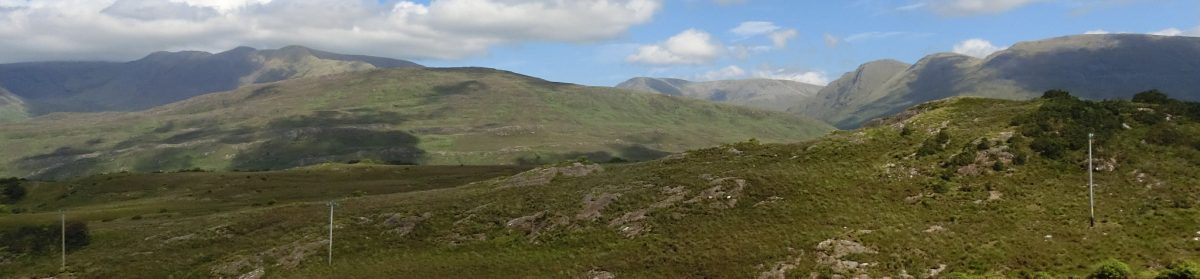
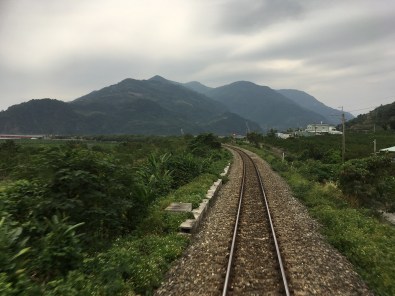
Taiwan is a very mountainous place, with most of the middle of the island too mountainous to navigate and very few roads going east-west. Some mountain are over 4000 m high, in fact, amongst the highest in Asia (if you ignore the Himalayas). Just like Australia (but for a different reason), most people live on the coasts. I enjoyed travelling along the coasts by train, and could often see the nearby central mountains, as in this shot:
IMG_5442

I did not have enough time for serious hiking or mountaineering – beyond my skill set anyway – but did enjoy a lovely day in the famous Taroko Gorge on the east coast, just next to the city of Hualien. Here are some snaps from my day in the Gorge, which capture some of its diversity and grandeur. (Click on the photos to see them better).


I could have spent several days here, and there were enough marked trails of varying levels of difficulty to do that. The marble walls and cliffs were spectacular, and I enjoyed wandering various paths, surrounded by greenery, rocks, mists and extraordinary cliffs and drops. certainly worth a visit!

Taipei had some monumental buildings, in great Chinese style. Two very impressive examples are shown below. The building with the red pillars is part of a shrine to Chinese Nationalists who died in various battles, firstly against the invading Japanese and then against various Chinese groups (such as war-lords) and lastly the Chinese Communist party, which eventually won the long civil war, leading to the People’s Republic of China (what used to be known as ‘Red China’). [The Nationalists under Chiang Kai-shek fled to Taiwan and founded the Republic of China, which used to be recognised as ‘China’, but is no longer so.] The other two photos are from the Chiang Kai-shek Memorial Park in central Taipei, which includes the huge memorial shown, as well as two other spectacular buildings. These (and others) are beautiful examples of traditional Chinese architecture.


As well as monumental buildings, there are many smaller distinctive creations, such as the two showing below. The carving was on a footpath in Beitou (the hot springs area outside Taipei), while the four characters were at the Confucius temple in Taipei. I saw many others, as well …


In a central park in Taipei, I even saw this construction for DIY foot massage, with an associated reflexology chart. Chinese medicine has lasted for thousands of years, and this is just one example, I guess. (You’ll need to click on the picture to see the details)


Although Taipei (and a couple of other cities) are quite large, you’re never far away from greenery and countryside, and of course never far away from people. Taiwan has a similar population to Australia but is much much smaller geographically. the snaps below were taken in Maoking (half an hour south of the city on the MRT and then on cable cars) as well as Beitou and Yangminshan (half an hour north of the city on the MRT).


The hot springs at Beitou have always been popular, of course, and became even  more so with Japanese occupation early in the twentieth century. The cable cars at Maokong were built in part to allow people to get out of the city and into the hills, where there is lots of greenery, tea plantations, etc. The couple I photographed (son and mum) shared a cable car ride with me and were very friendly, but not more so than people everywhere in Taiwan. I was regularly offered help and advice and a hand of friendship wherever I went, and never felt even slightly uneasy or anxious about people.

Although I visited in winter, there was still some nice weather and I also saw lots of greenery and flowers. The three snaps below give typical examples, of lovely flowers, of manicured trees (this one next to the Chiang Kai-shek memorial) and bunches of flowers in temples (everywhere).


A constant source of stimulation in Taiwan is from food, which is simply everywhere! One of the photos below is from a night market in Kaohsiung, similar to night markets all over Taiwan, in which there are many many fast street food outlets like this. One of the photos is from a DIY restaurant in Taipei, where you paid by weight for what you chose. The third is not technically food (for most of us) but the extraordinary collection of Scotch whisky in the hotel in which I stayed in TaoYuan (just of out of Taipei). (The whisky cache was unusual, to say the least, unlike the other two).

Finally, I have hundreds of other photos and at least as many memories, but space is always limited here, so I’ll finish with three snaps of everyday life in Taiwan.

I saw many people (mostly – but not only – men) engrossed in a board game of same kind all over the island, and also saw a countless number of scooters. The latter were usually clogging the footpath, but these were unusually in a scooter park. And there were many many small shops, small streets and distinctively Chinese shopping areas, like the one shown above.

Taiwan is a lovely place to visit, with rich diversity, only some of which is captured in these few slides. Friendly people, mostly inexpensive, easy enough to get around and enough interesting stuff to keep most of us amused for a long time.

I’m pleased I went to Taiwan, and would happily go again.

Out and about in Kaohsiung

I enjoyed an interesting day wandering around Kaohsiung, especially the Lotus Pond area and the small offshore island of Ciji. Both of these places are popular with locals and with Taiwanese tourists. Like

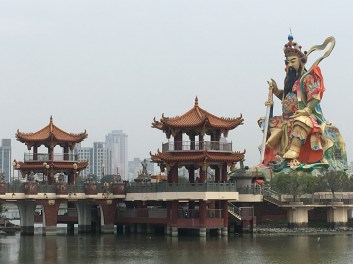
Lotus Pond comprises a large lake and a number of ‘attractions’ around it. It’s very kitsch, mostly, although there are a couple of temples of note as well. The picture at the top shows the Tiger and Dragon pagodas, which are about as kitsch as it gets. Like Chinese temples, the paths to the entrance of the pagodas are zig-zagged (I think to prevent evil spirits from chasing someone – they have to keep turning corners; not sure).

As you can see below, you enter the pagodas via the mouth of the animal. There is another example below, from a bit further around the lake. It shows a dragon, but another picture shows the insides of the dragon, which is filled with all sorts of beings from Chinese stories and legends not recognisable to me.


The lake was also decorated with this enormous statue. It was also possible to go up inside the statue, where there was a small temple of some sort.

IMG_5166

Kitsch it might be, but the workmanship of these kinds of things was pretty impressive, as the next couple of pictures suggest. Lots of intricate carvings are involved and the whole collection has an air of fun about it.


Less obviously fun-like were the genuine temples around the lake, although these too had fabulously detailed carvings and paintings in them. These few photos give an idea of the extraordinary work involved in some of them:


I’m always a bit uneasy around religious sites, never quite knowing how to behave, and very conscious that my own religious upbringing had very strong views about ‘proper’ and ‘respectful’ behaviour. It seems to me that the Chinese religions and temples are rather more relaxed than are Christian, Jewish, or Muslim sites of similar significance, but it’s hard to tell and there are certainly protocols that need to be observed. I am often struck by the wildly fantastic nature of the temples, but it is too easy to forget that other religions probably have a similar view of Christianity! It’s hard to break loose of the things you grew up with and of course everybody claims that their own religion is the ‘right’ one and all the others are mistaken …

I enjoyed the Confucius Temple at Lotus Pond, rather different from the Buddhist and other Chinese temples above. The Confucian philosophy is deeply ingrained in much of the Chinese world, so much so that I have colleagues in the Far East who talk of a ‘Confucian Heritage Culture, valuing education, scholarship, ethics, meritocracy, etc and claim that this is one of the reasons for the success of many students on Chinese origin in the west. Here are a couple of pics of the temple, clearly different from the others and much more sedate:


In fact, when I was there, there were some people dressed up in traditional garb; I’m not sure if they were rehearsing for a wedding or an advertising shoot …


Lots of other things caught my eye, wandering around the lakeside. A few of them are captured below in the snaps:


I was puzzled by the Wheelchair gates (of which I saw several) … it looked to me as if they were making it harder for wheelchair people; since I never saw them being used, I didn’t understand them. The innate sense of humour of it all was captured for me in the hen with her golden eggs and with the Lego block display version of the Tiger and Dragon. I saw lots of morning shopping opportunities, with countless food stands, fruit and vegetable stalls and even live shellfish. Just walking around revealed lots of things to me that I am sure were of no interest at all to locals – as it is all familiar to them. No doubt the same would be true if Taiwanese wandered around Perth suburbs …

My trip to the island later in the day involved travelling on the excellent MRT system, common in the Far East but sadly rare in Australia. It is a quick, easy, safe and efficient way of getting around. Lots of things caught my eye – too many to record here, of course – but here are just three examples:


Everyone seems to be dressed up as if it is cold (it is actually ‘winter’ but the days often reach into the 20’s Celsius, so it’s hardly cold, at least by my standards). I was impressed that some of the ladies here had matched their hats to their outfits. I was also impressed with the large stations, which had lots of facilities, shops, etc (and free toilets, unlike too many countries), including breast-feeding rooms, as you can see. The High Speed Rail stations are exceptionally large, as you can see, and there is of course a very large number of motorcycles parked there.

I was (slightly) uneasy about my ferry across to Cijin Island – bringing to mind all those stories about ferries sinking in various Asian places in recent years, but only slightly, as the trip was very short and across a harbour!

IMG_2889

There was a ferry every few minutes throughout the day, taking people as well as people on their motorcycles, so there was no need to wait. [As for the MRT … no need to find a timetable, as the next one is almost here already.]

The island is very popular with locals, who seemed to day trip across mostly to eat seafood, walk or ride along the beach front and also to watch the sunset.


There were many places apparently designed essentially as sunset watching places, it seemed to me, so it was a shame that the sunset was spoiled a bit by cloud cover. There were seats and little stands available for watching the sunset and even this massive shell-like construction to allow people to photograph the sunset through the shell. many people hired bikes or carts to wander up and down the beach (but didn’t get much exercise as many of them were electric! I walked and so got lots of exercise!)

People were very relaxed on the island, and often seemed to be there in family groups. I enjoyed the experience as well, and so stayed to have a beer and some dinner, waiting for the sunset, a very pleasant way to end an interesting day.


Art in Kaohsiung

I was attracted to the Taiwanese city of Kaohsiung in part because I had heard of their recent artistic adventures, but I did not really know what to expect until I arrived. In fact, the first thing I noticed when I arrived in the city was the extraordinary railway station (the HSR – High Speed Railway – has fairly new stations on Taiwan’s west coast, as it has only been going recently). They all have spectacular high ceilings, with girders, like the one below (a comparatively small example, in fact). I don’t think there is a technical reason for the height and all the exposed girders … except to create a feeling of spaciousness. (Of course, it also creates a mathematical space … but that’s another story.)

IMG_4974

The HSR stations are all a bit out of town – as they have just been built – so I had to travel on the MRT from the HSR station into the centre of the city where my hotel is located. My arrival at the MRT station was a great surprise: a spectacular coloured dome (under which a lady was playing a grand piano!) greeted me, and I then travelled to the surface under spectacular roof constructions, shown below. (Click on the images to see them in full).

There is no need for any of this: a subway station can be boring and uninteresting, but I was pleased that it wasn’t. Somehow, artistic creations of these kinds are uplifting – at least to me. It got me thinking about who might have designed these, and how pleased they must have been with the end results. I loved the (apparently) curved roof, made up of perfectly flat planes of glass … a 3D version of some designs I have done and got students to do in mathematics, in fact, just because they look good.

I travelled by MRT to Kaohsiung’s Pier-2 Art District, which is a large area of disused and abandoned warehouses on the waterfront. They have been resurrected by the energetic arts community if Kaohsiung into a spectacular artistic space. Many of them are now being used as museums, commercial spaces, design studios, galleries, restaurants, etc. I was unsure of which way to go when I arrived, until I spotted this massive construction of old containers about 500 m away, so knew I was heading in the right direction:

IMG_5047

What makes something ‘artistic’? I really don’t know, but the things I saw today all provoked a feeling of some sort in me, usually a pleasurable feeling of some kind. The big red container construction was visible from a long way away and had a certain sort of solidity to it. I loved the shapes and the angles and how it looked different from different places.

The warehouses (about 20 or 30 of them – I didn’t count carefully) often look quite drab from the outside, and thus have retained some of their past lives:

IMG_5033

But there is often a twist. In the example above, the arms of the thing on the roof (which was certainly not there when it was a warehouse!) is constantly moving – even wriggling – around. Somehow, the building seemed to be alive!

And it’s not just the buildings, but also the spaces around them. I was amused to see these fanciful sculptures outside one building, as well as the drawings of faces, made with rusty steel, which looked different as I moved around them. So art doesn’t have to look ‘beautiful’ … but it should provoke a reaction of some sort.

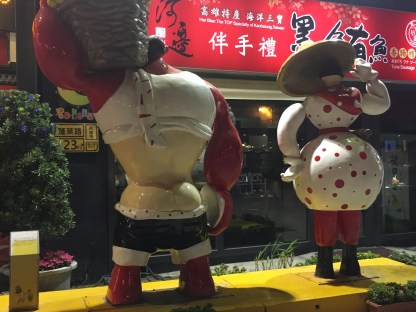
Some of these figures reappeared in several ways, sometimes huge in size, as the picture at the top of this blog shows. I loved them … looking slightly fantastical, and designed to amuse. They serve no useful purpose at all, except perhaps to entertain people (which they did, judging by the number of people photographing them – or giggling at them). Here are some more examples of the same sort of them, scattered around the area:

They seem likely to have been made by the same artist – I couldn’t tell, as any descriptions were hard to find and, anyway, written in Chinese. I loved them. I especially liked the big guy and the big lady (shown at the top of the blog), somehow adding a neat gender balance to the industrial world of warehouses and waterfront. To my surprise, the sculptures looked the same from the front and the back – which was a bit disconcerting – but why should they not.

Sometimes, art is intended to surprise, as it did in this case. Later on, I saw another example, which similarly amused me:

IMG_5053

There were other sculptures around, too, each of which provoked me in one way or another. It was very hard to ignore things like these!

Some sculptures were less obviously anthropomorphic, but also caught my fancy. here are four examples:

The small train going under the huge sculptured objects looked like lots of fun … it ran around the precinct of a warehouse that housed a museum devoted to early sugar trains and was popular with kids – and not only little kids. When I was a lot younger, I used to think that paintings ought to look right (as in a photograph) and sculptures should be of something real, but that is not the case, of course. All of these provoked me, or jolted me in some way, which is presumably part of their purpose.

Some of the buildings too had become art objects, with elaborate murals or decorations of some kind, as the two examples below show. I enjoyed both of these.

Some of the local buildings are already artistic, in fact, such as the temple top and the huge gate below, both characteristically Chinese. Does something have to be in an art gallery to be ‘artistic’? Of course not.

Other building decorations were clearly designed to amuse or entertain, however, such as this mosaic built around a water outlet, which periodically came on (unexpectedly) to the amusement of whoever was passing by! The young boy was about the size of a 5 or 6 year old.

IMG_5030

I hope that you don’t find this offensive, but I’m pretty sure that you won’t … as almost everyone who saw it when I was around found it amusing and in some cases, shrieks of laughter or giggles from children could be heard. The artist is having fun, and we are invited to share the joke.

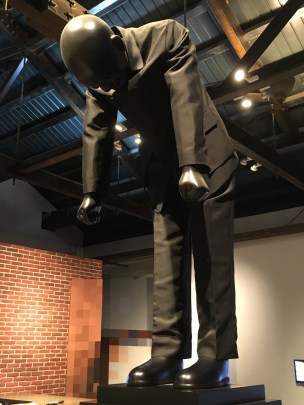
Similarly, this sculpture on a pedestal inside one of the buildings got me wondering about why sculptures never wear clothing … and also got me wondering what was under the clothing …

IMG_5054

I am not sure which of the things I saw today were permanent and which were part of an  art exhibition that just opened. And I’m a little embarrassed to not know the details of the artists, but it was not easy to find these. (I may know more when I return later. There are various art exhibitions available in the arts precinct, so I’m hoping to find time to see them.)

I thoroughly enjoyed my first afternoon in Kaohsiung, wandering around various works of art that had me wondering, admiring, liking, amused, excited, annoyed, puzzled, irritated, confused … and various other reactions. I have similar sorts of reactions to mathematics, by the way, which may account for why many of us regard mathematics as a form of art, too … except those who keep asking what ‘use’ it is.

As I wandered around the various art forms today, I hardly ever asked myself what ‘use’ anything was … so there’s a tale …