A day in the Lavaux region

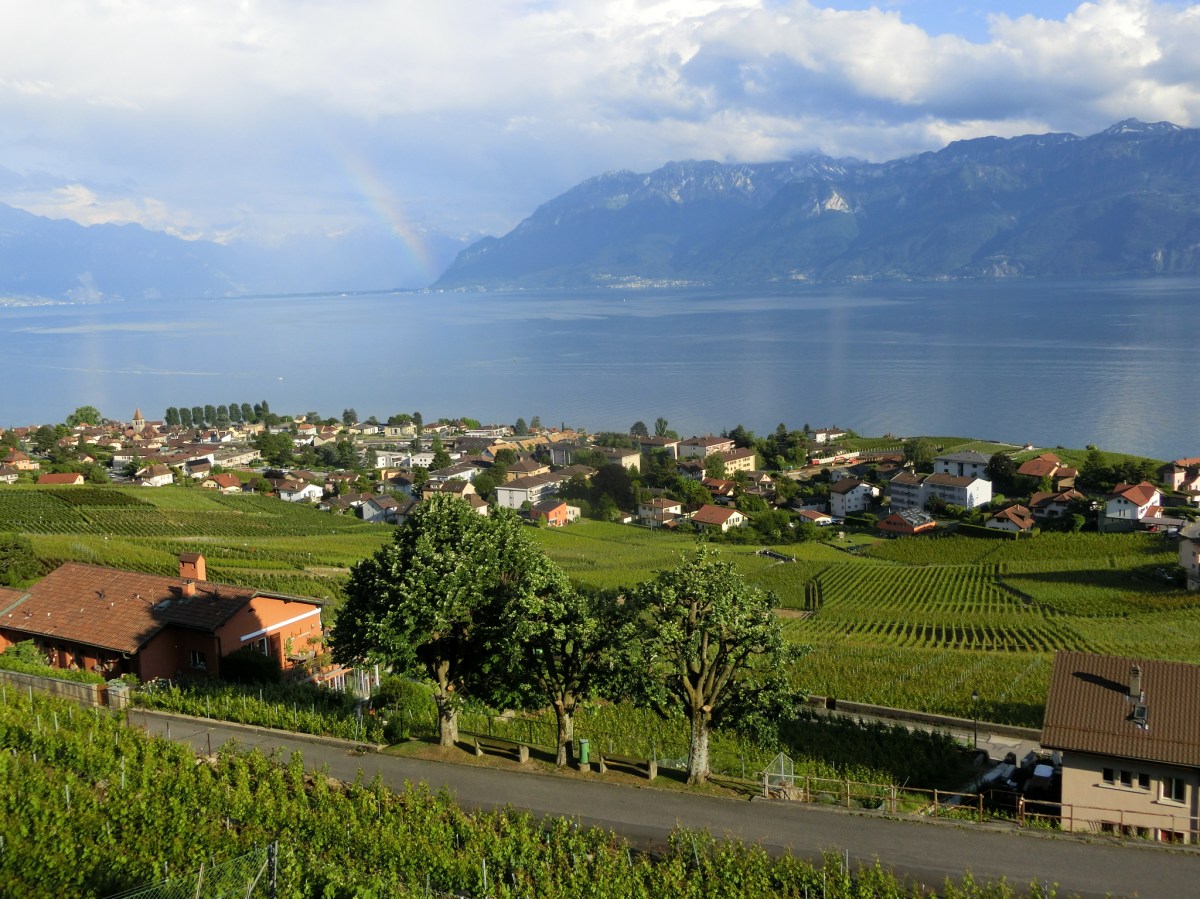
Nestled on a hillside adjacent to Lac Léman (popularly, but incorrectly, known as Lake Geneva), we were fortunate to stay in the small village of Grandvaux, set in a beautiful location with stunning views across to the Alps from our high vantage point. The village of Grandvaux is part of the Lavaux region, just out of Lausanne. The border between France and Switzerland goes down the midle of the lake, so that the Alps immediately opposite, showing in the picture above, are in France.

This region has UNESCO World Heritage status because of its lovely terraces upon which wines have been produced for many hundreds of years. The holdings are relatively small and drape over the hillside in picturesque ways.

Local restaurants, such as this fine dining example in Grandvaux itself serve local wines, and even show patrons precisely where the grapes were grown for a particular wine, as you can see from the wine map provided at the tables. You can also see that the restaurant has wonderful views across the lake to the mountains beyond, so that the excellent food and wine is not the only attraction.

Looking over the lake from our balcony is a delight, especially in the sunshine that we have enjoyed recently, with beautiful views in all directions, and the occasional craft sliding by. We also saw yachts, stand-up paddle boards and other vessels, enjoying the environment and helping to create lovely pictures.

Although it is tempting to just sit and look and take it all in, we embarked on an excursion, wandering by car around the area before heading up to a chalet in the nearby (Swiss) mountains. Chalets are typically owned by families for many years, and were essentially holiday houses in many cases. These days, with the benefits of cars to get around, they are easily accessible up small mountain roads, even in winter seasons. The family chalet we visited had jaw-dropping views across the valley and nearby mountains.

Inside the chalet, traditional Swiss furnisihings and designs were apparent … this chalet was a veritable family history museum, with lots of memorabilia, as well as being somewhere comfortable to spend time in various seasons.

High up in the mountains (this chalet was at around 1100 m), summer flowers are evident everywhere, basking in the sunshine, so it was a delightful place to wander around and enjoy the views and the mountain air. It’s always good to slow down and smell the roses (or other flowers) and you can do that a bit by clicking on the pictures to see more of them.

In summer time especially, the beautiful countryside of the Lavoux region is enjoyed by walkers and cyclists as well as by car drivers. It looked to me to be a very long way to ride a bicycle uphill, or to walk, so I was pleased to be driven up instead. We saw many cyclists during the day, both around the wine-growing terraces and even up in the mountains, as well as casual walkers and hikers.

Even higher up the mountains from the chalet, at just over 1600 m, we enjoyed lunch at a traditional restaurant, with startling views across the valley.

The green colours everywhere are beautiful and we were confident that the cattle wandering high in the mountains thought so too.

Driving back through Montreux, on lake’s edge, was also a delight. Montreux has been famous for many years because of its annual Jazz Festival, but is also a lovely place to visit, and is reminiscent of the French Riviera. People strolled along the lovely lake, enjoying the general ambience, the flowers and the views across the lake. It’s also likely to be a place for affluent people – we even saw an Indian wedding in progress, which no doubt cost a great deal of money to stage here.

Several notable people have lived in Montreux and nearby. The statue of Freddie Mercury, lead singer of Queen, reminds visitors of one example, but there are others from the entertainment industries, such as Charlie Chaplin and David Bowie.

Being here in summer, on a lovely day, has no doubt added to the ambience, although I suspect that this region is beautiful at any time of the year and in almost any conditions. The summer flowers have certainly added to the occasion, helping everything to look clean and sparkling, and the grapes (just starting to appear) will help create an ambience of abundance and beauty long after we regrettably leave.

Sunset over the lake is a reminder that this is a stunningly beautiful part of the world that can only be appreciated by being here, not looking at photos or reading about it. I have heard it said that life can be somehow measured in part by the moments that take your breath away … there are lots of those up here.

CIMG3419

We are so lucky to be here. I hope that you can make it here one day to see it for yourself.

Viña del Mar

Today I used the Metro to visit Vina del Mar, the city adjacent to Valparaiso. It wasn’t terribly interesting, so I had some lunch and pottered around a bit but didn’t stay as long as I expected. I returned to Valparaiso in search of ascensores and watched the sun set on the port.

On the way to the Metro, I popped into the Naval Museum nearby. Most of it was full of the daring exploits of Chilean naval personnel, especially when Chile was successful in the 19th century. But a few other things caught my eye.

The 1746 map showing Australia – but only the western bits – was a surprise; the map was on a lovely stained glass window, and it was not really clear to me why Neil Armstrong was on the window as well, which added to the surprise. The Wanted poster for Francis Drake, described by the Chileans as a pirate, was also a surprise to me; they were clearly miffed that the Queen of England had chosen to beknight him, when they regarded him as worthy of locking up and arresting – or worse. The local branch of the Dockers football club is also evident in the third photo, which I had not previously realised.

The museum also had an interesting display about Cape Horn, and I learned that there is a society of captains of sailing ships that have rounded the Cape without engine help. The painting was the prizewinner in a competition on rounding Cape Horn under sail. Before the advent of the Panama Canal, the route to and from Europe went via the treacherous Cape Horn and then up to Valparaiso, which made the city rich. Cape Horn was even described by some as the biggest cemetery in the world, as it was very treacherous.

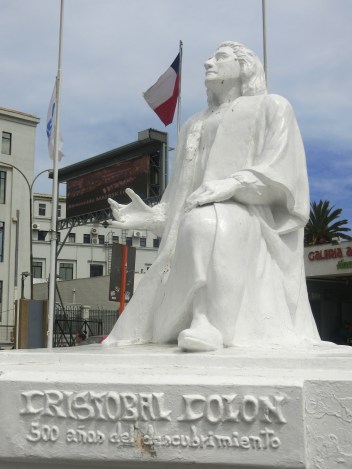
Continuing the nautical theme, just before I got on the metro, I spotted a rather weathered statue of Christopher Columbus (known in Spanish as Cristobal Colon) on the nearby wharf, obviously erected in 1992, the 500th anniversary of his ‘discovery’ of the New World.

CIMG2543

The Metro ride to Viña del Mar was very smooth and easy, but the town itself didn’t really appeal to me, certainly nowhere near as interesting as its neighbour. The picture at the top of this blog shows that it is on the coast; apparently it is a popular destination for local holiday makers, especially Argentine folks. The rows and rows of beachside apartments did not stir my soul much – and nor did the beach itself. It reminded me of a slightly shabbier version of Australia’s Gold Coast, and no more attractive.

It’s a sure sign you’re in tourist territory when you see a horse and cart, but I was surprised to see a Kombi again. (I think I have found where they all came to die …). At first I thought it strange that all the children’s toys were available for hire, but then I figured that probably kids don’t normally have things like that (as they don’t normally have an outside space to call their own), so it seemed less strange.
There were some sea birds on the nearby shore that I watched for a while. Some of them were quite photogenic:

CIMG2612

There was a slightly interesting archeological, museum I visited, especially as it had some interesting material on Easter Island (which is part of Chile)

The museum even had a genuine Easter Island statue out the front (the other statues are from a video I watched), as well as carved wooden statues (with ribs) inside. Apart from other problems, it’s a sad story of environmental mismanagement that they used up all the wood on the island for fuel, and so were not able to build boats to go elsewhere, it seems.

The three pictures below show three different things that caught my eye. The large park in the middle of the city was damaged by the 2010 Chilean earthquake, with a major building still under reparation. The big crack in this rock wall gives an indication of the size of the quake. (I think it measured 8.8, one of the strongest in recorded history.) Too scary to think about much …

The funny shaped rocks were in the archeological museum, and were related to the Inca people. I’ve seen them a few times now (including in Santiago); it’s funny how things from a different continent become familiar after a short while. Somehow, I had not seen these in my previous life, presumably because museums I go to (in Australia, Asia and Europe mostly) did not mention the Incas. The third photo shows a bit of street campaigning, as there is a Presidential election coming up (next month, I think). It seems a pretty open contest, but I hope it turns out better for Chile than did the last American election I was close to did for the USA. I’ve seen lots of leaflets being handed out in the streets, as well as the occasional person like this waving flags.

I popped briefly into the casino in Viña del Mar, as I happened to be walking past it. I wandered over to the Roulette tables and watched a chap put 80.000 Chilean Pesos (around $160 Australian) on the table (not in a very strategic way) in each of three successive spins and lose the lot. It took no more than 15 minutes. He probably thought he was unlucky as two of the spins came up 00, the banker’s number in the Americas, but I thought he was just foolish. I’m not a gambler – as I know way too much probability – but my hunch is that if one of this big bets came off, he would have reinvested it and lost it anyway. My AirBnB host in Santiago told me that the minimum monthly wage in Chile is around 220.000 Chilean pesos, so he blew more than a month’s minimum salary in about 15 minutes. I am an advocate of teaching gambling in school, so that people will understand what not to do and why to not do it; I wonder if it would have helped him, poor chap. I hope he could afford to lose money like that and did not continue to lose even more after I left. He did not look prosperous, but looks can deceive.

Back in Valpairaiso, I went in search of more ascensores. I managed to find one working (and of course went up and down it). This was some distance away from the more interesting parts of town, but I noticed from the vantage point at the top that even some of the newer apartment buildings have large murals, as you can see. One of the ascensores I found had been replaced (I think) with an elevator, and I chose to walk down after going up; the picture shows that this was a little tricky, with steps going every which way. It would be a nightmare if it were raining; mercifully it wasn’t.

While searching for acsensores, I discovered what must be close to the ugliest piece of public sculpture I’ve seen anywhere. I realise that tastes differ, but I did wonder what on earth they were thinking to install this huge work in a main street. I also noticed that Halloween stuff has started to appear with the street sellers, maybe reflecting North American influences? I think that the associated Latin American festival is Day of the Dead. I’ll have to check it out, as I will still be in Chile at that stage.

I had an evening meal overlooking the large container port, not far from my present abode (so that I could get home safely before dark!). I was fascinated to watch the containers being loaded onto the ship and onto trucks. It all looked very efficient, and I could see almost no people except the truck drivers (whom I assumed were in their trucks still). Part of me marvelled at the extraordinary amount of mathematics and computing that makes it all work, moving very large and heavy things with precision and somehow remembering where everything is and needs to go … But another part of me worried about all the people that used to work there, but now no longer do. And when the truck drivers are also replaced by automatic driverless vehicles, they will be gone too. Not a good outlook for the local people, although no doubt the Port Authority and the Shipping companies will prosper.

My little blue restaurant looked rather fragile from the outside, although it was fine from inside. I decided to ignore the possibility of an earthquake while I was enjoying my meal and a beer, watching all the activity way below me.

Fortunately, nothing happened and I made it home OK, neither shaken by an earthquake nor by a local unemployed street criminal …

My last full day in Valparaiso tomorrow …

Santiago hills and opera

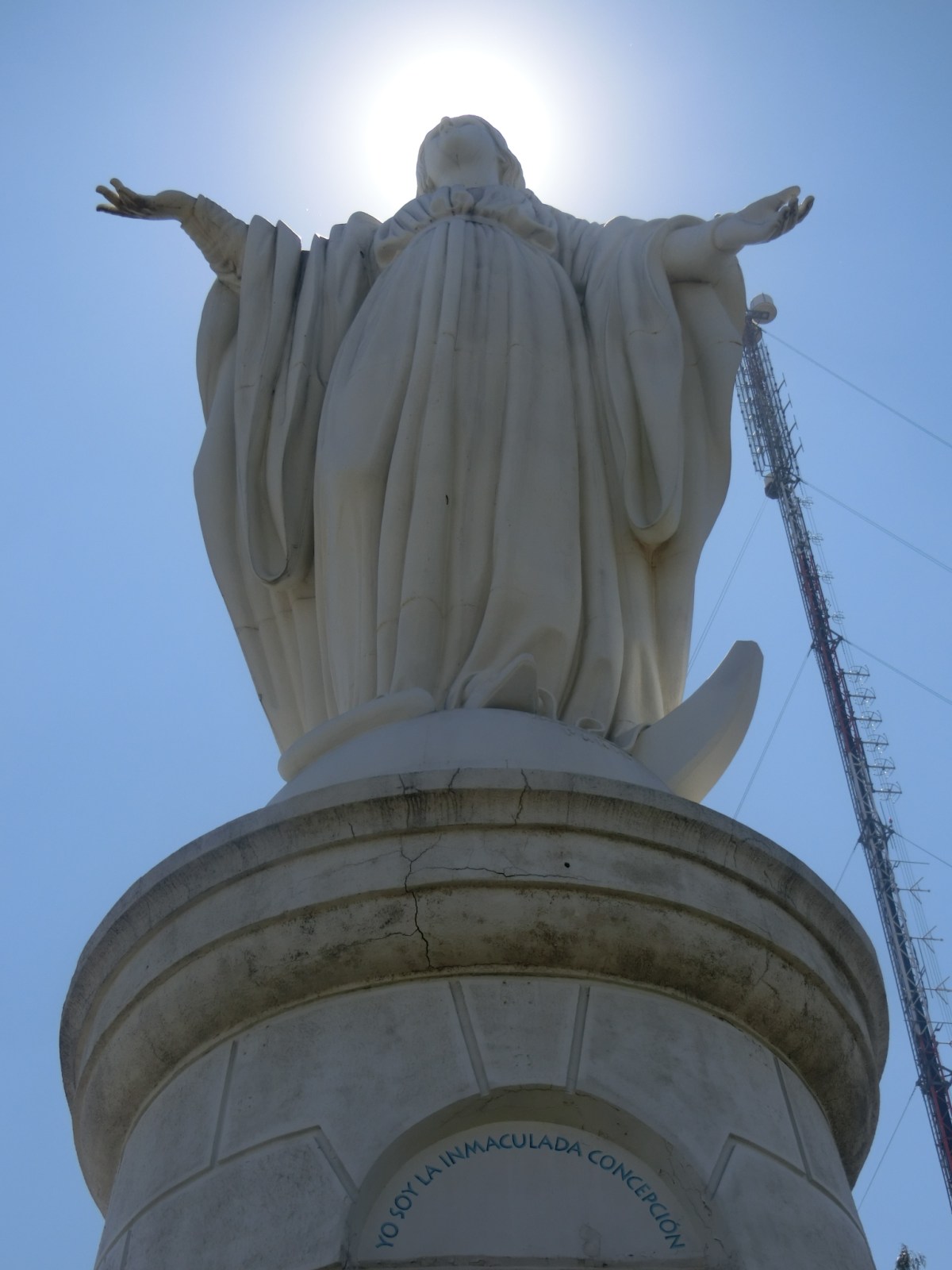
Another lovely spring day, in which I first visited Cerro San Cristobal, a hill overlooking Santiago with a statue of the Virgin Mary on top of it, and then enjoyed a night (or an afternoon) at the opera.

Actually, the day started with my breakfast, not with the hill or the opera. My AirBnB host kindly provides me with a lovely continental breakfast each morning and we practice conversing in Spanish and English. It’s a very pleasant start to each day, and usually involves a few local tips for me, as well as some practice with dictionaries for both of us!

We eat in the sitting room, adjacent to a nice enclosed balcony overlooking a busy intersection with the Alameda. Of course, I am now thoroughly familiar with all the Spanish words associated with my breakfast. I am very pleased I chose to stay here rather than in an hotel.

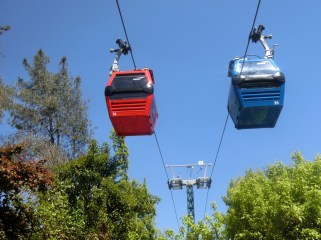
Getting to the metro, I noticed again the busker space (vacant this morning, maybe because it’s Saturday?) and also noticed when I arrived that the main street of Bellavista was completely clean – quite a feat, as it was very busy last night. The line to go up the Cerro San Cristobal was no shorter than it was the day before, unfortunately but unsurprisingly for a Saturday, so I just had to wait patiently. Never easy for me: I get sick of standing in queues for long, but I managed to strike up a conversation with the nearby people, including a lovely man and his two young daughters, who were very excited to be going up the funicular railway and cable car (called teleferico, which I discovered in the queue; I did not previously know it was there).

Eventually, we reached the top of the queue and headed up the hill, much to the girls’ excitement. The views over the city were wonderful, although spoiled a bit by the smoggy air. Santiago sits between two mountain ranges and the air struggles to clear sometimes, as you can see. I was impressed to see some old Kombi vans on top put to good use: old Kombis never actually die … they are often known to reincarnate! It was also a good spot for people to exercise and there were many cyclists who rode up farther than take the funicular.

The telerifico (a cable car in Australia or a ropeway in Japan) was pretty new and it was fun to share it with two little girls who squealed in excitement as we took off! We did a round trip to a distant part of the hill and returned, overlooking people picnicking, exercising, playing, etc. It’s clear that Chile is a very family oriented place as many people had children with them and many also had a dog or two. My new Chilean friends were lovely to spend some time with, and I appreciated their kindness to a stranger who didn’t speak their language very well.

CIMG1438

I left my companions and headed up to the statue of the virgin, which can be seen from various points in the city and can also be seen at the top of this blog. Not as big as the one in Rio de Janeiro, but clearly of great importance to the locals. The base of the statue is a praying area in which Pope Jean Paul II said mass when he visited here some years ago, and will be where Pope Francis will also say mass when he arrives early in 2018. The excitement is already building …

You may have to click on the photo (taken from the base of the statue) to see that the altar has a number of rows of garden seats/benches in front of it, as well as large messages announcing the papal visit. There was also some signs asking people to be silent, which had no effect on them at all, as far as I could tell. (A bit like a red man signal to a local pedestrian: regarded as a suggestion, rather than an instruction.) I enjoyed the beautiful collection of stripey flowers that were planted on the hillside next to the benches, as shown below.

I made my way back down the hill and enjoyed a delightful lunch in a Chilean restaurant in Bellavista, being careful this time to order something more manageable than yesterday’s outsized feast. The restaurant had lots of graffiti inside (as well as some graffiti outside), which I guess is inevitable when they are there for a long time, as this one was. I also passed another Pablo Neruda memorial en route to lunch.

On my way to the opera, I visited briefly an old Franciscan church (built in the sixteenth century, but earthquakes being what they are around here, rebuilt in parts several times since, mostly to the original design). Some of the really old original stonework is still visible inside the church, as you can see.

I also passed a large and rather noisy demonstration along the way, down the main street (the Alameda, easier than its full title of Avenida Libertador Bernado O’Higgins) but didn’t linger enough to determine precisely what it was about, although there were some political messages, as well as some religious messages (e.g. anti-abortion), so think there was a mixture of some kind. It’s rarely a good idea to get too close to demonstrations in foreign countries, I know, so I kept moving towards my opera, scheduled to start at the unusually early time of 5 pm.

It turned out that the street demonstration was only my first demonstration of the day, as there was also a very noisy demonstration at the opera as well. I had found out (in difficult circumstances) yesterday that the opera was to be performed without sets and costumes, because of a strike, but it had not occurred to me that the strike would be evident when I attended the opera. (I know … this should have occurred to me, but the circumstances distracted me). The lady who looked after me yesterday even told me through which door I should enter; I thought at the time that this was excessively detailed, but it was clear now why she had done that: the front door was clogged with protestors!

Having watched Murdoch University’s disastrous enterprise bargaining process recently, I was familiar with the problems involved, and so was a bit uneasy that I was ignoring the rights of the workers on this occasion and attending the opera anyway. Too late to turn back – and ignorant of any of the details – I went into the building as planned without incident. The performance began with a talk from (presumably) the manager regarding the strike, none of which made a lot of sense to me, as he spoke at a normal speed.

I love these European style opera houses, which are often very atmospheric and acoustically sound. I was too stingy to sit in the expensive seats on the ground floor, but not so cheap as to sit in the gods (level 4 in this case)! (I was on level 3 and could see most of the stage; aware that there were no sets, I had figured that sound was more important than vision.)

The opera had surtitles projected above the stage, translating the libretto into Spanish, as it was actually sung in the original Russian. I could have purchased a copy of the libretto, but chose to not do so as it was entirely in Spanish. Fortunately, I am completely ignorant of Russian so I concentrated on trying desperately to translate the Spanish surtitles into English before they disappeared instead of trying to interpret the words of the singing; this was an intellectual challenge, but I nonetheless managed to get most of the plot – certainly not all of it – and enjoyed the voices and the orchestra in any event. Of course I enjoyed the occasion, and even shared a few short chats in Spanish with the (local) person next to me on level 3. Also fortunately, not many people (at least not many men) were dressed up, so I didn’t look too out of place – as I had already verified before buying my ticket.

CIMG1548

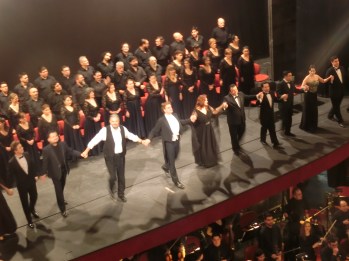
The opera certainly had Lady Macbeth type elements in it, and mostly made sense (as much as operas ever do). Unusually, there was even a very loud and realistic gunshot in one act (by the husband of the Lady Macbeth figure) and some lovely singing. There were also some confusing bits (again, as most operas have!), including one scene where a bunch of people came on stage with wind instruments! (but I had no idea why!). The opera ended with wild applause from the large audience and several (actually, an excessive number!) curtain calls from the principals, and then joined by the youthful conductor for several more, as you can see above.

I enjoyed the whole experience, although I do wish opera companies would put on a Verdi opera when I came to town; I seem to arrive at just the wrong moment, as Aida is on in a couple of weeks. (A similar fate befell me in Budapest earlier this year, where I saw a Wagner opera a week before the Verdi opera opened.)

Last night, I enjoyed the ballet, and tonight I enjoyed the opera. Tomorrow, Sunday, I’m going to be less artistically inclined and will instead check out some museums (as I know they will be closed on Monday) and enjoy some outdoor activities.


Barrio Brasil

Barrio Brasil is a neighbourhood close to where I am staying, and I spent a pleasant half day wandering its interesting streets and some local attractions. Blessed with glorious weather at present makes such things easy. The beautiful blue sky match Perth’s blue sky in fact.

On the way up from the train station, I encountered street decorations of various kinds, making it a colourful walk. The two below reminded me to check out theatre opportunities here while I’m in a big city and also that political statements of various kinds are well represented on street walls.

Speaking of politics, I encountered an interesting exhibition near the posters. It used released official documents (mostly CIA reports, it seemed) as data sources to inform people about the political events in Latin America over the past fifty years or so. A fascinating project, and no doubt disturbing in many ways to see what events had transpired and who was responsible for them, that I was pleased to see attended by a school group while I was there.

I wandered to the Natural History Museum in a large park (Quinta Normal park), where there was an exhibition of junior science projects on display. I had a quick look around the impressive museum, and enjoyed seeing some excellent displays of local significance, such as the condor birds, the people of the high Andean country (with their llama) and of course the continent’s wonderful gift to the world: potatoes.

The park is large and was delightful to wander in the spring sunshine. Lots of trees, as well as a lake, chairs and picnic spaces, small museums etc. There were some school excursions happening of course, which seemed a bit like school excursions everywhere: bunches of kids enjoying a day out of the classroom with their friends, and with a busy teacher trying to make it all work.

The chap wandering around was selling sweets (I think) as well as icy poles (in the box he is carrying). I am no longer surprised to see murals and other forms of urban art. It is a beautiful park, and was immaculately kept.

My main destination was the large Museo de la Memoria y los Derechos Humanos (Museum of memory and human rights), a rather grim looking building, befitting its contents:

CIMG1058

Inside, over several levels in this new museum, were the details of the events in Chile, starting with military coup in 1973 in which General Pinochet ousted Salvador Allende, and their many consequences. I was not able to photograph inside, and would have been uneasy posting photos here anyway, as there are many gruesome events that took place, with lots of abusive actives such as torture and about 40 000 people executed or just missing. A very troubled time, but it’s good to see a record of such things, and several school groups attending the museum, so that they are not forgotten – or repeated, hopefully. I struggled a bit inside as almost everything was in Spanish, but I have found that I can read a fair bit – slowly – even if I have more trouble speaking and listening.

I’m always a bit puzzled by photo refusals, and in fact was interviewed by a US doctoral student after my visit to talk about it all, so I told her that it is strange that no personal records are allowed. In some cases, I know that’s to help a museum sell their own photos etc, but in this case, there were no English publications available. The interview reminded me of the small world we inhabit: a Korean doctoral student (in the USA) interviewing an itinerant Australian about his experiences in a Chilean museum …

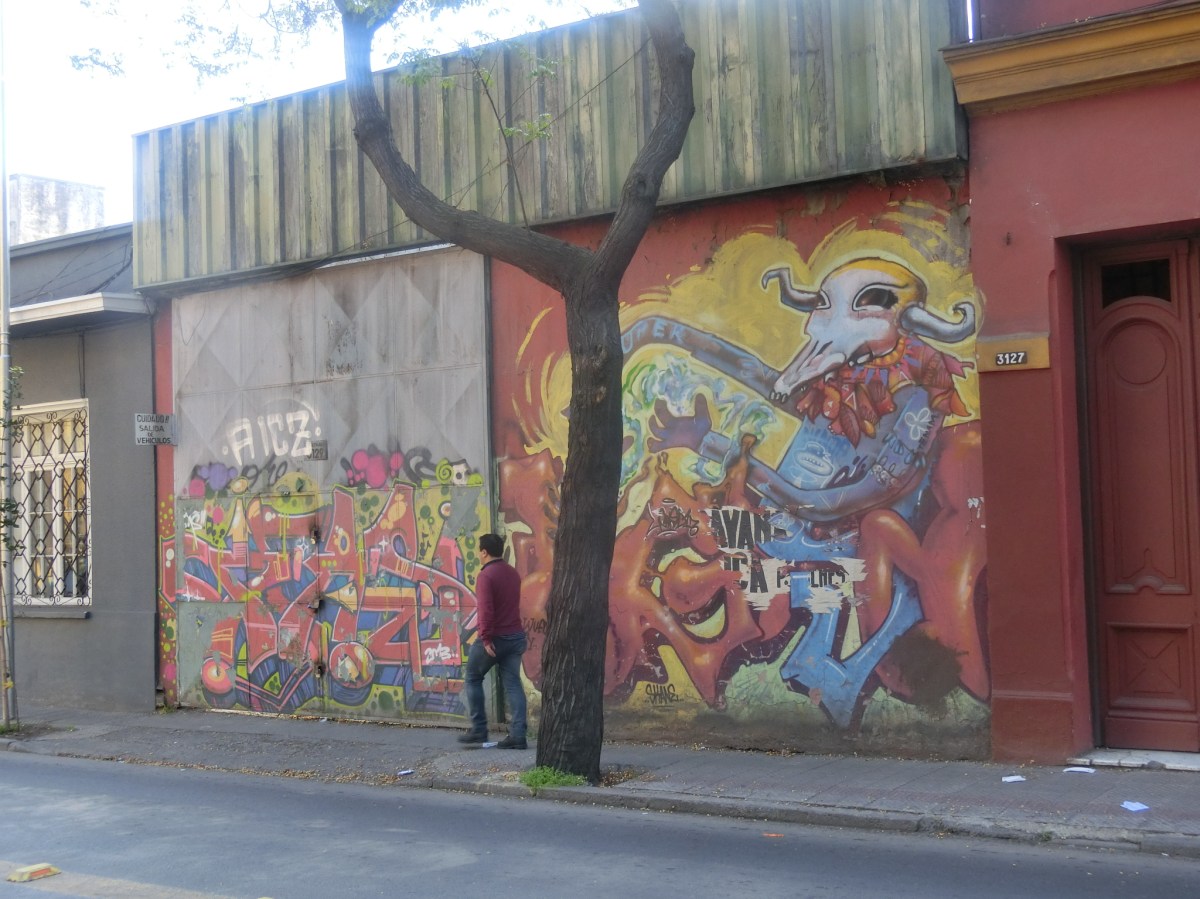
Wandering the streets of Barrio Brasil after my museum and park experiences was a fascinating activity, mostly because of the extraordinary urban street art. My Lonely Planet guide had advised me to take my camera (unnecessary in my case, of course) and I could see why. Many amazing examples of urban architecture, murals, streetscapes etc in this barrio, which is beginning to move from faded glory to chic, it seemed to me. Below are a few of the very many interesting examples that caught my eye. the red building is the First Methodist Church in Santiago, it seems (and may well still be the only one … thus is a very Catholic country)

This is a slightly dodgy place to be walking around at night (so I probably won’t until I’m a bit surer of things, if at all), but it was a lovely place to stroll around in the day time, and felt perfectly safe. On the edge of the barrio, some of the buildings had previously been magnificent, and were now wonderful to look at as well, even if their original purposes had changed. I was very surprised to see the car parts building, for example:

I also passed through  lovely little park in the middle of Barrio Brasil, in which there were lots of people relaxing, exercising, playing, picnicking or just hanging out. I was surprised to see the playground equipment – very funky – as well as the people practicing various kinds of moves and skills.

I stopped for lunch (which was delightful) in a French restaurant that had previously been a barber shop. In fact it still is a barber shop in places, as I found when I entered the wrong door! Full of antique furniture, pictures, etc, it also served great food as well as ambience.

Wandering around the barrio, I got occasional glimpses of the nearby Andes mountains, which generally excited me. Coming from Perth, I am not accustomed to either mountains or snow, so seeing them both together at the end of the street is still of great interest. I tried to imagine what it is like for this to be what you see every day – which is the case for the locals – but didn’t really succeed.

I also spotted one of the flashest garages/car ports I have seen in a  while in one of the older buildings! What driveway!

I wandered from here to Cerro Santa Lucia, but that will be the subject of another blog. It’s time to head out of the house again. It’s another beautiful day!


A corner of Kyoto

I wondered about visiting Kyoto, as I have been trying to do new things, and have already been there.But it is such a beautiful city – according to some, the most beautiful city in the world. That’s why it has (I think) sixteen UNESCO World Heritage Sites, more than any other city. Opinions will differ on that, of course, and first impressions of Kyoto make it seem like anywhere else in Japan. But it’s not like anywhere else; it’s the cultural heart of the country. And how could I live for five days only half an hour away by train and not visit at all?

So I decided to pop over briefly, and look at only a small corner, at Arashiyama, in the foothills, and walk slowly to soak it all in. (Kyoto sits in a basin surrounded by hills). There are three attractions there, only one of which I have previously visited. I knew in advance there would be a deluge of camera-carrying tourists – great cities of the world always are. But if we avoid the places full of tourists, we miss out on the reason they are there, don’t we? And, anyway, I am a tourist too. And I’ve got my camera. So I’ll just share a few impressions.

The Tenryu-ji Temple is a World Heritage Site just next to the famous bamboo forest, and was first built early in the fourteenth century. It has a stunning garden (which is not uncommon in this lovely city of gardens) which you can walk around or view from the temple, or both. I chose both.

Click on the pictures to see more. I loved the framing of the garden from the viewing seats, on tatami mats, and also loved the way the garden blends into the hills behind and even in the distance. The walking gardens go up the hill, and are meant to be strolled around, and to encourage meditation and admiring of the beautiful natural world.

I did some strolling, and (again) wished I was here in a few weeks time when the colours change or a couple of months ago, when the flowers were all out … but was thankful that I came at all. The greenery is extraordinary and, despite the tourist throngs, it’s quiet, and peaceful. And calm.

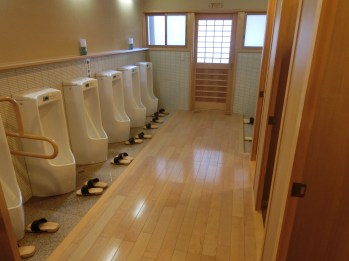
I also needed to visit the toilet in the temple. I very rarely take photographs of toilets, but when provoked, I can make an exception. I think this is the most beautiful toilet I have ever visited. I realise it wasn’t here in the fourteenth century, but it is a testament to the world of Kyoto that things should be made beautiful, whatever they are.

CIMG8423

I was intrigued to find a project at the temple for bringing back cultural treasures from abroad. These screens were made by digitally copying the originals, owned by and housed in a Boston museum, and transferring them here. They didn’t come from this temple originally, but from elsewhere in Kyoto (now lost); what a great idea for returning cultural heritage. Bringing together the old world with the new technology.

CIMG8410

Speaking of which, there were lots of people wandering around in kimonos, which I assumed were rented for the day, and I spotted many examples of the old world and the new like this one, with the ubiquitous smartphones evident:


CIMG8386

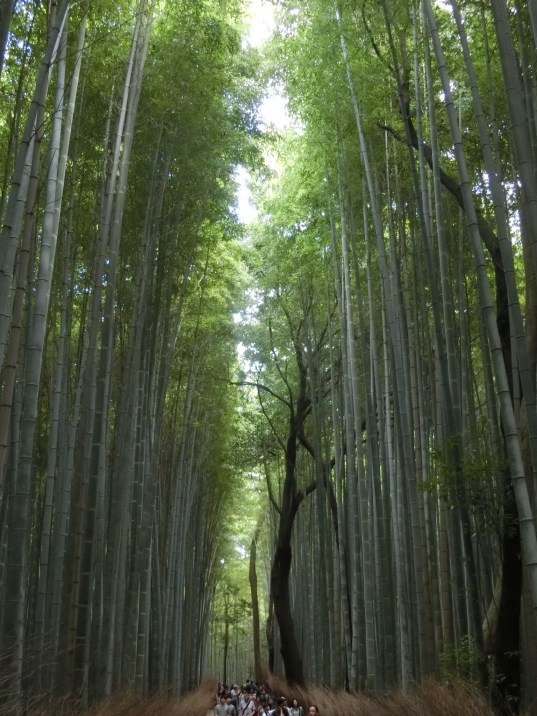
The Arashiyama Bamboo Forest is also a tourist magnet, and is adjacent to the temple. It’s a wonderful place to walk through, with enormous bamboos giving it an extraordinary feel. It was full of tourists, of course, but I kept reminding myself that I was one of them and that there was a reason we were all there. However, it would be wonderful to be here almost alone, and I made a mental note to do that next time I return to Kyoto, and to come very early in the morning.

CIMG8469

I was amused to see one bamboo going against the grain here and there, such as this one:

CIMG8466

Maybe a reminder that none of us lasts forever? And that the world around us will keep going after us.

An uncharacteristic noise (drumming and shouting) suggested to me that something was happening in the forest. And shortly afterwards, I encountered a procession of some kind, with police protection, probably headed to a temple somewhere I assumed. There was no way to find out and five minutes later they had all gone. I resisted the (strong) temptation to follow, as I had set myself on a close time to return to see something of Kobe.

It seemed that a priest was the most important character, although the lady being pulled at the rear on a pedicab was also obviously important. I was intrigued to see the sake barrel having an important role, and was a bit puzzled about all the connections. the marchers (pullers) were all chasing, bot of course in Japanese.

Just past the forest was the third attraction I had decided to visit, a villa and garden called Okochi Sanso, built and owned by a former silent movie star of Samurai films, who died in the 1930s.

The villa itself is lovely, but the gardens are the main attraction. A lovely garden for strolling, and arranged so that there are beautiful views out of the garden as well as lovely plants inside. I had no trouble imagining Okochi san going for a morning stroll around his garden, followed by an evening stroll later, as well as pausing to admire his views. I was thankful that it has been left for tourists to do the same.

These were a couple of my favourite views here, despite the crane in the foreground:

Here is a view from  viewing platform, also very attractive (to me, at least) and still ignoring that crane.

CIMG8514

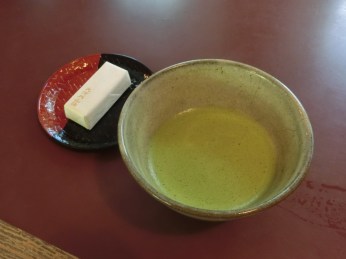
Part of the deal to see the villa and gardens was a cup of tea in the tea house, along with a Japanese sweet, both beautifully served, of course. Very refreshing, even though I don’t normally drink green tea.

CIMG8521


My time was almost up, but not quite, so I decided (with my heart and not my head) to have a look at another attraction, some distance away, the Funishi-Imari shrine in Kyoto’s suburbs. So I walked to the station, amidst a throng of tourists, and enjoyed looking at some of the many shops along the way.

Fans were a popular commodity of course, as was food, and I discovered one of the sources of all the kimonos. Many of the shops were very photogenic and I could have repeated this small collection of snapshots ten times over.

The Fushimi Inari shrine is an extraordinary vermillion complex on a hillside, that goes right up the hillside. Again, very popular with tourists, and very photogenic! This is the sight that greets you as you step out of the small Inari railway station (itself with many vermillion decorations):

CIMG8567

The shrine has many images of a fox, like this one, a large version near the shrine gate:

CIMG8572

There were dozens of fox statues all over the place, however, both large and small. In Japan, the fox was a symbol of good harvest (unlike in western countries where a fox is regarded as an savoury intruder and a pest to be hunted), and the key in its teeth is a key to the granary. These days, it has also become a symbol of prosperity generally (as in business, for example). An interesting cultural difference!

vermillion is evident everywhere in this shrine, as you can see. Even the little prayer votives are vermillion in colour.

Apart from the colour, the most distinctive thing about the shrine are further up from the temple area, requiring a few stairs to be climbed. Again, lots of people in kimonos as well as other camera-laden tourists:

CIMG8596

Not far from the station, you encounter lots columns of torii heading up the mountain! At this stage (the lower levels … I was in a rush!) they are full of tourists, but at higher levels, the tourist throng thins out. The first time I was here, I went up as high as I could (almost), until there was just me and the torii. An extraordinary sight; I understand that there are about four kilometres of passages!

In places, they branch out, like this, with one side for going up and the other for coming down. And you are not permitted to go up the down side, as advised by a large sign to keep right.

CIMG8585

A sight like I’ve not seen elsewhere. Extraordinary.

I had overstayed my (self-imposed) quick visit to a little corner of Kyoto by about an hour, but still left enough daylight to zip back to Kobe and to look around, thankfully. I was pleased that I decided to see somewhere I had previously visited.

I learned in Hiroshima that Kyoto was one of half a dozen targets considered for the first atomic bomb explosion. I am pleased and thankful that it was not chosen, as that would have been a senseless war crime of incomparable magnitude.

Kyoto is a wonderful city. A magical place. I realise that beauty is in the eyes of the beholder, but this beholder has never seen a more beautiful place. If you are ever in Japan, don’t miss it. Join the tourists: they know.

Day trip to Koyasan

Although some of my travels have been decided at the last minute, others have been decided before I left home. Koyasan was one of these. It’s a lovely and famous mountain temple complex in the south of Kansai, based on the Shingon School of Buddhism, founded by the same person as Daishi-on in Miyajima, so around 806 AD. It’s been likened (by some) to Shangri-La … a long way away from the everyday world, but I think that’s overdoing it. It is a UNESCO World Heritage site (or at least some of the buildings and t he cemetery are, I think). Although one of the attractions of the area, high in the mountains, is that you can stay overnight at temples, that looked too hard and so I opted for a day trip.

Not that the day trip was easy … the trip involved zipping into Osaka and then catching  train for about 90 minutes, before a cable car to get up the mountain itself, and then a bus. The trip itself was interesting, as it was nice to see some rural and mountain scenery, although tough to photograph from moving trains. (We don’t have many mountains in Western Australia, so I’m always attracted to being in other people’s mountains.)

I did find out the difference between a cable car and a ropeway, en route to Koyasan. A cable car is pulled along by a cable at ground level, while a ropeway has a cable in the air from which the cars hang. In Australia, we call these both cable cars – incorrectly, I now realise. The cable car was needed for the last bit of the ride up the mountain; you can see for yourself how steep this was (click on a picture to expand it a bit).

The town was very pretty, with many temples in the area, as well as an extraordinary cemetery, described below. The first temple I visited was Kongobu-ji, which is the head of the (international) Shingon Buddhist group. It was a beautiful complex of buildings, but sadly I was not allowed to photograph the best parts, which were some beautiful rooms with painted sliding doors. I’m never quite sure why photographs are prohibited, but assume it’s a mixture of avoiding people flashing their cameras (as they don’t know how to avoid that!), (thus safeguarding the objects too), preventing people from irritating others (especially the selfie brigade) by upsetting the decorum of the place or making sure that they can sell their printed copies of the objects in question. Whatever the reason, it prevents me from showing you one of the day’s highlights …

I was able to take photos of other bits of the temple, and you can see that it is very beautiful:

The temple is entirely wooden (as are most parts of most temples in Koyasan), which makes me wonder why there is so much forest left. Many of the temples in the area have been burned down at some stage and needed rebuilding; wood looks beautiful but it’s high maintenance if you have to reconstruct it occasionally. You can see above the interesting rock garden … a raked gravel area with tastefully arranged rocks in it (not what I grew up thinking a rock garden was). Apparently, this is the largest one in Japan. I liked it …

At the end of my trip around the temple, I was offered a cup of tea in the main meeting room, which was very large and very splendid, and of course covered in tatami mats:

Again, to repeat a comment I media few days ago, the colours of autumn are just starting to appear; it’s a shame I’ll miss them because of my timing. In a few weeks from now, they will enhance the sight of otherwise glorious buildings like these:

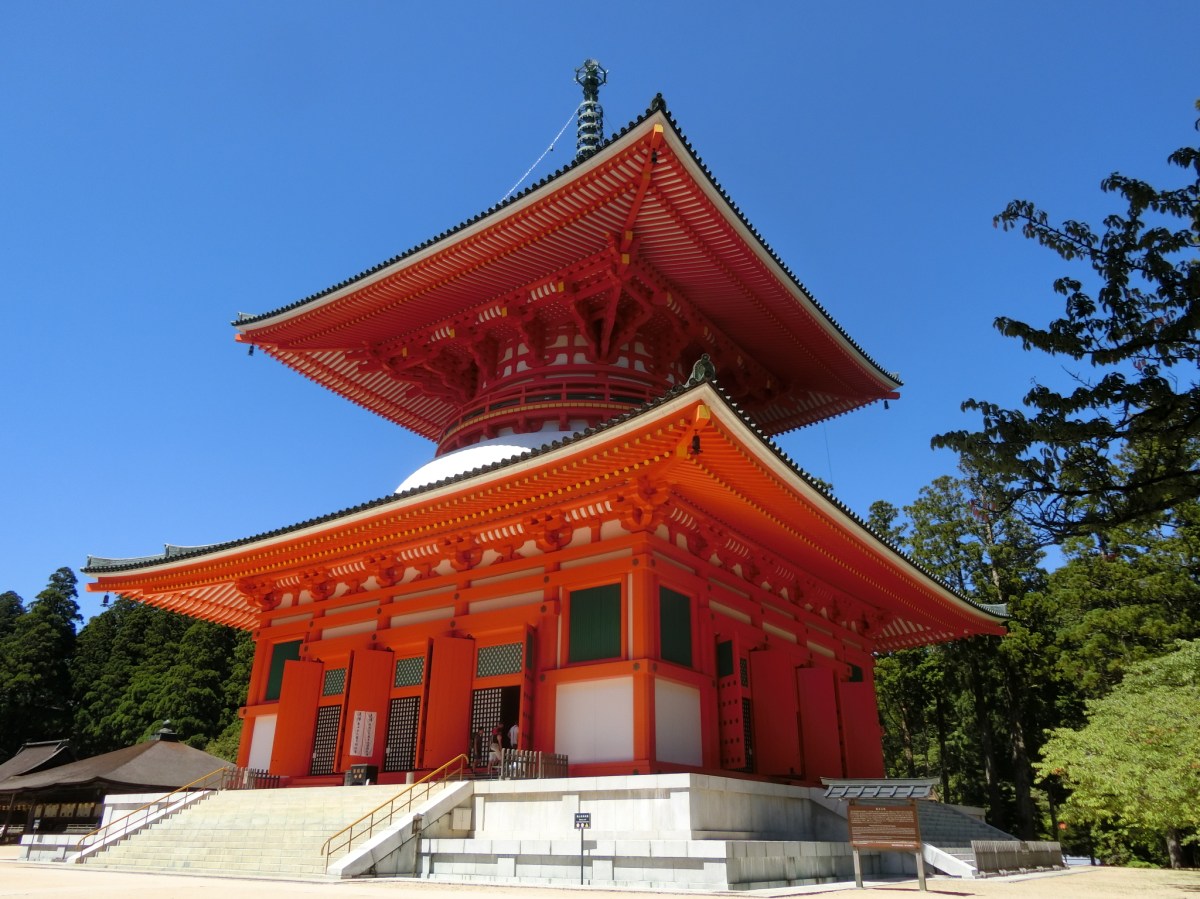
The most spectacular temple here is the vermillion-coloured Great Pagoda (Dai-to) showing at the top of this blog, but there are other lovely pagodas as well, as you can see. It was pretty quiet when I was there (school has now gone back after summer), and I found all of these majestic and beautiful.

CIMG8103Some of these buildings are very old, at least in one sense. For example, the Great Pagoda was first constructed by Kobo Daishi from 816 AD, but it took many years to build. (the same is true for cathedrals, of course, a spectacular recent example being Barcelona’s Sagrada Familia, still being constructed almost a century after Gaudi’s death!). Since then, it has been destroyed by fire several times and the last time it was rebuilt (in 1934), they chose to use a ferro-concrete base, for fire reasons.

I didn’t quite understand the little monk pictures here and there, but finally worked out that they were a symbol of the recent anniversary of the founding of the complex in 816, 1200 years ago last year!

With all the temples around, it’s not surprising that the occasional monk was evident too. I took snapshots of these two (from the rear, so as not to be intrusive on their raying activities):

Apart from lovely temples, pagodas and other buildings, there were other lovely sights around the town … way too many to document, but I thoroughly enjoyed strolling around for a couple of hours. here are a few snapshots of some nice or interesting things I saw:

The town’s main gate or daimon, looks pretty spectacular, and from that point you can see some of the nearby mountains, of which there are apparently eight:

Apart from temples and the lovely ambience, Koyasan is renowned for its amazing cemetery, very famous in Japan. Apparently, this is the final resting place of about 200 thousand people, most of whom have been cremated. The cemetery (called Okunion) is enormous, and very picturesque (if that makes sense for a cemetery). I think that the central path is a World Heritage site, but the whole area is pretty extraordinary. I walked from end to end, with a few snaps shown below:

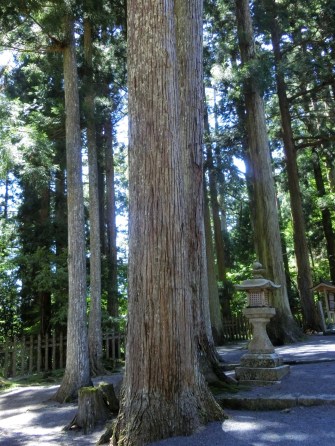
The central path is flanked by many lanterns and huge cedar trees, and indeed the whole cemetery has many huge cedar trees in it, some a thousand years old, as well as lots of greenery of various kinds.

CIMG8039

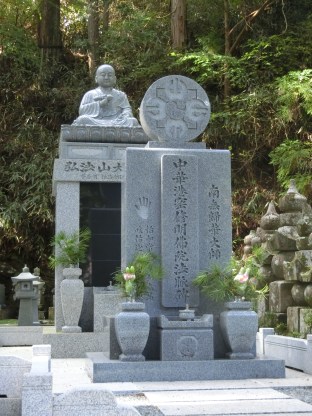
While most things look very old here (not unlike being in an Indian Jones movie!), it’s clear that the cemetery is in active use as there are some clearly more recent tombs, like this one:

CIMG8136

Both famous people and commoners are buried here, but the most famous is Kobo Daishi himself, who is in  a mausoleum at the end. It’s not possible to see the mausoleum, but there is a collection of deities in the general area, as well as an important temple:

CIMG8183

In fact the Shingo Buddhists don’t regard Kobo Daishi as dead, but merely as deep in meditation, and expect him to re-surface one day, when the next true Buddha appears.

If you get a chance, my advice would be to visit this lovely place, Koyasan, and to try to spend the night there at a temple if you can. I certainly enjoyed the whole experience.