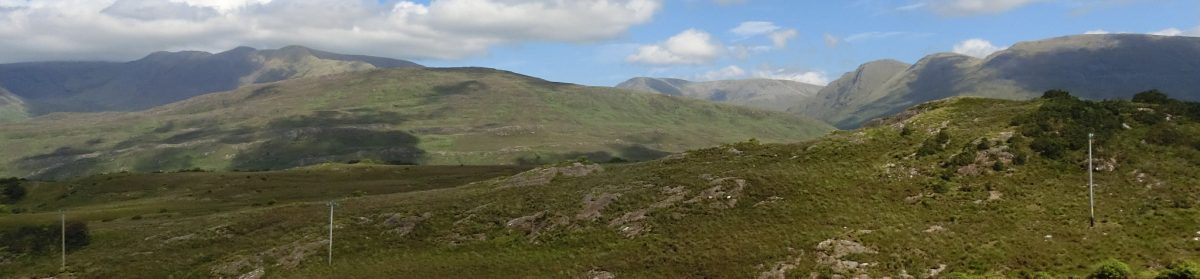

There are several cultural attractions on Miyajima Island, one of the main ones being an ancient temple, founded in 806 AD by Kobo Daishi, after whom it is named. (It’s an important Japanese temple in the associated sect of Buddhism it seems.) I thought that 806 AD seemed a long time ago! Clearly, the temple has changed over the years, but I was attracted to a temple that is more than 1200 years old, so thought I would have a look. It looked lovely from the gate, as you can see above, but I was a little disconcerted at the steps I could see … or at least how many of them there seemed to be, as it was a hot day.
Undaunted, I decided to have a look, and my attention was caught by this cute little stone monk at the gate:

When I saw the steps, I was a little uneasy … but ploughed on. I am pleased I did, although at the time, the steps became a bit hard to handle, as there were a very large number of them. I’ll bet the monks who lived here were pretty thin and fit (unlike the statue). Some of the steps had prayer wheels in them, and I think that spinning them around is meant to bestow a blessing of some kind on you. Here are a couple of examples:


I did wonder how often people would actually read all the characters on all the wheels … but perhaps that’s a good meditation practice; I don’t know.
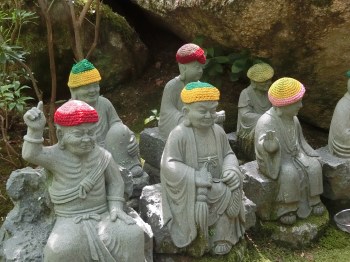
On my travels, I encountered further stone monks. Not far inside the gate, I found this set (each one different):
To my great surprise, a little further on, I found an even bigger collection (I’m not sure what is the collective noun for stone monks, I’m afraid):
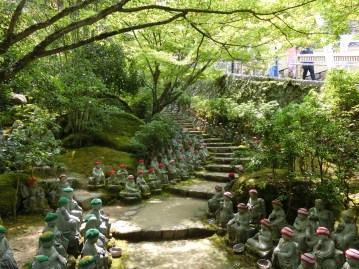
At this point, I stopped counting them, but a brochure told me that there are about five hundred of them. They looked very interesting, as if waiting for their master. I loved all the greenery too, so much so that I kept climbing up the steps.
There were various small temples dotted up the hillside, important for different temple purposes. Some of them looked spectacular inside, such as these two:


The temple on the left had a wonderful sand mandala (inside the case), such as the Nepalese Buddhists produce, and it was no coincidence that there was a photo of the Dalai Lama nearby, on the occasion of a visit of his, and hence probably the source of the mandala.
I saw many many statues in the temple grounds, of various kinds. It made me wonder if anyone actually knows how many statues are in the temple, in fact. Some of them were absolutely wonderful, made with great skill. Here’s a selection of them; if you click on a picture, you’ll see the whole picture:


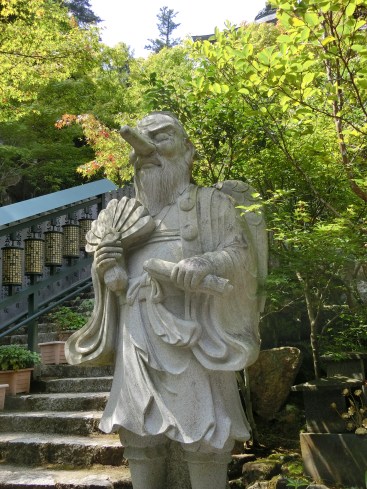
I was intrigued by this large statue just at the base of (yet another) set of stairs, however, as it reminded me of Pinocchio, in the children’s story, whose nose extended when he told a lie. I’m sure that is not the case for this statue, but failed to find any information on why his nose was extended.
There were of course many Buddha statues, sometimes popping up in strange places, unexpectedly. I enjoyed these two (well, four actually), including the “See no evil, hear no evil, speak no evil” trio:


An especially impressive set of eighty eight statues was in a cave, right at the top of the temple (hundreds of steps from the bottom). They depict the principal icon of each of a set of 88 temples on a prestigious pilgrimage route on Shinjuku (the large island south of Honshu). It seems that they give the same blessings as the temples on the route (which would save a lot of time and effort, I guess.).

I confess to being fairly ignorant of Buddhism (and its various sects), but do know at least that it’s not really a religion, but rather a set of practices, so people don’t pray to a Buddha, but hope that the Buddha will guide their spiritual practice. Without knowing a lot, I guess it’s hard to really understand what you see in a temple like this; I assume it’s just as hard for Japanese Buddhists to make sense of a Christian church and its various practices, or a Jewish synagogue or a Muslim mosque (although in those three cases, religion is actually involved). I generally try to treat places like this respectfully, even in my ignorance, but certainly enjoyed the beautiful things and the surroundings in this ancient temple.
Again, as noted in an earlier post, there is just a hint of colour changing happening here, as summer is fading, making me wish I was here a few weeks from now to see the effects.
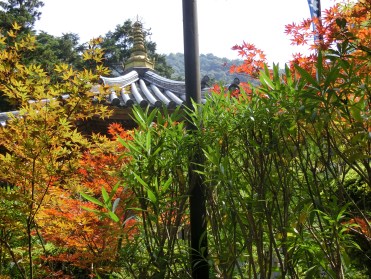
But the steps? I managed to get to the top, of course. And, since I am no longer there, repeated the performance to get to the bottom again. But it was very draining in the heat. You’ld think I’d get a bit thinner – like the monks – with all that climbing, but it has not happened.

 Barry's travel blog
Hi. I am really enjoying your blog!
LikeLike
That’s great, Kathy! Thanks!
LikeLike
I’m extremely impressed with your ability to successfully climb all those steps! Well done! I was imagining myself waiting in a cosy cafe for you to return and show me photos!
The statues were fabulous….I loved all the coloured tops…reminded me of the knitted tea cosies mum had.
Brilliant commentary and photos once more. Thanks for sharing.
LikeLike
Again one feels as if one is there from your informative writings and photos, though all those steps I’d never manage nor would my mobility scooter (gopher)
LikeLike
Thanks Helen. A gopher would not have been up to the challenge, I’m afraid! I’m pleased that I can’t work out how to count steps on my iPhone!
LikeLike