
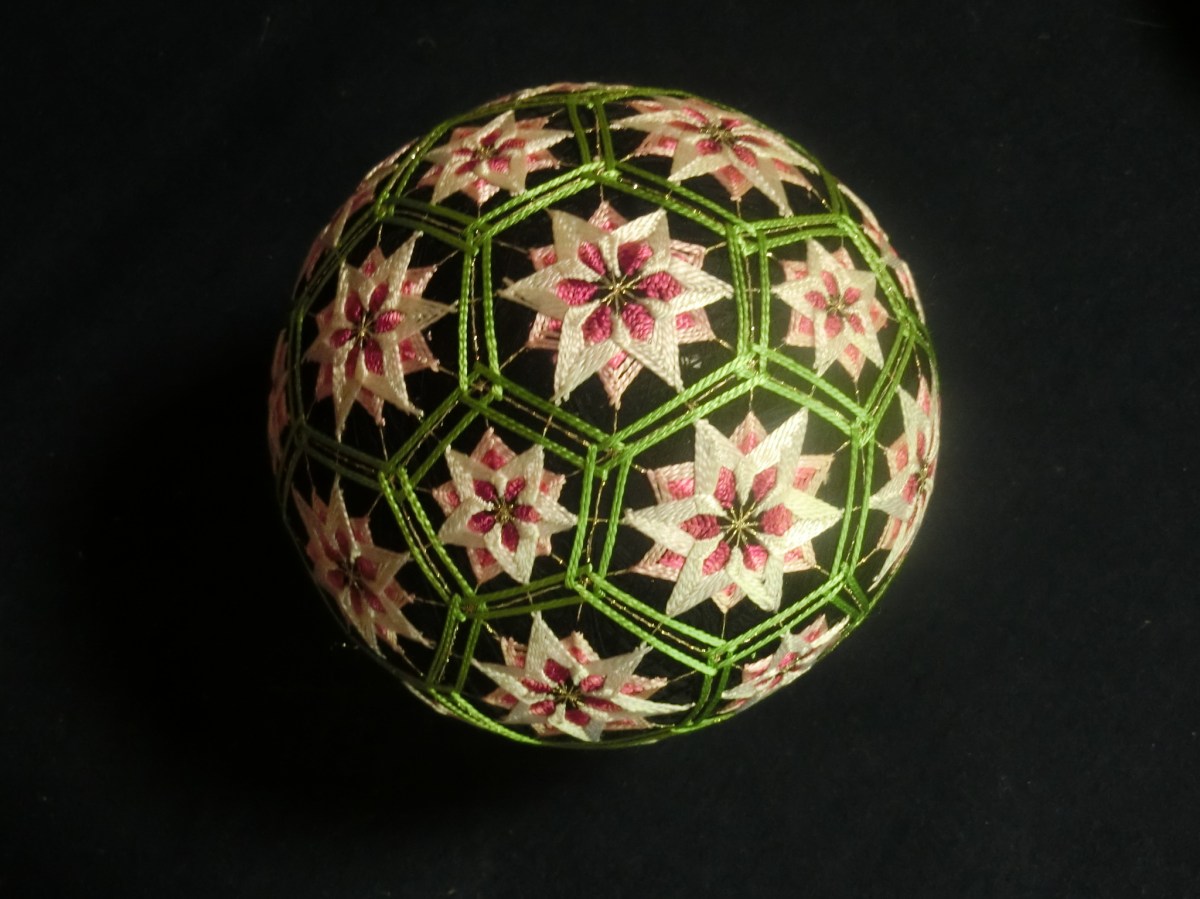
I had not heard of either temari or misuhiki before I found them unintentionally today. What beautiful traditional crafts these are! But to start at the beginning, I was wandering in the Samurai district on my last day in Kanazawa – indeed my last day in Japan for a while – and enjoying the change of weather. Yesterday was raining all day, sometimes heavily, but today was lovely and sunny.
I popped into what did not look very interesting, but I knew it was a sort of museum of pharmacy in the old days: just an ordinary building (at least for here):
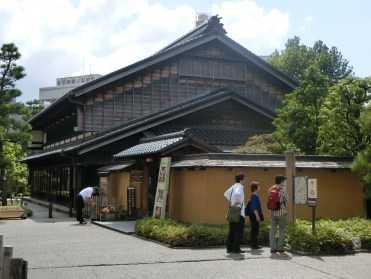
Indeed, it did include a museum of pharmacy, just inside the entry, which was interesting, but not especially rivetting, and the descriptions were a little cryptic to a non-Japanese.


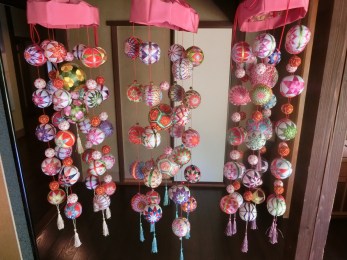
Then I turned the corner, and was astounded to see a collection of brightly coloured geometric objects with various patterns and sizes. No two patterns were the same: each was clearly made individually:

There was some English description of these, which are called Kaga Temari, or, more colloquially, temari balls. Apparently, they are something of a local tradition, which I had missed as I’d not been frequenting shops (yet).
It seems that they were first made from silk as handballs a long time ago (from the 14th century) by the nobility, as an engagement present for a daughter, but they were so attractive that other people started making them also. When cotton became available, early in the 17th century, they became very fashionable, and it is still a tradition in Kanazawa that mothers make one of these for their engaged daughters.
Here are some other examples:


I was of course intrigued by the mathematics of weaving these beautiful shapes onto a sphere, and was instantly impressed with the level of craft competence that must be involved – to say nothing of the mathematical competence.
It seems that the balls are made from tightly bound yarn, which is then embroidered on the outside. It is no mean feat to get the shapes and sizes correct to produce a pattern that fits around a spherical surface, as you will appreciate if you try it for yourself. Here are some others, which were somewhere between a softball and a soccer ball in size:


There were smaller ones as well, clearly less intricate. Some of these were about golf ball size, and some even smaller:
I didn’t tarry to look too closely at the mathematics (except to admire it), but geometric shapes were very evident. This one looked a bit like a dodecahedron (a solid made with regular pentagons on each face, all twelve of them), for example:
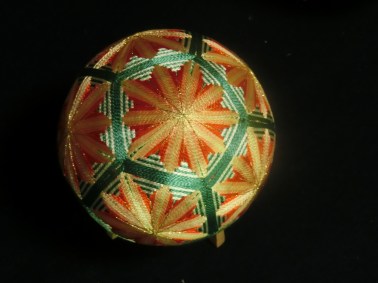
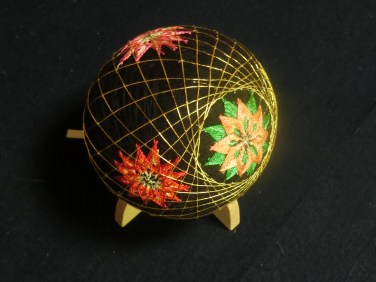
Others reminded me of ‘string art’, which we have sometimes done in mathematics classes, as it’s nice to see curves coming from straight lines:
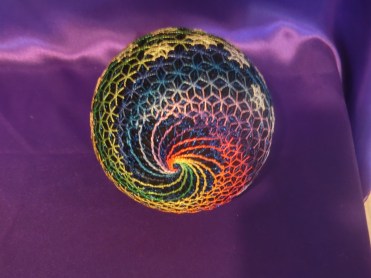
Here’s another that included spiral patterns:
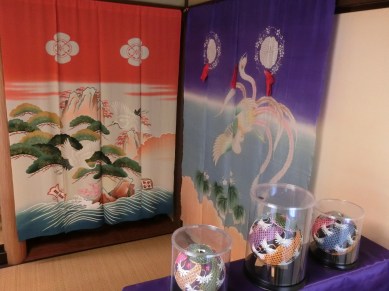
And here is yet another selection, this time in cases and with a pleasant background of traditional fabric printing:
What a treat! I was quite excited and I think I made the day of the person selling tickets to the museum. He seemed very pleased that I seemed very pleased, although that may just be (typical) Japanese politeness and care for visitors.
I would have been perfectly happy with my ‘discovery’ – a bit like Captain Cook’s ‘discovery’ of Australia, although the locals did not realise that it was lost ;-). But I went up to the next floor of the pharmacy museum and found some beautiful Japanese wrapping, called mizuhiki. Here’s an example:
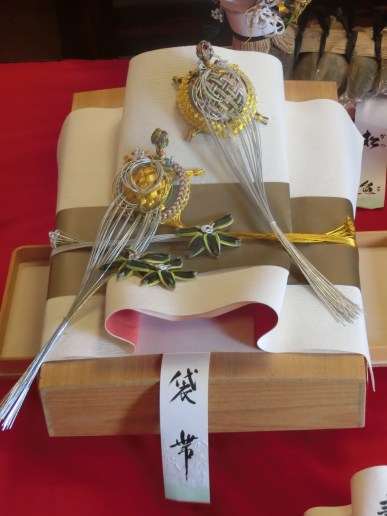
The wrapping in this (and the other cases shown) is for an engagement present. Regardless of what the present is/was (clearly not just the block of wood shown), the wrapping must be a major part of the gift, I think. The examples shown were absolutely beautifully done. Here’s another set of examples (click on it to see it more closely if you wish), showing that paper-folding as well as tying strings are both involved. (Not quite origami, however).
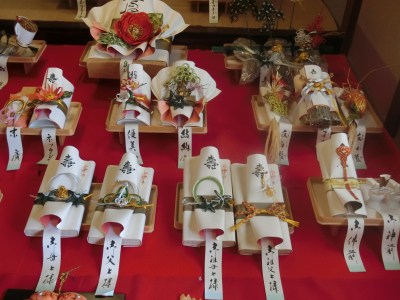
I have long known that Japanese people pride themselves on wrapping things beautifully … buying anything in a department store, for example, will give you a sense of that pride. I recall once in the large Takashimaya store in Shinjuku, in Tokyo, counting no less than fourteen shop assistants working full-time at the wrapping counter on one floor. It was unacceptable to just buy something and pop it into a plastic bag. the wrapping is part of the transaction. But these mizuhiki seem to take the art form to a new level.
Here are some others, nicely arranged:

… and a blown-up version of one of them, so that you can see the intricacy and the care with which it has been created.

I learned a valuable lesson (already known to the rest of the world as “Don’t judge a book by its cover”. Sometimes as a traveller, you have to just go ahead and look at things, even if you are not sure about them, or taste or drink them, even if they look unfamiliar. Now, just as I am leaving Kanazawa, I am beginning to realise why it prides itself on its traditional arts and crafts.
The Pharmacy Museum made my day.

 Barry's travel blog
Stunningly beautiful. What a treat to see the real thing. Wonderful photography also.
LikeLike
Gosh. How beautiful.
LikeLike
It’s funny that I was watching a program about globes, and how difficult it is to represent a flat dipictiom of a map onto the globe and the various distortions in the different globe maps, just before I read your blog – something I, as a non mathematical type, would never have pondered without prompting; then I read your blog about the japenese balls and intricate patterns on then and thought – I would have just admired the “pretty balls” and not realised the level of skill required to craft them. We all help each other see the world through different eyes don’t we. Thank you.
LikeLike