
Nishi-Shinjuku, or the west side of Shinjuku, is often called Tokyo’s skyscraper district, for good reasons. It must surely be one of the most extraordinary urban environments on the planet. Perched forty stories up, as shown above, I thought I’d go down for a stroll to get some fresh air and to try to capture some of the amazing architecture and ambience to share.
I’ve been here often before and strolled around often, but it is always pleasurable. Tokyo was destroyed by the great Kanto earthquake of 1923, and was devastated again after WWII, but somehow the skyscrapers today in Nishi-Shinjuku seem to be making a defiant statement of some sort, that they are here to stay regardless. The earthquake codes are very strict here, and I understand that the buildings are erected to cope with severe earthquakes (but you never really know until they happen). Maybe irrationally, I’ve not felt unsafe here, even up high.
For me, the centrepiece has always been the Tokyo Metropolitan Government Building, from which there is a neat free observatory (in each of the two towers) 45 floors up. I’ve often taken friends – newcomers to Tokyo – up there to see the view, showing the city from horizon to horizon, with greater Tokyo now having some 37 million people or so. I happened to do that again today … here are a few quick snaps, giving a sense of the views. You can also see some green space: the huge Yoyogi Park nearby, for example.


The view from the tower also gives a good look at other things, such as the expressways (so-called … often not very express with commercial traffic!) snaking their way among buildings, such as these two:


But I’m in Nishi-Shinjuku and the building itself is beautiful. Here’s a view from my hotel, up high:
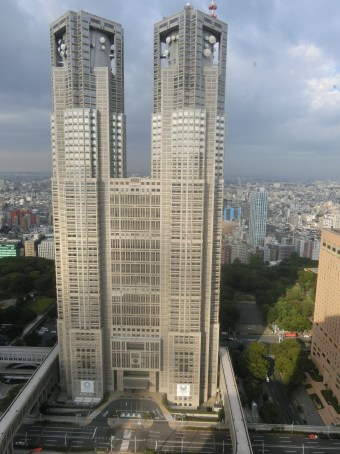
You can see the Olympic logos near the ground. This is the building from which Tokyo’s successful bid for the 2020 Olympic games came. I like the mathematical feel to the two logos, which you can see more clearly here:

If you look more closely around the base, you can see some of the roads and walkways around it, as well as the companion buildings next to it and the park behind it.

But let’s get down from the heights and look from below. The building just seems to go up and up …


And the courtyard below dwarfs anyone wandering around it … with an amazing feeling of spaciousness, in a country where things often feel cramped. If you click on these photos, you’ll see larger versions.


You will already have noticed how hard it is to faithfully reflect large architecture in a photo, without doctoring the photos … the angles often look wrong, as if the world is leaning in. But I’m too lazy (and also lacking in skill) to fix the problems, so I hope you can get a sense of the environment anyway.
The TMG is but one of the many skyscrapers here. None are really really tall (typically around 40-50 floors high?), but walking around the TMG gives a sense of perspective of other buildings in the district. The first one below is actually taken from underneath the TMG, showing the immense colonnade:


None of the buildings is really really tall, but they are tall enough to give an impression of urban-ness, typically around 50 or 60 stories, I think. Here are a couple of examples of famous buildings, a little closer up:


I loved the huge intersections, too! The cocoon building looks especially spectacular, maybe because it is so different from its companions.


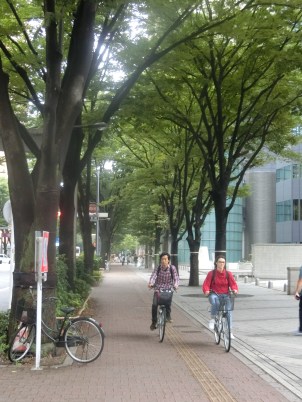
Walking around the Nishi-Shinjuku area, with skyscrapers all around, is remarkably pleasant, with wide walkways, devoid of rubbish usually and with lots of trees. Here are a few examples, to give you a sense of the ambience:


The first of these is right outside my hotel, and I have often enjoyed sitting in the restaurant at breakfast, watching the streams of people walking past, going to work. [These pictures were taken on Saturday morning, so the streets are all but deserted.]
There are also gardens associated with many of the buildings, so the whole area feels surprisingly green. Below are a few examples, including a couple where the green of summer is about to be replaced by autumnal colours. I’m not sure why the tree is tied down so securely, but I assume it’s to protect against typhoons?


There are also sculptures scattered around the area, such as the iconic Love symbol and the more recent (2017 – which explains why I had not seen it previously) Keimu Kamata statue called ‘Hand of peace’.


Near the Love sign is an interesting astronomical clock on a tower, reminiscent of the wonderful old clock in Old Prague square – albeit a modern version by Seiko – and associated with another nice piece of urban architecture, the I-Land building with its neat water features.


Cycling is a popular mode of transport around Nishi-Shinjuku, and the footpaths are wide enough to cope with it. I was impressed that this lady was taking two children for a ride on her bike, both protected from the elements.


Another striking feature of the area are the underground walkways. Last night, it was raining a little, but I managed to walk from Shinjuku station back to my hotel almost entirely under cover (using the first walkway shown below). Shinjuku station in rush hour in the mornings is still regarded as the busiest place on Planet Earth, so having an efficient way for people to walk from the station to their offices is obviously a good idea. It was a lot more crowded last night.


Walking around even revealed some unexpected things to me. I had noticed these odd architectural features in the street outside, but thought they were just decorative triangles. This morning, I found out – somewhat to my astonishment – that they were entries to the subway train underneath my hotel! The work crew (a small army, in fact!) were making sure everything was gleaming, while they had a chance, as you can see.


While it’s not surprising that there are subway lines under my hotel – after all, it is only a couple of hundred metres to Shinjuku station and there are many lines going through there – it’s surprising that I didn’t know, because I have stayed here four or five times previously!
At the edge of the skyscraper district, there’s a nice little park, called the Shinjuku Chuo Park. It’s very green, with lots of plants, and even a few animals such as turtles in a pond.


While breakfasting this morning, I noticed small group of a couple of dozen people down there, so wandered down to see what was drawing them there (I recall a few years ago finding a swap-meet!). To my surprise, I found a now very large number of people in the park, and wondered if it was a demonstration of some sort, unlikely as that might seem. I was intrigued at the chap taking photos from the shoulders of someone else (Did he really think he got a much better view??). Then they all started to move off in a sort of march, but the person to whom I spoke said it was for ‘exercise’, so maybe it wasn’t a demonstration? The people seemed to be out for a good time, as you can tell, too. All very mysterious.


Finally, I can’t help but comment about East Shinjuku (the other side of the train station). Notwithstanding the large exercise group, Nishi-Shinjuku is quiet, almost serene, stately and at times almost overwhelming, an urban architectural showcase with grandeur in abundance. Yet the ‘other side of the tracks’ is mad, crazy, noisy, brash and could easily be on a different planet:


And at night, the neon lights come out in East Shinjuku, while West Shinjuku is already sleeping:


There must be few places in the world where everything changes so much with a short stroll, although I know there are some. I’d prefer to end this post with stately quiet, calm Nishi-Shinjuku:
It’s a lovely spot. Even if you’re not staying there, should you get to Tokyo, at least go for a stroll, and soak it all in.

 Barry's travel blog
As always love the pictures and the narrative!😊
LikeLiked by 1 person
Lovely view!!!! And wonderful pictures!!!
LikeLike
Thanks!
LikeLiked by 1 person
Looking forward to more lovely posts !!
LikeLike