
As I had a spare morning, I decided to go by subway from my hotel in Shinjuku to Happo-en, with its delightful garden. Subway travel can look daunting at first, but is remarkably easy because of all the signage.
Whether you look at a map book, as shown below, or at an automatic ticket machine area, as shown at the top of this blog, it can at first look a bit daunting to foreigners, especially those like me who come from a city with only a few train lines. But the basic navigational skills relevant to many other world cities work in Tokyo as well, and, indeed, the system is planned well to make it easier than in many other places.
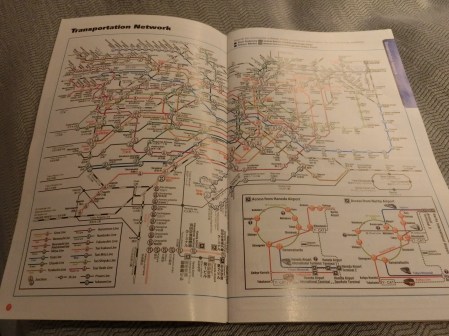
It’s much easier than it might at first seem. These days, many of the ticket machines have an English button, and you can avoid the machines altogether by using a pre-purchased card, which lets you in and out of stations, deducting the fare automatically from the stored balance. To see where to go, a closer look at a map shows that you can even avoid trying to read the writing, but just read the numbers:


In this case, my subway station under my hotel is Tochomae (number E-27 on the Oedo Line), and the guide book advised me that the Happo-en is at Shirokanedai (number N-02 on the Namboku Line). Following the coloured line shows me that I needed to change lines at Azabu-juban (Number E-22 and N-04). It is much easier to follow the numbers than the names! Mathematics to the rescue again! E-22 is five stops from E-27 and then N-02 is two stops from N-04. Easy!
Along the way, trains usually offer some form of information regarding where you are, what the next station is, which lines you can change to at the next station, etc. Much of this is in Japanese, but there is some English announcement and often good signage. As an especially good example, the Oedo train showed in real time at each station (inside the carriage) what to expect when you got off!

I’m in carriage 6, as we arrive at Kokuritsu-Kyogijo (or E-24 for short!). There will be stairs and an escalator where I get off, or a lift to the left opposite carriage 5 or further stairs and escalators at carriage 3. Brilliant! (especially if you’re carrying luggage).
Once you get off the train, There are usually maps and signs in abundance, telling you how to get to many places. In this case, there were many signs directing me to the Namboku line I needed to change to (tap the images to see the whole sign):


Some of the connections between lines are a fair distance apart in reality, as well as some levels apart, even if contiguous on the printed map, so you can even get a bit of exercise transferring! But you’re unlikely to get lost.
It’s not hard to get lost if you leave the station via the wrong exit, however, so it’s worth paying attention to the maps showing local features and advising which exit to use. In this case, it was easy enough to find Happo-en required Exit 1, and as soon as I left the station and surfaced in the street, there was another map to follow, as shown below. All very helpful to people unfamiliar with the area:


In this case, there are only two exits – so only one way of getting it wrong – but some stations have many more than that. There are many other signs in stations allowing you to find your way to particular attractions and exits without too much problem. All remarkably easier than you might think, in fact.
I was rather surprised to see that the crosswalk to Happo-en, not far from the station, had a crosswalk attendant, who sprung into action as soon as the walk light turned green. Unlike, say, New Yorkers, Tokyo citizens wait for the light to turn green before walking and the cars all stop for pedestrians (unlike, say, Beijing drivers), so it was not clear to me why this chap was needed at all, but he did his job with great diligence, and I crossed the street without incident:


What is Happo-en? It’s a delightful garden of about 30 000 square metres, hidden near Shinagawa in Tokyo. It’s about 300 years old and is a lovely place, with many attached dining options, so is a popular place for functions, like banquets, weddings, etc. I had not heard of it until the previous night, when I was lucky enough to attend a nice dinner there. I returned in the day time because it was hard to see the garden properly in the night.
I was pleased I came back, as the garden was truly lovely and very green:


Like many Japanese gardens, there were some lovely lanterns and some nice water features, in this case including even some waterfalls:


Interestingly, the Happo-en garden included a lovely collection of Bonsai trees, some of them more than 500 years old (i.e., older than the garden itself). [I was concerned that all of the ages ended in 0, suggesting to me that they were incorrect, and making me want to return next year to see if they were all increased by a year … So I was a bit skeptical about the ages shown.] Here are a couple of Bonsai examples:


While I saw some of these features at night, they were much better in the daylight. My dinner last night was delightful, showing again how much attention is paid to presentation of food in Japan. We had a succession of courses, all of which were delicious:


While in the area, I decided to further test out my navigational skills to find Sengakuji Temple, which was nearby (according to maps and guidebook). This proved to be a bit trickier than navigating the subway. I found myself walking through small lanes with relatively few signs to help. Japanese addresses and street signs are rarely of much help, in fact, unlike my own country, where they are a reliable guide.


To my surprise, however, I rounded a corner and there was the temple, with no earlier signs warning of its impending arrival!


It was a nice little temple, and I knew almost nothing about it until I arrived. It turns out to be quite famous as the burial site of the forty-seven Ronin (a set of Samurai who were loyal to their master and exacted revenge on a Feudal Lord who was responsible for his death by suicide). The story was even made into a film recently – unbeknownst to me.


The Buddhist temple revered one of its famous monks, shown here, and had some lovely plants. (The images above show one example, together with a blown-up version to see the detail.)
The forty-seven Samurai warriors are buried in the temple grounds, and are the reason that the temple is quite famous and visited by many Japanese people. Here are some of the set of grave markers … the 47 are all buried near their Feudal master, also buried at the temple.

I wandered on a bit further, looking for Shinagawa JR station, not far away, to make my journey back to the hotel. I encountered this extraordinary map on the street, which made it emphatically clear how large and complex the station is:
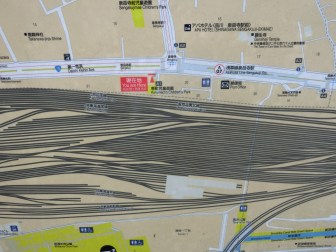
When I entered the station, which was as large as the collection of lines would predict, I was intrigued to find a massive bridge over the lines:

But, despite the size and scale of the station, it was easy to navigate and I had no trouble getting back to my hotel in time for a scheduled meeting.
The Tokyo transportation system is unequalled in the world. Easy to navigate, covering an immense area and servicing a population of about 37 million people as well as lots of tourists, it is reliable and safe, with frequent trains all day long and much easier to get around with than anything else here in Tokyo.
It’s always hard going back to Perth, where public transport is at best meagre, and the navigational skills I have developed here are usually of no value at all.

 Barry's travel blog
Great to see your mathematically skills paying off yet again!
LikeLike